Image

A 1982 Modem For $100

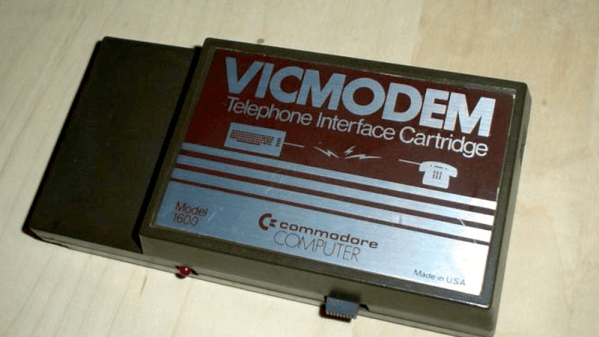
[Dave Farquhar] takes a walk down memory lane about the Commodore 1600 VICModem, perhaps the first phone modem to sell for less than $100. Commodore, of course, was famous for making cheaper computers like the VIC20, the Commodore 64, and lower-cost peripherals like disk drives. But how did they hit the $100 price point with the modem when competing 300 baud modems sold for at least twice that, and a 1200 baud unit would set you back at least $600?

First, Commodore didn’t handle the design themselves. Instead, they outsourced to Anchor Automation, a well-known modem manufacturer. It used a Motorola MC14412 modem on a chip, along with six other chips. The chip could, in theory, do 600 baud, but the modem was rated for 300. But it did make some interesting design choices.

Continue reading “A 1982 Modem For $100” →

Image

2026 Retrocomputing Challenge: I Would Do Anything For Serial Data

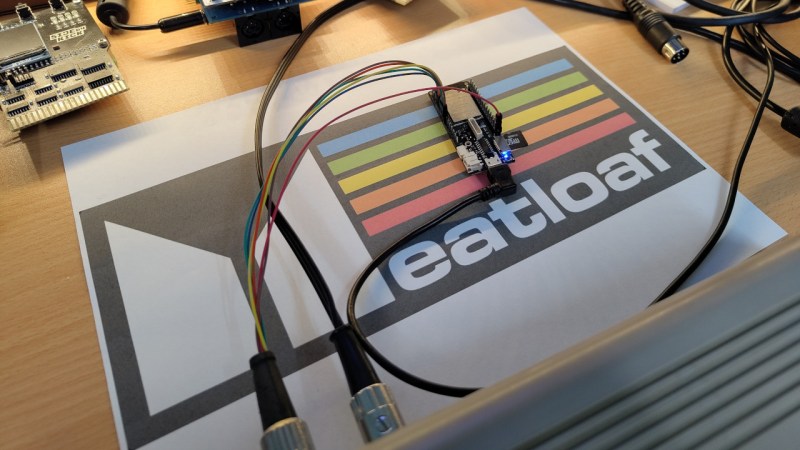
These days we take high-speed networking for granted, but it can be difficult to get vintage computers talking to modern machines. To help solve this problem [jaime] came up with Meatloaf which can provide files to a Commodore regardless of their location or medium of storage.

Meatloaf is an ESP32 device at its core, which plugs in to any of several Commodore computers through their IEC serial port. Many similar systems exist to bridge the gap between the modern world and the now-retro one, but this one connects to a dedicated service which points towards files no matter where they’re stored. There is some local storage, but it can also retrieve files from any active URL, and Meatloaf retrieves the files and then sends them to the Commodore over that serial link.

Part of what makes this unique is that the user doesn’t need to configure Meatloaf in any particular way, everything is done from the Commodore as long as the URL is known to the user. The system can even parse nested files like archive file types and send them along to the computer just like it would if they were on a period-correct floppy drive. There’s a GitHub project page as well for anyone looking to get into the weeds of this serial data interface.

Image

Amiga And Commodore, Back Together (Sort Of)

The story of Commodore, the famous manufacturer of home computers, is a murky one at best. Commodore fans will decry their woeful marketing and dismal product roadmap, while former employees such as our Hackaday colleague [Bil Herd] have shone a bit of light on the goings-on behind the scenes. The company’s final demise in the collapse of the German company Escom scattered its parts to the four winds, but now we find a potential return to clarity.

Amiga Corporation, holders of much of the Commodore and Amiga IP, have reached agreements with Commodore International Corporation, the recently formed face of the Commodore brand, and Hyperion Entertainment BV, who have been behind a series of Amiga developments over recent decades.

The press release provides a fascinating map of the Commodore and Amiga ecosystem as it stands in the 21st century, something which has sometimes eluded fans. As we understand it the rights to the 8-bit IP reside alongside the rights to the Amiga IP with Amiga Corporation, and it’s these 8-bit rights, or at least the software and documentation within them, that have been licensed to Commodore International Corporation. Meanwhile in a separate agreement the rights to continued development of AmigaOS 4.x remain with Hyperion, while the AmigaOS 3.x versions for the 68k Amigas will revert to Amiga Corporation at the end of 2027.

As far as we can see then, this should enable Commodore International Corporation to produce their line of 8-bit Commodore 64s and other machines, while Hyperion continue to serve the AmigaOS 4.x community. The interesting part comes in the AmigaOS 3.x versions, for which Amiga Corporation say they will continue to direct the development and evolution. Does that mean we’ll eventually see a 68k Amiga of some kind licensed through a company such as Commodore International Corporation? It’s an interesting prospect, and a story we’ll follow.

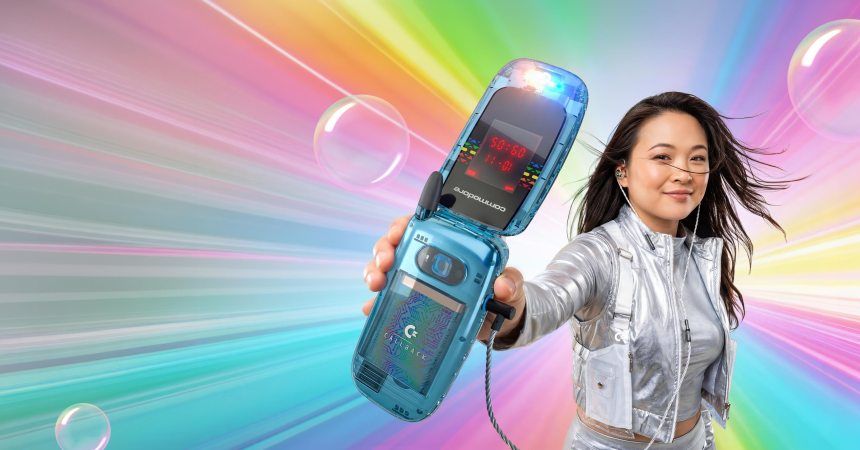
A promo image that might have been a little much even in 1999.

Commodore Unveils Linux Powered Flip Phone

Whatever happens with the new incarnation of the Commodore corporation, we’ll always remember the old one fondly. Well, we’ll remember certain of its products fondly, at any rate, if not the corporate leadership that drove them under. About that, perhaps the less said the better. That’s why we’re looking at the revived Commodore’s latest offering with equal parts interest and trepidation — is there really a market for a Linux-based, Commodore branded flip phone in 2026 and beyond?

The official reveal trailer, which you can watch below, can only be described as weaponized nostalgia for the late 90s, which tracks because the revived C-64 is more-or-less the same thing for the 8-bit era. That said, between replaceable batteries, actually having a decent camera  — a 48MP Sony module — quality Cirrus Logic DAC for audio, and running the Linux-based, Android-app-compatible Sailfish OS, the “Callback 8020” ticks all the boxes. Except for price, that is. Many will find the $499 USD launch price a little tough to swallow in this economy, so we hope they aren’t betting the farm on this one being a mass hit.

Image

Still, compared to other premium “digital minimalist” products like the LightPhone III, the price looks reasonable — and with web browsing and social media explicitly excluded from the app store, this phone is firmly in that category. At least this one comes with some sweet Commodore branded headphones, which double as an FM antenna just like they did on your Nokia back when.

While it doesn’t come with DOOM from the factory, it does come with Snake and a selection of emulated C64 games . Ringtones are SID samples, but of course there’s no actual SID chip in the phone, any more than there’s a 6502. That said, if someone builds a phone around a 6502, please let us know.

No, it’s not a new Amiga, as so many of us were hoping for, but by putting quality modern components into the flip phone form-factor, at least they’re trying to innovate (or perhaps retrovate) and we have to respect that. Only time will tell if the market does.

Continue reading “Commodore Unveils Linux Powered Flip Phone” →

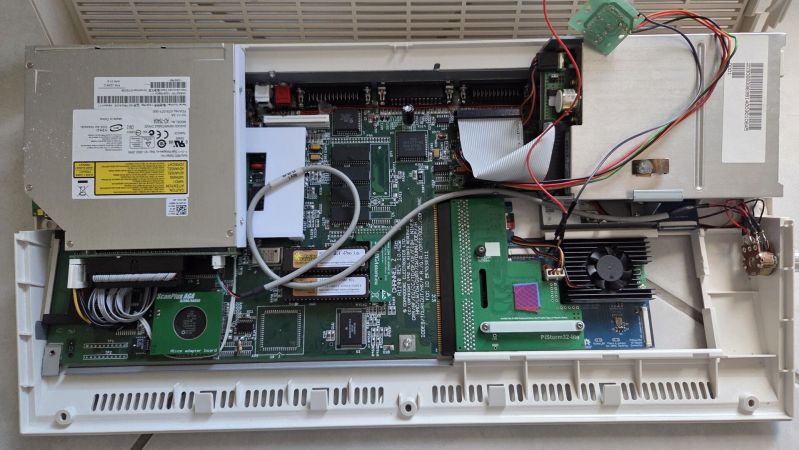
It's rare to see an A1200 case fuller than this.

Amiga 1232 Storm CD Packs Every Upgrade Into One Wedge

You know what they used to say– once you go Commodore, you’ll never leave by any door. Well, they might not have said that, but given the prevalence of projects still using Commodore-branded systems decades after the company’s demise, perhaps someone should have. A case in point is [Jit06] with this writeup on his Ultimate Amiga 1200 — or “Amiga 1232 Storm CD”– which crams just about every upgrade you might think of into the 1990s wedge computer.

Of course it has the PiStorm 32, with a CM4 providing supercomputer performance, at least by A1200 standards. That’s rather old hat, though, and it’s everything else crammed into the old Commodore that takes the score. For one thing, there’s a slot-loading, slim-form DVD drive from an old laptop that’s been incorporated so smoothly it almost looks factory. Ditto for the compact flash card slot, which is also on the IDE bus. The two share a custom IDE cable– yes, kids, we did used to roll our on 44-pin cables back in the day, but you’d better believe no one did it unless they really had to. With the space constraints inside the A1200 case, [Jit06] falls into that category.

The optical and CF cards trigger the drive LED on the Amiga case by default, but [Jit] wanted to see access on the PiStorm’s SD card as well, so he wired a couple of red LEDs to the default lightguide to get a colour-contrasting flash. That SD card is also broken out with an extender for easy access without opening the case– and once again, it looks almost as good as stock. So does the modded-on VGA port, which is stealing space that once belonged to the Amiga’s RF modulator and fed by a ScanPlus AGA board.

The only thing that really stands out as modded is the volume knob on the floppy-drive side of the case; that controls a mixer that sits between the CD audio and Paula, the Amiga’s custom sound chip. This lets him use the A1200 as a CD-32 system, and is very handy to have as CD-32 games used CD audio tracks that apparently were not well mixed with the digital audio in the games.

With all the cutting and soldering, this is not a reversible mod, something people are becoming much more concerned with as these machines slowly increase in rarity. Still, as a quality-of-life improvement, this sort of upgrade might be worth it if can keep the old A1200 relevant for another three decades. For anyone else who never got over the Amiga bug, he’s also published a linux-native SD-card creator called emu68 bootstrap on github to help with making images for the PiStorm.

Thanks to [Jit] for the tip! With the easy OS-swapping he’s enabled with the SD-breakout, there’s no reason not to try the rediscovered Amiga Unix. If you want the same without cutting into a vintage case, the PiStorm can be a sidecar.

Continue reading “Amiga 1232 Storm CD Packs Every Upgrade Into One Wedge” →

Image

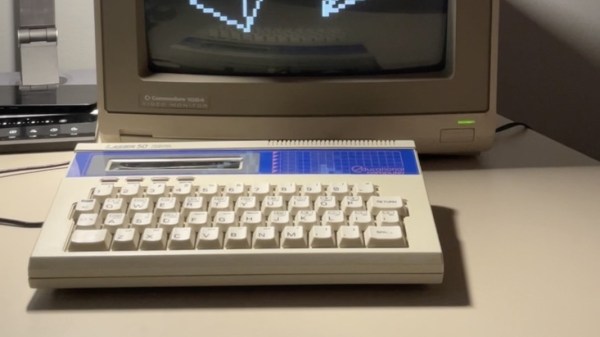
Three Arduinos Team Up To Make 80s-Style Computer

Back in the 80s, buying a home computer could easily mean an inflation-adjusted cost of thousands of dollars (or your equivalent currency unit of choice), and all for an 8-bit machine that might not have a hard drive and almost certainly didn’t connect to a network. Here in the future it’s easy to get spoiled by all the computing power and inexpensive devices practically falling into our laps, but using some modern low-cost microcontrollers can connect us to our early computing roots like [Joe]’s latest Arduino-based computer.

Taking design an engineering cues from computers like the Timex Sinclair 1000, Commodore PET, and TRS-80 MC-10, this computer uses a trio of Arduinos to accomplish what the best computer manufacturers once did with tons of integrated circuits. An Arduino Due handles all of the processing and traditional computing tasks, including a somewhat customized BASIC implementation, while an Uno performs audio processing duties. Taking care of the video processing is the much more capable Arduino Mega, outputting 40×25 monochrome NTSC composite video at 8×8 character resolution. There’s even WiFi courtesy of an ESP32 — certainly an upgrade compared to the source material.

After booting it up, the user gets a Commodore-like experience that replicates the 80s computing era quite well, and is even built inside its own keyboard case just like that era of computers usually were. [Joe] plans to release all three firmware images and the Python script used to get files onto the faux-retro machine, so keep an eye out for that.

In the event that you used rubles instead of dollars to pay for your expensive 8-bit machines back in the 80s, this computer might be more up your alley instead.

Image

How Commodore Made A Sync Splitter

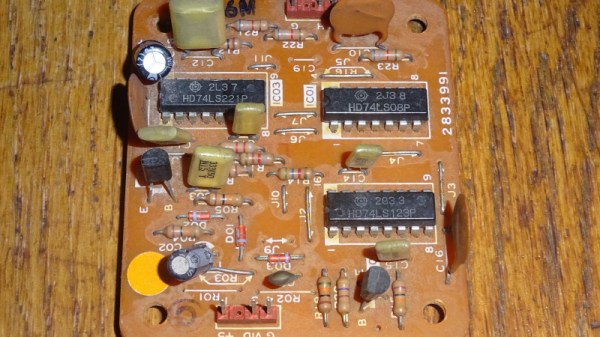
Recently we featured an unusual Commodore 8-bit computer on the bench of [Tynemouth Software] — a Commodore 64 in a PET case. One of the unique parts it had was a board which took the composite output from the mainboard and split out the sync pulses for the monitor, and now they’re back to give it a full reverse engineer.

Perhaps the first surprise is why this board is necessary at all, after all one might expect an 8-bit machine to have those signals already at hand. It seems that the VIC chip inside the 64 did the combination to composite internally, so no such luck for the Commodore engineers. The board they designed then is a complete and very well-engineered sync splitter.

The technology of a video signal has its origins in the 1930s, so it’s not hard to extract both vertical and horizontal sync pulses with little more than a few passive components and a couple of transistors. The trouble with such a simple approach is that the output will work, but it will be messy and crucially, not have quite the required timing. The Commodore board uses the same approach as a simple discrete circuit of having a pair of filters with a time constant selected to catch the relevant sync, but extends it with extra logic. There are one-shots designed to provide clean pulses of exactly the right length, and gates that provide blanking to remove the chance of pulses ending up where they shouldn’t. The video path is the only part which might differ from a conventional sync splitter, because as the output from the 64 is all-digital, it takes a TTL-level through a gate rather than a more conventional analogue path.

You can see the rest of the machine in our original write-up, and we’re reminded that the boards haven’t been cleaned at their owner’s request, to preserve their patina.