Image

Restoring A Soviet ES-4001 Mainframe Control Panel

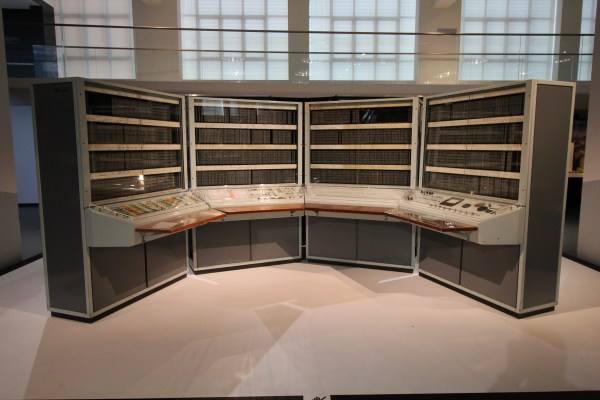
Recently the [Chornobyl Family] got their hands on an ES-4001 control panel for a 1970s-era Soviet mainframe, with the intention to restore it to full working order. Not just because they’re really into cool old Soviet technology, but also because of the connection that this control panel holds to the Chernobyl nuclear accident that was so instrumental to the area in modern times.
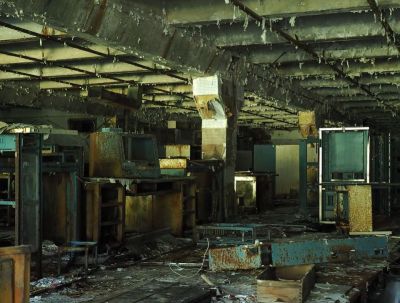
The Duga-1 computer room with what's left of the ES-1060 mainframe. (Credit: Chornobyl Family, YouTube)
The Duga-1 computer room with what’s left of the ES-1060 mainframe. (Credit: Chornobyl Family, YouTube)

During the 1970s the USSR felt that it could not be left behind in the race to create better digital computers. This led them to not only create a few original designs, but also effectively clone the IBM System/360 and System/370. This resulted in the ES EVM-series of mainframes, with an ES-1060 finding itself installed at the Duga-1 early warning radar system near what is now the Chornobyl nuclear power plant in Ukraine.

Although the radar arrays are the most well-known feature of the Duga-1, below it is the computer center where the ES-1060 was installed. It was never put into service following the ChNPP Unit-4 accident — all that remains of a once pinnacle of Soviet engineering are the picked-over carcass of the mainframe and its control panel.

The control panel in question was obtained was from the early 1980s, serving a more gentle service life in a datacenter and looks to be in a mostly good condition. That said, there was still enough to be done to make it work and undo the damage of its violent removal from the mainframe. Along the way we also learn how the system was used and how the control panel works.

Although similar in some ways to the System/370, it’s still very different, and with only about 300 of these mainframes produced, it’s worth saving whatever elements still remain today, along with the surviving documentation.

Continue reading “Restoring A Soviet ES-4001 Mainframe Control Panel” →
Image

Urban Explorers Reveal A Treasure Trove Of Soviet Computing Power

It’s probably a dream most of us share, to stumble upon a dusty hall full of fascinating abandoned tech frozen in time as though its operators walked away one day and simply never returned. It’s something documented by some Russian urban explorers who found an unremarkable office building with one of its floors frozen sometime around the transition from Soviet Union to Russian Federation. In it they found their abandoned tech, in the form of a cross-section of Soviet-era computers from the 1970s onwards.

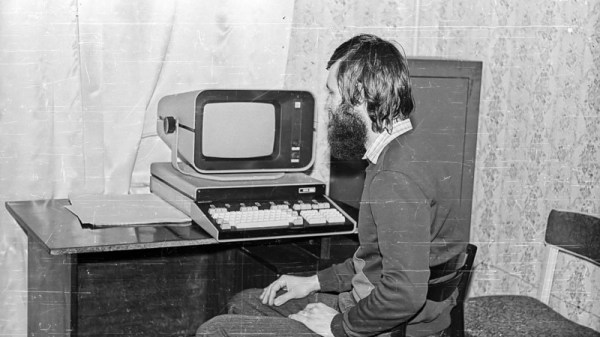
As you might expect, in a manner it mirrors the development of civilian computing on the capitalist side of the Iron Curtain over a similar period, starting with minicomputers the size of several large refrigerators and ending with desktop microcomputers. The minis seem to all be Soviet clones of contemporary DEC machines. with some parts of them even looking vaguely familiar. The oldest is a Saratov-2, a PDP/8 clone which we’re told is rare enough for no examples to have been believed to have survived until this discovery. We then see a succession of PDP/11 clones each of which becomes ever smaller with advancements in semiconductor integration, starting with the fridge-sized units and eventually ending up with desktop versions that resemble 1980s PCs.

While mass-market Western desktop machines followed the path of adopting newer architectures such as the Z80 or the 8086 the Soviets instead took their minicomputer technology to that level. It would be interesting to speculate how these machines might further have developed over the 1990s had history been different. Meanwhile we all have a tangible legacy of Soviet PDP/11 microcomputers in the form of Tetris, which was first written on an Elektronika 60.

We know that among our readers there is likely to be a few who encountered similar machines in their heyday, and we hope they’ll share their recollections in the comments. Meanwhile we hope that somehow this collection can be preserved one day. If your thirst for dusty mincomputers knows no bounds, read about the collectors who bought an IBM machine on eBay and got more than they bargained for.

Via Hacker News.

DVK-1 desktop computer, «Переславская неделя» / В. С. Спиридонов  CC-BY-SA 3.0.

Image

Add A Bit Of Soviet-Era Super-Computing To Your FPGA

The MESM-6 project is focused on bringing the 1960s Soviet BESM-6 computer to the modern age of FPGAs and HDLs. At the moment the team behind this preservation effort consists out of [Evgeniy Khaluev], [Serge Vakulenko] and [Leo Broukhis], who are covering the efforts on the Russian-language project page.

The BESM-6 (in Russian: БЭСМ-6, ‘Bolshaya Elektronno-Schetnaya Mashina’ or ‘large electronic computing machine’) was a highly performing Soviet super computer that was first launched in 1968 and in production for the next 19 years. Its system clock ran at 9 MHz using an astounding number of discrete components, like 60,000 transistors and 170,000 diodes, capable of addressing 192 kB of memory in total. Of the 355 built, a few survive to this day, with one on display at the London Science Museum (pictured above). Many more images and information can be found on its Russian Wikipedia page.

For those not gifted with knowledge of the Russian language, the machine-translated summary reveals that the project goal is to make a softcore in SystemVerilog that is compatible with user mode BESM-6, using the same Pascal compiler as originally used with that system. Further goals include at least 24 kB of data memory, 96 kB of command memory and the addition of modern peripherals such as SPI and I2C.

The system is meant to be integrated with the Arduino IDE, using the Pascal compiler to make it highly accessible to anyone with an interest in programming a system like this. Considering the MIT license for the project, one could conceivably use a bit of Soviet-era computing might in one’s future FPGA efforts.

If after watching the BESM-6 video — included below — you feel inspired to start your own Soviet-computing project, we’d like to wish you luck the Russian way: Ни пуха ни пера!

Continue reading “Add A Bit Of Soviet-Era Super-Computing To Your FPGA” →