Image

NASA Batteries Survive Extreme Cold And Heat

One of the major limits of mass-produced batteries is the electrolyte. From lead-acid to lithium ion, there’s some temperature where the electrolyte will freeze and cause all sorts of problems, from cracked casings to various non-favorable chemical changes in the battery itself. But if there’ a solid electrolyte available, many of the downsides of charging and discharging batteries in extreme cold disappear. These batteries developed by NASA, for example, can survive some wild temperature swings.

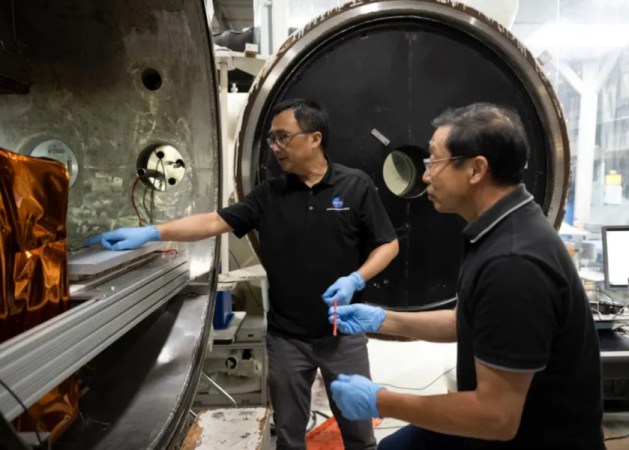
The electrolytes used for these batteries are either a ceramic or polymer electrolyte, both of which are solid. In testing, the batteries could meaningfully operate at temperatures of -60° C and up to 80° C on the high end. Further, the solid electrolyte helps protect them even outside of these temperature ranges. Bringing the battery temperature down to -170° C was not enough to damage the battery at all, and using a small heater to bring the temperature back up to its operating range showed no capacity losses or other issues.

These batteries are eventually intended for use in some of the coldest places outside of Earth still accessible to humans (in theory) such as the south pole of the Moon where the temperatures regularly get that cold and stay cold for long periods, especially in permanently-shadowed craters or places on the Moon we might want to put some telescopes eventually. There are other terrestrial situations where these batteries might be useful as well, since they don’t need as much thermal management as other battery types.

Image

Making A Five-Segment Display With Platinum-Titanium Cathodes

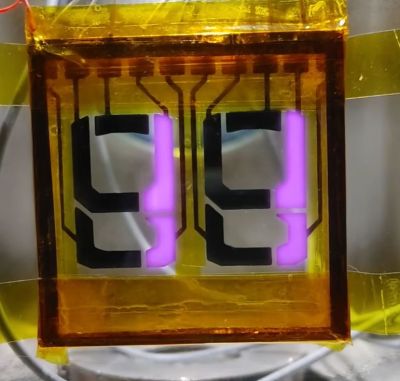
Before the advent of effective semiconductor LEDs many display types existed to display things like numbers and other characters. The Nixie tube is a well-known one, along with VFDs and there are also lesser known ones such as Burrough’s Panaplex, which all saw plentiful use in everything from calculators to audio equipment. The design that [Witchcraft and Alchemy] made appears to lean heavily on this Panaplex design.

ImageRather than neon, this uses argon as the gas. The anode is formed by the indium-tin oxide layer on a piece of glass, with the cathode sputtered onto the other side in the form of first a titanium layer followed by platinum. This combination helps to prevent the latter from flaking off due to incompatibilities between the molecular matrices of the glass and platinum.
Since this is an early prototype, only five segments were sputtered onto the glass and driven with a 74141 Nixie driver IC, creating the expected purple glow in a vacuum chamber. Following this a self-contained prototype was created, but this proved to be less successful, with the prototype quickly failing to light up as expected.

For a next attempt no tape or epoxy for sealing the device will be used, but rather a gasket instead of gluing the front glass onto the device. The use of conductive vias should make the device’s vacuum more permanent, and enable those last two segments to make it a seven-segment display. The final change should be to use a Penning mixture instead of pure argon.

Continue reading “Making A Five-Segment Display With Platinum-Titanium Cathodes” →

Image

Using Ultrasound And Microbubbles To Make Tiny Devices

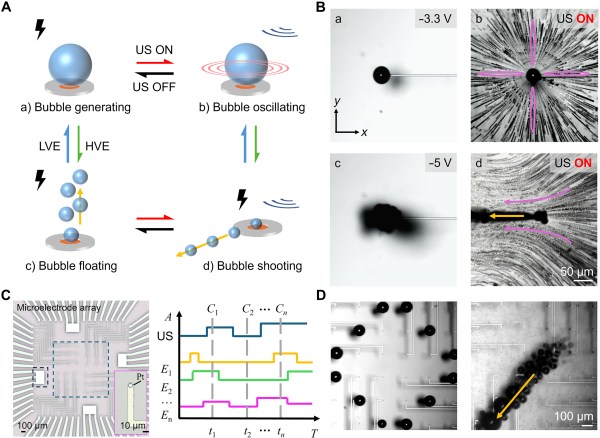
ImageAlthough we generally do not look at bubbles in fluids as more than a curiosity – if not an outright annoyance – in certain contexts they can be very useful. If you can namely control their formation and position, you can use them in small systems to control actuators and dynamically affect acoustic systems. The main issues here are that controlling their formation, lifetime and controllability remain hard to solve. This is what [Zhiyuan Zhang] et al. sought to address, with a recent study published in Science Advances covering their approach using ultrasound-driven, electronically programmable microbubbles.
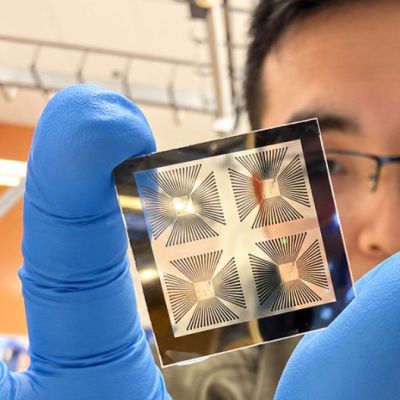
There’s also a Cornell press release article about their findings, which uses a new device that produces hydrogen bubbles along a grid of electrodes, before using ultrasound to steer them around. Using this chip-like device they claim to be able to control the 10-100 micron sized bubbles, with the ultrasound matching the resonant frequency of the target bubble. With each bubble size having its own resonant frequency, this allows for individual control by varying the induced oscillations.

Although in the demonstrated 2D setup this microbubble approach works well, it still requires a fairly bulky bench top setup around it which would need to be scaled down to be more practical. There is also the issue that the chamber geometry affects the movement of a bubble, which becomes especially important to further research when using complex (3D) chambers with this technology.

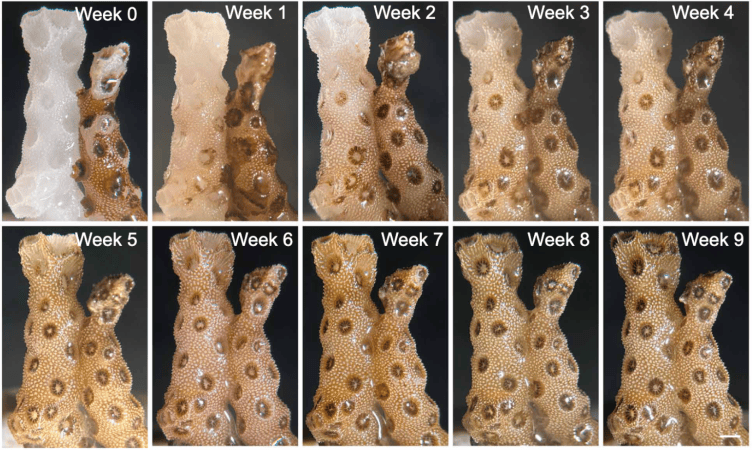
A series of ten close up images of two pieces of coral. In the first, on the top left, the coral on the left is bright white while the one on the right is brown with darker brown spots. Text reads: "Week 0." The last image, on the bottom right, shows both pieces of coral as brown with darker brown spots and the text, "Week 9." The intervening images show the white, dead coral, slowly becoming more brown as time progresses.

Spreading Life To Bleached Coral

Coral bleaching is a major problem for ocean ecosystems as the ocean gets warmer. Researchers at Stanford have found a new method for regenerating bleached corals.

Scientists working on coral found that when they had a bleached and healthy example accidentally touching in the lab, the symbionts from the healthy coral that make its food were able to spread to the bleached coral, reviving it in a matter of weeks. Contact was only required for one week, although three days was sufficient in a few cases. The effect only seems to work with corals of the same genet as the healthy corals of other genets just take over the bleached coral antagonistically.

This is particularly exciting, as areas where not all coral has bleached may indicate the presence of symbionts that are more heat tolerant, and being able to spread these symbionts to their neighbors quickly can greatly speed up the process of coral regeneration and save the reef. Coral reefs are some of the most vibrant ecosystems in the ocean, so if you save the coral, you can save many other species as well that rely on them.

If you’d like to explore how the coral is doing near you, perhaps you should try an open ROV or a bionic jellyfish?

Image

Making Photovoltaic Solar Cells With A Microwave

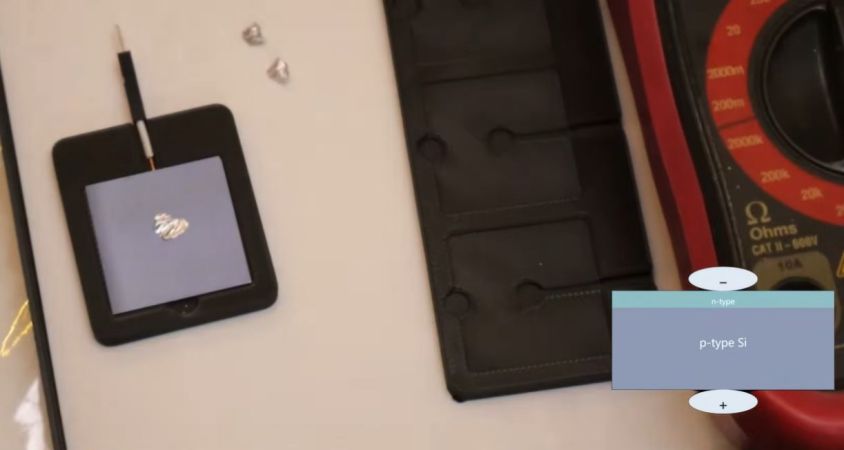
Although solar panels may seem like a kind of magic, they’re really quite simple devices, in their silicon form featuring nothing but the p-type silicon wafer and an n-type layer doped with e.g. phosphorus. Because of this simplicity it’s quite possible to make your own solar cells at home using only a few basic, off-the-shelf ingredients and a kiln, which in this recent video by [Dr. Semiconductor] uses a microwave kiln and thus justifies the video’s title.

Even the silicon wafer that you start with can be easily purchased online, though you have to be careful that it’s a bare wafer, without existing etchings on it. On this you need to get a phosphorus-rich layer, which is done by creating a delicious mixture of 1 mL of tetraethyl orthosilicate (TEOS), 0.3 mL of 85 wt% phosphoric acid, 5 mL of ethanol and 0.25 mL of distilled water. After low heat boiling this for 30 minutes, it is spincoated onto the cut square of silicon wafer using a spinning platform, like a PC fan.

Next, you shove the coated silicon into the kiln and put it into the microwave to bake at a fairly low power level for half an hour. In the video it took less than 50% power of the microwave to not melt the silicon, so remember that those microwave kilns get pretty hot.

With the delightful smells of freshly baked silicon now teasing your nostrils, you can then take out the doped silicon to sand or etch off the thin layer of glass that’s formed around the new PV cell. On the clear spots you can now put a gallium-indium contact on the p-type Si side and a wad of indium on the newly doped Si-P side, which are now your contacts for the PV cell.

The full recipe along with many of the issues discussed in the video can also be found on the blog article, though the video conclusion notes that many improvements are still possible. The created PV cell in the video reaches an efficiency of about 5%, but this could be improved through changes like the use of a clean-room, adding an anti-reflection coating and improving the contact with the cell.

Continue reading “Making Photovoltaic Solar Cells With A Microwave” →

Image

A Plasma Donut

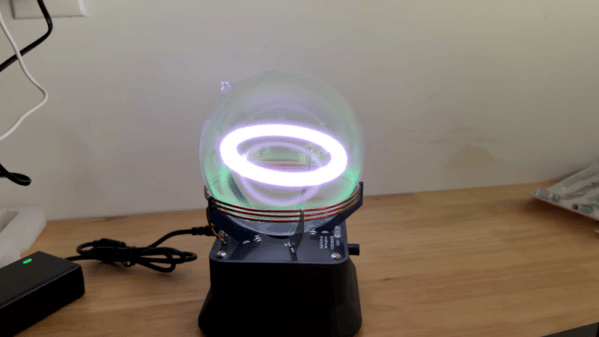
We know [The Action Lab] always has something hands-on. This time, the video shows a toroidal plasma demo and how it relates to nuclear fusion. Plasma has a high temperature, and if you use physical electrodes to excite the plasma, this high temperature tends to destroy the electrodes. But thanks to the relationship between electricity and magnetism, you can create plasma with an alternating magnetic field instead of physical electrodes.

The actual practical device is a 10 MHz source with a coil and a low-pressure globe full of xenon gas. It looks pretty cool. Of course, the little tabletop demo isn’t strong enough to drive a fusion reaction. But if you scale it up and make some modifications, including using hydrogen, you get a tokamak reactor.

Continue reading “A Plasma Donut” →

Image

Busting The Myth That Plastics Are Chemically Inert In Water

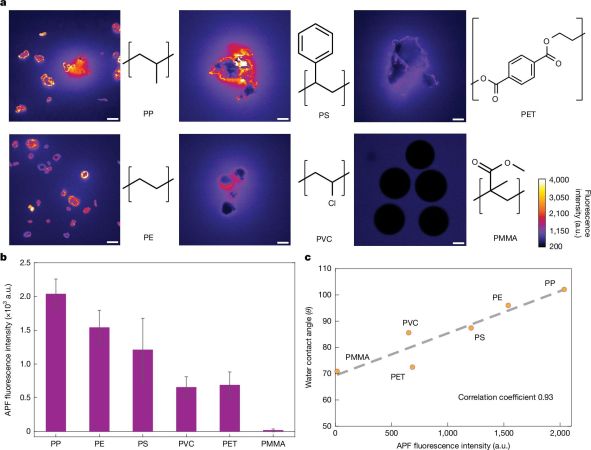
One of the often made claims about plastics is that they are chemically inert under most conditions, such as when exposed to water. This long-held belief has also challenged the notion that micro- and nanoplastics (MNPs) are dangerous to organisms such as us human animals. A hitherto unknown mechanism between common plastics as investigated by [Naixin Qian] et al. and published in Nature serves to generate highly reactive hydroxyl radicals when exposed to water.

Hydroxyl radicals (HO•) are the neutral form of the hydroxide ion (OH–). It’s a free radical that tends to be extremely short-lived due to its reactivity, much like the singular oxygen molecule that is freed at the plastic-water interface. The energy provided for this reactivity comes from the electrostatic effect, itself highly correlated with many plastics, with the six types of microplastics used in the experiment showing varying levels of free radicals, particularly for the more hydrophobic types.

This high reactivity of free radicals is a well-known problem in cellular biology, with evolution having developed many tools over the years to deal with capturing these radicals as well as repair the (DNA) damage that they can cause. The effect of these microplastics and their generated free radicals was thus studied as well.

Of note here is that the electrostatic effect itself already serves to draw charged biomolecules to it, before the impact of free radicals is considered. By using mouse red blood cells and exposing them to polystyrene (PS) microplastics fatal damage was observed to the red blood cells.

This indicates that there are at least three possible ways in which MNPs can be harmful to organisms. It also provides another clue to how this may affect the ageing of plastics, among other implications.

Currently there is still ongoing debate on whether MNPs are truly harmful and just how prevalent they may be in e.g. our bodies. Reliably detecting them in e.g. biological tissues remains a challenge, which this new study may also be helpful with, since one of our biggest blind spots is that we lack solid knowledge of how MNPs may behave inside an organism.