Image

Floating-Point Addition And Subtraction On Intel’s 8087

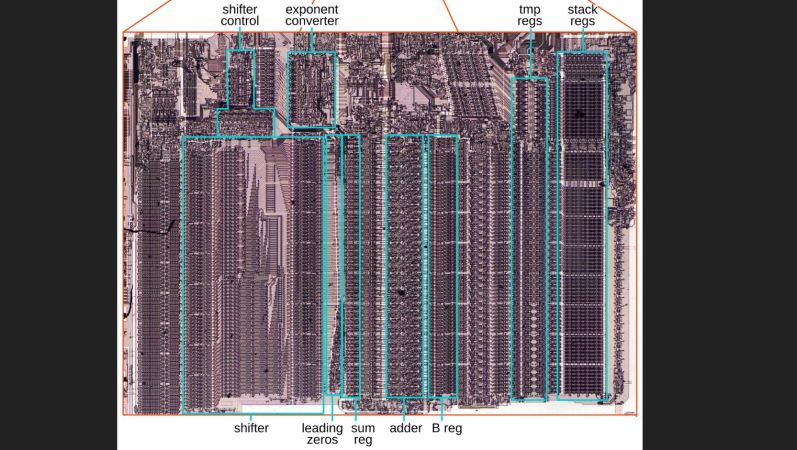
Although you can do basic floating point format operations like addition and subtraction just fine on any CPU, having specialized hardware for it can provide a significant speed boost. Here Intel’s 8087 was the first mainstream floating-point coprocessor to provide this option to a wide audience, with [Ken Shirriff] recently reverse-engineering using an 8087 die how these basic operations were implemented.

The real-world speed-up of even simple operations like adding two floating point numbers compared to the 8086 CPU was on the order of a hundred times, which is very relevant the moment you start doing interesting things with spreadsheets, not to mention rendering 3D scenes in CAD software or even games.

As always, the devil is in the details, with sneaky infinities and edge cases also providing the biggest potential for speed-ups in dedicated silicon, along with the large circuitry spent on the shifter. With floating point values being very much about aligning values with shifting by a number of bits, this circuitry along with the detecting of over- and underflows is the key element why the 8087 and its successors were so crucial in making floating-point operations at all feasible in PC applications.

How this shifting works in theory is detailed in the article by [Ken], along with how the 8087 implements this in its circuits. Naturally, a large part of this is implemented in microcode, the listing for which is also provided. From this it’s quite clear how what seems like a simple set of operations is actually quite complex, making even the now much maligned x87 ISA an improvement over doing it all in integer-based software.

Image

Making A Five-Segment Display With Platinum-Titanium Cathodes

Before the advent of effective semiconductor LEDs many display types existed to display things like numbers and other characters. The Nixie tube is a well-known one, along with VFDs and there are also lesser known ones such as Burrough’s Panaplex, which all saw plentiful use in everything from calculators to audio equipment. The design that [Witchcraft and Alchemy] made appears to lean heavily on this Panaplex design.

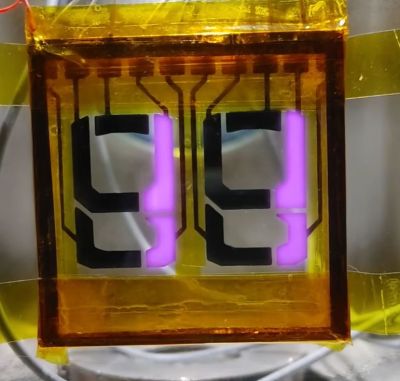
ImageRather than neon, this uses argon as the gas. The anode is formed by the indium-tin oxide layer on a piece of glass, with the cathode sputtered onto the other side in the form of first a titanium layer followed by platinum. This combination helps to prevent the latter from flaking off due to incompatibilities between the molecular matrices of the glass and platinum.
Since this is an early prototype, only five segments were sputtered onto the glass and driven with a 74141 Nixie driver IC, creating the expected purple glow in a vacuum chamber. Following this a self-contained prototype was created, but this proved to be less successful, with the prototype quickly failing to light up as expected.

For a next attempt no tape or epoxy for sealing the device will be used, but rather a gasket instead of gluing the front glass onto the device. The use of conductive vias should make the device’s vacuum more permanent, and enable those last two segments to make it a seven-segment display. The final change should be to use a Penning mixture instead of pure argon.

Continue reading “Making A Five-Segment Display With Platinum-Titanium Cathodes” →

Image

Every Type Of Current Sensor Explained

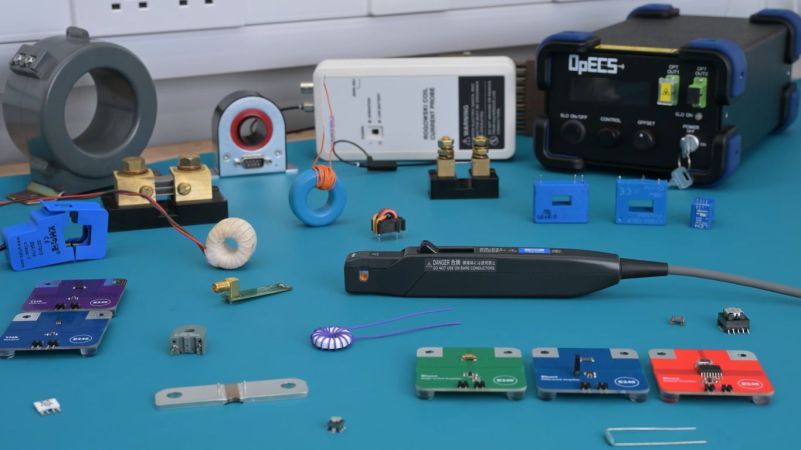
Measuring electric currents is an essential element of many electrical systems, but doing so in a way that is as nonintrusive as possible is not an easy problem to solve. Due to this we got a wide variety of current sensors to choose from for any given application, with [ElectrArc240] running us through these variants in a recent video.

The fairly low-tech, cheap and quite reliable method of using a shunt resistor is first demonstrated. This sees a lot of use in fairly low-voltage and low-current applications, with for example videocards using it to limit the amount of power the GPU can use, a feature that modders will happily bypass. Here simply the voltage drop across a known resistance value is measured, from which the current can be derived.

Of course, you got higher voltage and higher current applications too, as well as direct- and alternating current, with the latter especially allowing for easy current measurements simply from the electromagnetic field, or flux. Anyone who has used a clamp meter can attest to that such contact-free current sensing works, even for DC applications.

Beyond the basic transformer type you got many variants including Hall-Effect, TMR and fluxgate sensors, as well as the fiber-optic current sensor that uses an interferometer to measure the phase-change induced by the magnetic field – the Faraday effect – to the transmitted electromagnetic radiation. These more exotic types will improve resolution, at the cost of a rapidly increasing void in your project budget.

These various sensor types and their construction are demonstrated and discussed in the video, including when you’d want to use a specific type, and what the potential gotchas are with each type. Even if for many applications a simple shunt resistor suffices, it’s a good idea to know these different types, as well as their underlying theory of operation.

Continue reading “Every Type Of Current Sensor Explained” →

Image

Using Ultrasound And Microbubbles To Make Tiny Devices

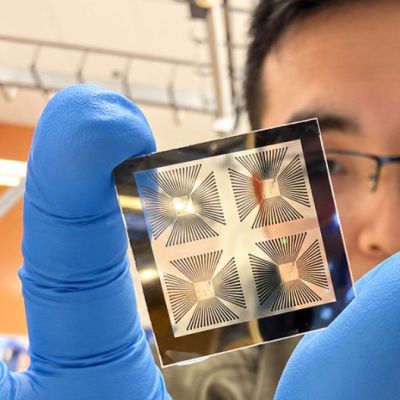
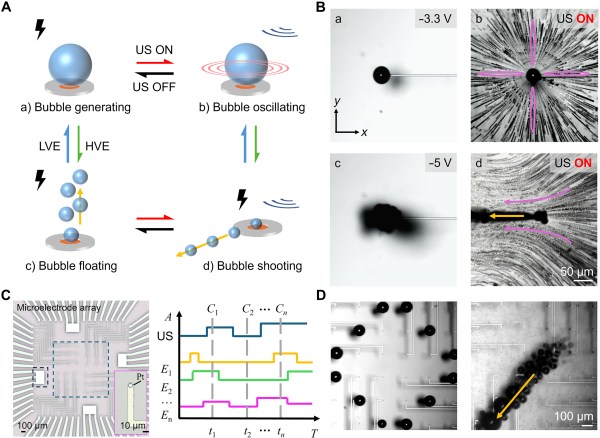
ImageAlthough we generally do not look at bubbles in fluids as more than a curiosity – if not an outright annoyance – in certain contexts they can be very useful. If you can namely control their formation and position, you can use them in small systems to control actuators and dynamically affect acoustic systems. The main issues here are that controlling their formation, lifetime and controllability remain hard to solve. This is what [Zhiyuan Zhang] et al. sought to address, with a recent study published in Science Advances covering their approach using ultrasound-driven, electronically programmable microbubbles.
There’s also a Cornell press release article about their findings, which uses a new device that produces hydrogen bubbles along a grid of electrodes, before using ultrasound to steer them around. Using this chip-like device they claim to be able to control the 10-100 micron sized bubbles, with the ultrasound matching the resonant frequency of the target bubble. With each bubble size having its own resonant frequency, this allows for individual control by varying the induced oscillations.

Although in the demonstrated 2D setup this microbubble approach works well, it still requires a fairly bulky bench top setup around it which would need to be scaled down to be more practical. There is also the issue that the chamber geometry affects the movement of a bubble, which becomes especially important to further research when using complex (3D) chambers with this technology.

Image

Lazarus And The Free Pascal Compiler Gain Dynamic Package Support

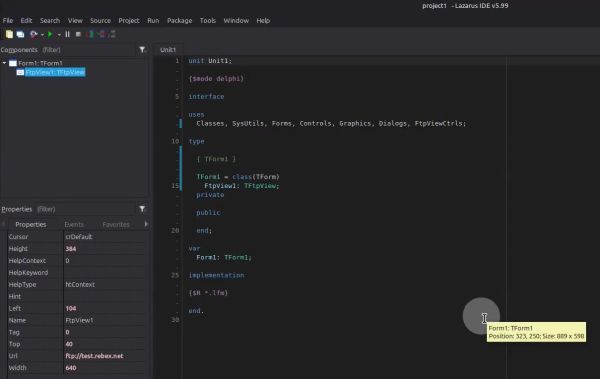
"Built with Free Pascal Lazarus" bannerIf you have developed in Pascal or Delphi in the past decades, you’re probably familiar with the Lazarus IDE that provides an interface to the Free Pascal Compiler (FPC), much like Delphi’s IDE. For users of Lazarus IDE there’s now an exciting new development, with the announcement that FPC and Lazarus now support dynamic packages.
The upshot of this is that you no longer need to rebuild the IDE if you want to add components, controls and Lazarus extensions. In addition you can use this same dynamic package feature in your own Pascal applications this way.

Naturally this is a great improvement, and it’s good to see more improvements to such a venerable programming language. Not only is it still being used today for just about anything, including web development, but there is a good case to be made for using Pascal today as it’s no longer the language it was half a decade ago.

We’d also be remiss to not mention the legacy of [Niklaus Wirth], who not only created Pascal, but was also instrumental in the development of Object Pascal together with Apple. This effort ultimately led to everything from Turbo Pascal to Delphi, FPC and so much more, making it a heartening sight to see this legacy being kept alive today.

Image

NASA’s Lunar Grounding Challenge Is A Real Buzz

One could make a joke about how an astronaut walking on the lunar surface is rather akin to a cat walking on the carpet in the living room, but out in space the resulting triboelectric discharge can do a lot more damage than just some stinging fingers and a bemused looking cat.

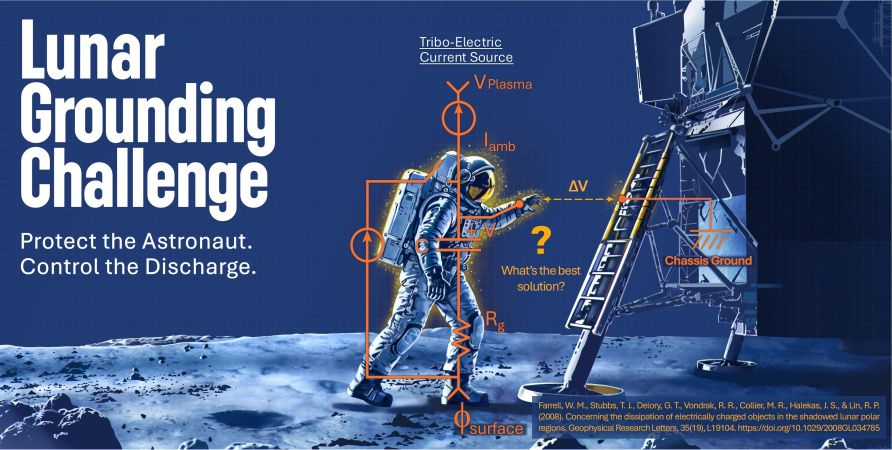
The problem that NASA and other space agencies are dealing with is that the charge that builds up on a lunar-walking astronaut is very hard to equalize with something like a lunar lander. For this reason they have now set up the Lunar Grounding Challenge to consult the public whilst dangling $150,000 of rewards in front of anyone ready to pounce with a good idea.

Here on Earth we have many ways in which we can get rid of unwanted charge: dry winter weather, for instance, demonstrates effectively that humidity is a crucial factor here. With no real atmosphere on the Moon, each astronaut becomes a walking capacitor, which is worsened when said astronaut ventures outside of the sunlit areas and then returns to the slightly positively charged lander.

The challenge here is to equalize the astronaut and lander, with a design specification of a -100 kV or higher astronaut and about 100 V lander. A resulting current should not exceed 1 mA, ideally less than 0.2 mA to remain below human perception levels. If an arc exists it should not contact the suit or astronaut.

Of course, the most low-tech solution would be to use a resistor to limit the current, but at those voltage ranges it would take an awful long time to bleed off, in an environment that’s basically a perfect insulator. It definitely seems like a fun challenge to sink one’s fangs into.

Image

Super Mario Galaxy Now Runs On The GBA

Joining the ranks of fresh backported Nintendo games is Super Mario Galaxy for the Nintendo Game Boy Advance (GBA), courtesy of [Tobias Friedly], AKA [Tobi]. In a recent video he announces the release of this game, along with the release of the source code of the engine and all the game’s code in a GitHub project.

Naturally none of the original Wii game’s assets are provided to appease Nintendo’s vicious lawyers, so you’re expected to bring your own super-legally acquired ISO image or equivalent to fill in these blanks when you build your ROM for the GBA.

This is a mostly complete port, even integrating the star pointer despite the GBA’s limited number of controls compared to the Wii. In some situations it’s opted to have star bits automatically collected to work around this limitation, which is probably a quality-of-life improvement that many SMG players will appreciate.

For the game’s logic a lot of code was borrowed from the recently decompiled version of the original game, which saved a lot of time even if the GBA’s hardware is no match for the Wii’s. From the gameplay in the video it definitely looks like a playable version of the game, with an acceptable frame rate that looks to be worth a try.

Continue reading “Super Mario Galaxy Now Runs On The GBA” →