Image

NASA Batteries Survive Extreme Cold And Heat

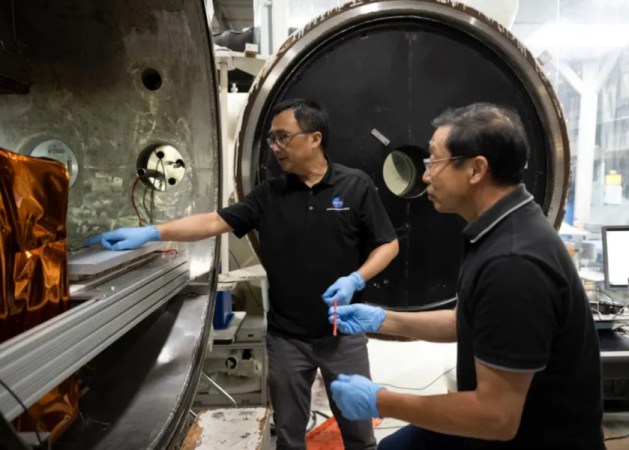
One of the major limits of mass-produced batteries is the electrolyte. From lead-acid to lithium ion, there’s some temperature where the electrolyte will freeze and cause all sorts of problems, from cracked casings to various non-favorable chemical changes in the battery itself. But if there’ a solid electrolyte available, many of the downsides of charging and discharging batteries in extreme cold disappear. These batteries developed by NASA, for example, can survive some wild temperature swings.

The electrolytes used for these batteries are either a ceramic or polymer electrolyte, both of which are solid. In testing, the batteries could meaningfully operate at temperatures of -60° C and up to 80° C on the high end. Further, the solid electrolyte helps protect them even outside of these temperature ranges. Bringing the battery temperature down to -170° C was not enough to damage the battery at all, and using a small heater to bring the temperature back up to its operating range showed no capacity losses or other issues.

These batteries are eventually intended for use in some of the coldest places outside of Earth still accessible to humans (in theory) such as the south pole of the Moon where the temperatures regularly get that cold and stay cold for long periods, especially in permanently-shadowed craters or places on the Moon we might want to put some telescopes eventually. There are other terrestrial situations where these batteries might be useful as well, since they don’t need as much thermal management as other battery types.
Image

NASA’s Lunar Grounding Challenge Is A Real Buzz

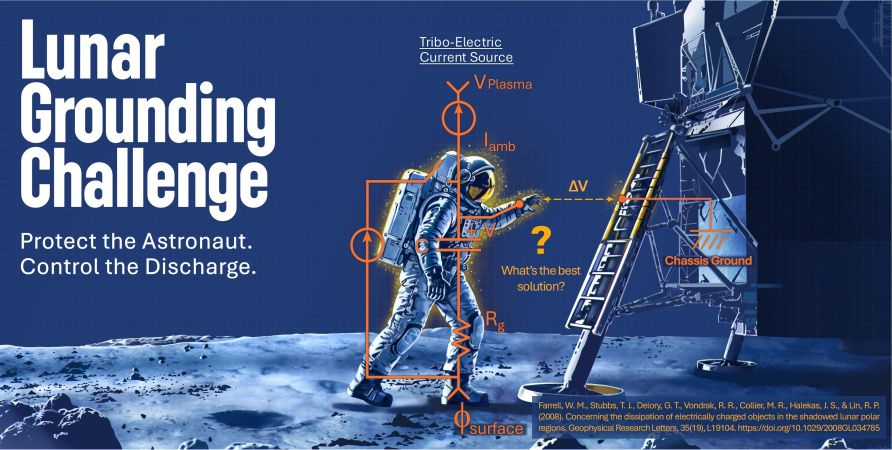
One could make a joke about how an astronaut walking on the lunar surface is rather akin to a cat walking on the carpet in the living room, but out in space the resulting triboelectric discharge can do a lot more damage than just some stinging fingers and a bemused looking cat.

The problem that NASA and other space agencies are dealing with is that the charge that builds up on a lunar-walking astronaut is very hard to equalize with something like a lunar lander. For this reason they have now set up the Lunar Grounding Challenge to consult the public whilst dangling $150,000 of rewards in front of anyone ready to pounce with a good idea.

Here on Earth we have many ways in which we can get rid of unwanted charge: dry winter weather, for instance, demonstrates effectively that humidity is a crucial factor here. With no real atmosphere on the Moon, each astronaut becomes a walking capacitor, which is worsened when said astronaut ventures outside of the sunlit areas and then returns to the slightly positively charged lander.

The challenge here is to equalize the astronaut and lander, with a design specification of a -100 kV or higher astronaut and about 100 V lander. A resulting current should not exceed 1 mA, ideally less than 0.2 mA to remain below human perception levels. If an arc exists it should not contact the suit or astronaut.

Of course, the most low-tech solution would be to use a resistor to limit the current, but at those voltage ranges it would take an awful long time to bleed off, in an environment that’s basically a perfect insulator. It definitely seems like a fun challenge to sink one’s fangs into.

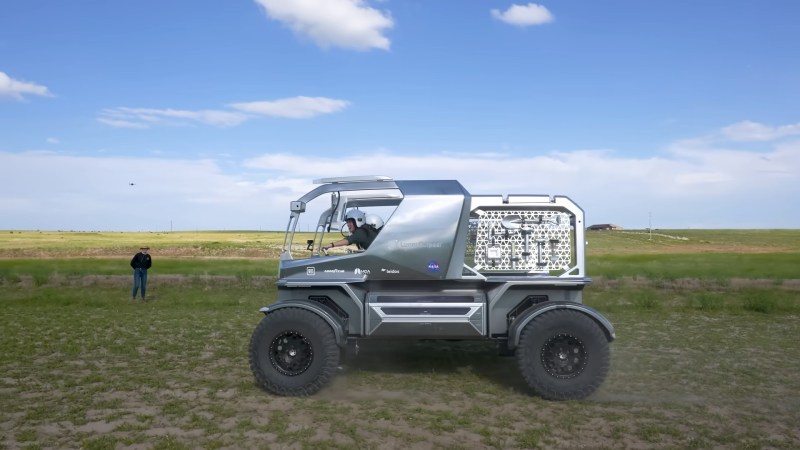
A shiny, silver vehicle with tools on a mesh rack on the back half and a large open cab up front drives across a grassy field under blue, partly cloudy skies. A person in a black shirt stands in the background with a drone hovering above their head. Two women in white helmets are piloting the vehicle from the cab.

Driving On The Moon At A Blistering 11.6 MPH

As NASA continues humanity’s slow march back to the Moon, different pieces of the puzzle of establishing a more permanent base there are falling into place. One of these pieces is the the Lunar Terrain Vehicle (LTR), and [Cleo Abram] and [Michelle Khare] got a look at the LTR candidate from Lunar Outpost.

Designed to help astronauts traverse the lunar surface as well as function as a semi-autonomous rover when uncrewed, the LTR will be an integral part to any future Moon base. NASA announced earlier this year that it would be moving forward with the LTR featured in this video and another from competitor Astrolab. Regardless of manufacturer, the LTR will have to deal with some wild conditions in the lunar environment.

Lunar dust is abrasive, so the LTR generates an electric current to pull the dust under the truck to prevent it from entering the cab of the vehicle as it moves along. Given the extreme temperature swings on the moon (-200˚C to 200˚C), the space truck will also be fitted with wire mesh tires as nobody wants to be changing a flat in space. The two seats in the cab are oversized and can help lift the astronauts up as space suits hamper their agility to a significant degree. There are compartments for storing samples, and the truck has a robot arm that can grab samples to bring back if no one is along for the ride.

We’ve still got a few years before crews arrive on the moon, but when they do, there’s a good chance they’ll be using the LTR to explore the lunar south pole in hopes of water.

Continue reading “Driving On The Moon At A Blistering 11.6 MPH” →

Hackaday Links Column Banner

Hackaday Links: October 11, 2026

It probably goes without saying that if you send four humans to observe the Moon up close, they’ll see things that those of us stuck here on Earth have never noticed. Luckily for us, they took impeccable notes and brought plenty of cameras, which NASA has shared with the rest of the class as Artemis II: Sights & Sounds of Science.

Well, technically it’s called the Artemis II Preliminary Lunar Science Report, but we appreciate the space agency adding a little flair to it and formatting the findings for public consumption. Arguably the most significant observations detailed in the report are the impact flashes on the lunar surface. As you may recall, the trajectory of the Orion spacecraft meant the crew experienced a unique solar eclipse on the sixth day of the mission, giving them an unprecedented close-up view of the darkened Moon. During this time, they were able to see flashes of light with their unaided eyes, which NASA has since confirmed were small rocky fragments — perhaps no more than a few inches wide — slamming into the lunar surface at incredible speeds.

Image
To boldly go where no whisky has gone before.

The Artemis II mission was one for the history books, for most of us the most significant space mission of our lifetimes. But as access to space becomes cheaper and more routine, it stands to reason that not all activities in orbit will be quite so momentous. For example, students from the University of Glasgow and Japan’s Kyushu Institute are currently collaborating on a planned mission to distill whisky in space for the first time.

Scheduled to launch in 2028, the CubeSat will carry 10 ml of fluid and spend five years in orbit studying how its chemical composition changes, with a special interest in how the frequent changes experienced as the spacecraft travels around the Earth could influence the maturing process. While this might not seem terribly interesting to teetotalers, it offers an opportunity to gain more practical experience with orbital manufacturing which will likely inform future missions.

Continue reading “Hackaday Links: October 11, 2026” →

Image

The Big Moon Plot

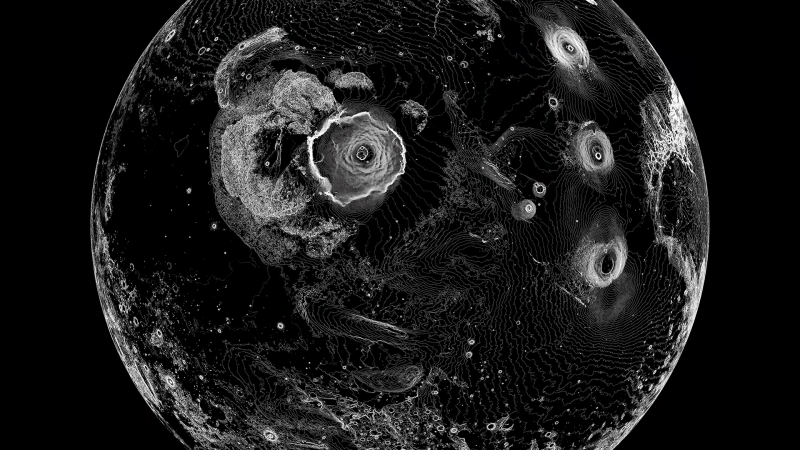
When you look into the night sky, you can’t help but wish to bring the outer worlds to your doorstep. One of the best ways to do that is to photograph the Moon’s surface to display in a frame. However, [Sebastian Lague] found a simple image too lackluster compared to something with a bit more style, such as a plotted image of the lunar terrain.

Why plotting? Well, the Moon is not defined in the same way with contrasting colors as Earth is. The Moon is peppered with craters and differing elevations that separate regions, so why not build an entire DIY plotter from scratch? [Sebastian Lague] did exactly this with a custom algorithm to take the elevation maps and create vector drawings which are plotted on his custom plotter.

Continue reading “The Big Moon Plot” →

Image

Retrotechtacular: A View Of The Moon From 1964

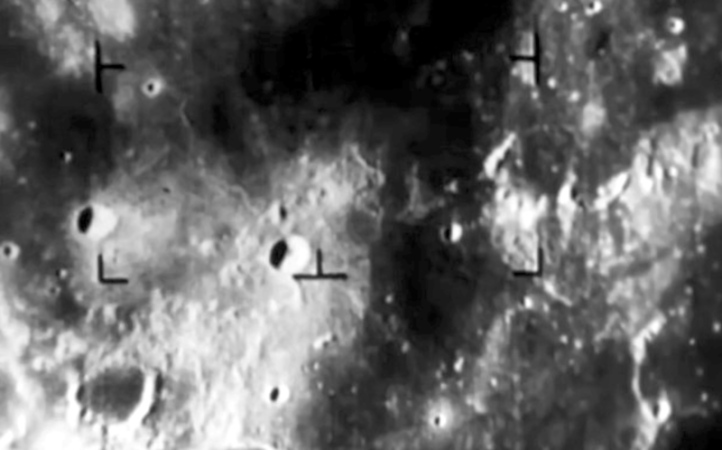
If you didn’t live through it, it is hard to understand how excited the general public was about the race for the moon. You can capture some of it by watching “Lunar Bridgehead,” a film about JPL monitoring the Ranger spacecraft as it hit, rather hard, on the lunar surface.

The Ranger program had been plagued with problems. The first five didn’t make it to the moon. Ranger 6 hit the moon, but failed to start its cameras. Ranger 7 was the first successful mission. There would be two more successful missions before the end of the program.

Continue reading “Retrotechtacular: A View Of The Moon From 1964” →

Image

NASA Announces Artemis III Crew And Ambitious Goals

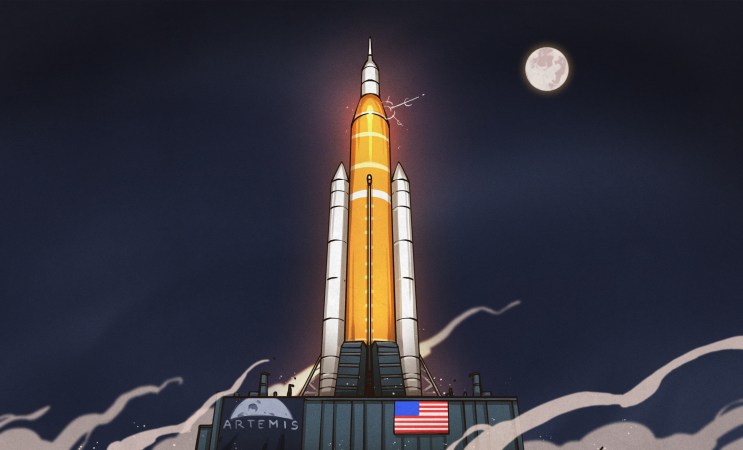
When the Artemis lunar program was first conceived, the third mission would have seen astronauts step foot on the Moon for the first time since Apollo 17 in 1972. But as hard as getting into space is, a sojourn to our nearest celestial neighbor is even more mindbogglingly complex, and so earlier this year it was announced that actually landing on the Moon would be pushed out to the fourth mission.

ImageIn turn Artemis III would take a page out of the Apollo 9 playbook and test out rendezvous and docking procedures with commercial landers while operating in the relative safety of low Earth orbit. Moving the target date for the landing a few years down the road gave all involved parties a little more breathing room, but it also provided a valuable opportunity to gain insight into the performance of the vehicles and systems ahead of the critical moment. In the original timeline, the first time Orion would attempt to dock with the lander would have been just before descending to the lunar surface — leaving precious little time to troubleshoot should anything go wrong.

Yesterday NASA held a press conference to update the public on their progress towards the planned 2027 launch of Artemis III, which included the long-awaited announcement of the crew that will kick the tires on the next-generation lunar landers being developed by SpaceX and Blue Origin

Continue reading “NASA Announces Artemis III Crew And Ambitious Goals” →