Image

Birduino Plays Bird Calls On Demand With NFC-enabled Cards

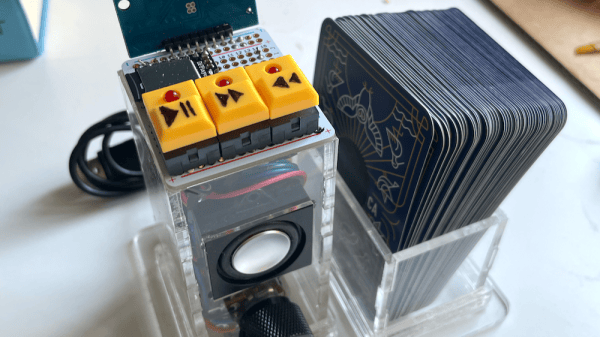
All [Hannah Robertson]’s Birduino needs is for one to tap an NFC-enabled card to the reader, and the device plays one of the vocalizations associated with the bird shown on the card. It ties together a few different components into a whole, and acts as a good reference design for similar work. There are a few time-saving construction tips worth keeping in mind, too.

The major components are an Arduino Nano, an RC522 RFID reader, and an MP3 player module. Using hardware modules and breakout boards means simpler wiring and being able to take advantage of existing libraries and sample code. There are also a few other things in this build that avoid re-inventing the wheel.

Image
A deck of bird cards plus a roll of NFC stickers equals a ready-to-scan assortment without having to design it oneself.

Rather than design, print, and cut a set of bird cards, [Hannah] found a set of bird-themed playing cards with a different North American bird on each. The back of each card gets an NFC sticker off a big roll purchased online. The result? A set of NFC-enabled bird cards with a minimum of work and fuss. The RC522 RFID reader doesn’t fully support NFC, but it works well enough to read the ID off the stickers.

When the user touches a card to the reader, the device plays one of the vocalizations from a collection of sounds for each bird. Creating the manifests and linking each card’s ID to them was a lot of manual work, but the result is great. The sound themselves come from the Cornell Guide to Bird Sounds of the United States and Canada, a $20 USD curated compilation of vocalizations from a staggering 908 bird species of North America. In a way, the biggest bottleneck is the card deck itself. At 52 cards plus two Jokers, it contains only a small subset of the total birds in the Cornell collection.

The enclosure is laser-cut clear acrylic, and here [Hannah] offers some time- and money-saving advice for anyone looking to glue acrylic to acrylic in a way that doesn’t frost or cloud the clear acrylic: Clear Gorilla Glue Gel. There are of course other glues made for this purpose, but Clear Gorilla Glue Gel (the one in a squeeze tube) is something one should be able to find in just about any hardware store. Another tip: double-check before buying, because many Gorilla Glue products are very similarly named despite being significantly different products.

Watch (and listen to) the video embedded below. If birds and their vocalizations are something that intrigues and inspires you, Cornell also has a resource for identifying birds by sound alone — we’ve seen it implemented with a Raspberry Pi and USB microphone.

Continue reading “Birduino Plays Bird Calls On Demand With NFC-enabled Cards” →
Image

Track Bird Visitors With A Raspberry Pi And A USB Mic

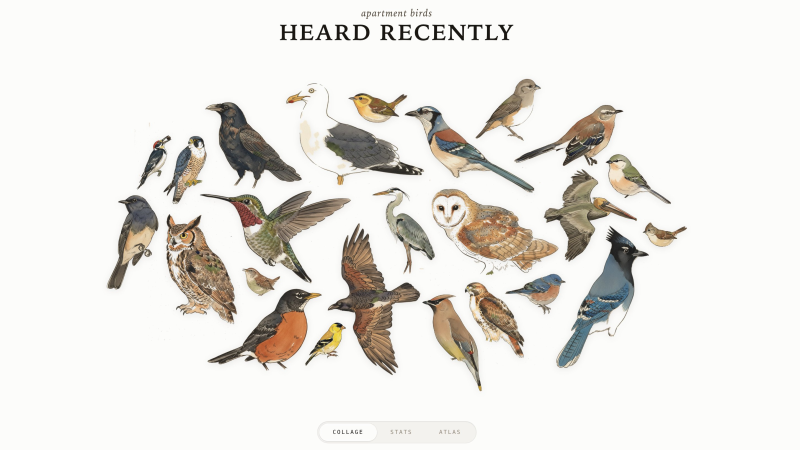
Avian Visitors is a lovely project by [Teddy Warner] that uses a Raspberry Pi and microphone to keep track of which birds have been visiting your home, and creates a colorful illustration of recent visitors on top of it all.

It reports on a web interface of its own making, but what really takes things to a new level is an optional, stylish E-Ink panel that shows the last 24 hours’ worth of visitors at a glance in a collage.

ImageThe key to identification is BirdNET (GitHub here), a deep learning classifier from Cornell that can reliably identify and classify more than 11,000 species worldwide based on sound alone.

Based on that information, the system pulls bird images from a reference set for the region and creates a collage representing the breadth and frequency of visitors in a single image. The larger the image of a bird, the more frequently it was heard.

That’s a cool project, but [Teddy] took things one step further by setting up a color E-Ink display to show a running summary of all the avian visitors the system identifies. [Teddy] has a knack for leveraging projects into wall-mounted art, as we saw with his generative art wall plotter. Continue reading “Track Bird Visitors With A Raspberry Pi And A USB Mic” →

Image

V Formation Flying Of Birds Is Explained By A Minimal Wake–Vortex Model

Although it’s commonly suspected that migratory birds fly in a ‘V’ formation due to this saving energy for the birds in the slipstream, understanding the exact aerodynamics behind this and how it affects the way that the birds use their wings to maintain this optimal pattern. After all, unlike airplanes and cars, our feathered avian dinosaur friends need to flap their wings if they want to have any chance of staving off plummeting back to Earth. Recent research by Brown University researchers now have provided a simulated model that answers many questions.

The major question was how this would work in the up- and down-wash zones created in this type of formation, with every bird following the lead bird dealing with the vortices created by the flapping of the wings of the bird before them. These wake vortices are quite complex, and thus required careful modelling to make sense of them.

As described in the paper by [Olivia Pomerenk] et al., the model is based on northern bald ibises, taking into account live-bird measurements for validation of the model. The main effect that can be observed is a reduced flapping amplitude, leading to an 11% energy savings for the birds in the leader’s wake.

The main advantage of having such a model is of course that it provides insight into the kinematic and aerodynamic mechanisms, meaning the ability to model virtual flocks of birds, predict the efficiency of specific in-flight configurations, and apply the lessons to swarms of drones, or whatever else we want to put in the air.

Image

A Bird Watching Assistant

When AI is being touted as the latest tool to replace writers, filmmakers, and other creative talent it can be a bit depressing staring down the barrel of a future dystopia — especially since most LLMs just parrot their training data and aren’t actually creative. But AI can have some legitimate strengths when it’s taken under wing as an assistant rather than an outright replacement.

For example [Aarav] is happy as a lark when birdwatching, but the birds aren’t always around and it can sometimes be a bit of a wild goose chase waiting hours for them to show up. To help him with that he built this machine learning tool to help alert him to the presence of birds.

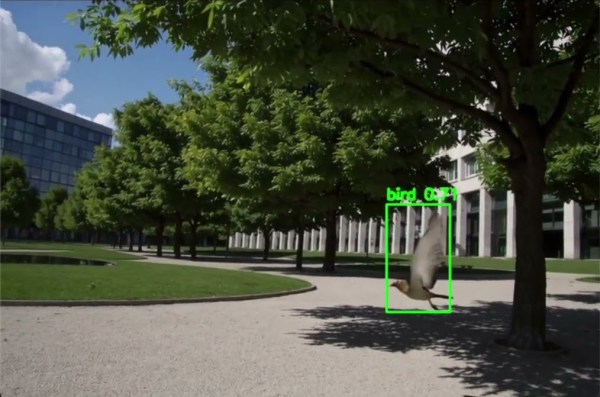
The small device is based on a Raspberry Pi 5 with an AI hat nested on top, and uses a wide-angle camera to keep an eagle-eyed lookout of a space like a garden or forest. It runs a few scripts in Python leveraging the OpenCV library, which is a widely available machine learning tool that allows users to easily interact with image recognition. When perched to view an outdoor area, it sends out an email notification to the user’s phone when it detects bird activity so that they can join the action swiftly if they happen to be doing other things at the time. The system also logs hourly bird-counts and creates a daily graph, helping users identify peak bird-watching times.

Right now the system can only detect the presence of birds in general, but he hopes to build future versions that can identify birds with more specificity, perhaps down to the species. Identifying birds by vision is certainly one viable way of going about this process, but one of our other favorite bird-watching tools was demonstrated by [Benn Jordan] which uses similar hardware but listens for bird calls rather than looking for the birds with a vision-based system.

Continue reading “A Bird Watching Assistant” →

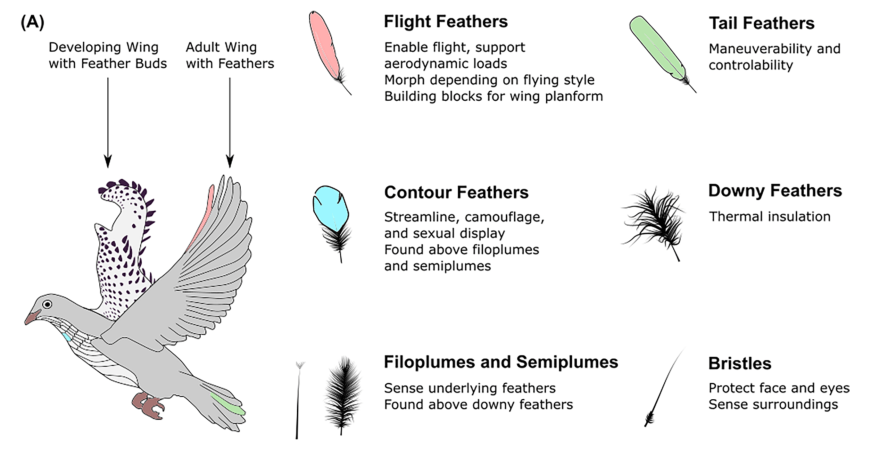
An image of a pigeon on the left and a breakdown of six of the different kind of feathers on the bird. The bird's right wing is white with black dots and has an arrow pointing to it saying, "Developing wing with feather buds." The left wing is grey with one feather highlighted in pink with the text "Adult wing with feathers" at the end of an arrow pointing to it. The six feather types on the right side of the image are flight feathers, illustrated in pink with the text "enable flight, support aerodynamic loads, morph depending on flying style, building blocks for wing planaform." In green, we have tail feathers and the text "Maneuverability and controlability." In blue are the contour feathers, accompanied by the text, "streamline, camouflage, and sexual display. Found above filoplumes and semiplumes." A black floofy branched structure shows us the downy feathers next to the text "thermal insulation." Filoplumes and semiplumes look to be both thin and bushy feathers in black with the text "Sense underlying feathers, found above downy feathers." Finally, we have a black, stick-like bristle feather with the text "Protect face and eyes, sense surroundings."

Feathers Are Fantastic, But Flummoxing For Engineers

Birds are pretty amazing creatures, and one of the most amazing things about them and their non-avian predecessors are feathers. Engineers and scientists are finding inspiration from them in surprising ways.

The light weight and high strength of feathers has inspired those who look to soar the skies, dating back at least as far as Ancient Greece, but the multifunctional nature of these marvels has led to advancements in photonics, thermal regulation, and acoustics. The water repellency of feathers has also led to interesting new applications in both food safety and water desalination beyond the obvious water repellent clothing.

Sebastian Hendrickx-Rodriguez, the lead researcher on a new paper about the structure of bird feathers states, “Our first instinct as engineers is often to change the material chemistry,” but feathers are made in thousands of varieties to achieve different advantageous outcomes from a single material, keratin. Being biological in nature also means feathers have a degree of self repair that human-made materials can only dream of. For now, some researchers are building biohybrid devices with real bird feathers, but as we continue our march toward manufacturing at smaller and smaller scales, perhaps our robots will sprout wings of their own. Evolution has a several billion year head start, so we may need to be a little patient with researchers.

Some birds really don’t appreciate Big Brother any more than we do. If you’re looking for some feathery inspiration for your next flying machine, how about covert feathers. And we’d be remiss not to look back at the Take Flight With Feather Contest that focused on the Adafruit board with the same name.

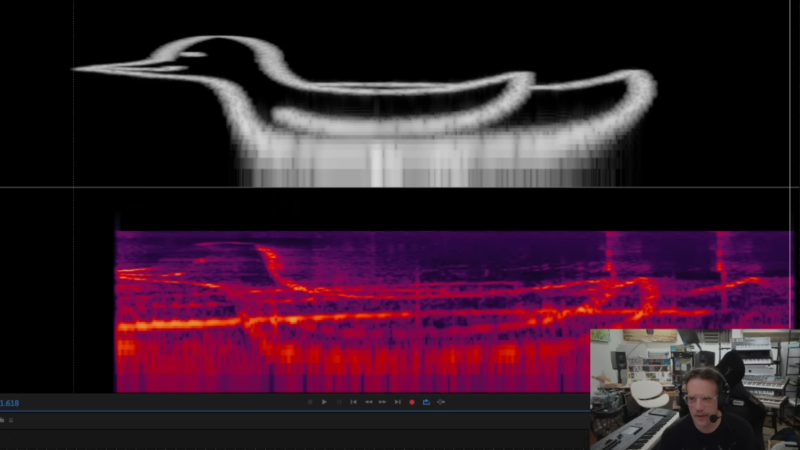
A rough, pixelated outline of a bird is shown in white in the top of the image. A red replica of this image is shown in a spectrogram in the lower half of the image. A smaller picture-in-picture display in the bottom right of the image shows a man sitting in a studio.

AVIF: The Avian Image Format

Humans have long admired the sound of birdsong, but to fully appreciate how technically amazing it is, you need an ultrasonic microphone. [Benn Jordan] recently created a video about using these microphones to analyze a collection of bird calls, even training a starling to repeat an image encoded in sound, and has some recommendations for amateurs wanting to get started in computational ornithology.

In the first part of the video, [Benn] set up automated ultrasonic recorders at home, made recordings in Florida and rural Georgia, and visited a starling named “The Mouth,” famous for his ability to mimic human sounds. As a demonstration of his abilities, [Benn] drew a simple bird shape in a spectrogram, converted it into sound, and played it for The Mouth several times. Initially, it didn’t seem that the starling would repeat it, but while he was analyzing his recordings later, [Benn] found the characteristic bird shape. The Mouth had been able to repeat it almost pitch-perfectly. It was in this analysis that the ultrasonic microphones showed their worth, since they were able to slow down the birds’ complex vocalizations enough to detect their complex structures without losing audio quality. Continue reading “AVIF: The Avian Image Format” →

Image

Small Feathers, Big Effects: Reducing Stall Speeds With Strips Of Plastic

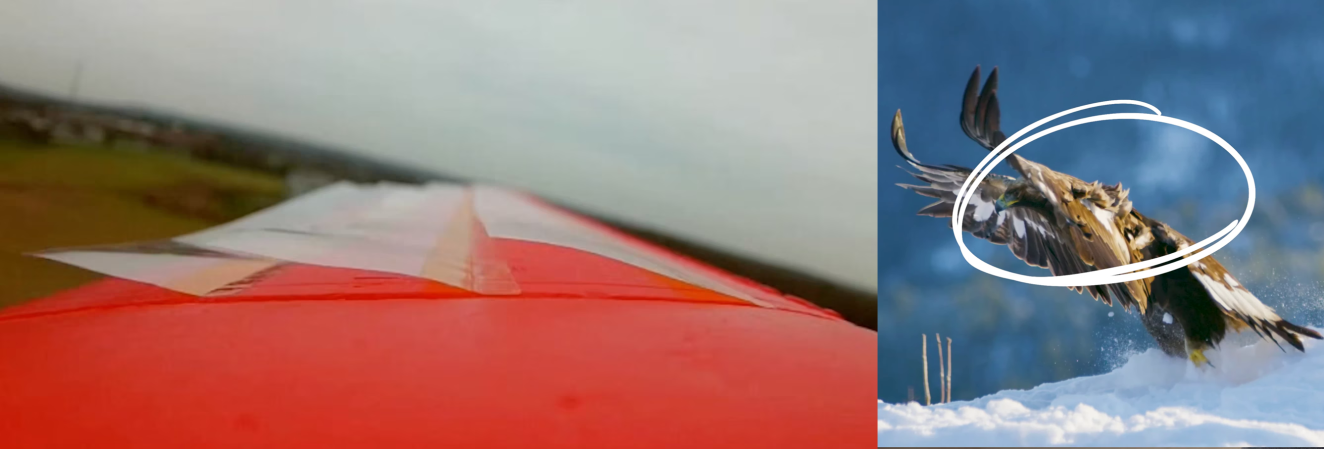
Birds have long been our inspiration for flight, and researchers at Princeton University have found a new trick in their arsenal: covert feathers. These small feathers on top of birds’ wings lay flat during normal flight but flare up in turbulence during landing. By attaching flexible plastic strips – “covert flaps” – to the top of a wing, the team has demonstrated impressive gains in aircraft performance at low speeds.

Wind tunnel tests and RC aircraft trials revealed a fascinating two-part mechanism. The front flaps interact with the turbulent shear layer, keeping it close to the wing surface, while the rear flap create a “pressure dam” that prevents high-pressure air from moving forward. The result? Up to 15% increase in lift and 13% reduction in drag at low speeds. Unfortunately the main body of the paper is behind a paywall, but video and abstract is still fascinating.

This innovation could be particularly valuable during takeoff and landing – phases where even a brief stall could spell disaster. The concept shares similarities with leading-edge slats found on STOL aircraft and fighter jets, which help maintain control at high angles of attack. Imitating feathers on aircraft wings can have some interesting applications, like improving control redundancy and efficiency.

Continue reading “Small Feathers, Big Effects: Reducing Stall Speeds With Strips Of Plastic” →