
Image

3D-Printed Filter Removes Most Microplastics From Water

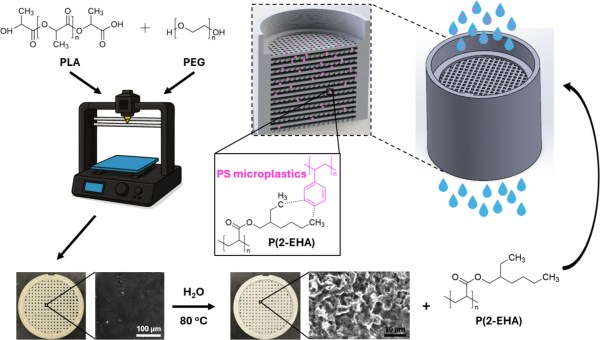
With the rise of synthetic polymers in everywhere from clothing, packaging and beyond, we have also seen a corresponding rise in fragments of these polymers in the environment. These micro- and nanoplastics (MNPs) come in a wide variety of sizes, but have in common that they do not break down very easily, leaving filtration as an important way to keep them out of our potable water sources. A recent paper by [Ethan A. Crawford] et al. in  Separation and Purification Technology details a way to use a low-cost, 3D-printed filtration mesh to filter out up to 90% of MNPs using their prototype.

This prototype uses a multi-layer filtration system printed in PLA, creating a flow-through system in which polyethylene glycol (PEG) acts as a sacrificial additive to the PLA. Whereas creating the fine pores required for filtration of MNPs is impossible using FDM printing, the spheres of PEG that form inside the printed filter can be subsequently etched away using nothing but hot (80°C) water, leaving behind a porous surface capable of trapping fine particles.

These pores are characterized in the paper, with the PLA-PEG10 sample showing the best porous structure while maintaining structural integrity of the PLA material. With 20 layers of these filters a filtration efficiency of 90% was achieved, though as the authors note aspects like improving the system and potential reusability still have to be investigated.

We have previously looked at MNPs, including how little we know about how many of them really are inside our bodies right now, and how lab gloves may be contaminating test results.
Image

These 3D Printed Biocatalytic Fibers Scrub Carbon Dioxide

On today’s episode of “What If?” — what if the Apollo 13 astronauts had a 3D printer? Well, for one thing, they may have been able to avoid all the futzing with duct tape and procedure list covers to jury rig the lithium hydroxide filters, at least if they’d known about these 3D printed enzymatic CO2 filters. And time travel…they probably would have needed that too.

A bit of a stretch, yes, but environmental CO2 scrubbing is at least one use case for what [Jialong Shen] et al from the Textile Engineering Department at North Carolina State University have developed here. The star of the show isn’t so much the 3D printing — although squirting out a bio-compatible aerogel and cross-linking it with UV light on the fly is pretty cool. Rather, the key to developing a CO2-scrubbing textile is carbonic anhydrase, or CA, a ubiquitous enzyme that’s central to maintaining acid-base homeostasis. CA is a neat little enzyme that coordinates a zinc ion in its active site and efficiently catalyzes the addition of water to carbon dioxide to produce bicarbonate and hydrogen ions. A single CA molecule can catalyze the conversion of up to a million CO2 molecules per second, making it very attractive as a CO2 filter.

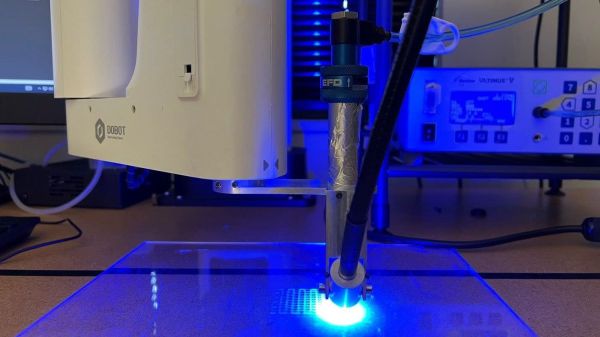
In the current work, an aerogel of poly(ethylene glycol) diacrylate/poly(ethylene oxide) (PEG-DA/EO) was used to entrap CA molecules, holding them in place in a polymer matrix to protect them from denaturation while still allowing access to gaseous CO2. The un-linked polymers were mixed with photoinitiators and a solution of carbonic anhydrase and extruded through a fine nozzle with a syringe pump. The resulting thread was blasted with 280–450 nm UV light, curing the thread instantly. The thread is either wound up as a mono-filament for later weaving or printed directly into a 2D grid.

The filament proved to be quite good at CO2 capture, managing to scavenge 24% of the gas from a mixture passed over it. What’s more, the entrapped enzyme appears to be quite stable, surviving washes with various solvents and physical disruptions like twisting and bending. It’s an exciting development in catalytic textiles, and besides its obvious environmental uses, something like this could make cheap, industrial-scale bioreactors easier to build and run.

Photo credits: [Sen Zhang] and [Jialong Shen], NC State; [Rachel Boyd], Spectrum News 1

[via Phys.org]

Image

Injection-Molded Glass Breakthrough Shatters Ceiling Of Work Methods

Glass is one of humanity’s oldest materials, and it is still used widely for everything from drinking vessels and packaging to optics and communications. Unfortunately, the methods for working with glass are stuck in the past. Most methods require a lot of high heat in the range of 1500 °C to 2000 °C, and they’re all limited in the complexity of shapes that can be made.

As far as making shapes goes, glass can be blown and molten glass pressed into molds. Glass can also be ground, etched, or cast in a kiln. Glass would be fantastic for many applications if it weren’t for the whole limited geometry thing. Because of the limitations of forming glass, some optic lenses are made with polymers, even though glass has better optical characteristics.

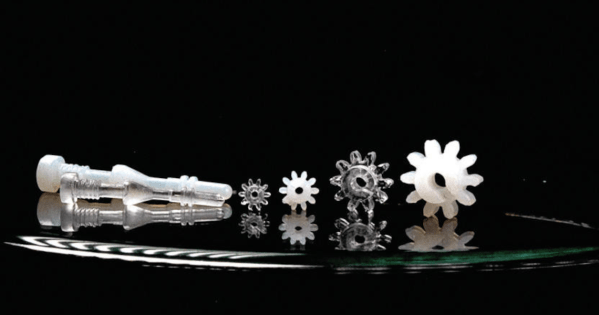
Ideally, glass could be injection molded like plastic. The benefits of this would be twofold: more intricate shapes would be possible, and they would have a much faster manufacturing time. Well, the wait is over. Researchers at Germany’s University of Freiburg have figured out a way to apply injection molding to glass. And it’s not just any glass — they’ve made highly-quality, transparent fused quartz glass, and they did it at lower temperatures than traditional methods. The team used x-ray diffraction to verify that the glass is amorphous and free of crystals, and were able to confirm its optical transparency three ways — light microscopy, UV-visible, and infrared measurements. All it revealed was a tiny bit of dust, which is to be expected outside of a clean room.

Continue reading “Injection-Molded Glass Breakthrough Shatters Ceiling Of Work Methods” →









