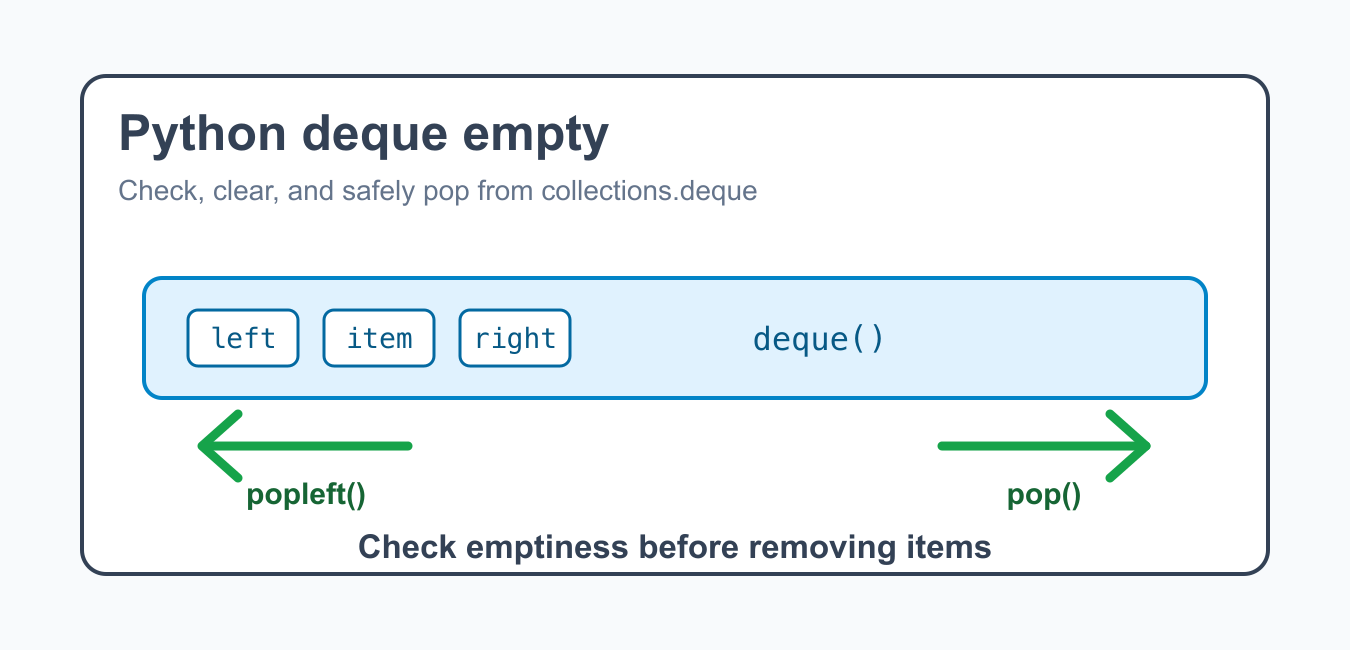
Quick answer: A Python deque is empty when it contains no items. Check it with if not queue or len(queue) == 0 before peeking at queue[0] or queue[-1], and before calling popleft() or pop(). If the program should wait for work rather than raise an error, use a blocking queue abstraction instead of treating an empty deque as a transient failure.
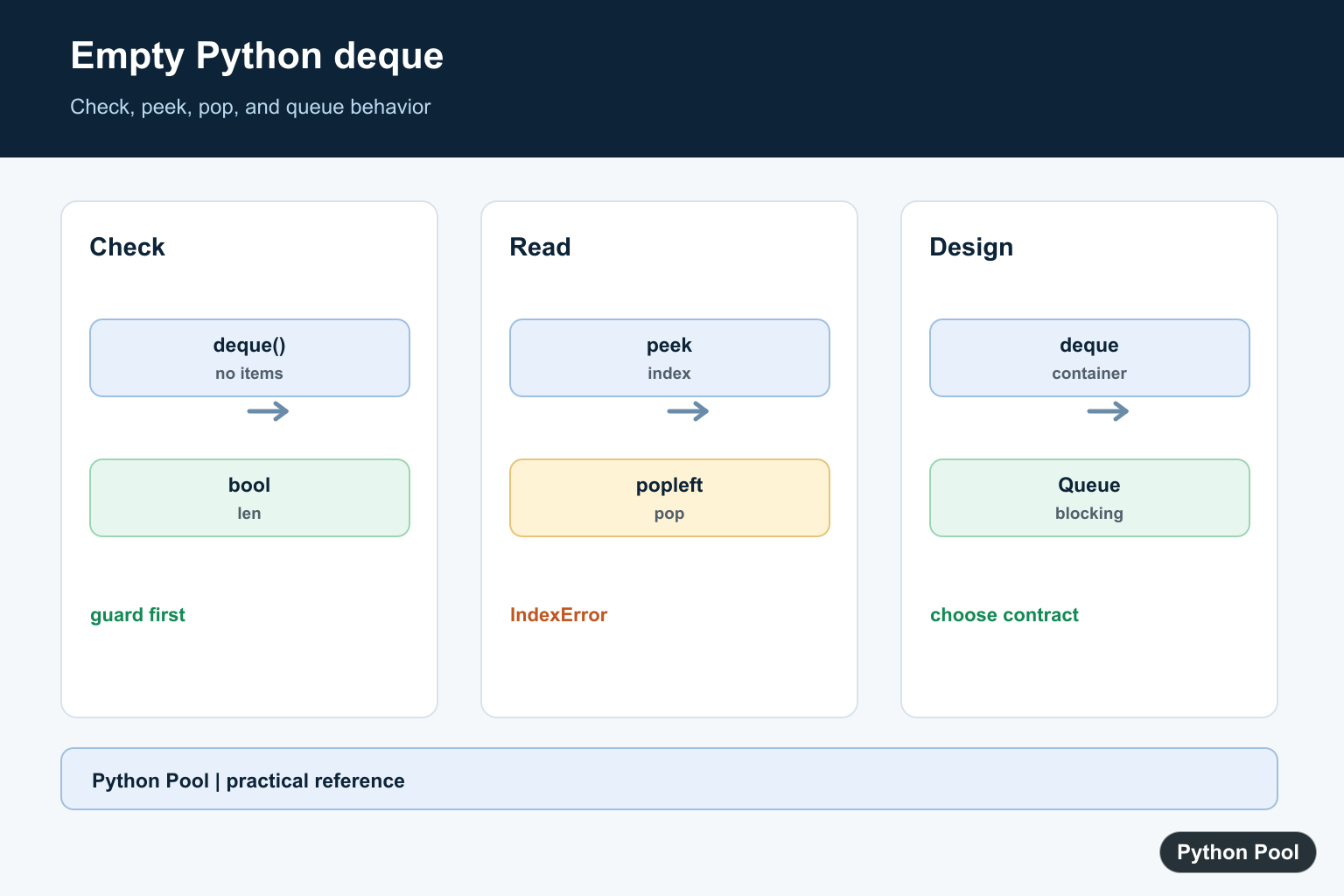
A Python deque is a double-ended queue from the collections module. It is useful when you need fast appends and pops from either side of a sequence.
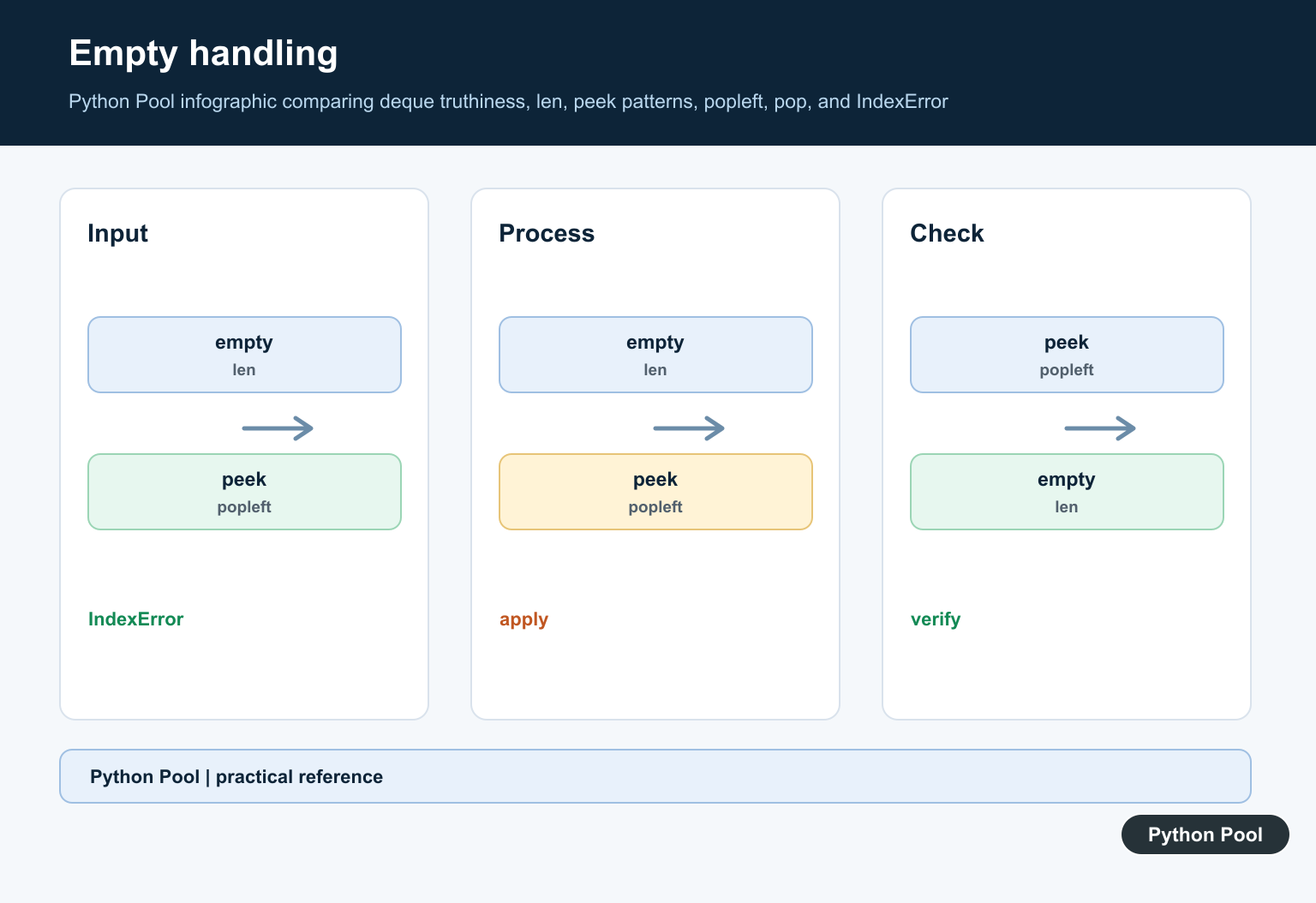
Empty deque handling matters because methods such as pop() and popleft() raise IndexError when there is no item to remove. A safe queue workflow checks the deque before removing an item or catches the exception deliberately.
This is especially important in queue-style code, where an empty state is normal rather than a bug. A worker may finish all tasks, a recent-history buffer may be cleared, or a search process may run out of nodes to inspect.
The official Python deque documentation describes the full API. For related Python organization topics, see the Python collections guide and the class vs module guide.
Create An Empty deque
Create a deque by importing it from collections. An empty deque has length zero and is false in a boolean check.
from collections import deque

items = deque()

print(items)
print(len(items))
print(bool(items))
This makes if items: a concise way to check whether the deque currently contains anything.
The same truth-value behavior applies after appending, popping, and clearing. It gives you a readable guard without repeatedly comparing len(items) to zero.
Check Before Removing
Use a boolean check before popleft() when empty queues are expected.
from collections import deque

tasks = deque(["build", "test"])

while tasks:
    task = tasks.popleft()
    print("Running:", task)

print("Queue empty")
This pattern is common in simple task queues. The loop stops cleanly when the deque has no more work.
Use this when the queue is owned by the current loop. If another thread or process can change the queue at the same time, you need synchronization or a thread-safe queue from the queue module instead.
Handle Empty popleft Safely
If an empty deque is unusual but possible, catch IndexError at the removal point.
from collections import deque

messages = deque()

try:
    message = messages.popleft()
except IndexError:
    message = None

print(message)
This keeps the failure local and makes the fallback explicit. Avoid catching broad exceptions around queue handling.
Catching IndexError is better than catching all exceptions because it documents the exact condition you expect. Other errors should still be visible during debugging.
Write A Safe Helper
A small helper can return a default value instead of raising when the deque is empty.
from collections import deque

def pop_left_or_default(items, default=None):
    if items:
        return items.popleft()
    return default

numbers = deque([10])

print(pop_left_or_default(numbers))
print(pop_left_or_default(numbers, "empty"))
This is useful when several parts of the program need the same safe behavior. Keep the helper name specific so readers know which side it removes from.
A helper also makes defaults consistent. One caller should not return None while another returns an empty string unless there is a clear reason.
Clear A deque
Use clear() when you want to keep the same deque object but remove all items.
from collections import deque

history = deque(["open", "edit", "save"])

history.clear()

print(history)
print(len(history))
Clearing is different from assigning a new deque. Other references to the same object will see that it is now empty.
This behavior is useful when a deque is shared inside an object. Clearing preserves the object identity while resetting the stored items.
Use maxlen For Bounded Queues
A deque with maxlen automatically drops old items when new items exceed the limit.
from collections import deque

recent = deque(maxlen=3)

for value in [1, 2, 3, 4, 5]:
    recent.append(value)
    print(list(recent))

print("Final:", list(recent))
This is helpful for recent history, rolling logs, fixed-size buffers, and simple caches. A bounded deque can become empty after clear(), but it keeps the same maximum length.
With maxlen, appending to a full deque does not raise an error. It silently drops the oldest item from the opposite side, so only use it when that automatic eviction is desired.
Best Practices
Use deque when both ends matter or when frequent left-side pops would make a list inefficient. Use a normal list when you only append and iterate, because lists are simpler and familiar.
Do not confuse deque with a full worker-queue system. A deque is a fast container, but it does not provide task tracking, blocking reads, or cross-process coordination by itself. For producer and consumer threads, compare it with queue.Queue before choosing.
Also keep the element type consistent. Mixing task objects, strings, and sentinel values in the same deque can make empty handling harder to reason about. Use clear sentinel names when a special value means “stop”.
Choose one empty-handling style per code path. Use a loop condition for normal queue draining, a helper for repeated safe pops, or try/except IndexError when an empty pop is exceptional.
The reliable pattern is to check emptiness before removing from a deque unless the exception is part of the design. That keeps queue code predictable and prevents avoidable IndexError crashes.
Create And Check A Deque
collections.deque supports efficient operations at both ends. Its truth value is false when it has no items, which makes a simple guard readable in queue and stack code.
from collections import deque

queue = deque()
if not queue:
    print("queue is empty")
queue.append("task")
print(queue, len(queue))
Peek Without Removing
Indexing a deque does not remove the item, but an empty deque has no valid index. Check first and decide what the empty case means for the caller rather than returning a made-up sentinel that could be confused with real data.
from collections import deque


def peek_left(queue):
    if not queue:
        return None
    return queue[0]

items = deque(["first", "second"])
print(peek_left(items))
print(items)
Pop Safely Or Raise Clearly
popleft and pop raise IndexError on an empty deque. A helper can return a sentinel, raise a domain-specific error, or require the caller to guard the operation. Pick one contract and document it.
from collections import deque


def take_left(queue):
    if not queue:
        raise LookupError("no task is available")
    return queue.popleft()

items = deque(["task"])
print(take_left(items))
try:
    take_left(items)
except LookupError as error:
    print(error)
Use The Right Abstraction For Waiting
A deque is an in-memory container and does not block when empty. Worker systems that wait for producers should use queue.Queue or another synchronization primitive, while a deque is appropriate when the caller controls the processing loop.
from collections import deque

work = deque([1, 2, 3])
while work:
    item = work.popleft()
    print("processing", item)
print("done")
Python’s official deque documentation defines end operations and their empty behavior; queue.Queue is the better fit for blocking producer-consumer workflows. Related references include queue peeking, BFS with deque, and list pop behavior.
For related queue operations, compare queue peeking, BFS with deque, and list pop behavior when choosing an empty-container contract.
Frequently Asked Questions
How do I check whether a deque is empty?
Use if not queue or len(queue) == 0 before reading or removing an item.
How do I peek at a deque safely?
Check the deque first, then read queue[0] for the left end or queue[-1] for the right end.
What happens when popleft is called on an empty deque?
It raises IndexError, so handle the empty case or use a blocking queue abstraction when waiting is required.
Why use deque instead of a list for a queue?
deque provides efficient append and removal operations at both ends, while list.pop(0) shifts the remaining items.
