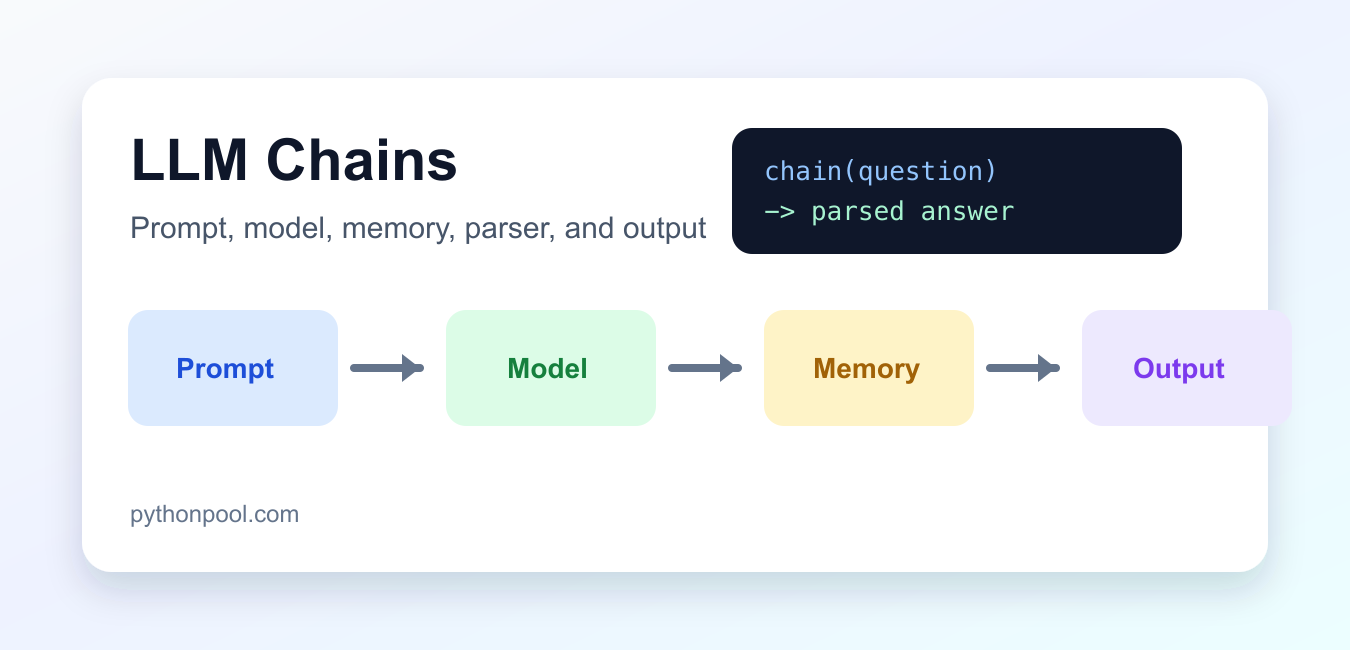
Quick answer: An LLM chain is a sequence of explicit application steps: validate input, build a prompt, call a model, parse the returned content, validate the result, and handle failure. Treat model output and retrieved context as untrusted data, and keep provider, prompt, state, and business logic boundaries testable.
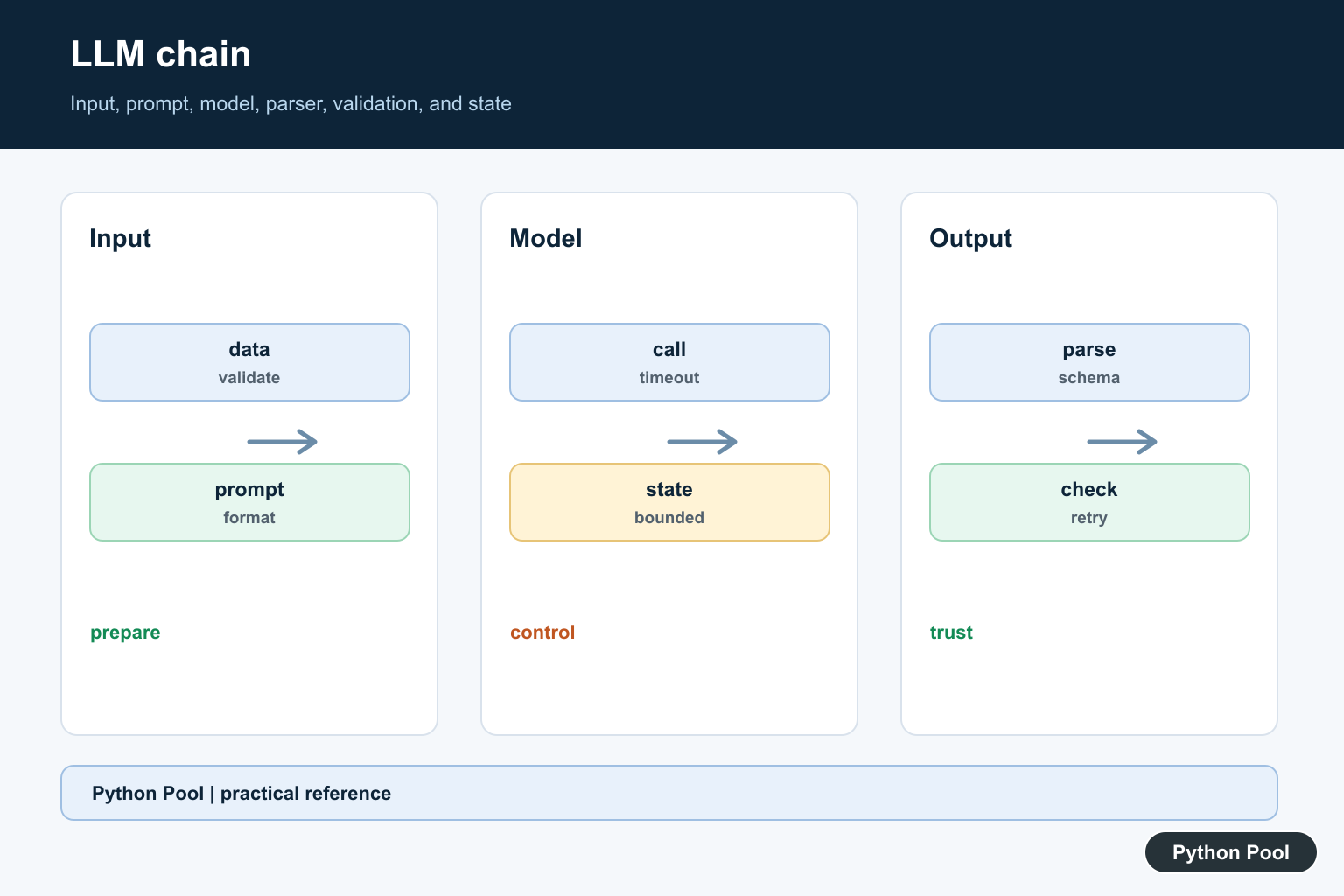
An LLM chain is an ordered workflow that turns an input into a model-ready prompt, calls a language model, and then converts the model response into a useful output. The chain may also include memory, retrieval, validation, logging, or fallback steps, but the core idea is simple: each step has one job and passes a clear result to the next step.
Chains are useful because real applications need more than a single prompt string. A support bot may add conversation history. A data assistant may require structured JSON. A documentation helper may retrieve context before asking the model. By splitting those responsibilities into steps, the application becomes easier to test and safer to change.
The key is to treat the chain as application code, not as a magic prompt. Each step should have inputs, outputs, and a clear failure mode. If prompt formatting fails, report the missing field. If the model times out, retry or show a controlled error. If parsing fails, keep the raw response for debugging and avoid passing bad data downstream.
Current references include the LangChain overview, LangChain models guide, short-term memory guide, structured output guide, and Python json documentation.
Format A Prompt
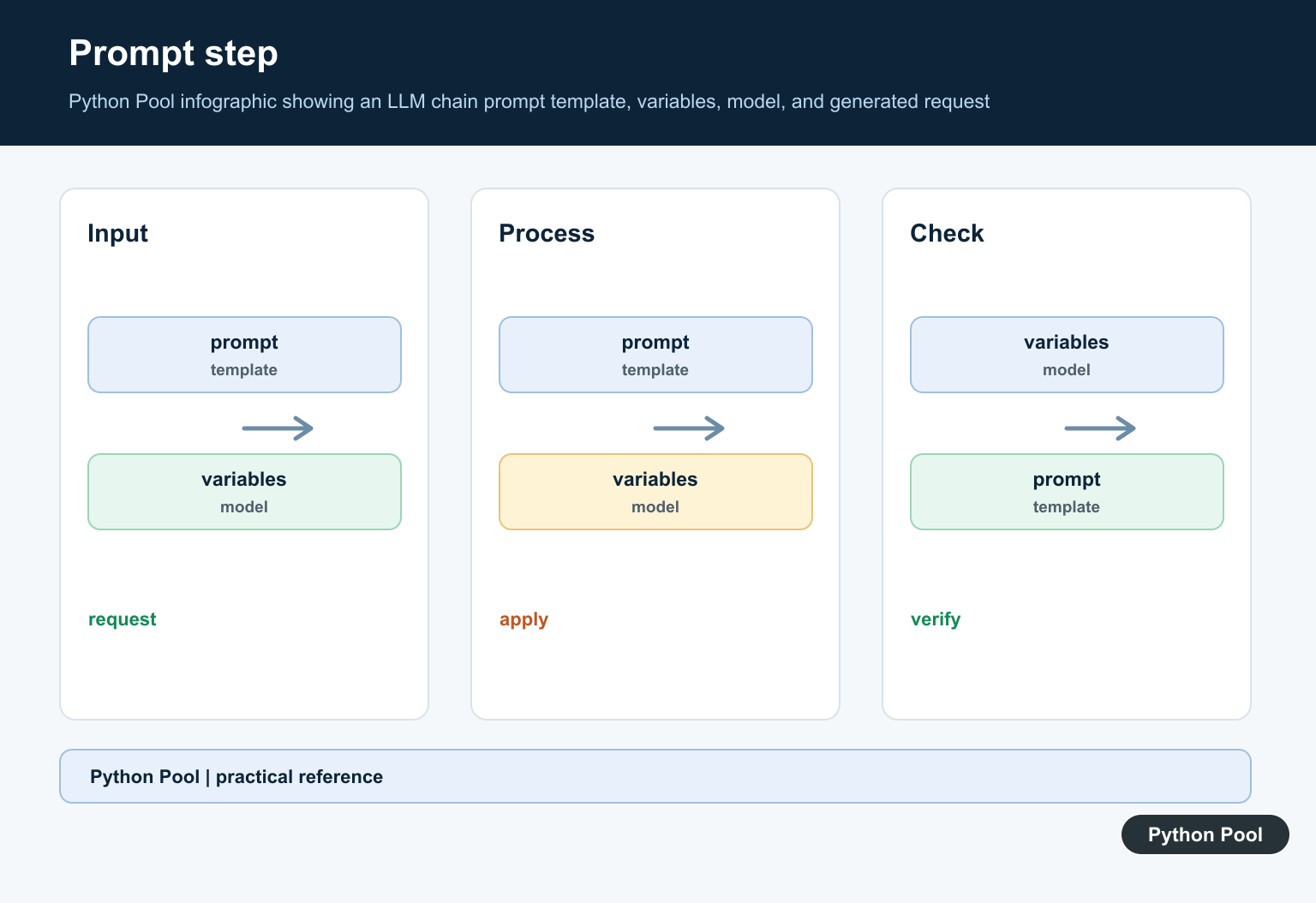
The first step in many chains is prompt formatting. Keep the template small enough to review and make each input field explicit.
template = "Summarize {topic} for {audience} in three bullets."

prompt = template.format(
    topic="unit tests",
    audience="new Python developers",
)

print(prompt)
This is the same idea used by prompt-template tools: accept trusted inputs, build the prompt, and pass that prompt to the model step.
Separate The Model Call
Keep the model call behind a function. That makes the chain easier to test with a local stub before connecting a real provider.
def fake_model(prompt):
    return "Unit tests check behavior, catch regressions, and support refactoring."

prompt = "Explain unit tests in one sentence."
response = fake_model(prompt)

print(response)
In production, this function would call a model provider or library. The rest of the chain should not need to know which provider is used.
Parse Structured Output
Many applications need a dictionary, list, score, or decision instead of free-form text. Parse the response and validate the expected fields before using it.
import json

raw_response = '{"title": "Unit tests", "priority": 2}'
parsed = json.loads(raw_response)

print(parsed["title"])
print(parsed["priority"])
Structured output is easier to store, filter, and test. If parsing fails, retry with a clearer prompt or route the case to manual review.
Add Short-Term Memory
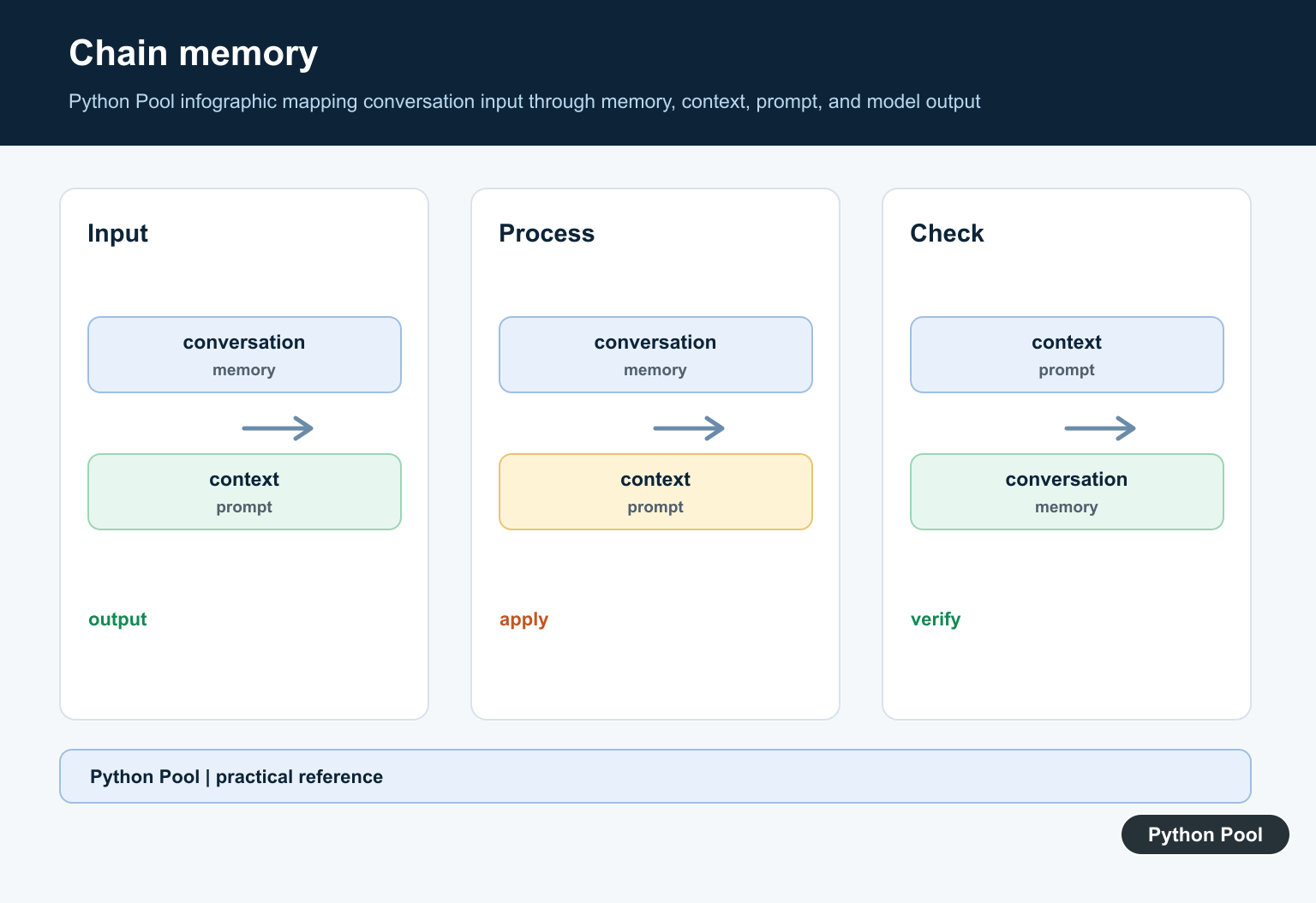
Conversation memory is a list of recent messages passed into the prompt-building step. Keep it short enough that the prompt stays focused.
history = []

def remember(role, content):
    history.append({"role": role, "content": content})
    return history[-4:]

remember("user", "What is an LLM chain?")
remember("assistant", "It is an ordered model workflow.")

print(remember("user", "Why split the steps?"))
Memory should help the next answer, not preserve everything forever. Long histories increase cost and can distract the model from the current task.
Compose The Chain
A small chain can be plain Python functions. This keeps the data flow visible and gives you obvious places to add tests.
def build_prompt(question):
    return f"Answer clearly: {question}"

def call_model(prompt):
    return f"answer: {prompt.replace('Answer clearly: ', '')}"

def parse_answer(text):
    prefix = "answer: "
    return {"answer": text.removeprefix(prefix)}

def chain(question):
    prompt = build_prompt(question)
    raw = call_model(prompt)
    return parse_answer(raw)

print(chain("What does a chain do?"))
Frameworks can reduce boilerplate, but the same boundaries still matter: prompt, model call, parser, memory, and error handling.
Validate The Output
Before returning a response to a user or saving it, check that required fields exist and have expected types. This prevents later code from treating a malformed model response as valid data.
def validate_answer(payload):
    required_keys = {"answer", "confidence"}
    missing = required_keys.difference(payload)
    if missing:
        raise ValueError(f"missing fields: {sorted(missing)}")
    return payload

result = {"answer": "Use small tested steps.", "confidence": 0.84}
print(validate_answer(result))
Validation is one of the most important chain steps. Models can be useful and still return output that needs checking before it drives application behavior.
For user-facing systems, add a final policy step that decides whether the answer is complete enough to show. That step can check confidence, required citations, output length, or whether a fallback message should be used. This keeps the model response from becoming the only decision point in the application.
Practical Checklist
Start every LLM chain with a clear contract. Decide what input the chain accepts, what prompt it builds, which model step is allowed to do, and what shape the output must have. To supply a chain with a reproducible open-model family and intermediate checkpoints, see Pythia by EleutherAI: Open LLM Suite and Python Examples.
Keep memory small, log enough metadata to debug failures, and test each step without calling a live model. A fake model function is often enough to prove that prompt formatting, parsing, and validation behave correctly.
Use a framework when it removes real plumbing, but keep the chain understandable. The best chain is not the longest one; it is the one where each step has a clear reason to exist and a failure path you can handle.
Make The Input Contract Explicit
Validate length, required fields, allowed values, and sensitive data before constructing a prompt. A chain should know what it accepts and what it refuses, rather than relying on a model to discover malformed or unauthorized input.
Separate Prompt And Model Calls
Keep prompt construction independent from the model client so templates can be tested with fixed inputs and the provider can be changed without rewriting business rules. Record the model and configuration needed to reproduce a run, but never log credentials or unnecessary personal data.
Parse Structured Output
If downstream code needs JSON or typed fields, request a defined structure and parse it with a real parser. Check required keys, types, ranges, and allowed values. A model saying that output is valid is not the same as application validation.
Keep State Bounded And Deliberate
Conversation history or short-term memory should have a retention limit, reset behavior, and privacy policy. Summarize or select relevant state rather than sending an unbounded transcript into every request. Make state a visible input to the chain so tests can reproduce it.
Handle Retries, Timeouts, And Costs
Network failures, rate limits, malformed output, and provider errors need distinct policies. Set timeouts, bound retries, use backoff where appropriate, and avoid retrying an operation that may have side effects without idempotency. Track latency, token or usage cost, and failure reason without exposing content.
Evaluate With Fixtures
Use deterministic prompt and response fixtures to test parsing, validation, refusal paths, empty output, malformed output, and unexpected tool data. Keep model-quality evaluation separate from unit tests, and review prompt changes as code changes because they alter the chain’s behavior.
The LangChain Expression Language documentation describes composable runnable steps. The structured-output guidance explains schema-constrained model results. Related guidance includes safe logging and fixture tests.
For related application boundaries, compare dependency checks, JSON responses, and safe logging when making a model workflow observable.
Frequently Asked Questions
What is an LLM chain?
It is a sequence of steps that prepares input, calls a language model, and transforms or validates the returned output for a downstream task.
What are the main parts of an LLM chain?
Common parts are input validation, prompt construction, model invocation, output parsing, optional state, and application-level validation.
How should an LLM chain handle invalid output?
Treat model text as untrusted input, parse it with a defined schema, validate required fields, and return a controlled error or retry according to an explicit policy.
Should an LLM chain store conversation memory?
Only when the task needs it; define retention, size, privacy, and reset behavior rather than passing an unbounded conversation into every request.
