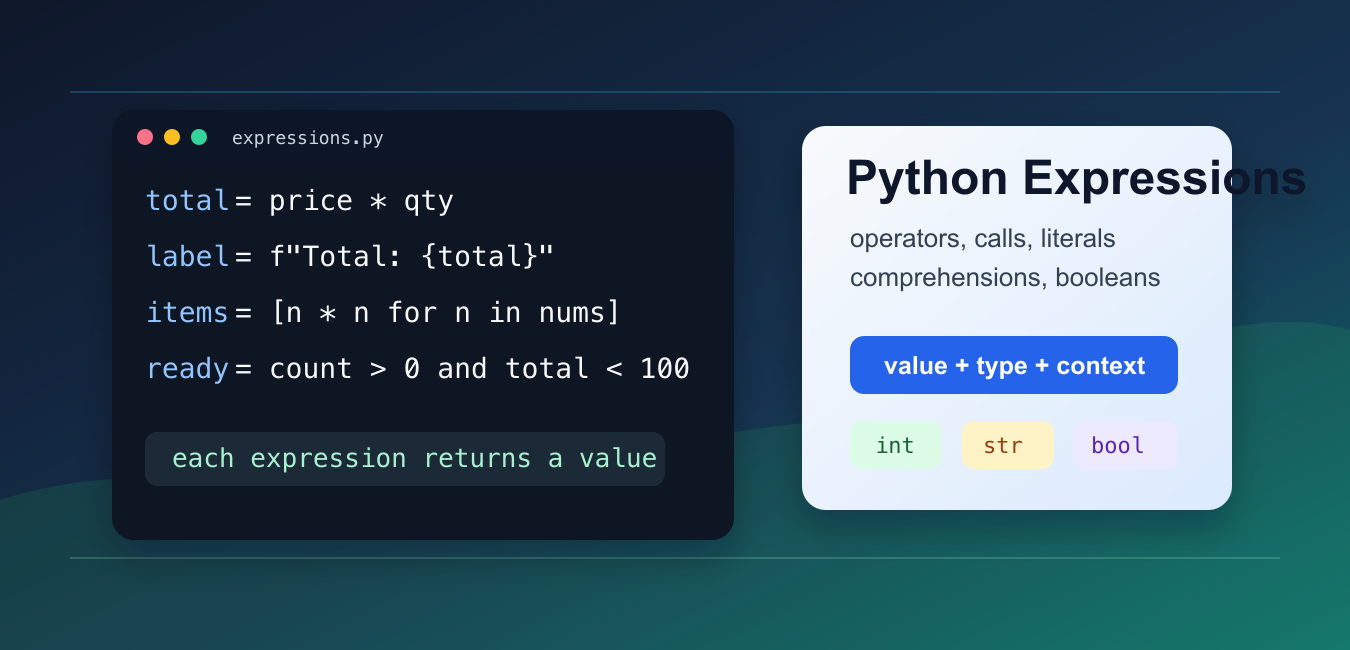
Quick answer: A Python expression evaluates to a value. Literals, names, operators, calls, comprehensions, attribute access, conditional expressions, and assignment expressions combine according to precedence, associativity, and short-circuit rules.
A Python expression is any piece of code that produces a value. Literals, arithmetic, comparisons, function calls, attribute access, indexing, conditional expressions, and comprehensions are all expressions.
The core references are Python’s expression reference, the literal reference, and the if statement documentation.
The simplest way to reason about an expression is to ask three questions: what value does it return, what type does that value have, and when is it evaluated? Those questions catch most beginner mistakes.
Expressions are different from statements. A statement performs an action such as assigning a name, importing a module, defining a function, or starting a loop. Many statements contain expressions inside them.
For example, the right side of an assignment is an expression, while the assignment itself is a statement. The condition inside an if statement is an expression. The iterable in a for loop is an expression. Seeing that split helps you place code in the correct form. For in-place-style augmented assignment and its behavior on mutable versus immutable values, continue with Python += Operator Explained Clearly.
An expression can be simple or nested. Python evaluates the inner pieces first, applies operators and calls, then passes the final result to the surrounding syntax. If you can describe each step in plain language, the expression is usually clear enough.
Start With Literal Expressions
A literal writes a value directly in code. Numbers, strings, lists, tuples, dictionaries, sets, booleans, and None can all be written as literals.
count = 4
price = 19.5
name = "Ada"
tags = ["python", "data"]
settings = {"debug": False, "retries": 3}

print(type(count).__name__)
print(type(price).__name__)
print(type(tags).__name__)
print(settings["retries"])
Literal expressions are evaluated when Python reaches that line. Mutable literals such as lists and dictionaries create fresh objects at runtime.
Use type() while learning to confirm the result you are actually handling. In production code, prefer clear names, tests, and documented inputs over constant type printing.
Combine Values With Operators
Operators build new expressions from smaller expressions. Arithmetic operators work on numbers, while some operators also support strings, lists, sets, and other objects.
subtotal = 35
tax_rate = 0.08
shipping = 6

total = subtotal + (subtotal * tax_rate) + shipping
is_large_order = total >= 40

print(round(total, 2))
print(is_large_order)
Parentheses make evaluation order clear. Python already has precedence rules, but explicit grouping is easier to read when a calculation matters.
Comparison expressions return booleans. Those boolean results can be used in if statements, filters, comprehensions, and validation checks.
Call Functions Inside Expressions
A function call is also an expression. It evaluates its arguments first, runs the function, and returns the function result.
def normalize(text):
    return text.strip().lower()

raw_names = [" Ada ", "GRACE", " Linus "]
clean_names = [normalize(item) for item in raw_names]

print(clean_names)
print(max(len(item) for item in clean_names))
This example combines calls, a list comprehension, and a generator expression. Each part returns a value that becomes input for the next part.
When an expression becomes hard to read, split it into a few named steps. That makes debugging easier without changing the final behavior.
Use Conditional Expressions Carefully
Python supports inline conditional expressions with A if condition else B. They are best for short choices, not long branching logic.
score = 84
status = "pass" if score >= 60 else "retry"
message = f"Result: {status}"

print(message)

discount = 10 if score >= 90 else 0
print(discount)
Only one of the two result expressions is evaluated. That matters when a branch calls a function, reads a file, or does expensive work.
If the condition or either result is complex, use a normal if block instead. The extra lines usually make intent clearer.
Understand Boolean Expressions
Boolean expressions often use and, or, and not. Python evaluates these from left to right and may stop early when the answer is already known.
username = "pythonpool"
attempts = 2
locked = False

can_login = username and attempts < 3 and not locked
fallback_name = username or "guest"

print(bool(can_login))
print(fallback_name)
and and or return one of their operands, not always a plain boolean. Wrap with bool() when you specifically need True or False.
Short-circuit behavior is useful for guard checks, but avoid hiding important side effects inside boolean expressions.
Build Collections With Comprehensions
Comprehensions are expression forms that build collections from an iterable. They are concise when the mapping and filter are both simple.
numbers = [1, 2, 3, 4, 5, 6]

squares = [item * item for item in numbers]
even_squares = [item * item for item in numbers if item % 2 == 0]
lookup = {item: item * item for item in numbers}

print(squares)
print(even_squares)
print(lookup[4])
List comprehensions build lists, set comprehensions build sets, dictionary comprehensions build dictionaries, and generator expressions produce values lazily.
Use comprehensions when they read naturally from left to right. For nested loops or multiple conditions, a normal loop is often easier to maintain.
The practical rule is simple: every expression returns a value, and that value has a type. Once you identify those two facts, most syntax choices become easier to explain.
For clean code, keep expressions focused. Name intermediate results when they carry meaning, use parentheses for grouping, and write tests for expressions that decide important behavior.
Also remember that expression results can be reused only if you store them or pass them onward. If a call returns a value and you ignore it, Python still runs the call, but the returned result is discarded. That is fine for logging or printing, but it is a sign to slow down when the returned result drives later work.
Separate Expressions From Statements
An expression produces a value, while a statement controls an action such as assignment, import, or flow. Some statements contain expressions, and understanding that boundary helps explain evaluation and return values.
Use Parentheses For Intent
Python’s precedence rules are precise, but readers should not have to reconstruct them for a security check, financial formula, or complex boolean condition. Parentheses make the intended grouping executable documentation.
Know Short-circuit Behavior
and and or may return one of their operands rather than a Boolean, and they can skip the right side. Use this for deliberate guards, not when a skipped function call would be surprising or required.
Understand Calls And Side Effects
A function call is an expression but may mutate state, perform I/O, or raise. Avoid burying expensive or stateful calls inside long conditions where their order is hard to review.
Use Comprehensions Carefully
List, set, and dictionary comprehensions express mapping and filtering compactly. Keep them readable, avoid hidden side effects, and use a regular loop when multiple steps or error handling are needed.
Test Evaluation Boundaries
Test precedence, short-circuit cases, chained comparisons, generator consumption, conditional branches, assignment expressions, exceptions, and side effects. Prefer assertions about values and observable calls rather than implementation guesses.
Use the official Python expressions reference for precedence and evaluation rules. Related Python Pool references include tests and list expressions.
For readable expression logic, compare precedence tests, comprehensions, and string expressions before shortening a condition.
Frequently Asked Questions
What is a Python expression?
An expression is syntax Python evaluates to produce a value, such as a literal, variable reference, operation, function call, comprehension, or conditional expression.
How does Python decide operator order?
Parentheses, the language’s precedence rules, and associativity determine grouping; use parentheses when the intended grouping is important to readers.
What is short-circuit evaluation?
and and or may skip evaluating their right operand when the left side determines the result, while chained comparisons evaluate with defined comparison semantics.
What is an assignment expression?
The := operator assigns a value within an expression, but it should be used where it improves clarity and should not replace a simple separate assignment.
