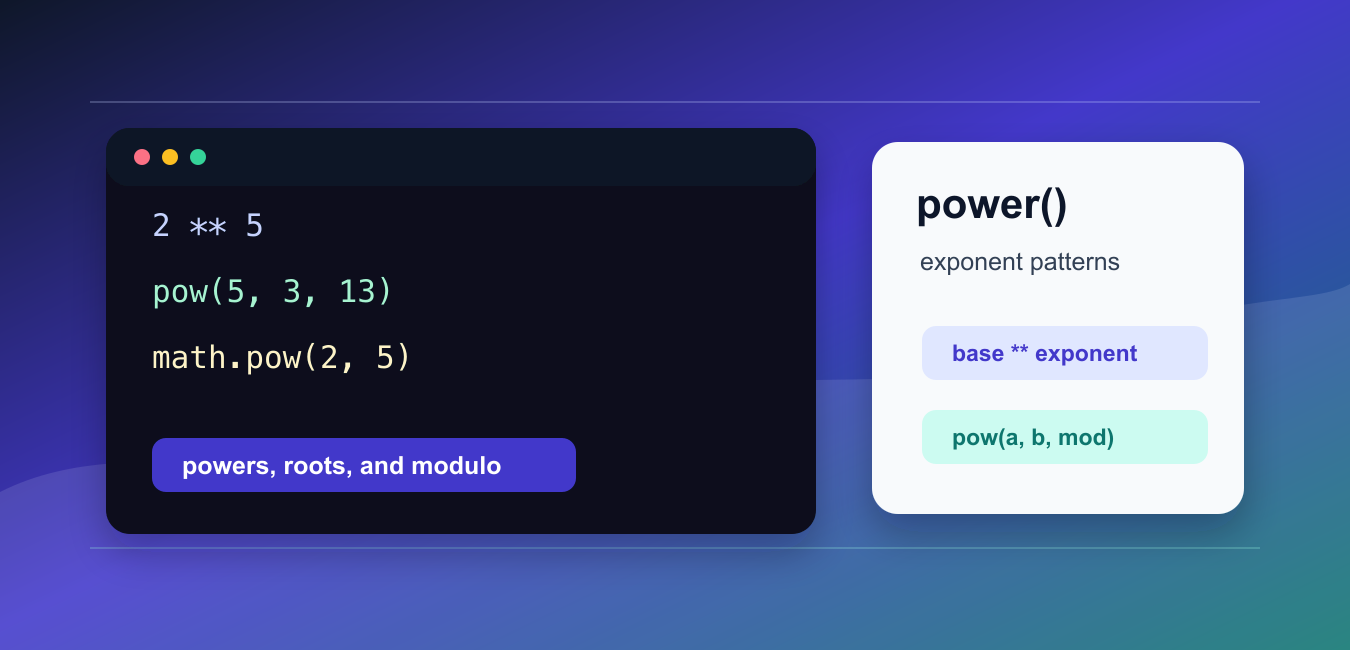
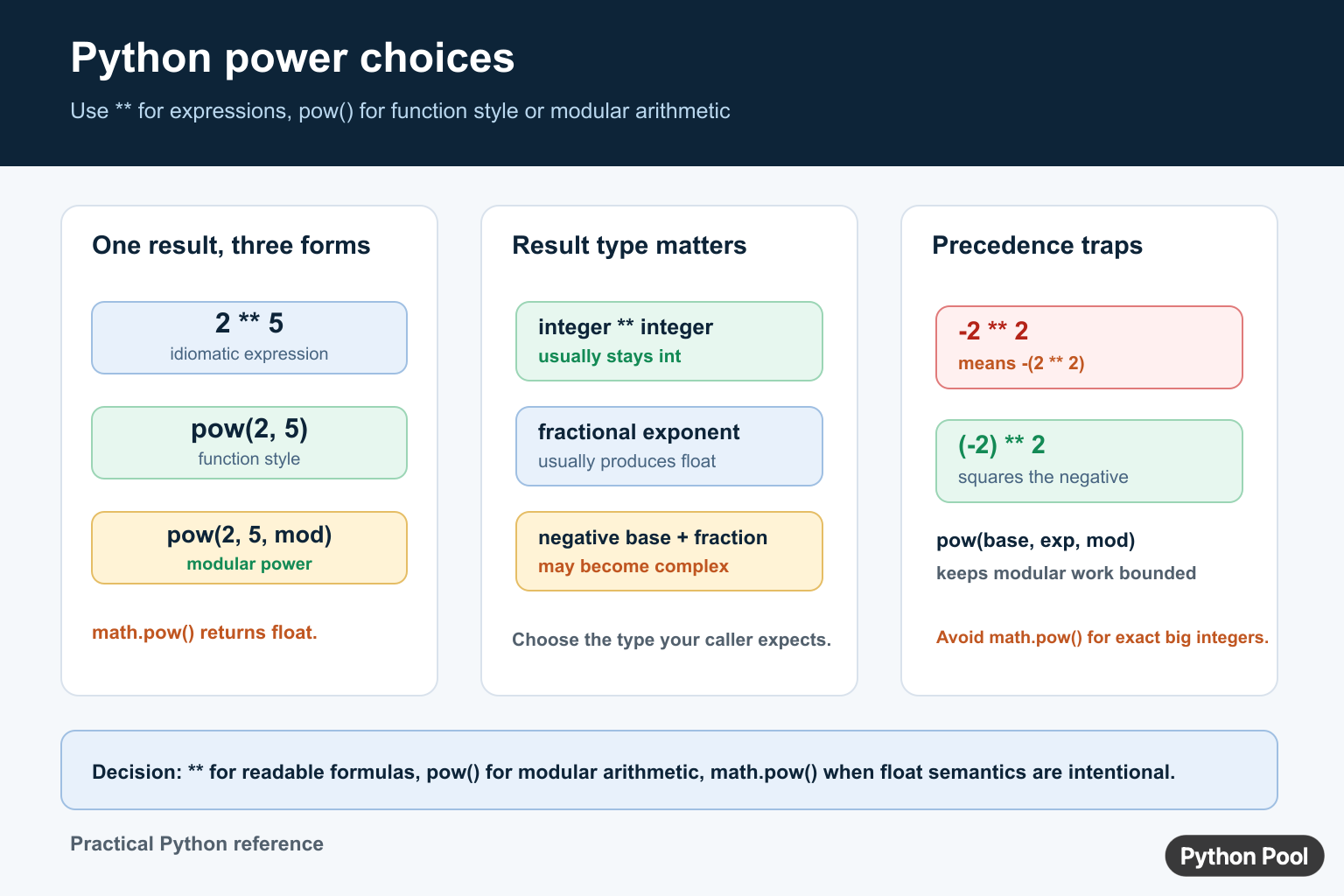
Python calculates powers with the ** operator, the built-in pow() function, and math.pow(). These tools overlap for simple examples, but they are not interchangeable in every context. Use ** for a readable expression, built-in pow() when function style or modular exponentiation matters, and math.pow() when a floating-point result is intentional.
Quick answer
Write base ** exponent for ordinary power expressions. Call pow(base, exponent, modulus) for modular powers without constructing the full intermediate integer. Use parentheses around a negative base when its sign should be part of the base. The official references for the power operator, built-in pow(), and math.pow() describe the differences.
Use the power operator
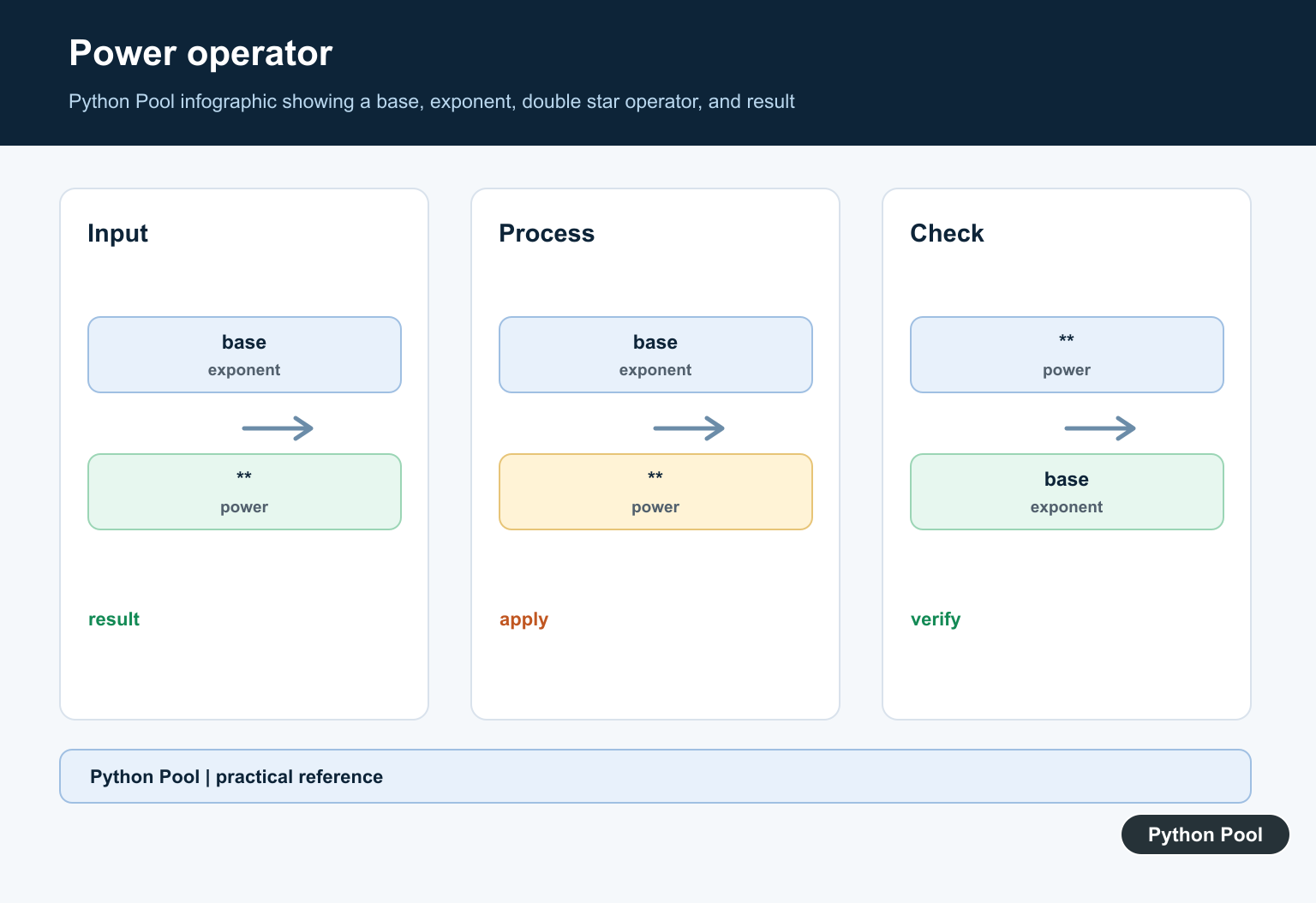
The ** operator is the clearest option when the expression itself communicates the formula.
square = 7 ** 2
cube = 3 ** 3

print(square)
print(cube)
Integer powers normally produce integers, and Python integers can grow beyond machine-word limits. That avoids overflow in the integer type, but a very large result can still consume substantial memory or be expensive to print and transmit.
Watch negative-base precedence
The unary minus and exponentiation operator do not group the way many readers first expect. -2 ** 2 means the negative of 2 ** 2. Use parentheses when the negative number itself is the base.
without_parentheses = -2 ** 2
negative_base = (-2) ** 2

print(without_parentheses)
print(negative_base)
Parentheses also help when a formula is translated from mathematical notation, a spreadsheet, or user input. Make the intended grouping visible instead of relying on a reader remembering operator precedence.
Use built-in pow() for function style
pow(base, exponent) produces the same basic result as base ** exponent. Function style can be useful when the base and exponent are already variables passed to a helper.
def raise_value(base, exponent):
    return pow(base, exponent)

print(raise_value(2, 5))
The two-argument form supports negative exponents and can return a float when the result is fractional. State the expected type in the function contract if callers depend on integer output.
Use modular exponentiation
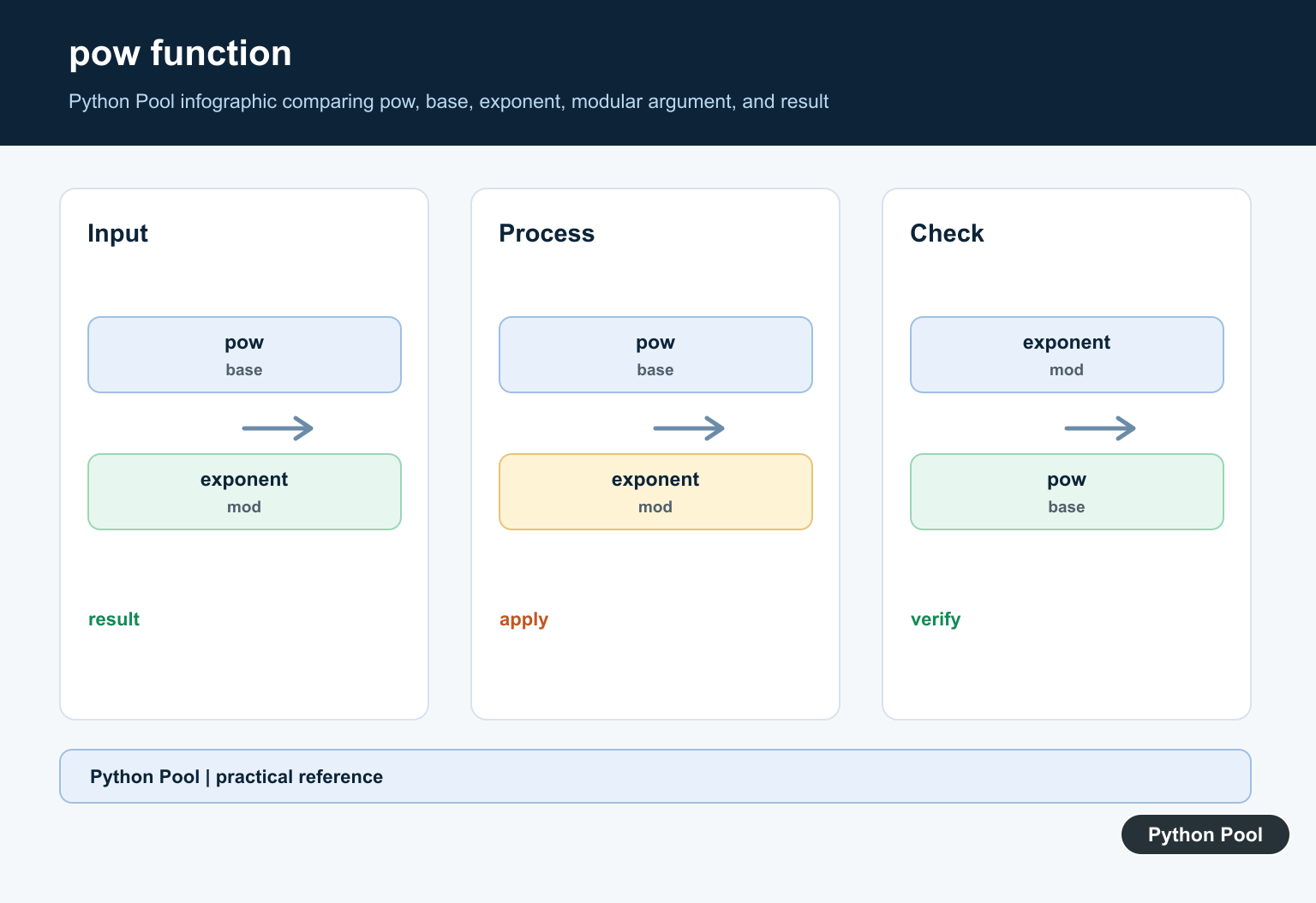
The three-argument form, pow(base, exponent, modulus), computes a power modulo a number efficiently. It is the practical choice for modular arithmetic because it avoids building the complete power before taking the remainder.
base = 7
exponent = 100
modulus = 13

result = pow(base, exponent, modulus)
print(result)
This form is useful in algorithms involving modular inverses, checksums, and number theory. The modulus must be a meaningful integer, and the three-argument form is not a general replacement for a floating-point formula.
Know what math.pow() changes
math.pow() converts its arguments to floating-point values and returns a float. Use it when the surrounding calculation is explicitly about floating-point math. Do not choose it merely because the name resembles the operator.
import math

value = math.pow(9, 0.5)
print(value)
For exact integer calculations, keep the operands integer and use ** or built-in pow(). Floating-point conversion can lose integer precision for very large values.
Calculate roots and fractional powers
A square root can be written as value ** 0.5, but the result is floating-point. Negative real bases with fractional exponents may produce complex results or a domain error depending on the function and inputs.
value = 81
root = value ** 0.5
fourth_root = value ** 0.25

print(root, fourth_root)
Use math.sqrt() when the input is intended to be a non-negative real scalar and you want its domain checks. Use complex arithmetic explicitly when complex results are part of the problem.
Avoid common power mistakes
Do not use ^ for exponentiation; it is the bitwise XOR operator. Do not assume that math.pow() preserves exact integers. Do not omit parentheses around a negative base, and do not materialize an enormous power when modular arithmetic is the actual goal.
For related numeric behavior, see Python max() and inclusive range patterns.
Handle negative exponents
A negative exponent represents a reciprocal. With integer inputs, the two-argument operator or built-in function generally returns a floating-point result because the mathematical answer may not be an integer.
inverse = 2 ** -3
function_form = pow(2, -3)

print(inverse)
print(function_form)
Use a numeric representation that matches the surrounding calculation when exact fractional arithmetic matters. Do not convert a result to an integer merely to silence a type mismatch, because truncation changes the mathematical meaning.
Use modular powers for large integers
The three-argument pow() form is more than a shorter spelling of (base ** exponent) % modulus. It can perform modular exponentiation without constructing the full intermediate power, which is important when the exponent is large. Keep the base, exponent, and modulus as integers and document the modulus contract.
Understand complex results
Raising a negative real number to a fractional exponent can leave the real-number domain. Python may produce a complex value for the operator, while a real-only math function may raise a domain-related error. Decide whether complex values are acceptable before accepting arbitrary bases and exponents.
real_result = (-8) ** (1 / 3)
complex_result = (-8) ** (1 / 3 + 0j)

print(real_result)
print(complex_result)
For a real cube root with a negative input, use a domain-specific rule rather than assuming that every fractional power is the same operation across numeric types.
Keep the contract visible
Power calculations appear in units, growth models, geometry, and cryptographic code. Name variables such as exponent and modulus, test the result type, and add boundary tests for zero and negative values. This is more reliable than selecting an API by habit.
When the result crosses an API boundary, document whether callers receive an integer, float, or complex value.
That small note prevents later code from relying on an accidental result type.
Zero exponents, zero bases, and very large exponents deserve explicit tests because they often expose assumptions in validation code. A formula that is mathematically defined may still be outside an application’s allowed domain, so validate business rules separately from Python’s arithmetic behavior.
Frequently Asked Questions
How do I calculate a power in Python?
Use base ** exponent for a readable power expression or pow(base, exponent) for function-style code.
What is the difference between ** and pow() in Python?
They overlap for two operands, but pow() also supports a third modulus argument for efficient modular exponentiation.
Why use parentheses around a negative power base?
-2 ** 2 means -(2 ** 2), while (-2) ** 2 makes the negative value the base.
When should I use math.pow()?
Use math.pow() when a floating-point result is intentional; keep exact integer calculations with ** or built-in pow().
