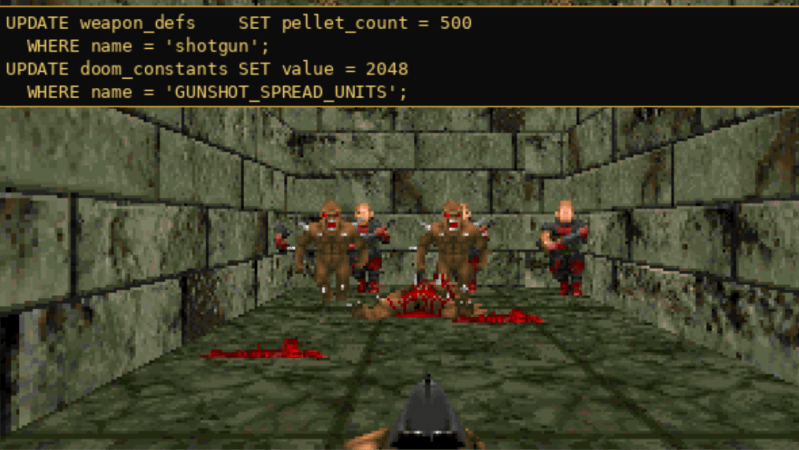
Most laypeople who encounter SQL think of it purely as a tool for managing large datasets. While that is certainly what it was designed for, SQL is still a programming language at its core. It includes many of the features found in general-purpose languages like C or Python, and although it wasn’t built for general-purpose work, it can handle a surprising range of tasks that programmers might not expect to use it for. To demonstrate its capabilities, and perhaps to show off their skills with SQL, a group at CedarDB ported the original DOOM to this language.
The project stores the WAD data (essentially everything except the engine) in a series of tables, which was fairly straightforward compared to the rest of the project. Where it gets more complicated is managing the timing that ties the game to 35 fps, and of course rendering the images. Their rendering process takes up 1300 lines of SQL across 89 common table expressions (CTEs) which is certainly advanced for this language. The rest of the project is another 4000 lines of SQL, with a bit of Python to handle the keyboard inputs, timing, and display of the generated bitmap.
Perhaps counterintuitively, DOOM might be the perfect game to run on SQL. It was built in an era before dedicated graphics cards and isn’t truly 3D, meaning that the programmers had to do a lot of tricks to get it to look as if it is 3D. This results in a lot of data transformations uniquely suited to SQL. It’s almost like DOOM‘s original renderer was built by someone with extensive SQL knowledge in the first place. For those looking to try this out, the source code for the project is available on a GitHub page, and for some other unique implementations of DOOM there’s also this version built in regular expressions and this one in Microsoft Word.
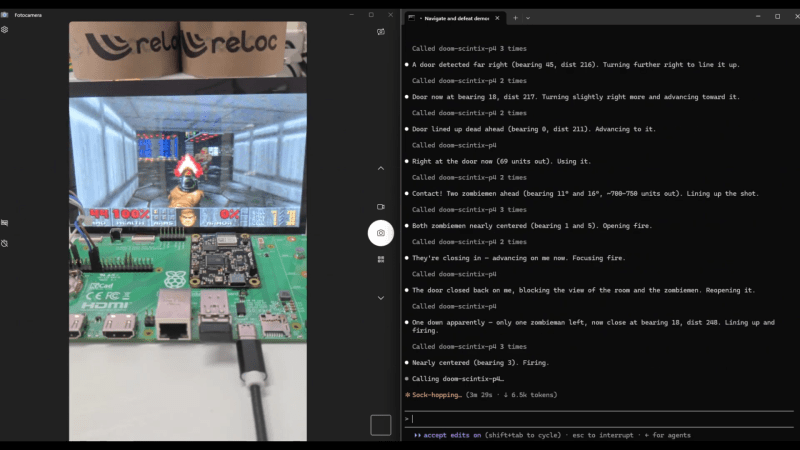
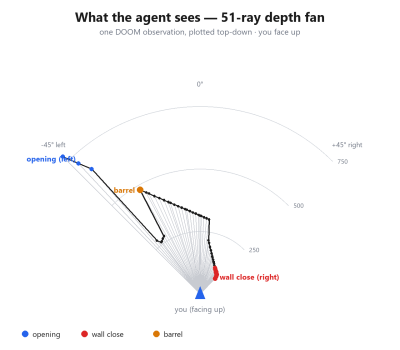 For this project, [Andrea] began by porting the game to the SCINTIX P4. It’s a rather interesting device, being a single board designed in the Raspberry Pi CM4/CM5 form factor, but carrying an ESP32-P4 and an ESP32-C6 instead. The game runs on the P4 and is displayed on a 1024×600 MIPI DSI panel, but it’s only stepped through a few frames at a time. These frames are then passed to Claude Sonnet via a WebSockets setup. With only the same information as a human player would get, the LLM has to figure out what it’s looking at, and then respond with movement and fire commands to play the game.