Image

With Latest Update, Alexa Refuses To Pass The Aux

Although the feature has been deleted from newer models, there was a time when Amazon’s Echo devices included a 3.5 mm “aux” input jack that let you connect other audio sources to the smart speaker. Alexa would even let you switch over to an external source with a voice command — or at least, it used to.

As first reported by Reddit user [n8-sd], Amazon has started informing users that voice control over the 3.5 mm jack is no longer supported. While the physical input will still function on models equipped with it, if you want to mute the audio coming from an external device you’ll have to wade through the Alexa smartphone application to do it.

Image

In a statement to Ars Technica, an Amazon rep confirmed that voice control over the auxiliary input has been removed as of the latest software version, and that their analytics showed not many people were using the feature in the first place. They also pointed out that no changes have been made to voice control of Bluetooth devices. While we don’t doubt that the total number of users that were physically plugging an audio source into their Echos was probably low in the grand scheme of things, that doesn’t really explain why such a simple feature needed to be actively removed.

Some commenters have theorized that the real reason behind the change is the fact that Amazon has no way of monitoring what users are playing over the auxiliary input. Since cataloging and selling the media consumption habits of users is big business these days, that’s a problem. While they might prefer to disable the feature entirely, they know that would stir up some bad press, so they’re opting to simply make it more annoying to use. We’re not saying we entirely buy this explanation, but it’s not the craziest thing we’ve ever heard either.

Although the Echo devices have never been particularly hackable, they have enjoyed a certain amount of success with tech-savvy users, making it all the more disappointing to see the ecosystem seemingly becoming less capable over time.

Image

Hacking Amazon Echo Show 8 3rd Gen Via UART And EMMC

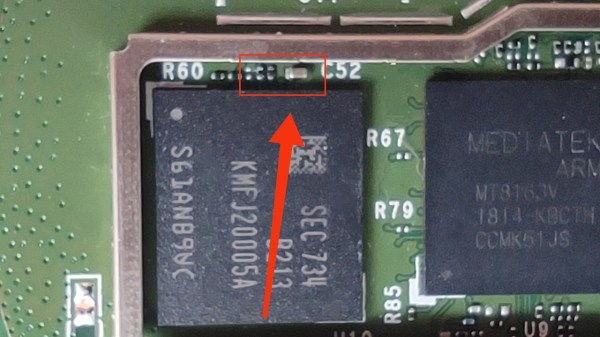
ImageEven with Amazon’s Echo Show devices running Linux in the form of the Android-derived FireOS, using them for non-Amazon approved purposes can be a chore at best. In the case of the Echo Show 8 even simple workarounds using ADB and the bootloader have been locked-down, requiring more drastic measures. Here [Vowed] over at the XDA forums shows off one such hack, involving directly tapping into the device’s eMMC.
Suffice it to say that this is not a hack for the faint of heart, with even the iFixit teardown guide for this device being rather daunting. Even after you get access to the mainboard, you still have to remove or cut open the metal can that covers the eMMC, so that you can unleash an eMMC programmer on it. It’s best to make sure to make a backup image of the original contents too, just in case you have to restore things.

With the shield out of the way you can solder fine wires to pads that connect to the eMMC to program it. You also have to solder wires to pads for the UART, though if you’re fancy you can also create a custom pogo pin adapter. With a serial connection established to the original firmware you can then enable features like ADB, and courtesy of the connected eMMC adapter it’s possible to directly alter system files to make rooting as easy as possible.

In addition to rooting the system you can also do a straight replacement of the eMMC contents, such as the demonstrated Debian installation. Even if not the most easy of mods, it’s good to see that it’s possible to repurpose these devices.

(Top image: Amazon Echo Show 8 3rd generation mainboard. Credit: iFixit, CC BY-NC-SA 3.0.)

Image

Root, On An Amazon Echo Dot

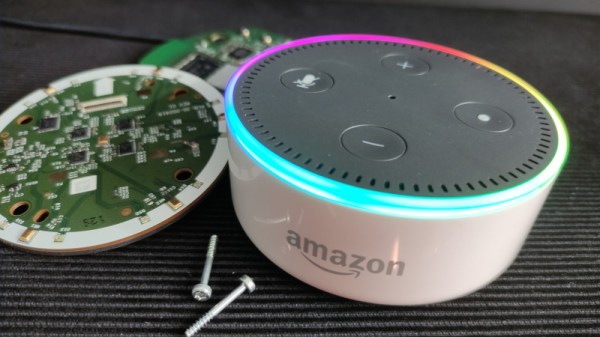
The Amazon Echo has become an indispensable device for many people unconcerned by its privacy implications. It’s easy to forget that it’s not quite a new product anymore, with the oldest examples now long in the tooth enough to no longer receive security updates. A surprise is that far from being mere clients to Amazon cloud services, they in fact run a version of Android. This makes old dots interesting to experimenters, but first is it possible to gain root access? [Daniel B] has managed it, on a second-generation Echo Dot.

In a sense, this is nothing new, as root has previously been achieved on an Echo Dot through means of a patched kernel. Echo devices use a chain of trust boot process in which each successive step must verify the Amazon signing of the previous one. The kernel patch method breaks the ability to reboot the device with root access. [Daniel’s] method bypasses that chain of trust by using a custom pre-loader injected over USB through an exploit.

As an example, [Daniel] created a web server on his Dot, which can serve audio captured by the device. Don’t panic just yet — an analysis of the other security features suggests that this is not the dangerous exploit it might seem. It does however open up these powerful but now pretty cheap devices as potentially usable for other purposes, which can only be a good thing.

We’ve previously brought you [Daniel]’s work freeing the WiFi details from a Dot.

A man next to a robot with animatronic eyes and a CRT display showing an audio waveform

Animatronic Alexa Gives Amazon’s Echo A Face

Today, we’re surrounded by talking computers and clever AI systems that a few decades ago only existed in science fiction. But they definitely looked different back then: instead of a disembodied voice like ChatGPT, classic sci-fi movies typically featured robots that had something resembling a human body, with an actual face you could talk to. [Thomas] over at Workshop Nation thought this human touch was missing from his Amazon Echo, and therefore set out to give Alexa a face in a project he christened Alexatron.

The basic idea was to design a device that would somehow make the Echo’s voice visible and, at the same time, provide a pair of eyes that move in a lifelike manner. For the voice, [Thomas] decided to use the CRT from a small black-and-white TV. By hooking up the Echo’s audio signal to the TV’s vertical deflection circuitry, he turned it into a rudimentary oscilloscope that shows Alexa’s waveform in real time. An acrylic enclosure shields the CRT’s high voltage while keeping everything inside clearly visible.

To complete the face, [Thomas] made a pair of animatronic eyes according to a design by [Will Cogley]. Consisting of just a handful of 3D-printed parts and six servos, it forms a pair of eyes that can move in all directions and blink just like a real person. Thanks to a “person sensor,” which is basically a smart camera that detects faces, the eyes will automatically follow anyone standing in front of the system. The eyes are closed when the system is dormant, but they will open and start looking for faces nearby when the Echo hears its wake word, just like a human or animal responds to its name.

The end result absolutely looks the part: we especially like the eye tracking feature, which gives it that human-like appearance that [Thomas] was aiming for. He isn’t the first person trying to give Alexa a face, though: there are already cute Furbys and creepy bunnies powered by Amazon’s AI, and we’ve even seen Alexa hooked up to an animatronic fish.

Continue reading “Animatronic Alexa Gives Amazon’s Echo A Face” →

Photo of the Echo Dot PCB, highlighting the capacitor that needs to be shorted out for the exploit to work

Squeezing Secrets Out Of An Amazon Echo Dot

As we have seen time and time again, not every device stores our sensitive data in a respectful manner. Some of them send our personal data out to third parties, even! Today’s case is not a mythical one, however — it’s a jellybean Amazon Echo Dot, and [Daniel B] shows how to make it spill your WiFi secrets with a bit of a hardware nudge.

There’s been exploits for Amazon devices with the same CPU, so to save time, [Daniel] started by porting an old Amazon Fire exploit to the Echo Dot. This exploit requires tactically applying a piece of tin foil to a capacitor on the flash chip power rail, and it forces the Echo to surrender the contents of its entire filesystem, ripe for analysis. Immediately, [Daniel] found out that the Echo keeps your WiFi passwords in plain text, as well as API keys to some of the Amazon-tied services.

Found an old Echo Dot at a garage sale or on eBay? There might just be a WiFi password and a few API keys ripe for the taking, and who knows what other kinds of data it might hold. From Amazon service authentication keys to voice recognition models and maybe even voice recordings, it sounds like getting an Echo to spill your secrets isn’t all that hard.

We’ve seen an Echo hijacked into an always-on microphone before, also through physical access in the same vein, so perhaps we all should take care to keep our Echoes in a secure spot. Luckily, adding a hardware mute switch to Amazon’s popular surveillance device isn’t all that hard. Though that won’t keep your burned out smart bulbs from leaking your WiFi credentials.

Image

This Week In Security: Ransomware, WeLock, And Amazon Arbitration

Another week of ransomware, and this time it’s the beef market that’s been shut down, due to a crippling infrastructure attack out of Russia — but hold up, it’s not that simple. Let’s cover the facts. Some time on Sunday, May 30, JBS USA discovered a ransomware attack against their systems. It seems that their response team did exceptionally well, pulling the plug on affected machines, and starting recovery right away. By Wednesday, it was reported that most of their operations were back in action.
Continue reading “This Week In Security: Ransomware, WeLock, And Amazon Arbitration” →

Image

PSA: Amazon Sidewalk Rolls Out June 8th

Whether you own any Amazon surveillance devices or not, we know how much you value your privacy. So consider this your friendly reminder that Amazon Sidewalk is going live in a few weeks, on June 8th. A rather long list of devices have this setting enabled by default, so if you haven’t done so already, here’s how to turn it off.

Don’t know what we’re talking about? Our own Jenny List covered the topic quite concretely a few months back. The idea behind it seems innocent enough on the surface — extend notoriously spotty Wi-Fi connectivity to devices on the outer bounds of the router’s reach, using Bluetooth and LoRa to talk between devices and share bandwidth. Essentially, when Amazon flips the switch in a few weeks, their entire fleet of opt-in-by-default devices will assume a kind of Borg hive-mind in that they’ll be able to share connectivity.

A comprehensive list of Sidewalk devices includes: Ring Floodlight Cam (2019), Ring Spotlight Cam Wired (2019), Ring Spotlight Cam Mount (2019), Echo (3rd Gen), Echo (4th Gen), Echo Dot (3rd Gen), Echo Dot (4th Gen), Echo Dot (3rd Gen) for Kids, Echo Dot (4th Gen) for Kids, Echo Dot with Clock (3rd Gen), Echo Dot with Clock (4th Gen), Echo Plus (1st Gen), Echo Plus (2nd Gen), Echo Show (1st Gen), Echo Show (2nd Gen), Echo Show 5, Echo Show 8, Echo Show 10, Echo Spot, Echo Studio, Echo Input, Echo Flex. — Amazon Sidewalk FAQ

Now this isn’t a private mesh network in your castle, it’s every device in the kingdom. So don’t hesitate, don’t wait, or it will be too late. Grab all your Things and opt-out if you don’t want your doorbell cam or Alexa machine on the party line. If you have the Alexa app, you can allegedly opt out on all your devices at once.

Worried that Alexa is listening to you more often than she lets on? You’re probably right.