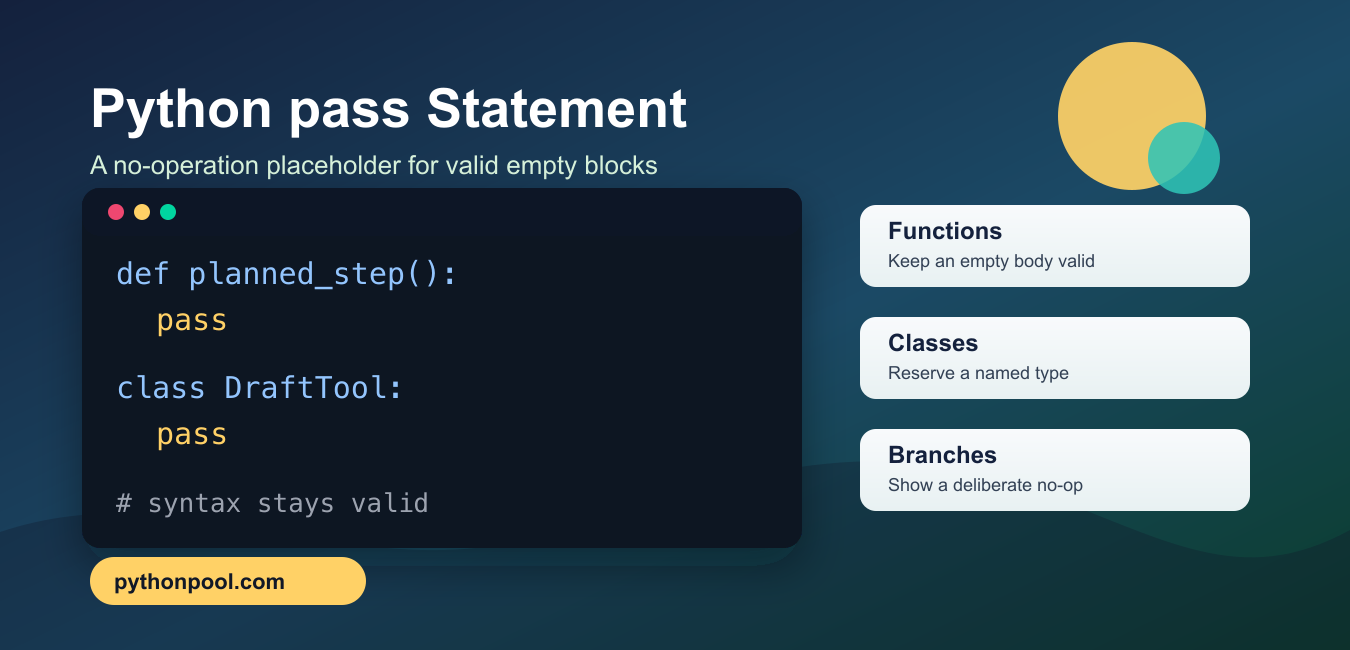
Quick answer: Python pass is an intentional no-op. It makes an empty suite valid while scaffolding a function, class, branch, loop, or exception handler, but it does not skip an iteration or implement missing behavior.
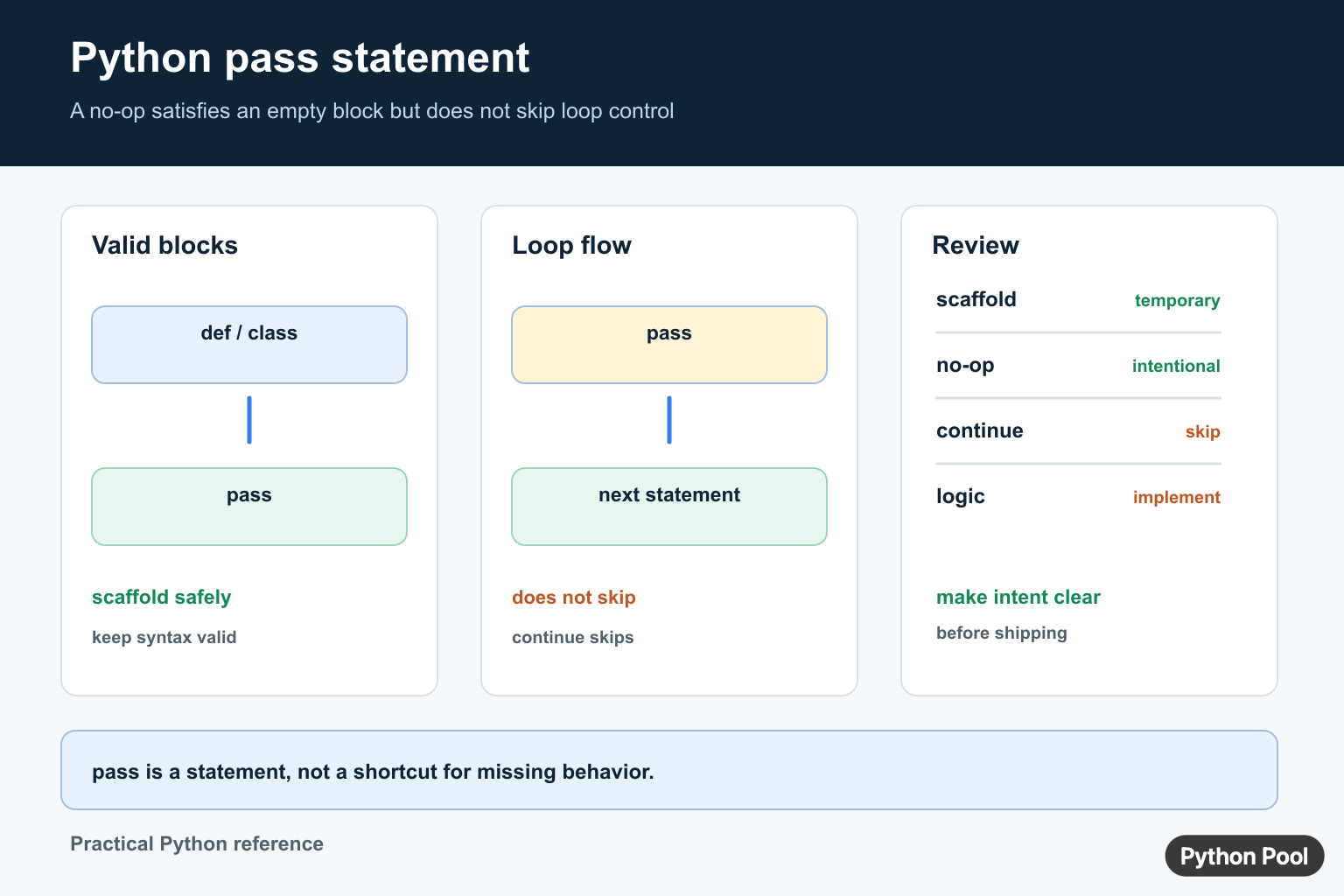
The Python pass statement is a placeholder that tells the interpreter, “do nothing here, but keep the syntax valid.” It is useful when Python requires a statement and the real body is intentionally empty, planned for later, or handled somewhere else.
pass matters because Python uses indentation to define blocks. A function, class, loop, if branch, or except handler cannot be left blank. When there is no action to take yet, pass gives the block a legal body without changing program state.
The official references are the Python pass statement reference, the Python tutorial section on pass statements, and the broader compound statements reference.
Basic pass Usage
Use pass when a block must exist but no work should happen yet. A function body is the simplest example.
def reserve_spot():
    pass

result = reserve_spot()
print(result)
The function is valid and callable. Because it has no explicit return, the result is None. That is different from a missing body, which would raise a syntax error before the program could run.
This pattern is helpful while sketching a module or writing tests around an interface that will be filled in later. Keep it temporary unless the empty behavior is truly part of the design.
Use pass In Empty Classes
A class definition also needs a body. When you want a named type before adding methods or attributes, pass is the cleanest placeholder.
class DraftParser:
    pass

parser = DraftParser()
parser.status = "planned"
print(parser.status)
The class exists, can be instantiated, and can still receive attributes in normal Python code. For production code, replace the placeholder with the real constructor, methods, dataclass fields, or a clear comment explaining why the empty type is intentional.
An empty class can be useful for a marker type, a plugin hook, or a staged refactor. It should not hide missing behavior in code that callers already depend on.
Use pass In Branches
Sometimes one branch of an if statement is intentionally empty. In that case, pass makes the no-op visible.
settings = {"debug": False, "theme": "light"}

if settings["debug"]:
    print("debug logging is on")
else:
    pass

print("theme:", settings["theme"])
This reads as “there is no fallback action.” It is usually clearer to remove an empty else branch if the code does not need it, but pass can be useful while drafting control flow or documenting that a no-op branch was considered.
Do not use pass to make a confusing condition look complete. If one branch matters and the other does not, consider rewriting the condition so the active branch stands alone.
pass Is Not continue
Inside a loop, pass does not skip to the next item. It only does nothing at that exact line. The rest of the loop body still runs.
names = ["Ada", "", "Grace"]

for name in names:
    if name == "":
        pass
    print("checked:", repr(name))
Use continue when you want to skip the rest of the current loop cycle. Use pass when the empty branch is intentional and execution should move to the following statement in the same block.
This distinction prevents subtle loop bugs. A placeholder in a condition is harmless only when later statements should still run for that item.
Use pass Carefully In except Blocks
pass is allowed inside except, but it can hide errors if used too broadly. Only ignore an exception when the failure is expected and harmless.
values = ["8", "bad", "13"]
parsed = []

for text in values:
    try:
        parsed.append(int(text))
    except ValueError:
        pass

print(parsed)
Here the code ignores strings that cannot be parsed as integers. That can be acceptable for small cleanup tasks, but larger programs should often count skipped items, log a message, or report bad input to the caller.
Avoid broad handlers such as except Exception: pass. They can hide spelling mistakes, wrong types, and broken assumptions. If the ignored case is real, catch the narrow exception type and keep the surrounding block small.
pass, Ellipsis, And NotImplementedError
pass means no operation. The ellipsis literal ... can also stand in a block, but it is an expression, not the same statement. Some teams use ellipsis in stubs, while pass remains the direct no-op statement.
class BaseExporter:
    def export(self, text):
        raise NotImplementedError("export must be implemented")

class ConsoleExporter(BaseExporter):
    def export(self, text):
        print(text)

ConsoleExporter().export("ready")
When callers must override a method, raising NotImplementedError is stronger than pass. It fails loudly instead of returning None and letting the program continue with an incomplete result.
Use pass for a deliberate empty body, a temporary scaffold, or a no-op branch. Use continue to skip loop work, return to leave a function, and an exception when missing behavior should be treated as an error.
The practical rule is short: pass keeps syntax valid without doing work. It is best when that absence of work is intentional, local, and easy for the next reader to understand.
pass Keeps An Empty Block Valid
Python uses indentation to define suites, so a declaration with no body is invalid. pass supplies a statement without changing state, returning a value, or raising an exception. That makes it useful while a module is being designed or when a branch deliberately has no action.
class Plugin:
    pass

def reserved_for_later():
    pass

for item in []:
    pass
pass Is Not continue
Inside a loop, pass executes and then continues to the next statement in the same iteration. continue skips the rest of the current iteration. Use the statement that expresses the intended control flow rather than replacing a condition with a no-op that hides the reason.
for number in range(4):
    if number == 1:
        pass
    print(number)

for number in range(4):
    if number == 1:
        continue
    print(number)
Use It Deliberately
A pass in an exception handler can intentionally ignore a known, harmless condition, but a comment or narrow exception type should explain why. In application code, replace placeholder pass statements with real validation, a return value, or an explicit error before shipping.
For nearby control-flow decisions, compare Python break with Python next(); those statements change control flow, while pass intentionally does not.
Frequently Asked Questions
What does pass do in Python?
pass is a no-op statement that lets an otherwise empty suite remain syntactically valid.
Does pass skip a loop iteration?
No. continue skips to the next iteration; pass does nothing and execution continues with the next statement.
Can I use pass in a function or class?
Yes. It is commonly used while scaffolding an empty function, class, branch, or exception handler.
Should pass remain in production code?
Keep it when an intentional no-op is part of the design, but replace it when it merely hides unfinished logic or an error that should be handled.
