
Quick answer: Python evaluates Boolean expressions from left to right and can stop once the final result is known. This makes and and or useful for guards and defaults, but it also means a right-hand function call may never run.
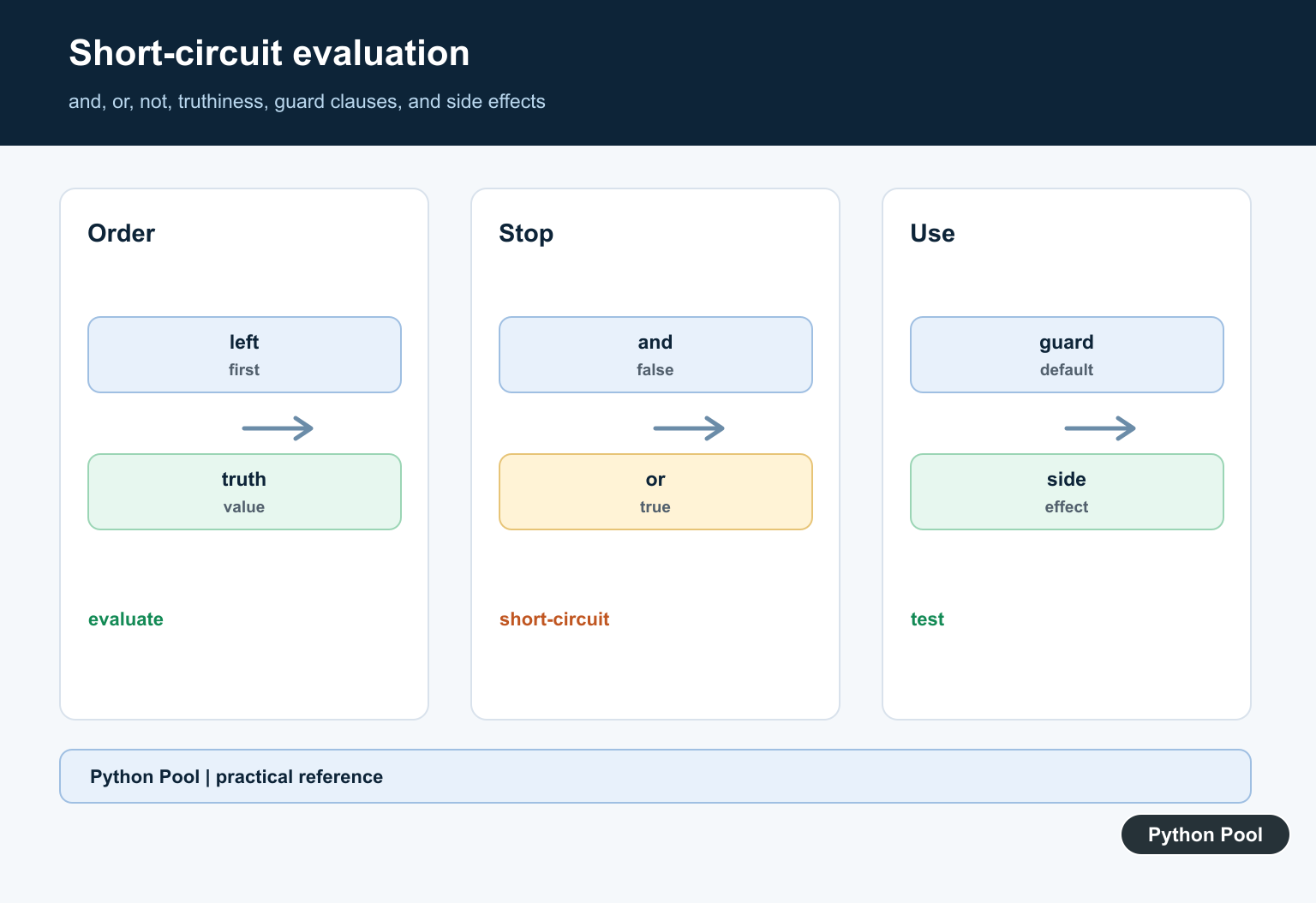
Short-circuit evaluation means Python stops evaluating a boolean expression as soon as the final result is already known. This behavior applies to and and or.
The main references are Python’s boolean operation reference, the truth value testing documentation, and the conditions tutorial.
With and, Python stops at the first false value. With or, Python stops at the first true value. This is useful for guard checks, default values, and avoiding work that is not needed.
Short-circuit behavior is predictable, but it can hide important actions if you place side effects inside conditions. Keep condition checks clear and deliberate.
The feature matters because Python evaluates expressions from left to right. That means the order you choose is part of the behavior, not just a style preference.
Use it to protect operations that require earlier checks, such as reading from a list only after confirming the list has data, or calling a string method only after checking for None.
See How and Stops Early
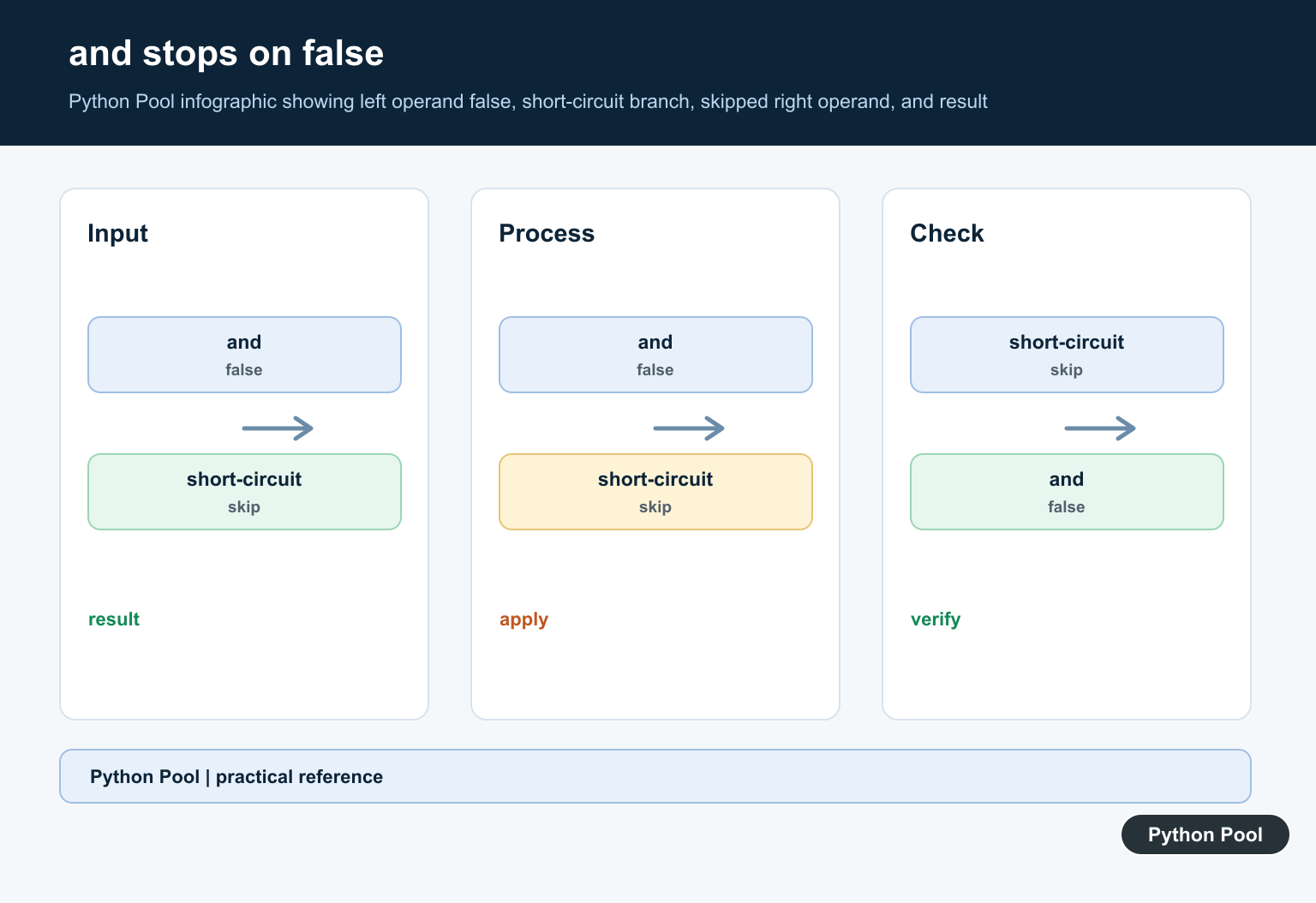
For and, every part must be true for the whole expression to be true. When one part is false, the remaining parts are skipped.
def check(label, result):
    print(f"checking {label}")
    return result

answer = check("first", False) and check("second", True)

print(answer)
The second call does not run because the first result is false.
This is why and is often used for guard checks, where the second expression is only safe after the first expression passes.
Use and For Guard Checks
A guard check prevents an unsafe operation from running too early.
items = ["python", "pool"]

if items and items[0] == "python":
    print("first item matched")

empty_items = []
if empty_items and empty_items[0] == "python":
    print("this line is skipped")
The list access is safe because Python checks whether the list has any items before reading position 0.
If the list is empty, Python stops before the indexing operation.
See How or Stops Early
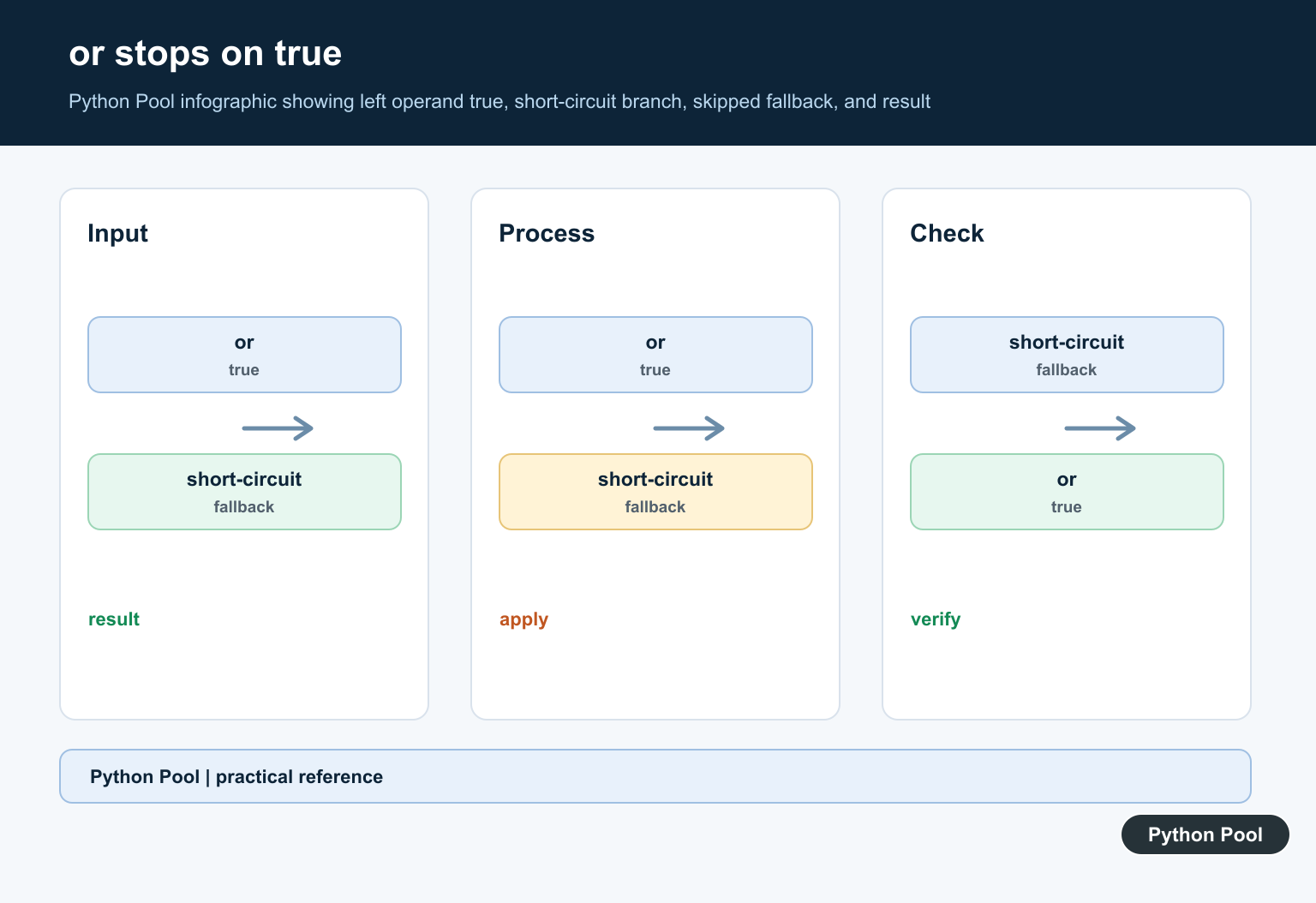
For or, one true value is enough. Python stops when it finds that value.
def check(label, result):
    print(f"checking {label}")
    return result

answer = check("first", True) or check("second", False)

print(answer)
The second call does not run because the first result is already true.
This behavior is useful when the first valid choice should be used immediately.
If the first true value is expensive to compute, put cheaper alternatives first when they are equally valid. If one choice is more correct than another, correctness should decide the order.
Choose A Default With or
or is often used to choose a fallback value.
supplied_name = ""
display_name = supplied_name or "guest"

supplied_limit = 0
limit = supplied_limit or 10

print(display_name)
print(limit)
This code chooses the fallback when the left value is false-like.
Be careful with values such as 0, empty strings, and empty lists. They may be valid input even though Python treats them as false in a boolean context.
and and or Return Operands
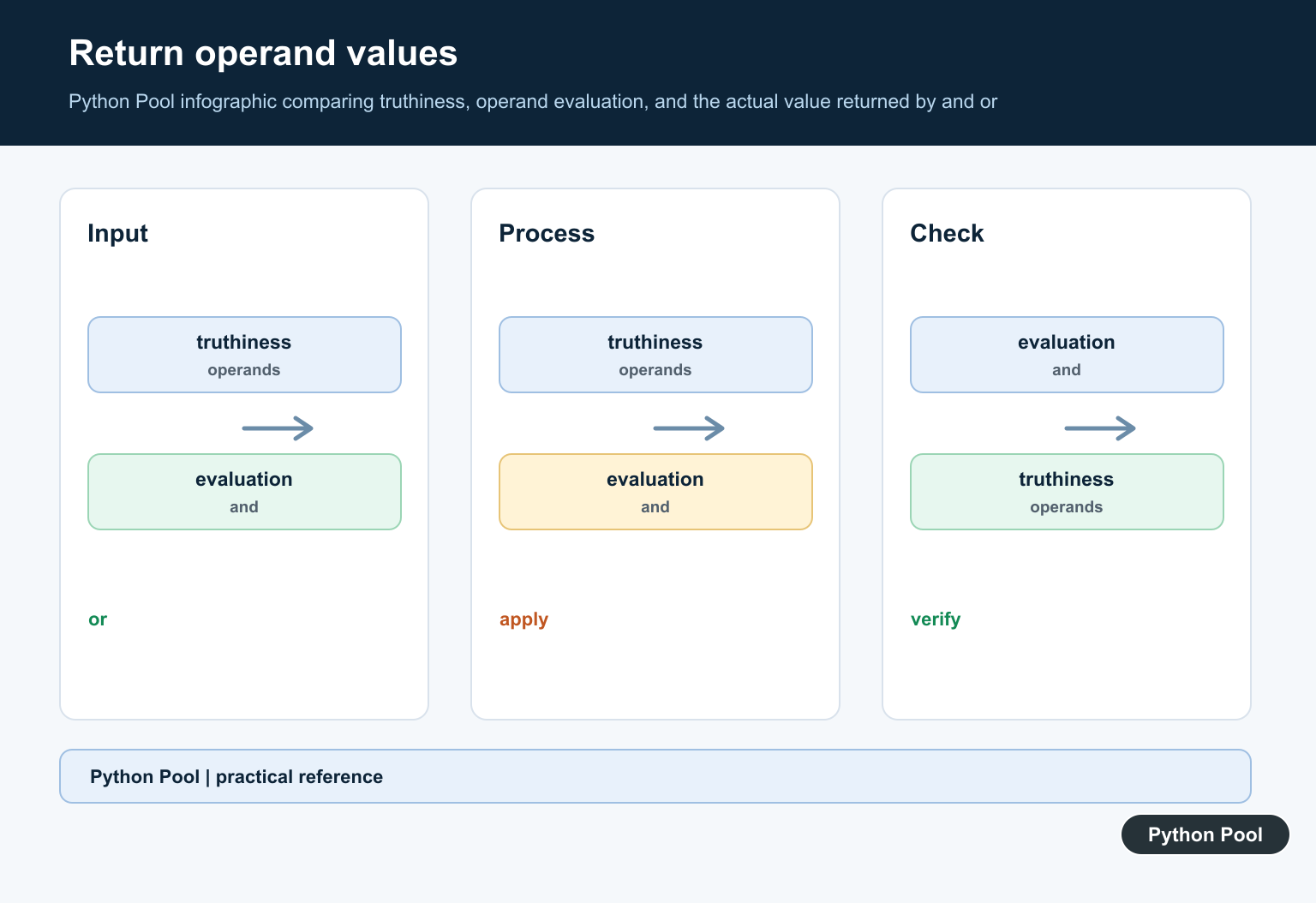
Python’s and and or operators return one of the original operands, not always a plain boolean.
print("python" and "pool")
print("" and "pool")
print("python" or "fallback")
print("" or "fallback")

result = bool("python" and "pool")
print(result)
Use bool() when your code specifically needs True or False.
Returning operands is powerful, but explicit if statements are clearer when fallback rules are more complex.
This operand-return behavior is why or fallbacks can surprise people. A value such as 0 may be meaningful for a limit or count, but or treats it as false-like.
Order Conditions Safely
Put the cheap and safe checks before expensive or risky checks.
def has_prefix(text, prefix):
    return text is not None and text.startswith(prefix)

print(has_prefix("pythonpool", "python"))
print(has_prefix(None, "python"))

ready = True
count = 3
if ready and count > 0:
    print("start")
The None check runs before startswith(), so the function avoids an attribute error.
The practical rule is to put required existence checks first, then type or shape checks, then the operation that depends on those checks.
Use short-circuit evaluation for readable guards and fallbacks. Avoid using it as a compact replacement for multi-step logic where a normal if block would explain the intent better.
When debugging a complex condition, split it into named intermediate results or print each part separately. That makes it obvious which part stops the expression.
Write tests for both paths: one where evaluation stops early and one where it reaches the later expression. That confirms your condition order protects the risky operation without skipping valid work.
Also avoid hiding logging, database writes, file changes, or network calls inside the right side of a boolean expression. Those actions may not run, and a future reader may not notice why.
Short-circuit evaluation is best used for simple conditions that read naturally. When a condition grows beyond one clear line, split it into smaller checks or use a normal branch.
Read The Evaluation Order
Python evaluates operands left to right. and stops at the first falsy operand, while or stops at the first truthy operand; when no early result is possible, the final operand supplies the return value.
Use Guard Clauses
A condition such as user is not None and user.is_active avoids an attribute lookup when the first condition fails. Keep the guard close to the operation it protects so the dependency is visible.
Use Defaults Deliberately
name = supplied or fallback is concise, but it treats every falsy value as missing. If zero, an empty string, or an empty collection is valid, test for None explicitly instead.
Remember It Returns Operands
and and or return one of their operands rather than converting the result to True or False. Use bool(expression) when a strict Boolean value is part of the interface.
Avoid Hidden Side Effects
Do not put required writes, logging, cleanup, or security checks only on the right side of a short-circuited expression. Use an explicit if statement when both actions must be understood and tested.
Test Truthy And Falsy Cases
Test None, zero, empty containers, custom objects, exceptions, and functions that should or should not be called. Assert both the returned operand and the evaluation side effects.
The official Boolean operations reference documents operand return values and short-circuiting. Related Python Pool references include tests and logging.
For related Python behavior, compare side-effect logging, truth-table tests, and explicit default mappings when using short-circuit expressions.
Frequently Asked Questions
What is short-circuit evaluation in Python?
Python evaluates Boolean expressions from left to right and may stop once the final result is determined.
How does and short-circuit?
and stops at the first falsy operand and returns it; if every operand is truthy, it returns the last operand.
How does or short-circuit?
or stops at the first truthy operand and returns it; if every operand is falsy, it returns the last operand.
Why can short-circuiting cause a bug?
A function or expression on the right side may never run, so relying on its side effect can make the code order-dependent.
