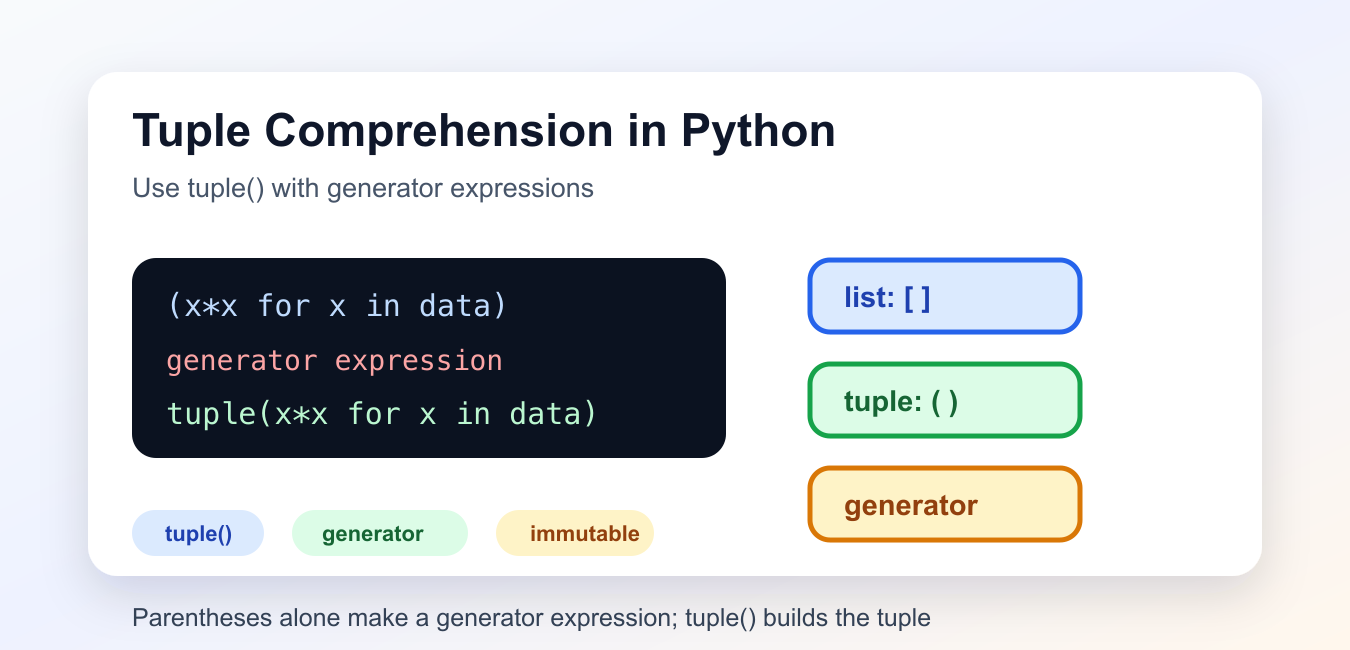
Quick answer: Python has no dedicated tuple-comprehension syntax. Use a generator expression inside tuple() when you need an actual tuple, for example tuple(value * 2 for value in values). Parentheses alone group an expression or create a generator; they do not turn a comprehension into a tuple.

Python does not have a separate tuple comprehension syntax. Parentheses around a comprehension-style expression create a generator expression, not a tuple.
The official Python docs describe generator expressions, comprehension displays, the tuple type, and tuples and sequences.
To build a tuple from generated values, wrap a generator expression with tuple(). This keeps the lazy generator behavior separate from the final immutable tuple.
The distinction matters because generators are consumed once, while tuples store all values immediately. If you need to reuse the result many times, build the tuple. If you only need to stream through values once, the generator may be enough.
Parentheses Create A Generator
A comprehension-like expression inside parentheses produces a generator object.
numbers = [1, 2, 3]

squares = (number * number for number in numbers)

print(squares)
print(next(squares))
print(next(squares))
The output shows a generator object, then the first two generated values. The values are produced as the generator is consumed.
This is why calling the syntax a tuple comprehension is misleading. The parentheses do not materialize a tuple by themselves.
After a generator is consumed, it does not restart automatically. Create a new generator expression or convert it to a tuple if the values must be revisited.
Build A Tuple With tuple()
Pass the generator expression to tuple() when you want an actual tuple.
numbers = [1, 2, 3]

squares = tuple(number * number for number in numbers)

print(squares)
print(type(squares))
This evaluates the generator and stores the results in an immutable tuple.
Use this form when you need tuple behavior, such as hashability, fixed structure, or a result that should not be modified.
A tuple can also make function output clearer when the caller should treat the result as a completed collection rather than a work-in-progress list.
Filter Values While Building A Tuple
Generator expressions can include an if clause before they are passed to tuple().
numbers = range(10)

even_squares = tuple(number * number for number in numbers if number % 2 == 0)

print(even_squares)
The result contains only values that pass the filter. The filtering happens before the tuple is created.
This pattern is concise for small transformations where the final output should be a tuple.
For longer transformations, consider a normal loop or a named helper function. Readability matters more than forcing every operation into one expression.

Compare List And Tuple Results
List comprehensions use square brackets. Tuple results need tuple().
numbers = [1, 2, 3]

list_result = [number + 1 for number in numbers]
tuple_result = tuple(number + 1 for number in numbers)

print(list_result)
print(tuple_result)
The list can be modified after creation. The tuple cannot be changed in place.
Choose the result type based on how the value will be used, not just on syntax preference.
Lists are practical when values will be appended, removed, or sorted in place. Tuples are practical when the result is final and should travel through code unchanged.
Create Tuples Of Pairs
The generated item can itself be a tuple. This is common for coordinate pairs, key-value pairs, or compact records.
names = ["Ada", "Lin", "Maya"]
scores = [92, 88, 95]

pairs = tuple((name, score) for name, score in zip(names, scores))

print(pairs)
The outer tuple() builds the final tuple. The inner parentheses create each pair.
This distinction is useful: one set of parentheses groups the pair, while tuple() controls the final container.
If the pair expression becomes hard to read, split it over multiple lines or build the pair in a small helper before collecting the final tuple.

Use tuple() With map
tuple() accepts any iterable, so it can consume map() results too.
words = ["python", "pool", "tuple"]

lengths = tuple(map(len, words))
upper_words = tuple(word.upper() for word in words)

print(lengths)
print(upper_words)
map() is compact when an existing function already does the transformation. A generator expression is often clearer when the expression is custom.
Both approaches are valid. The important part is that tuple() materializes the iterable into a tuple.
Generator expressions tend to be more flexible because the transformation is written inline. map() is compact when a named function already exists.
Common Tuple Comprehension Mistakes
Do not expect (x for x in items) to be a tuple. It is a generator expression.
Do not add a trailing comma to fix this pattern unless you actually want a one-item tuple that contains the generator object.
Do not use a tuple when the result needs frequent changes. Build a list first, then convert to a tuple only if immutability is useful.
The practical rule is simple: use [...] for a list comprehension, use (...) for a generator expression, and use tuple(...) when the generated values should become a tuple.
Separate The Three Forms
A list comprehension uses square brackets and creates a list. A generator expression uses parentheses or appears as a function argument and is lazy. tuple() consumes an iterable and creates the final immutable tuple.
Remember The One-Item Comma
The expression (value) is just value, while (value,) is a one-item tuple. This comma rule is independent from generator-expression syntax and is a common source of confusing examples.
Choose Eager Or Lazy Deliberately
tuple(generator_expression) consumes all values immediately. That is appropriate when the final tuple is needed, but keep the generator lazy when the source is large and the consumer can stream it.
Filter Inside The Expression
A conditional generator expression can include an if clause, such as tuple(item for item in values if item is not None). Keep the predicate readable and avoid side effects during iteration.
Use Tuples For A Reason
Tuples are useful for immutable records, dictionary keys when their members are hashable, and stable return values. A list is usually better when callers need mutation or list-specific methods.
Test Type And Consumption
Assert the result is a tuple, verify empty and one-item cases, and confirm a generator is not accidentally reused after tuple() has consumed it.
The official generator-expression documentation and tuple() reference describe the behavior. Related Python Pool references include lists and testing.
For related collection choices, compare list construction, iteration patterns, and type tests when building a tuple.
Frequently Asked Questions
Does Python have tuple comprehension?
Python has no separate tuple-comprehension syntax; use a generator expression inside tuple() to build a tuple.
How do I convert a generator expression to a tuple?
Pass the generator expression to tuple(), for example tuple(value * 2 for value in values).
Why does parentheses syntax not create a tuple?
Parentheses group an expression, while a one-item tuple needs a trailing comma; generator-expression syntax is a different construct.
Should I use a tuple or list comprehension?
Choose a tuple for an immutable result or fixed record-like data, and a list when you need mutation or repeated indexing and list methods.
