Quick answer: A data science internship application is stronger when it connects Python, SQL, statistics, and communication to a reproducible project. Choose a focused question, explain uncertainty and limitations, and show the decisions behind the analysis.
Getting a data science internship with no experience is possible when “experience” means proof, not a previous job title. Employers and mentors need to see that you can load data, clean it, ask a useful question, evaluate a result, and explain the limits. A small project that does those steps clearly is stronger than a long list of tools.
Start with reliable learning sources. Use the pandas getting started guide for tabular data, the scikit-learn getting started guide for basic modeling, the official Python csv documentation, json documentation, and statistics documentation for standard-library fundamentals. For notebook practice, the Jupyter Notebook documentation explains the environment many beginner projects use.
PythonPool guides can support the same path: data science algorithms in Python, CSV DictReader patterns, NumPy array to pandas DataFrame, pandas market calendars, and Python career options. Use these as building blocks for a portfolio that has real data, readable code, and a short findings section.
Build A Skills Map First
A beginner does not need every data science topic before applying. You need enough Python, data cleaning, SQL or spreadsheet comfort, basic statistics, visualization, and communication to finish a small analysis. Make the gaps visible, then turn each gap into a project task.
Keep the map honest. Rate only what you can demonstrate in a notebook, script, chart, or written explanation. That prevents resume padding and gives each week a concrete practice target.
required = {
    "python": 4,
    "data_cleaning": 4,
    "statistics": 3,
    "visualization": 3,
    "model_evaluation": 3,
}

current = {
    "python": 3,
    "data_cleaning": 2,
    "statistics": 2,
    "visualization": 1,
    "model_evaluation": 1,
}

gaps = {
    skill: max(0, required_level - current.get(skill, 0))
    for skill, required_level in required.items()
}

print(gaps)
This turns vague preparation into action. If visualization and evaluation are weak, add a chart and a holdout metric to the next project instead of starting another beginner course from zero.
Use Small Public Data Carefully
A portfolio project can begin with a tiny CSV sample, then grow later. The important habit is to parse fields deliberately and keep raw rows separate from cleaned rows. That makes mistakes easier to review.
import csv
from io import StringIO

raw = """city,applications,offers
Austin,12,2
Boston,9,1
Chicago,15,3
Denver,7,1
"""

reader = csv.DictReader(StringIO(raw.strip()))
rows = []
for row in reader:
    rows.append({
        "city": row["city"],
        "applications": int(row["applications"]),
        "offers": int(row["offers"]),
    })

print(rows[0])
print(sum(row["offers"] for row in rows))
When you use a real dataset, include a README note about source, license, cleaning choices, and missing values. Hiring teams care about that because real analysis work is full of imperfect data.
Show One Clear Metric
A data science internship project should not stop at a chart. Add a metric that answers the project question. For an analysis project, that might be a rate or grouped average. For a model project, it might be accuracy, mean absolute error, or another metric that matches the task.
from statistics import fmean

rows = [
    {"city": "Austin", "applications": 12, "offers": 2},
    {"city": "Boston", "applications": 9, "offers": 1},
    {"city": "Chicago", "applications": 15, "offers": 3},
    {"city": "Denver", "applications": 7, "offers": 1},
]


def offer_rate(row):
    return row["offers"] / row["applications"]


rates = [offer_rate(row) for row in rows]
best = max(rows, key=offer_rate)

print(round(fmean(rates), 3))
print(best["city"], round(offer_rate(best), 3))
Write the result in plain language: what changed, how large it was, and what could be wrong. That communication layer is what turns code into internship-ready evidence.
Add A Simple Model Only When It Helps
Many internship applicants rush into models too early. A small classifier or regression example is useful if it is evaluated honestly. Split data first, fit only on training rows, and report the test result even when it is imperfect.
def split_train_test(items, every=4):
    train = []
    test = []
    for index, item in enumerate(items):
        if index % every == 0:
            test.append(item)
        else:
            train.append(item)
    return train, test


examples = [
    {"features": (1, 8), "label": 0},
    {"features": (2, 7), "label": 0},
    {"features": (5, 3), "label": 1},
    {"features": (7, 2), "label": 1},
    {"features": (3, 6), "label": 0},
    {"features": (8, 1), "label": 1},
]

train, test = split_train_test(examples)
print(len(train), len(test))
If you use scikit-learn, document the same choices: what the target is, how rows were split, which baseline you compared against, and which metric decides success.
Package The Project For Review
A project is easier to review when it has a predictable structure. Put the notebook or script, data notes, saved outputs, and a short summary in one repository. The GitHub getting started guide is enough to learn the basics of hosting that work.
import json

project_card = {
    "title": "city application analysis",
    "question": "which city had the strongest offer rate?",
    "data_notes": ["small sample", "manually checked numeric fields"],
    "result": {"best_city": "Chicago", "offer_rate": 0.2},
    "next_step": "replace sample rows with a larger public dataset",
}

print(json.dumps(project_card, indent=2, sort_keys=True))
Keep the README direct: project question, data source, how to run, key result, limitations, and next step. Recruiters scan quickly, so make the evidence obvious.
Track Applications Like A Dataset
Apply in batches and review your own pipeline. Track company, role, source, date, response, and the project you used as evidence. After every ten applications, update your resume or project summary based on what is getting responses.
applications = [
    {"company": "A", "role": "analytics intern", "status": "applied"},
    {"company": "B", "role": "data intern", "status": "screen"},
    {"company": "C", "role": "ml intern", "status": "applied"},
    {"company": "D", "role": "research intern", "status": "rejected"},
]


def status_counts(items):
    counts = {}
    for item in items:
        counts[item["status"]] = counts.get(item["status"], 0) + 1
    return counts


print(status_counts(applications))
For candidates with no prior job experience, the best strategy is targeted proof. Build two complete projects, make one focused resume, write short role-specific notes, and keep improving based on feedback. A data science internship is often the first professional step, but the habits are the same ones used in real data teams: clean inputs, measured claims, repeatable work, and clear communication.
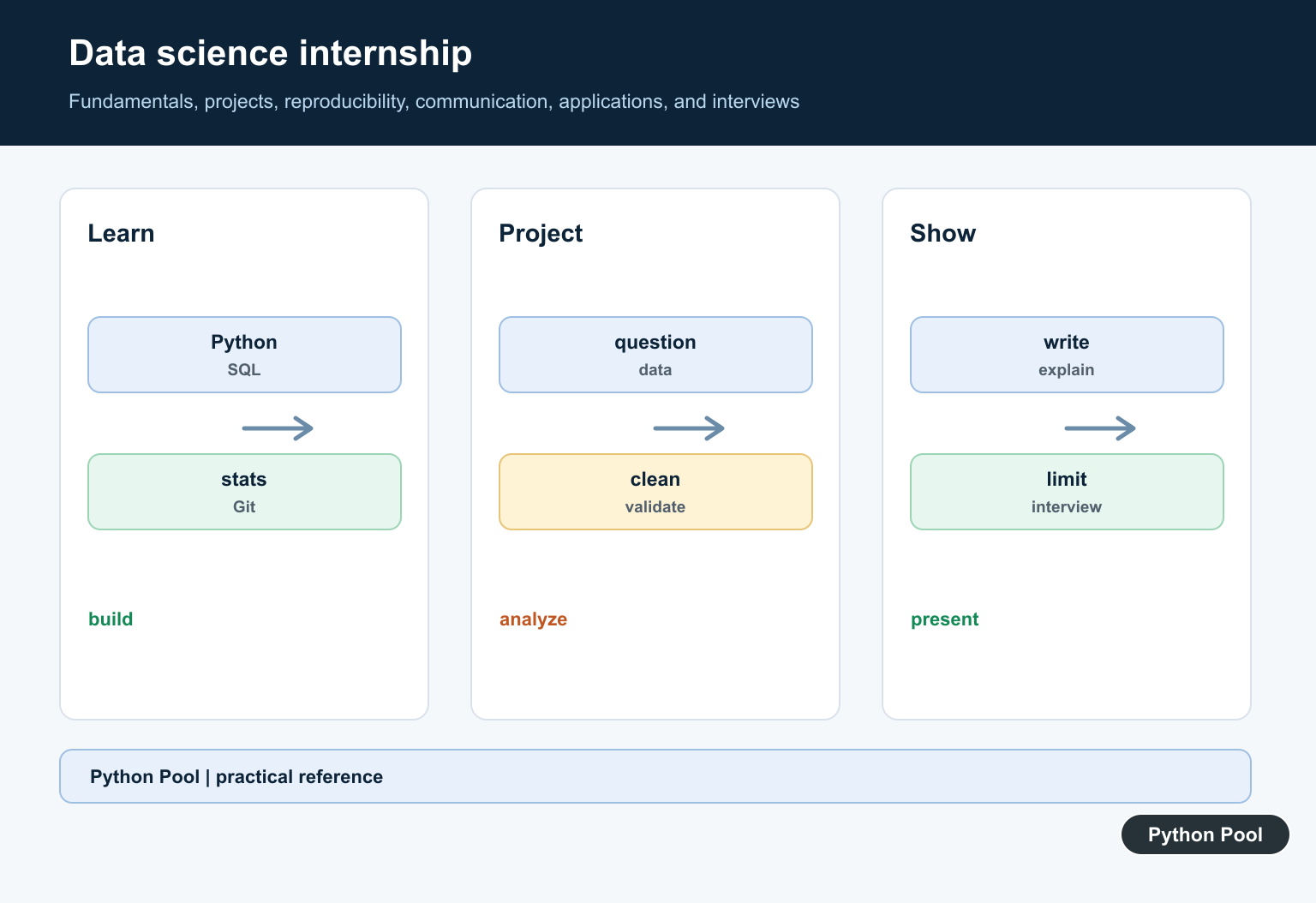
Build Fundamentals
Practice Python data structures, functions, files, environments, Git, SQL joins and aggregation, descriptive statistics, probability, and clear plots.
Choose A Real Question
A project should answer a specific question with a defensible dataset and success measure. A smaller complete analysis is usually more useful than a huge unexplained dashboard.
Make It Reproducible
Include data provenance, setup instructions, notebooks or scripts, environment details, validation steps, and a clear path from raw input to final result.
Explain Uncertainty
Describe missing data, sampling limits, assumptions, alternative explanations, metric choice, and what the analysis cannot establish. This matters as much as a polished chart.
Show Communication
Write a concise project summary for a non-specialist, then be ready to explain technical choices, failed approaches, and tradeoffs to an interviewer or teammate.
Apply With Focus
Tailor the resume and project selection to the role, seek feedback, track applications, and prepare for Python, SQL, statistics, case-study, and project-deep-dive questions.
Use the official Python tutorial for foundations and the scikit-learn user guide for modeling and evaluation concepts. Related Python Pool references include testing and NumPy arrays.
For related data workflows, compare array preparation, reproducibility tests, and feature mappings before presenting a project.
Frequently Asked Questions
Can I get a data science internship with no prior job experience?
Yes, although competition varies; coursework, research, volunteer work, projects, and clear evidence of analytical thinking can demonstrate readiness.
Which skills matter for a data science internship?
Python, SQL, statistics, data cleaning, visualization, experiments, Git, communication, and the ability to explain uncertainty are useful foundations.
What project should I put in a data science portfolio?
Choose a focused question with a real or well-documented dataset, show cleaning and validation, explain limitations, and make the analysis reproducible.
How should I prepare for a data science interview?
Review Python and SQL fundamentals, probability and statistics, experiment reasoning, case-study communication, and the details of every project on your resume.

Does learning from youtube or pursuing any non-certification course will get us an internship?
Yes. There are many software tech companies that no longer require degrees/certifications.
Only make sure that you learn Data Science very well.
Moreover, I’d suggest you participate in hackathons/competitions to improve your skill level. Kaggle is the best place to learn more about Data Science.
If you need any help feel free to contact us.
Regards,
Pratik