
Quick answer: Deep learning opportunities span applied modeling, research, data, infrastructure, evaluation, and model operations. Build a focused, reproducible project with a baseline and error analysis rather than assuming a large model is the only credible evidence.
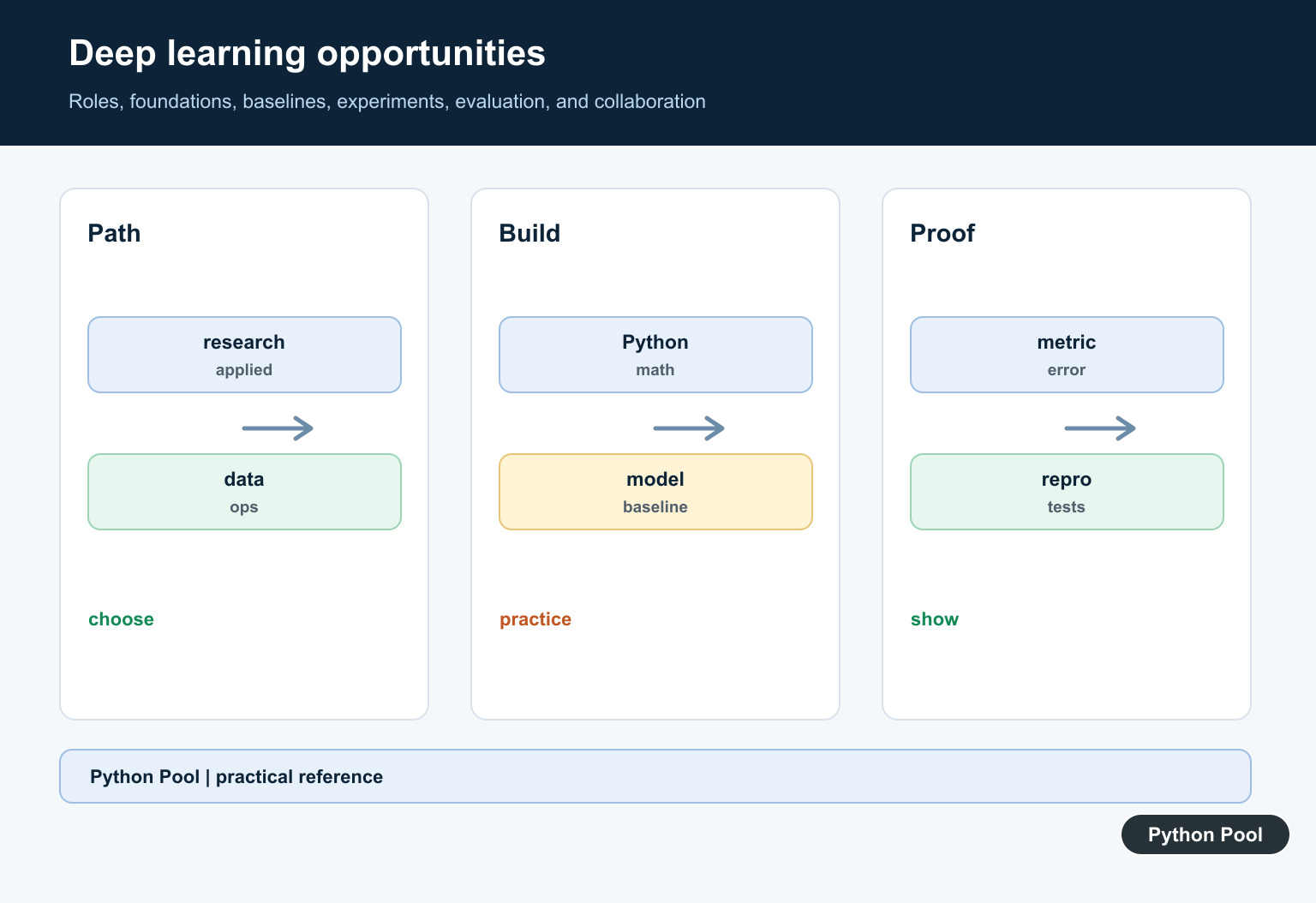
Deep learning opportunities for Python beginners are strongest when you build small, measurable projects before chasing large models. The useful path is not magic: learn arrays and data loading, train a baseline, measure it honestly, then turn the result into a portfolio item that shows code, tests, and limitations. Before starting a TensorFlow project, use Fix No Module Named TensorFlow Error to align the package, Python version, platform build, and notebook environment.
Current beginner paths are well documented by the main tool builders. The PyTorch Learn the Basics track introduces data, models, optimization, and saving models. The TensorFlow tutorials include beginner Keras workflows for classification and text. The scikit-learn neural network guide explains multi-layer perceptrons and regularization. For core language practice, the official Python tutorial and json module documentation are still the best reference points.
Start With Data Shapes And Labels
The first opportunity is learning how training examples are represented. Images, text, audio, and tabular rows all become numeric features before a model can learn from them. Beginners should practice that step with tiny examples before using a large library.
samples = [
    {"hours": 1.0, "errors": 8.0, "label": 0},
    {"hours": 2.0, "errors": 7.0, "label": 0},
    {"hours": 5.0, "errors": 3.0, "label": 1},
    {"hours": 7.0, "errors": 2.0, "label": 1},
]

def min_max_scale(rows, field):
    values = [row[field] for row in rows]
    low, high = min(values), max(values)
    width = high - low or 1.0
    return [(row[field] - low) / width for row in rows]

hours = min_max_scale(samples, "hours")
errors = min_max_scale(samples, "errors")
features = list(zip(hours, errors))
labels = [row["label"] for row in samples]

print(features)
print(labels)
This is the same idea behind tensors in PyTorch and TensorFlow. Good projects keep the target separate from inputs, store preprocessing choices, and document any data that was removed or merged. That alone separates a serious beginner project from a notebook that only works once. To turn beginner machine-learning projects into portfolio evidence, follow the project and application strategy in How to Get a Data Science Internship With No Experience.
Build A Baseline Before A Neural Network
A baseline tells you whether a deep model is worth the extra complexity. For classification, a simple rule or linear model can reveal class imbalance, bad labels, or data leakage. If a baseline already fails for a clear reason, a neural network usually hides the issue instead of fixing it. For a concrete NLP portfolio project beyond a generic classifier, XLNet for Text Classification in Python and NLP develops XLNet tokenization, labels, training inputs, and evaluation tradeoffs.
def predict_rule(point):
    hours, errors = point
    return int(hours > 0.55 and errors < 0.65)

def accuracy(features, labels):
    hits = 0
    for point, label in zip(features, labels):
        hits += int(predict_rule(point) == label)
    return hits / len(labels)

features = [(0.0, 1.0), (0.17, 0.83), (0.67, 0.17), (1.0, 0.0)]
labels = [0, 0, 1, 1]

print(round(accuracy(features, labels), 2))
Portfolio reviewers like to see that you compared something simple. It proves you can evaluate, not just import. For a beginner, that is one of the most practical deep learning opportunities: show judgment around model choice.
Understand A Dense Layer
A dense layer multiplies inputs by weights, adds bias terms, and sends the result through an activation. Libraries handle this efficiently, but the math is small enough to inspect in pure Python.
def relu(value):
    return max(0.0, value)

def dense_layer(inputs, weights, biases):
    outputs = []
    for column, bias in zip(zip(*weights), biases):
        total = sum(item * weight for item, weight in zip(inputs, column))
        outputs.append(relu(total + bias))
    return outputs

inputs = [0.6, 0.2, 0.9]
weights = [
    [0.4, -0.3],
    [0.8, 0.1],
    [-0.2, 0.7],
]
biases = [0.1, -0.05]

print([round(value, 3) for value in dense_layer(inputs, weights, biases)])
Once that is clear, PyTorch modules and Keras layers feel less opaque. You can read model summaries, notice shape mismatches, and explain why activation functions change the output.
Train A Tiny Classifier
The next learning opportunity is optimization. A model begins with rough parameters, compares predictions with labels, and adjusts those parameters in small steps. This example is intentionally small, but it shows the same loop: predict, compute error, update, repeat.
from math import exp

def sigmoid(value):
    return 1 / (1 + exp(-value))

def train(points, labels, steps=200, rate=0.8):
    weights = [0.0, 0.0]
    bias = 0.0
    for _ in range(steps):
        for point, label in zip(points, labels):
            score = sum(a * b for a, b in zip(point, weights)) + bias
            pred = sigmoid(score)
            error = pred - label
            weights = [w - rate * error * x for w, x in zip(weights, point)]
            bias -= rate * error
    return weights, bias

points = [(0.0, 1.0), (0.2, 0.8), (0.8, 0.1), (1.0, 0.0)]
labels = [0, 0, 1, 1]
model = train(points, labels)

print([round(value, 3) for value in model[0]], round(model[1], 3))
In a real workflow, a framework supplies automatic differentiation and GPU support. The habit remains the same: watch loss, measure validation performance, and keep training settings in source control.
Pick Projects That Match Entry Roles
Deep learning beginner projects should map to visible job tasks. For computer vision, classify a small image dataset and explain false positives. For natural language processing, classify short support tickets or summarize labels with clear metrics. For tabular data, compare a neural net with a tree-based model and report when the simpler model wins. For deployment, expose a prediction function with documented input and output rules.
def confusion_counts(predictions, labels):
    counts = {"tp": 0, "tn": 0, "fp": 0, "fn": 0}
    for pred, label in zip(predictions, labels):
        if pred == 1 and label == 1:
            counts["tp"] += 1
        elif pred == 0 and label == 0:
            counts["tn"] += 1
        elif pred == 1:
            counts["fp"] += 1
        else:
            counts["fn"] += 1
    return counts

predictions = [1, 0, 1, 1, 0, 0]
labels = [1, 0, 0, 1, 0, 1]

print(confusion_counts(predictions, labels))
This style of result is useful in interviews because it talks about mistakes. A beginner who can name false positives, false negatives, test data, and repeatable evaluation has a better story than someone who only lists model names.
Save Work So It Can Be Reused
Another practical opening is model operations. Even a small project should save its configuration, preprocessing notes, and metric results. That makes the project repeatable and helps another person run it without guessing hidden notebook state.
import json

run_card = {
    "project": "ticket classifier",
    "features": ["message_length", "keyword_hits"],
    "metric": {"accuracy": 0.83, "false_positive": 1},
    "next_step": "collect more support examples",
}

text = json.dumps(run_card, indent=2, sort_keys=True)
loaded = json.loads(text)

print(loaded["project"])
print(loaded["metric"]["accuracy"])
The strongest beginner portfolio pieces are small but complete: a clean data step, a baseline, a model, a metric table, and a short explanation of tradeoffs. From there, opportunities open in data preparation, model training, prompt and retrieval systems, evaluation, automation, and internal tools that help teams use models responsibly. For application work around language models, LLM Chains Explained: Prompt, Model, Memory, Output separates prompt construction, model calls, memory, parsing, validation, and fallbacks into testable steps.
For Python beginners, deep learning is worth pursuing when it is tied to concrete practice. Start with the official tutorials, build one small classification project, add one text or vision project, and write down what worked and what failed. That path is slower than copying a large notebook, but it creates durable skills that transfer to real work. For a focused text-analysis workflow that connects scikit-learn style APIs with language models, continue with Scikit-LLM Guide for Text Analysis with LLMs.
Map The Roles
Research, applied ML, computer vision, NLP, recommendation, data engineering, model operations, and education use different day-to-day skills even when they share frameworks.
Build Foundations
Practice Python, linear algebra, probability, optimization, data preparation, version control, and experiment design before adding a large number of model APIs.
Start With A Baseline
A simple rule or classical model establishes whether the data and task are meaningful. Without a baseline, a complex neural model can hide data or evaluation problems.
Evaluate Errors
Use task-appropriate metrics, leakage-resistant splits, class analysis, calibration when needed, and representative error examples. A training curve alone is not a product result.
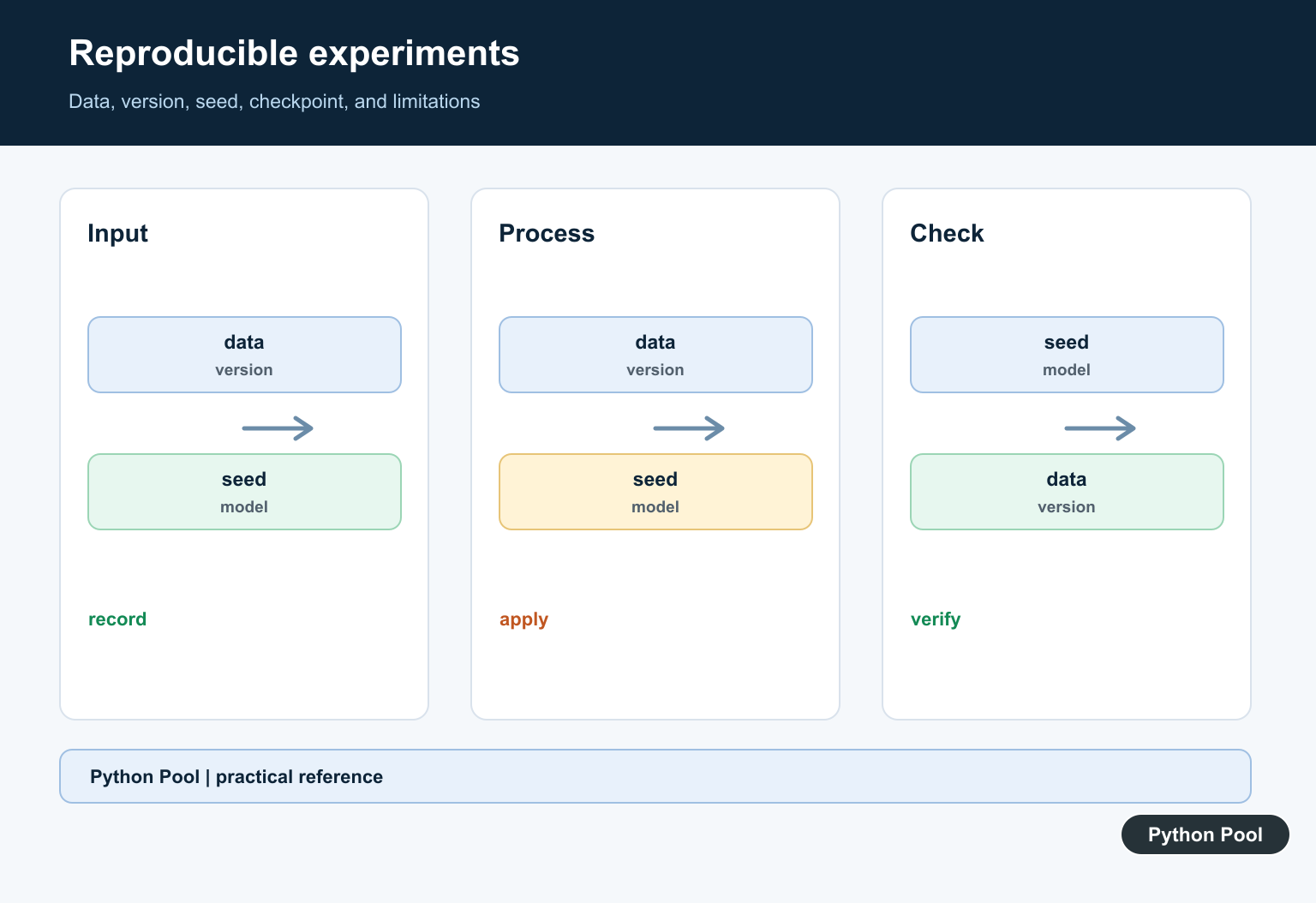
Make Work Reproducible
Record data sources, preprocessing, seeds, versions, hardware, configuration, checkpoints, and limitations so another person can reproduce and challenge the result.
Show Collaboration
Deep learning work involves problem framing, data quality, documentation, review, deployment constraints, and communication with people who do not work inside the model.
Use the official PyTorch documentation or the documentation for the framework used in the project. Related Python Pool references include testing and NumPy arrays.
For related learning workflows, compare array preparation, experiment tests, and run diagnostics before scaling a model.
Frequently Asked Questions
What opportunities are available in deep learning?
Paths include applied machine learning, research, computer vision, NLP, recommendation systems, data engineering, model operations, and education.
Which skills help with deep learning?
Python, linear algebra, probability, optimization, data preparation, a framework, experiment design, evaluation, and clear communication are useful foundations.
What should a beginner build?
Build a small reproducible project with a clear baseline, careful data split, appropriate metrics, error analysis, and documented limitations.
Is a large model required to learn deep learning?
No. Small datasets and models can teach the full workflow more affordably and make it easier to inspect errors and assumptions.
