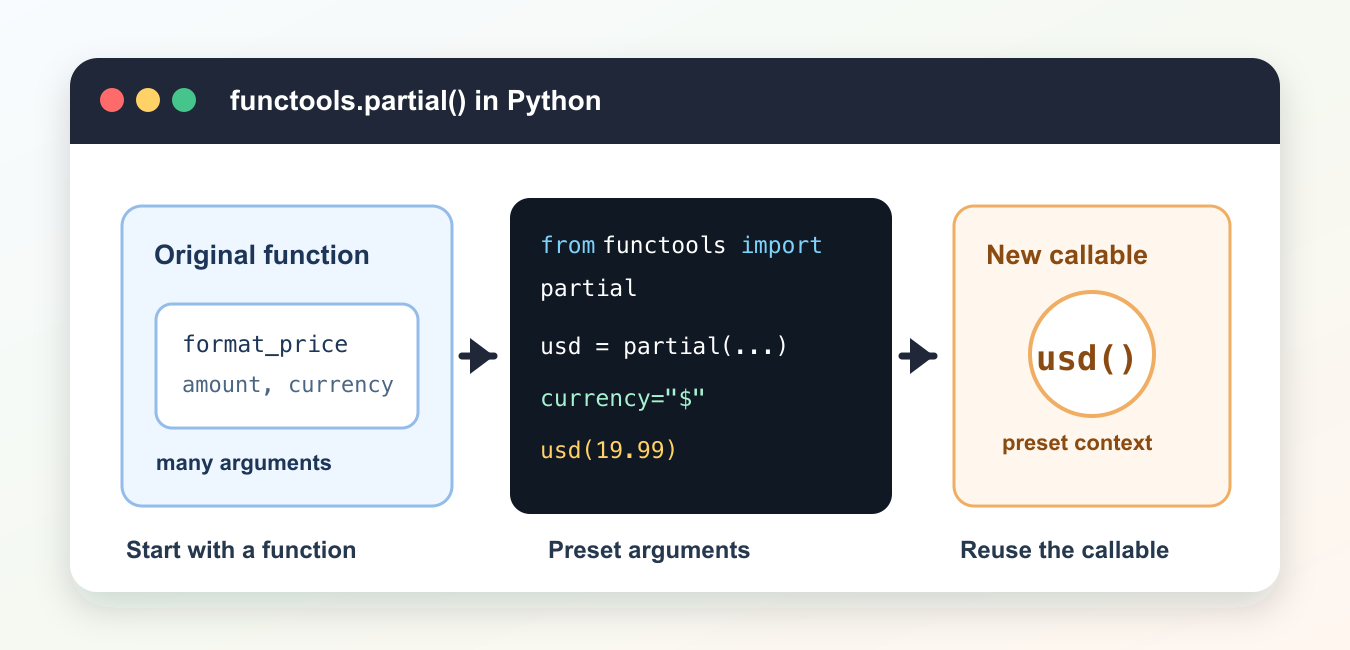
Quick answer: functools.partial returns a callable with selected arguments already bound. It is useful for callbacks and adapters when the original function already expresses the right operation. Keep the remaining call contract clear, avoid hiding important business logic inside a chain of partials, and inspect func, args, and keywords when debugging.
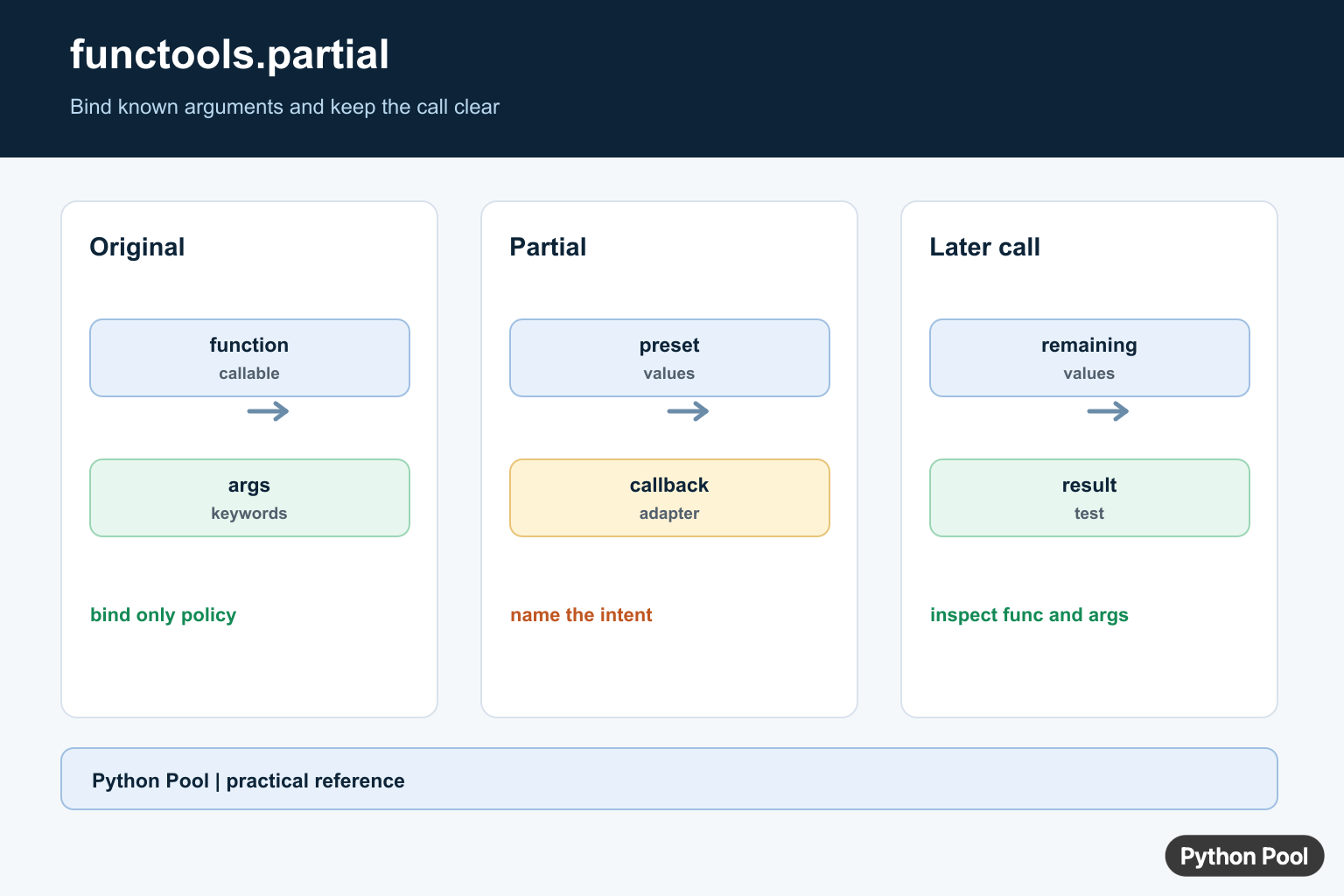
functools.partial() creates a new callable with some arguments already filled in. The official Python functools.partial documentation describes it as a way to freeze selected positional or keyword arguments. The result behaves like a smaller function that needs fewer inputs later.
Use partial() when one function is correct, but a specific use case always supplies the same context. It helps avoid repeating the same keyword arguments, and it can make callbacks, sort keys, converters, and formatting helpers easier to pass around. For reducing many values into one result, see the Python functools.reduce() guide.
The main benefit is clarity. A well-named partial callable can explain intent better than a lambda that forwards several arguments. It is still regular Python code, so if a small wrapper function is clearer, use that instead.
A partial callable keeps a reference to the original function plus the preset arguments. When you call it later, Python combines the stored arguments with the new ones. This makes it useful for configuration that belongs near setup code, while the later call site only supplies the changing value.
Create A Binary String Converter
The built-in int() function accepts a base argument. With partial(), you can create a converter that always reads base-2 text.
from functools import partial

binary_to_int = partial(int, base=2)

print(binary_to_int("1010"))
print(binary_to_int("1111"))
This keeps the call site focused on the input value. The base choice is named once when the helper is created.
Converters like this are a good use case because the behavior is narrow and obvious. Anyone reading binary_to_int("1010") can understand the expected input without reading repeated base=2 arguments throughout the code.
Preset A Formatting Option
Partial callables are useful when a helper function has one option that rarely changes.
from functools import partial

def format_price(amount, currency):
    return f"{currency}{amount:.2f}"

usd_price = partial(format_price, currency="$")

print(usd_price(19.99))
print(usd_price(4.5))
The original function remains reusable for other currencies, while usd_price is specific and easy to pass around.
This pattern also keeps formatting policy in one place. If the display format changes, update the original function or the partial setup, not every call site that prints prices.
Use partial For Sorting
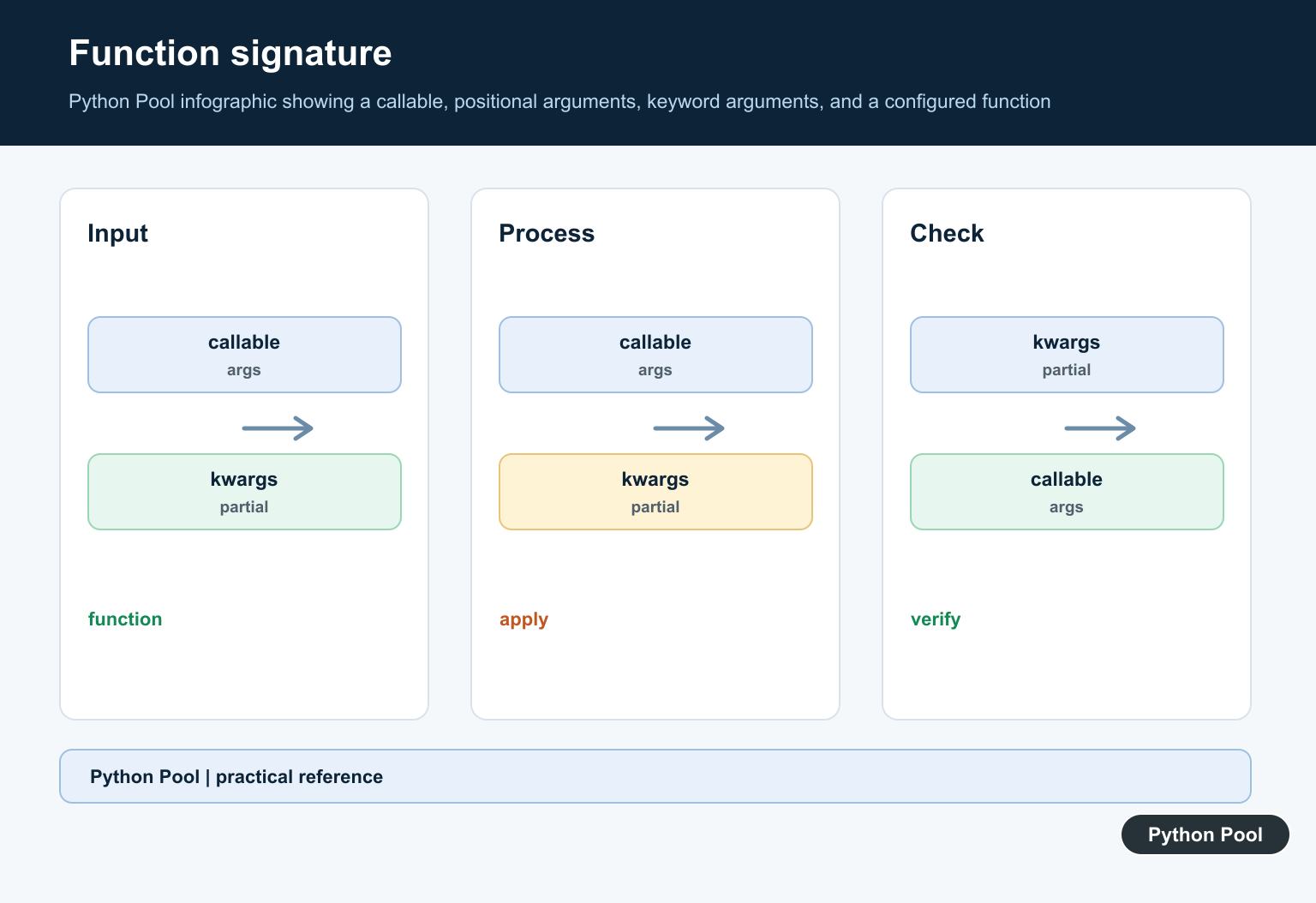
A sort key receives one item at a time. If your key helper needs extra context, partial() can preset it.
from functools import partial

def get_field(record, field):
    return record[field]

records = [
    {"name": "Ada", "score": 91},
    {"name": "Grace", "score": 98},
    {"name": "Linus", "score": 85},
]

records.sort(key=partial(get_field, field="score"))

print(records)
For simple dictionary keys, operator.itemgetter() is often shorter. The partial pattern is helpful when the key logic is more detailed.
Sort keys should stay cheap and predictable because Python may call them many times. If the key needs database access or slow parsing, compute that data before sorting instead of hiding the work inside the key function.
Apply A Reusable Rate
When a calculation uses the same rate many times, preset that rate once and reuse the callable.
from functools import partial

def add_tax(amount, rate):
    return round(amount * (1 + rate), 2)

add_sales_tax = partial(add_tax, rate=0.08)

prices = [10, 25, 40]
totals = [add_sales_tax(price) for price in prices]

print(totals)
This is clearer than repeating rate=0.08 throughout a report or checkout calculation.
Partial callables are also easy to test. Test the original function once with several rates, then test the preset helper with a few representative amounts. That gives confidence without duplicating every calculation path.
Pass A Partial Callback
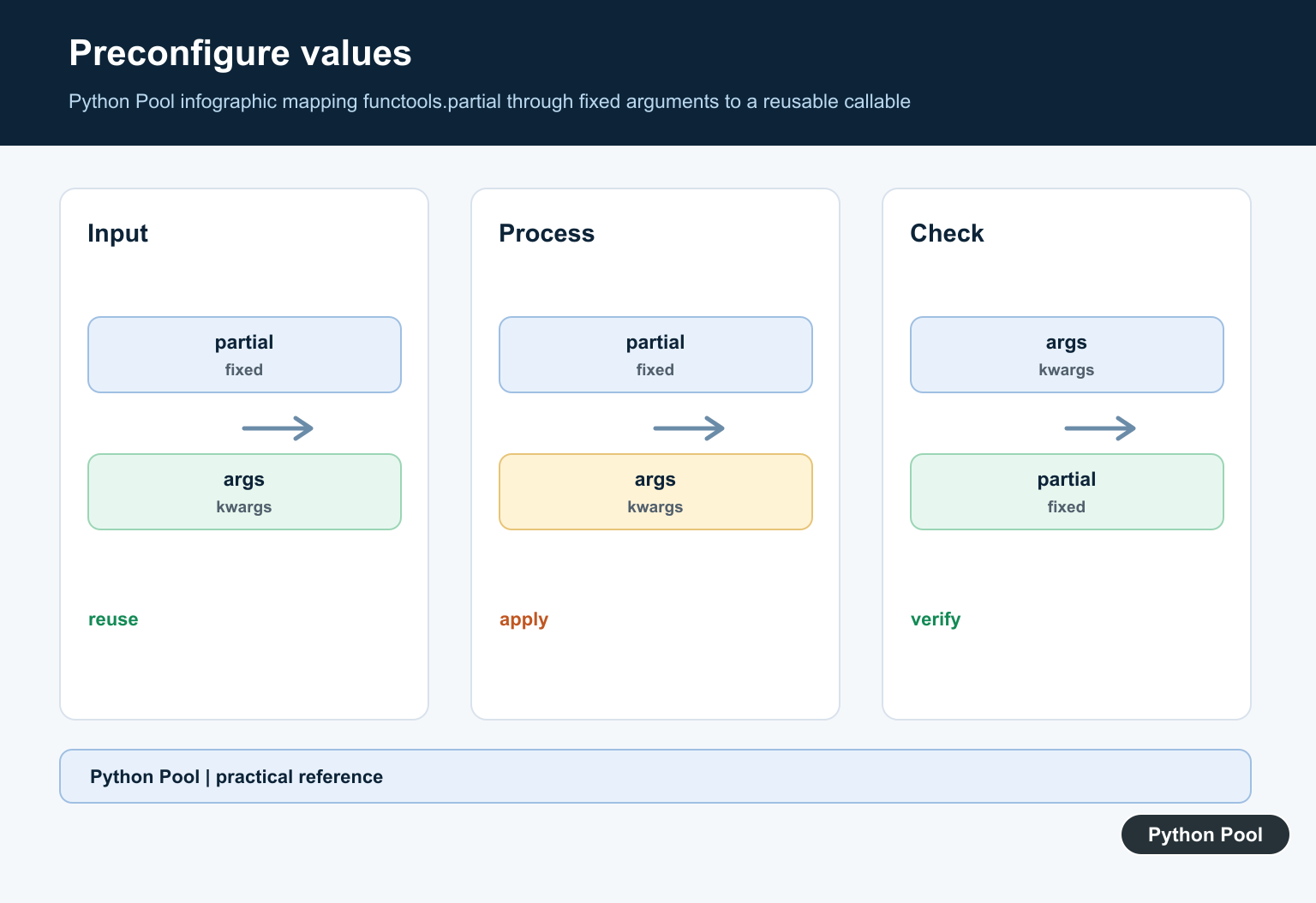
Many APIs accept a callable that will be used later. partial() lets you provide a callback with some context already attached.
from functools import partial

def log_event(prefix, event):
    print(f"{prefix}: {event}")

info_log = partial(log_event, "INFO")

for event in ["start", "process", "finish"]:
    info_log(event)
This avoids a tiny lambda and gives the callback a meaningful name. It also keeps the original log_event() helper available for other prefixes.
Callbacks are one of the places where partial() reads especially well. The code that registers the callback can include the context, while the code that triggers the callback only passes the event-specific value.
Compare partial With A Wrapper
A wrapper function is sometimes more readable than partial(), especially when the behavior deserves a docstring or extra validation.
def format_price(amount, currency):
    return f"{currency}{amount:.2f}"

def usd_price(amount):
    return format_price(amount, "$")

print(usd_price(12.75))
Choose the form that makes the code easiest to understand. Use functools.partial() for a compact callable with preset arguments. Use a wrapper function when the new behavior needs its own checks, comments, or documentation.
Good partial callables have clear names and small responsibilities. They are most useful at boundaries: callbacks, sort keys, converters, and reusable helpers. If the partial call hides too much detail, replace it with a named function so the next reader can follow the code quickly.
Avoid stacking many partial calls on top of each other. If a callable needs several layers of preset behavior, a small class or a plain function will usually be easier to debug. Use partial() as a small adapter, not as a replacement for readable design.
Bind Positional Arguments
partial stores the callable and the arguments supplied at construction time. Calling the result appends later positional values, which is often clearer than creating a one-line lambda that only forwards arguments.
from functools import partial

def power(base, exponent):
    return base ** exponent

square = partial(power, exponent=2)
print(square(5))
Bind Keywords For Callbacks
A callback often receives one value from a framework while your function needs a configuration value too. Bind the configuration with a keyword and leave the callback’s value unbound. Check the framework’s callback signature before choosing positional or keyword binding.
from functools import partial

def format_message(prefix, value):
    return f"{prefix}: {value}"

warning = partial(format_message, "warning")
print(warning("disk space is low"))
Know What Later Calls Can Override
The later call supplies the remaining arguments and can provide compatible keyword values. A partial that hides too many defaults can be harder to read than a named adapter, so use a descriptive variable or a small function when the policy itself deserves documentation.
from functools import partial

def connect(host, port=443, secure=True):
    return host, port, secure

https_connect = partial(connect, port=443, secure=True)
print(https_connect("example.com"))
print(https_connect("example.com", port=8443))
Inspect Metadata And Testing Boundaries
A partial exposes func, args, and keywords so logs and tests can describe what is bound. It does not automatically provide the same metadata as a wrapper function decorated with functools.wraps. Prefer a named adapter when signatures, documentation, or type checking are part of the public API.
from functools import partial

def multiply(value, factor):
    return value * factor

double = partial(multiply, factor=2)
assert double.func is multiply
assert double.keywords == {"factor": 2}
assert double(4) == 8
Python’s official functools.partial documentation defines bound positional and keyword arguments and the callable’s stored attributes. Use lambda expressions when a new computation is genuinely needed, not just to bind existing arguments.
For related callable design, compare filter() and lambda, functools.wraps(), and callable objects before choosing a partial, adapter, or wrapper.
Frequently Asked Questions
What does functools.partial do?
It returns a callable that pre-fills some positional or keyword arguments of another callable, so later code supplies only the remaining values.
When should I use partial instead of a lambda?
Use partial when you are binding existing arguments to an existing callable; use a lambda when the adaptation needs new logic or a different expression.
Can functools.partial bind keyword arguments?
Yes. Pass keyword arguments to partial and later calls can add or override compatible arguments according to the underlying function signature.
Does partial preserve function metadata?
partial exposes the original callable through func and stores bound arguments, but it is not a complete replacement for functools.wraps when building a wrapper function.
