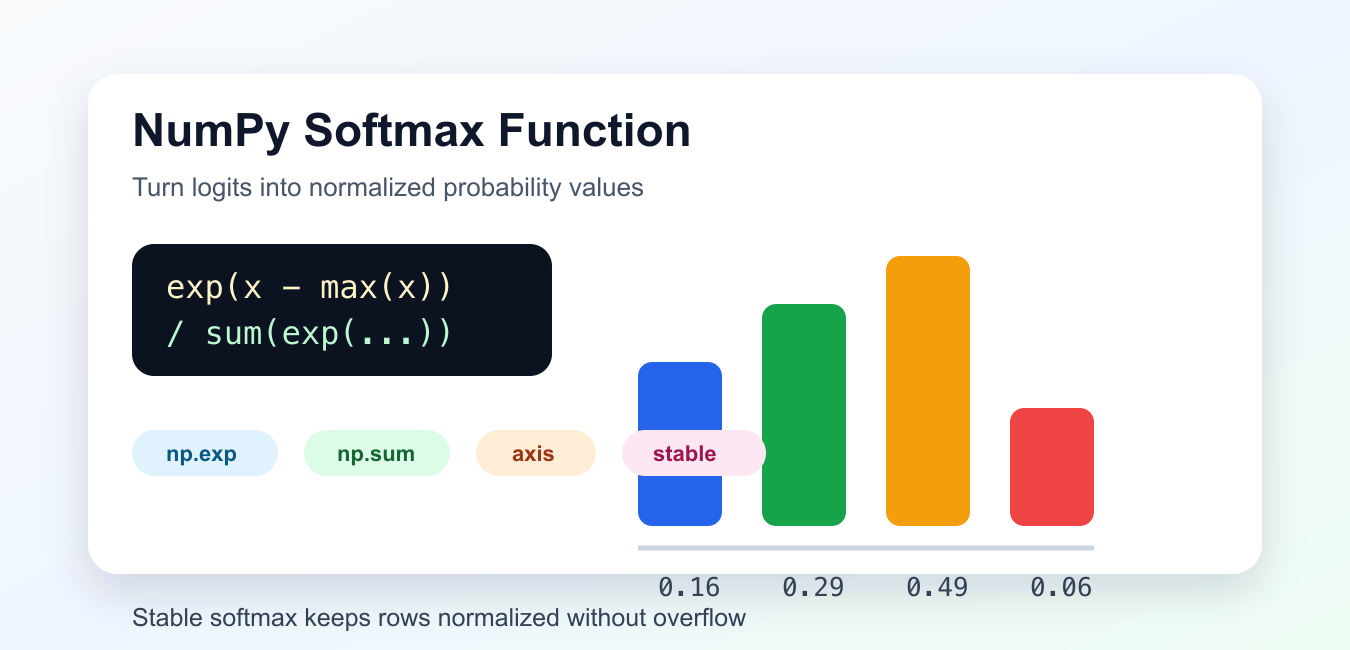
Quick answer: Softmax turns scores into non-negative values that sum to one along a chosen axis. Implement it stably by subtracting the maximum score before exponentiating, then divide by the sum and check finite outputs. The class axis must be explicit for multidimensional arrays.
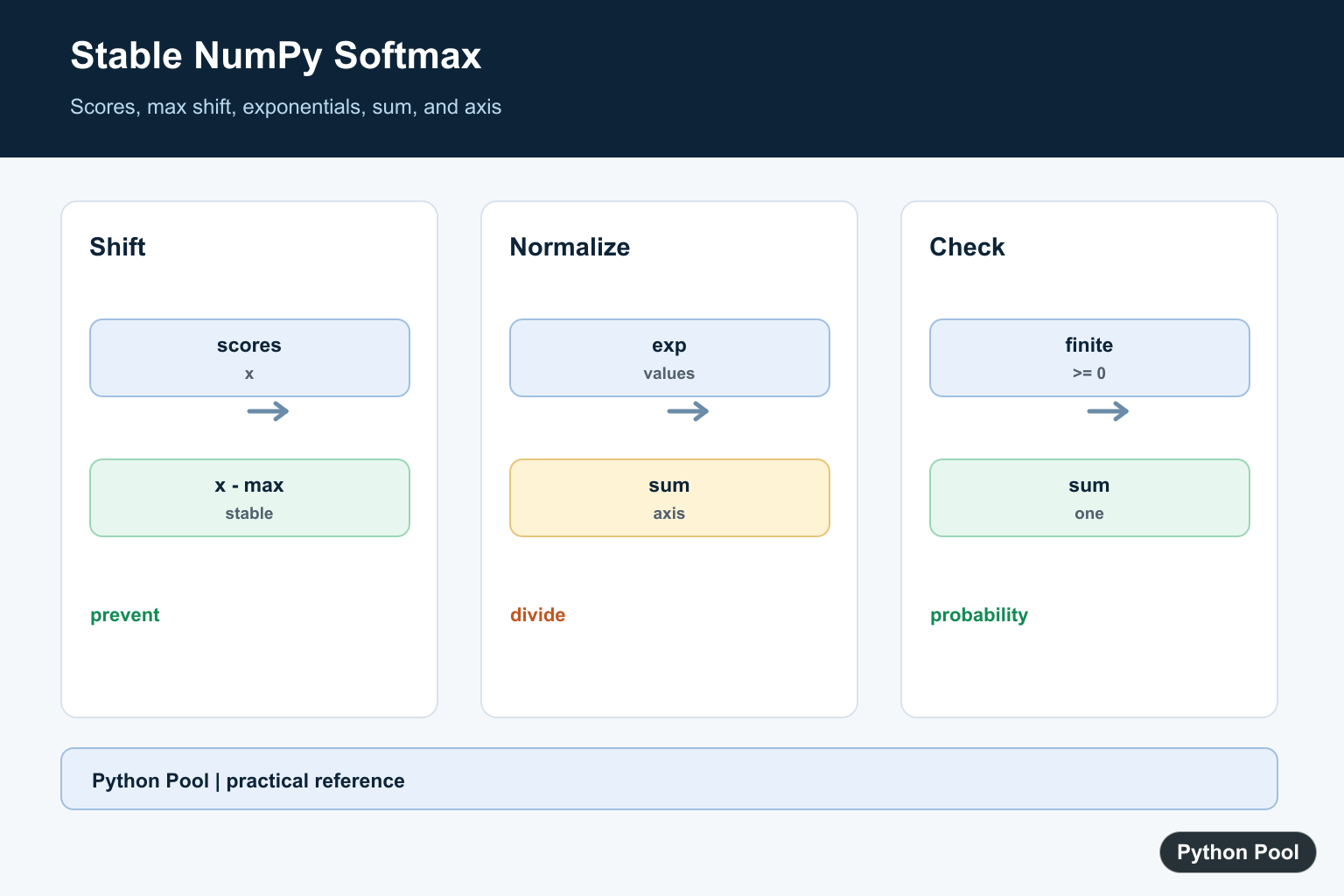
Softmax converts a list of scores into probability-like values that add up to one. It is common in classification models because the largest score becomes the largest probability, while every output remains positive.
NumPy does not provide a single top-level softmax function, but it gives the pieces needed to implement it clearly: exponentials, sums, maximum values, and axis-aware broadcasting. The official numpy.exp documentation covers exponentials, numpy.sum covers reduction, and scipy.special.softmax provides a ready-made reference implementation.
Basic Softmax Formula
The direct formula exponentiates each score and divides by the total of all exponentials.
import numpy as np

scores = np.array([1.0, 2.0, 3.0])
exp_scores = np.exp(scores)
probabilities = exp_scores / np.sum(exp_scores)

print(probabilities)
print(probabilities.sum())
The output values are positive and add up to one. Higher input scores receive larger output values.
This version is fine for small examples, but it can overflow when scores are large. A stable implementation is better for real numeric work.
Use A Numerically Stable Softmax
Subtract the maximum score before exponentiating. This does not change the final probabilities, but it keeps exponentials smaller.
import numpy as np

scores = np.array([1000.0, 1001.0, 1002.0])
shifted = scores - np.max(scores)
exp_scores = np.exp(shifted)
probabilities = exp_scores / np.sum(exp_scores)

print(probabilities)
The largest shifted score becomes zero, so its exponential is 1 instead of an enormous number. This prevents overflow in common model-output cases.
Use this stable pattern as the default whenever you write softmax yourself.
Wrap Softmax In A Function
A helper function keeps the formula reusable and makes axis handling easier to add later.
import numpy as np

def softmax(values):
    values = np.asarray(values, dtype=float)
    shifted = values - np.max(values)
    exp_values = np.exp(shifted)
    return exp_values / np.sum(exp_values)

print(softmax([2.0, 1.0, 0.1]))
np.asarray() accepts lists, tuples, and arrays. The float conversion avoids integer division surprises and makes the output numeric type clear.
For one-dimensional scores, this helper is usually enough.
Apply Softmax Row By Row
Model outputs often arrive as a two-dimensional array, with one row per example and one column per class. Use axis=1 to normalize each row. Softmax normalizes a vector across classes, while NumPy tanh() Hyperbolic Tangent Guide applies the element-wise tanh activation and its bounded output range.
import numpy as np

logits = np.array([
    [2.0, 1.0, 0.1],
    [0.5, 1.5, 3.0],
])

shifted = logits - np.max(logits, axis=1, keepdims=True)
exp_values = np.exp(shifted)
probabilities = exp_values / np.sum(exp_values, axis=1, keepdims=True)

print(probabilities)
print(probabilities.sum(axis=1))
keepdims=True preserves the two-dimensional shape during subtraction and division, so broadcasting lines up with each row.
Always choose the axis intentionally. Normalizing across the wrong axis can produce values that add to one in the wrong direction.
Compare With SciPy Softmax
If SciPy is already available, scipy.special.softmax() can calculate softmax directly.
import numpy as np
from scipy.special import softmax

logits = np.array([[2.0, 1.0, 0.1], [0.5, 1.5, 3.0]])
probabilities = softmax(logits, axis=1)

print(probabilities)
print(probabilities.sum(axis=1))
This is concise and handles the stable calculation internally. It is a good reference when checking a custom NumPy implementation.
If your project only uses NumPy, the manual stable formula avoids adding a new dependency.
Choose The Predicted Class
After softmax, argmax() returns the index of the largest probability. This is a common final step in classification demos.
import numpy as np

labels = np.array(["cat", "dog", "horse"])
probabilities = np.array([0.14, 0.79, 0.07])

index = np.argmax(probabilities)

print(labels[index])
print(probabilities[index])
Softmax output is useful for ranking classes, but it should not be treated as perfect confidence. Calibration depends on the model and training process.
For reporting, show both the predicted label and the probability so readers can see how decisive the result is.
Softmax Versus Normalization
Softmax is not the same as dividing raw values by their sum. Softmax first applies an exponential transformation, which increases the gap between larger and smaller scores. A score that is only a little larger can become much more prominent after exponentiation.
This behavior is useful for classification logits, where the model outputs relative scores rather than already normalized values. If your data already contains counts, percentages, or positive weights, ordinary normalization may be more appropriate than softmax.
Softmax also preserves order: the largest input gets the largest output. It changes the scale, not the ranking. That makes it useful when you need a probability-shaped distribution while keeping the model’s preference order intact.
Temperature And Sharpness
Some machine-learning workflows divide logits by a temperature before softmax. A lower temperature makes the largest class more dominant. A higher temperature spreads probability mass more evenly across classes.
Temperature is useful for experimentation and model calibration, but it should be chosen deliberately. Changing it can make predictions look more or less confident without changing the underlying model scores.
Common Softmax Mistakes
Do not exponentiate large scores without subtracting the maximum first. Overflow can create infinite values and break the normalization step.
Do not forget the axis for batch arrays. A one-dimensional example may work, then fail logically when moved to rows and columns.
Do not round probabilities before checking that they sum to one. Rounding can make a correct result look slightly off.
The practical default is a stable NumPy implementation with keepdims=True for arrays, or SciPy’s softmax() when SciPy is already part of the project.
Use The Stable Formula
For scores x, compute exp(x – max(x)) and divide by the sum of those shifted exponentials. Subtracting the maximum does not change the result because the common factor cancels, but it prevents avoidable overflow.
Choose The Class Axis
For a matrix of rows and classes, softmax usually runs across the class axis. Do not assume axis=-1 without documenting the array layout; a wrong axis can produce values that look plausible while representing the wrong distribution.
Handle Batches And Masks
Broadcast the maximum and sum with keepdims=True when normalizing a multidimensional array. If padded or masked scores are present, define how they contribute before exponentiation rather than letting padding become a class.
Validate The Probability Contract
Check that outputs are finite and non-negative and that sums are close to one along the selected axis. Extreme values, empty arrays, NaNs, and integer inputs deserve explicit tests.
Know When To Use A Library
SciPy provides scipy.special.softmax and may be preferable when the project already depends on SciPy. A small NumPy implementation is useful for teaching or a dependency-light path, but it should preserve the same numerical contract.
NumPy’s exp and sum references define the building blocks; SciPy softmax provides a ready-made implementation. Related references include axis semantics, numeric checks, and array tests.
For related array math, compare axis semantics, numeric checks, and array stacking when designing a model output.
Frequently Asked Questions
Does NumPy have a built-in softmax function?
NumPy provides the operations needed to implement it; SciPy also provides scipy.special.softmax as a ready-made implementation.
Why subtract the maximum score?
Subtracting the maximum preserves the probabilities while keeping exponentials in a safer numeric range.
What axis should softmax use?
Use the axis containing the competing class scores, which is often the last axis but depends on the array contract.
How do I validate softmax output?
Check finite values, non-negative probabilities, and sums close to one along the selected axis.
