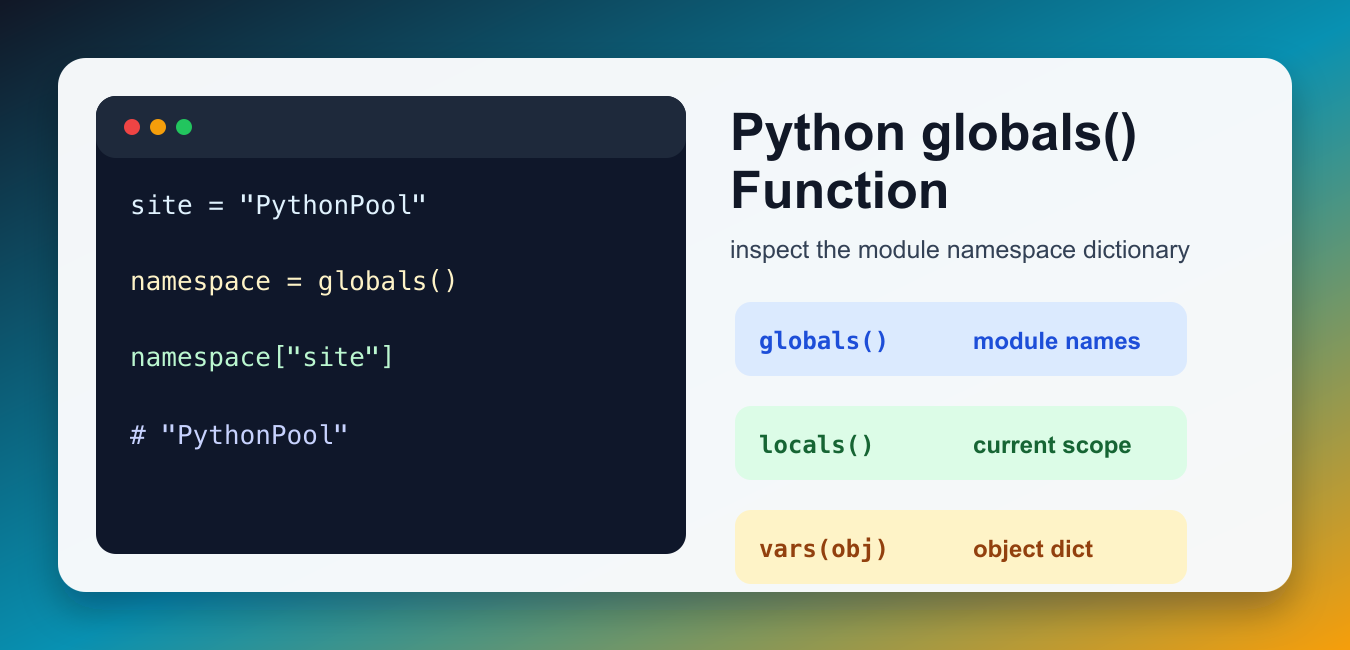
Quick answer: globals() returns the current module’s global namespace as a dictionary. It is useful for deliberate introspection, but using it for hidden configuration or arbitrary mutation makes dependencies harder to validate and test.
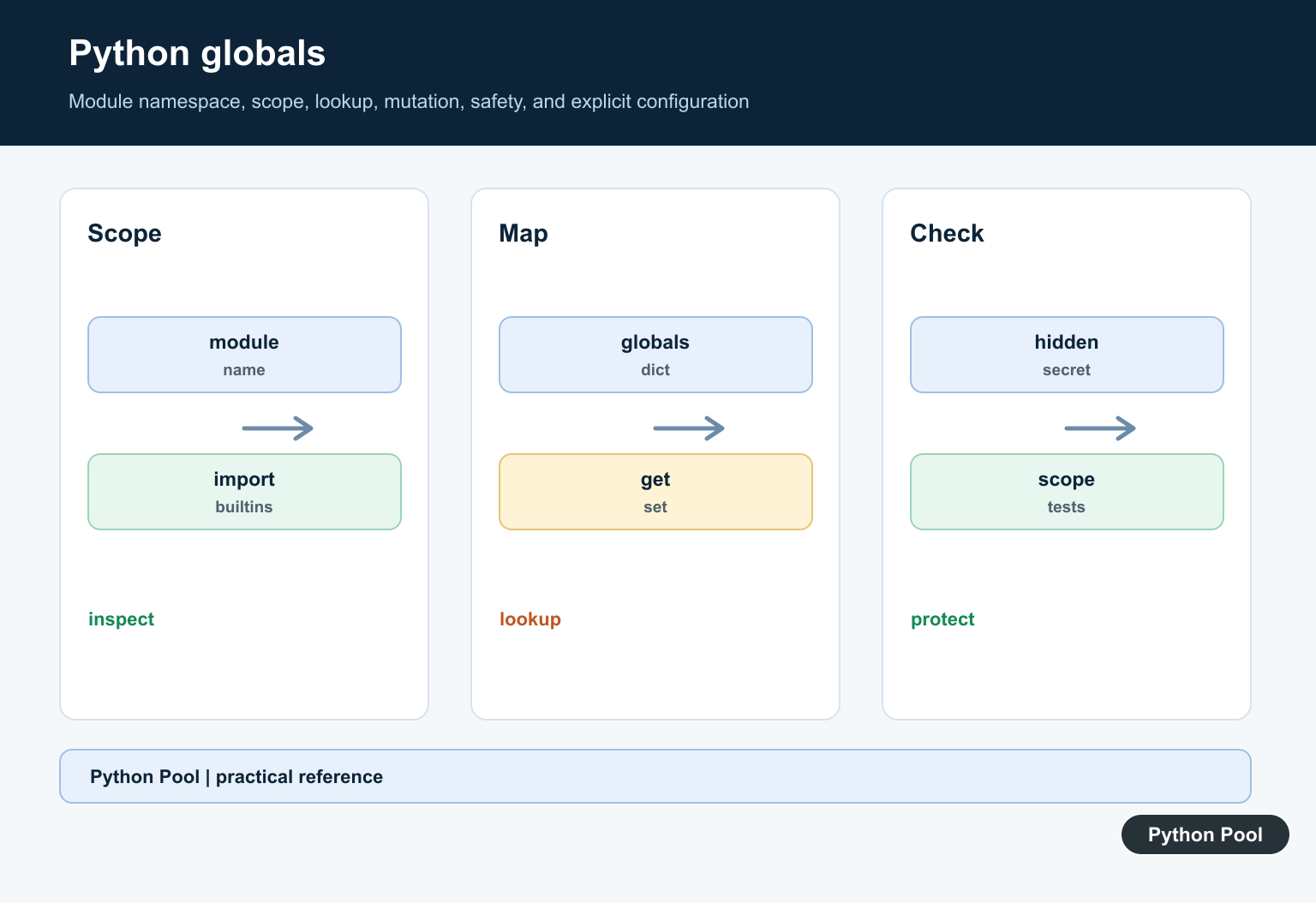
Python globals() returns the dictionary that represents the current module’s global namespace. In normal scripts, that dictionary contains names defined at the top level of the file, imported modules, functions, classes, and special names such as __name__.
The function is useful for inspection, debugging, dynamic lookup, and understanding how names are stored. It should be used carefully for mutation. Changing the dictionary returned by globals() can create or replace module-level variables, but explicit assignment is usually clearer.
Think of globals() as a window into the module namespace, not as a general storage system. If your program needs dynamic keys and values, a normal dictionary is usually easier to read and test. Use globals() when the namespace itself is the thing you need to inspect.
Basic globals() Example
At module level, globals() gives you a dictionary of names available in that module. You can read values from it with normal dictionary access.
site = "PythonPool"

namespace = globals()

print(namespace["site"])
print("site" in namespace)
The key "site" exists because site is a global name in the module. For related object namespace inspection, see PythonPool’s Python vars() guide. Reading from the dictionary is often safe in debugging tools, but production code should usually access known names directly.
globals() Inside a Function
Calling globals() inside a function still returns the module-level namespace, not the function’s local variables. This is the main difference between globals() and locals().
language = "Python"

def show_global_name():
    namespace = globals()
    print(namespace["language"])

show_global_name()
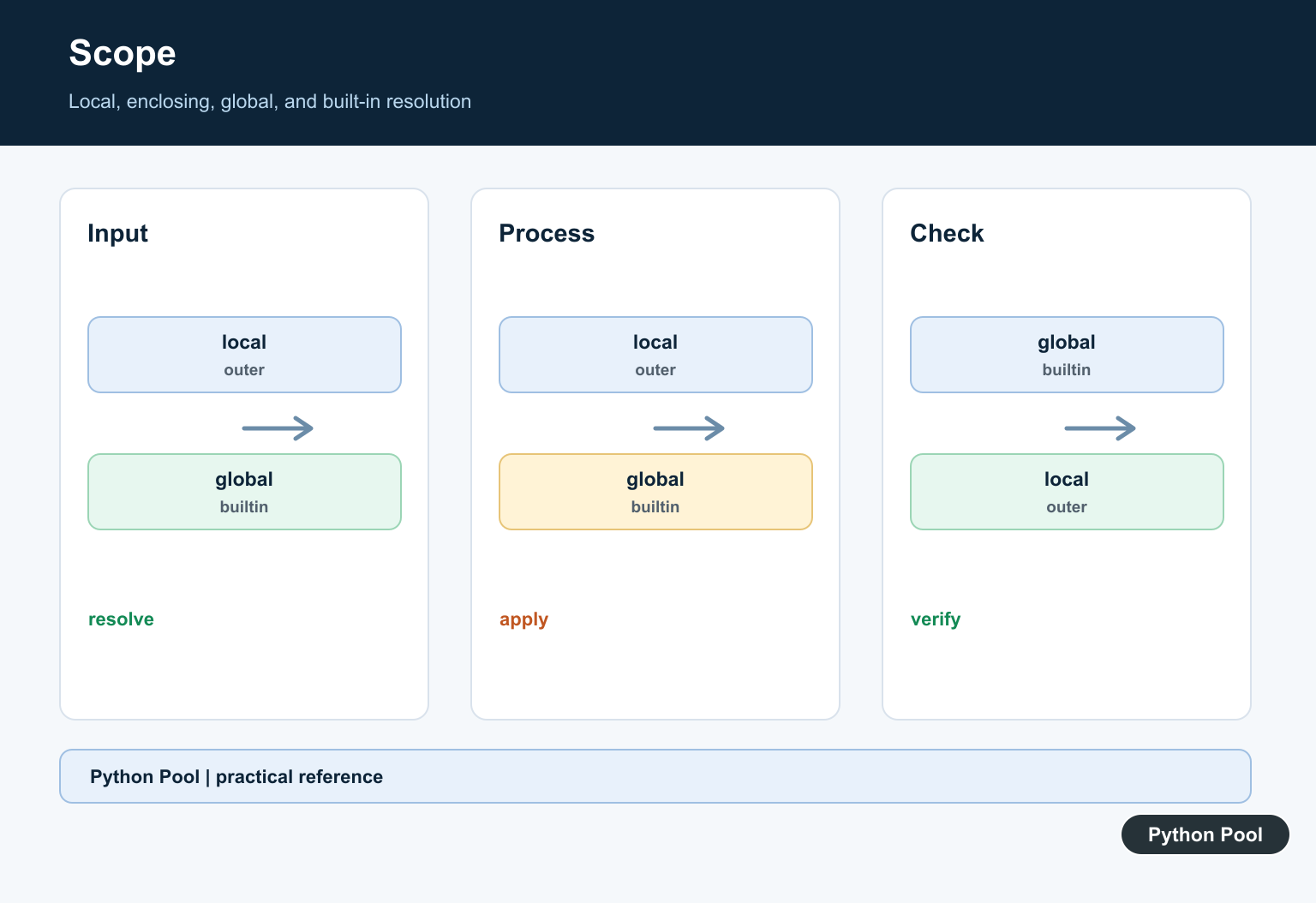
The function can read the global dictionary, but its own local variables live somewhere else. This matters when debugging name lookup because local, enclosing, global, and built-in scopes are checked in a specific order. A variable defined inside the function will not automatically appear in globals().
Creating a Global Name Dynamically
You can assign into the dictionary returned by globals(). This creates or updates a module-level name. It works, but it should be rare because dynamic global names make code harder to search, type-check, and refactor.
globals()["debug_mode"] = True

print(debug_mode)
print(globals()["debug_mode"])
Prefer a normal assignment such as debug_mode = True when the name is known while writing the code. Use dynamic assignment only when you are building tools, loaders, or very controlled metaprogramming utilities. Even then, keep the generated names predictable and document why a normal dictionary is not enough.
Check Whether a Global Name Exists
Because globals() returns a dictionary, membership checks are straightforward. This can be useful in diagnostic code or optional setup paths.
feature_name = "debug_mode"

if feature_name in globals():
    print("feature is configured")
else:
    print("feature is missing")
For imports and optional dependencies, a clearer pattern is often to catch ImportError or use import tools directly. PythonPool’s Python conditional import guide covers that case. For feature flags, a dedicated settings object or dictionary is usually more maintainable than a global-name lookup.
Compare globals() and locals()
locals() returns the current local namespace. Inside a function, that usually means the function’s local variables. globals() still points back to the module namespace.
topic = "namespaces"

def inspect_scope():
    count = 3
    print("count" in locals())
    print("count" in globals())
    print("topic" in globals())

inspect_scope()
This prints that count is local, not global, while topic is global. Use this distinction when reading tracebacks or debugging variable shadowing. If a name resolves to an unexpected value, checking the local and global namespaces separately can make the source of the value obvious.
Compare globals() and vars()
vars() is different again. With no argument, it behaves like locals() in many contexts. With an object argument, it returns that object’s __dict__ when available.
class Config:
    pass

config = Config()
config.timeout = 30

print(vars(config))
Use globals() for module-level names, locals() for the current local namespace, and vars(obj) for an object’s attributes. If you are checking whether a value can be called after retrieving it dynamically, see PythonPool’s Python callable() guide.
Best Practices
- Use
globals()mostly for inspection and debugging. - Avoid creating many dynamic global variables.
- Prefer explicit assignments and dictionaries for application state.
- Use
locals()orvars()when those namespaces better match the data you need.
Dynamic namespace access can be powerful, but it is also easy to overuse. If a regular dictionary would make the code clearer, choose the regular dictionary. Reserve globals() for cases where you truly need to inspect or interact with the module namespace.
One practical rule is to avoid writing to globals() inside business logic. If you find yourself doing that, replace it with a dictionary, a dataclass, or explicit module variables before the code grows harder to reason about.
References
- Python documentation: globals()
- Python reference: naming and binding
- Python tutorial: scopes and namespaces
Understand The Namespace
A module’s global namespace contains names defined or imported at module scope, along with runtime entries. It is not the same as every name accessible through attributes or builtins.
Read Deliberately
globals().get can inspect an optional name, but an explicit variable, mapping, or configuration object is usually clearer when the dependency is part of normal application logic.
Mutate With Care
Adding or replacing a global through the mapping changes module state without showing the dependency at the call site. Use this only for controlled metaprogramming with tests.
Compare locals
locals describes a local scope and has different update guarantees. Do not assume writing either mapping is a reliable way to rewrite optimized local variables.
Protect Secrets
A global namespace can contain imported modules, configuration, or sensitive objects. Do not dump it into logs or expose it to untrusted code.
Test Scope Behavior
Test imports, functions, nested scopes, missing names, module reloads, mutation, isolation, and a safer explicit configuration alternative.
Use the official Python globals documentation. Related Python Pool references include dictionaries and testing.
For related namespace workflows, compare mapping behavior, scope tests, and safe diagnostics before mutating globals.
Frequently Asked Questions
What does globals() return in Python?
globals() returns a dictionary representing the current global namespace of the module where it is called.
Can I change a global variable through globals()?
Updating the returned mapping can change module-level names, but it bypasses ordinary readability and may create hidden dependencies or invalid state.
What is the difference between globals() and locals()?
globals describes the module namespace, while locals describes the current local scope and has different update behavior and guarantees.
Should I use globals() for configuration?
Usually no. Explicit objects, dictionaries, environment parsing, or dependency injection make configuration easier to validate, test, and understand.
