Quick Answer
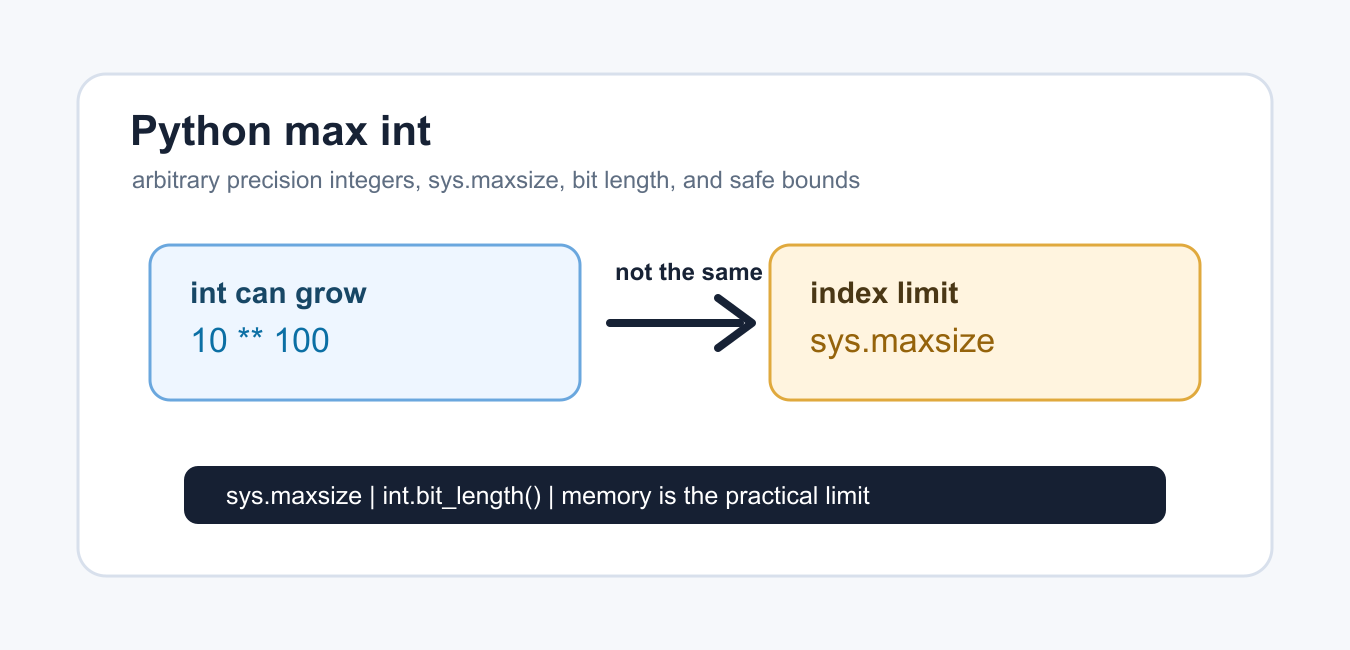
Python int uses arbitrary precision, so it has no fixed maximum value like a 64-bit integer. sys.maxsize is the platform-sized maximum used for many indexes and container lengths; it is not the maximum Python integer. Use int.bit_length() to inspect how many binary bits a value needs.
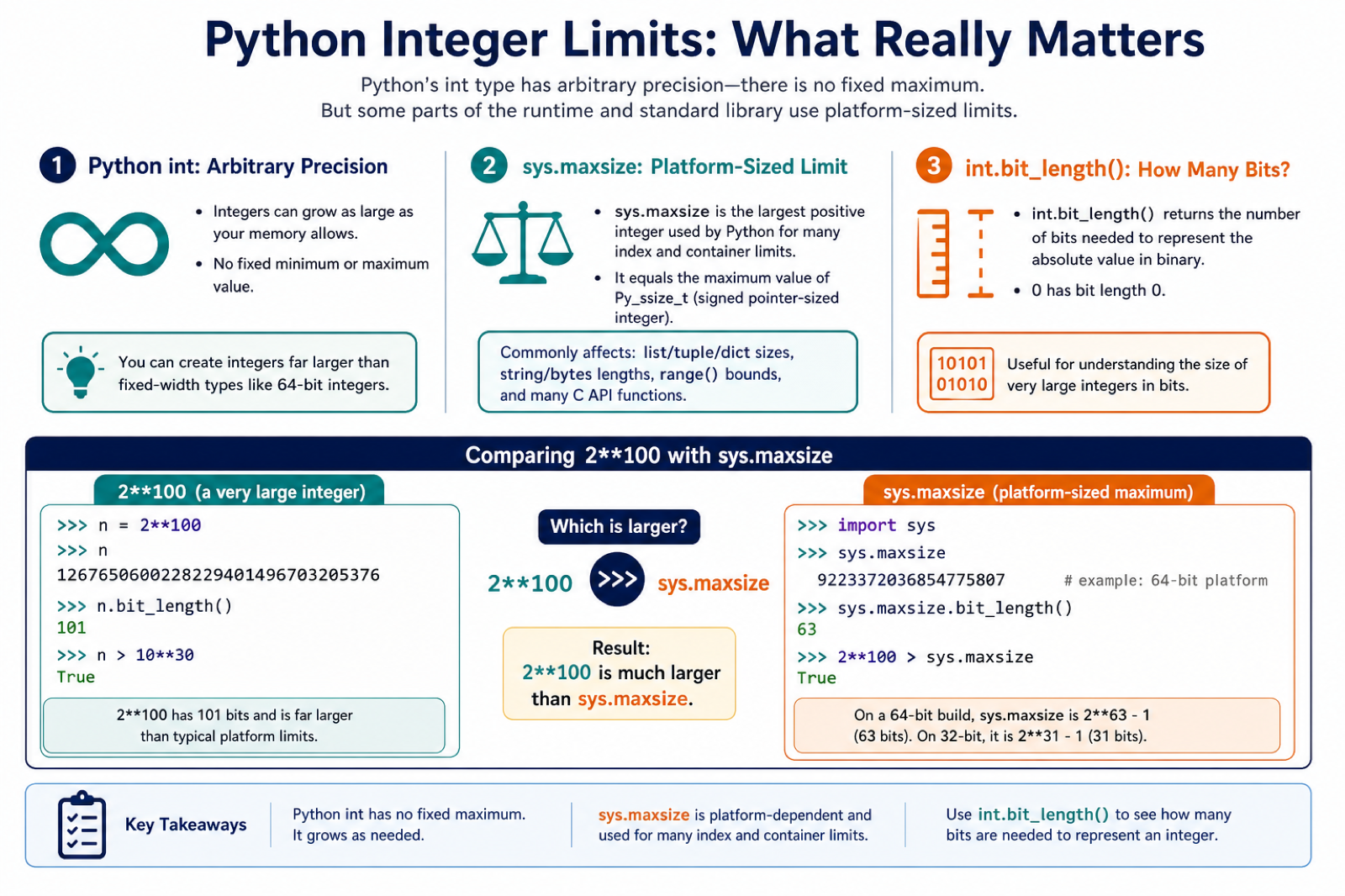
Python 3 does not have a fixed maximum integer value for normal int objects. Integers can grow as large as available memory allows. The value often confused with a Python max int is sys.maxsize, but that is not the largest integer Python can store. Converting to float is not a safe workaround for a fixed-width C boundary; Fix Python int too large for C long explains the actual integer limit and validation strategy.
The official Python documentation covers sys.maxsize, numeric types, and int.bit_length().
The practical rule is simple: use ordinary Python integers for exact whole-number arithmetic, use sys.maxsize when an API asks for an index-sized boundary, and use explicit validation when your application has its own business limit.
This distinction matters when porting code from languages with fixed-width integers. In Python, arithmetic such as 10 ** 100 works, but converting that number to a C type, array index, timestamp, or external database field may still fail.
It also matters when reading older tutorials. Some resources use “max int” to mean the largest machine word, while Python 3 uses a flexible integer representation. Be precise about which limit you are discussing.
If you need a maximum value for your own program, define it with a clear name. A business limit such as a maximum retry count, account balance, page number, or percentage is not the same as Python’s internal integer capacity.
Check sys.maxsize
sys.maxsize is the largest positive value used by Python’s platform-sized indexes.
import sys

print(sys.maxsize)
print(type(sys.maxsize))
On most modern 64-bit builds, this is 9223372036854775807. The exact value depends on the Python build and platform.
Use sys.maxsize for sentinel values, index-related bounds, or compatibility checks. Do not treat it as the largest possible Python integer.
For example, a list index, slice size, or platform-facing C extension may care about this value. A normal arithmetic expression usually does not.

Python int Can Grow Larger
Normal Python integers can exceed sys.maxsize.
import sys

big_number = sys.maxsize + 1
huge_number = 10 ** 40

print(big_number > sys.maxsize)
print(huge_number)
This works because Python integers use arbitrary precision. Python stores as many digits as needed until memory or another external limit becomes the problem.
This is useful for exact arithmetic in combinatorics, cryptography experiments, IDs, counters, and large calculations. It is not a reason to skip input validation.
The larger the number becomes, the more memory and CPU time operations can require. Python avoids fixed overflow for integers, but it cannot make every huge calculation cheap.
Use bit_length To Measure Size
bit_length() returns the number of bits needed to represent a positive integer in binary.
number = 10 ** 20

print(number.bit_length())
print((255).bit_length())
print((0).bit_length())
This is often more useful than asking for a maximum integer. It tells you how large the current value is in binary terms.
Use it when checking whether a number fits in 8 bits, 32 bits, 64 bits, or another fixed-width format before exporting it.
Unlike converting to a string and counting digits, bit_length() directly answers a binary storage question. That makes it useful for protocols, masks, binary files, and compact encodings.
Check A 32-Bit Boundary
If your application must fit a signed 32-bit integer, define that range directly.
MIN_INT32 = -(2 ** 31)
MAX_INT32 = 2 ** 31 - 1

def fits_int32(number):
    return MIN_INT32 <= number <= MAX_INT32

print(fits_int32(100))
print(fits_int32(10 ** 12))
This is the right style when writing to fixed-width databases, binary formats, or APIs that document a numeric limit.
The limit belongs to the destination system, not to Python’s normal integer arithmetic. Naming it clearly prevents confusion.
You can write similar helpers for unsigned integers, database IDs, port numbers, or any documented external range. The check should match the system that will receive the value.

Large Arithmetic Still Works
Python can calculate exact large integer results without overflowing.
from math import factorial

value = factorial(30)

print(value)
print(value > 2 ** 63 - 1)
The result is larger than a signed 64-bit maximum, but Python stores it as an integer.
Large integer arithmetic can still be slow or memory-heavy. The lack of a fixed max value does not mean every calculation is practical.
When performance matters, measure the real operation. Addition, multiplication, exponentiation, and factorial growth have different costs as numbers become larger.
Validate Application Limits
When user input should be bounded, write the rule explicitly instead of relying on Python’s integer behavior.
def parse_percent(text):
    value = int(text)
    if not 0 <= value <= 100:
        raise ValueError("percent must be from 0 to 100")
    return value

print(parse_percent("75"))
This validates the business rule. A percent has a meaningful range even though Python could store much larger numbers.
The same idea applies to form fields and API inputs. Validate what the field means, not what Python can technically represent.
The practical takeaway is that Python has no small fixed max int for normal arithmetic. Use sys.maxsize for platform index limits, bit_length() for measuring integer size, and explicit checks for external or application-specific limits.
Good tests should include zero, negative numbers, sys.maxsize, sys.maxsize + 1, a very large power of ten, and values just outside any external range you enforce.

Python int Does Not Have a Fixed Maximum
Python automatically expands an integer as long as the process has enough memory. The value can be much larger than a machine word without overflowing into a smaller integer type.
value = 2 ** 100
print(value)
print(value.bit_length())

large = 10 ** 1000
print(len(str(large)))
Arithmetic can still be limited by available memory, execution time, conversion limits, or the APIs that receive the value. “Arbitrary precision” means the language does not impose a small fixed-width integer maximum.
What sys.maxsize Actually Means
sys.maxsize is the largest value a platform’s signed Py_ssize_t can represent. It is commonly relevant to sequence lengths and indexes, but it does not cap ordinary Python integer arithmetic.
import sys

print(sys.maxsize)
print(sys.maxsize.bit_length())
print((sys.maxsize + 1).bit_length())
On a typical 64-bit build, sys.maxsize is 2**63 - 1. A list or other built-in container cannot necessarily grow that large because memory is a separate practical limit, and the exact behavior depends on the object and platform.
Frequently Asked Questions
What is the maximum integer in Python?
There is no fixed maximum Python int. Values grow to the practical limits of available memory and the operations that use them.
What does sys.maxsize mean in Python?
It is the largest platform-sized signed value commonly used for indexes and container lengths. It is not the maximum value of int.
What does int.bit_length() return?
It returns the number of bits needed to represent an integer in binary, excluding the sign and leading zeroes.
Why can Python integers be larger than 64 bits?
Python int uses arbitrary precision rather than a fixed 32-bit or 64-bit storage width, so it can expand while memory remains available.

The integer limit is equal to 2 to the power of the python RAM limit in bytes, if you want to find the python RAM limit check the RAM limit per program
I disagree with your statement. There is a clear mention that the integer limit is nondependent on the memory limit. As python3 operates on long int, The long int is not restricted by the number of bits and can expand to the limit of the available memory. Source: Texas Univ Lecture.