Image

This Week In Security: More Linux Bugs, Biggest Crypto Theft Ever, Prusa Printers, Residential Proxies

Linux kernel bugs which can be triggered remotely, without any login, are rare. Most kernel vulnerabilities need an attacker to already be running code on the machine. CVE-2026-98432 is one of those: a use-after-free in the IPv4 TCP handshake code, rated CVSS 9.8, which Atlas has written up in detail. It goes all the way back to Linux 4.4.

A use-after-free is exactly what it sounds like: the program releases a chunk of memory, but some other code keeps using it. If an attacker can get their own data placed into that freed memory before it’s used again, they can influence what the kernel does next. In this case, when a server accepts a connection whose SYN packet carries IPv4 header options (a rarely used feature of IPv4), the kernel hands those options from the half-open connection to the full connection without copying them, then frees them while another CPU core may still be reading them. The fix is a four-line change, from “kfree()” to “kfree_rcu()”, which waits until every reader is done before freeing the memory. A lost race simply fails the handshake, so an attacker can keep trying.

The bug was reported by Xinyang Ge at Anthropic, and Anthropic says its Claude model wrote a working proof-of-concept that gets root on “Linux servers with a multipath TCP listener.” Multipath TCP (MPTCP) lets a single connection use several network paths at once, like WiFi and cellular, and you might assume almost nobody runs it on servers. Unfortunately, as Marcus Hutchins points out, Debian kernels enable MPTCP by default, and Go 1.24 and newer open MPTCP listening sockets by default when the kernel allows it, so anything built in Go (including the Caddy web server) is potentially exposed. Hutchins’ scans found about 2.1 million servers reachable over MPTCP on port 443, and he’s already seeing scanning from residential proxies and Russian VPNs which looks like it’s specifically hunting for this bug.

Upstream stable kernels were fixed in mid October, but as of October 31, Ubuntu and Red Hat were both still listed as vulnerable, with fixes in progress. If you can’t patch yet, you can check for MPTCP listeners with “ss -Mlnp”, and disable MPTCP with “sysctl net.mptcp.enabled=0”, but note that this doesn’t affect sockets which are already open, so you’ll need to restart any services using them. Red Hat and AlmaLinux have also published firewall rules which drop TCP packets carrying IPv4 options, which basically no legitimate traffic uses.

We haven’t seen bulk exploitation of this vulnerability yet, which might hint that it’s less trivial to trigger than the severity might indicate, but it’s a great time to get servers up to date. “Not exploited yet” has a nasty habit of turning into “every vulnerable server exploited in a day”.

Meanwhile, on the local side, OpenAI has published the results of pointing an automated pipeline, built on an unreleased “cyber-focused” model, at the kernel. In a run in mid October, it found 2,300 candidate bugs, reproduced 1,700 of them, and produced 948 working local privilege escalation exploits against a stock desktop Linux distribution, for about $1.2 million in API credits, or roughly $1,279 per root exploit. That’s not cheap, but for comparison, Pwn2Own has historically paid $20,000 for a single Linux kernel privilege escalation. Local privilege escalation is the step after an attacker gets a foothold: turning an ordinary user account, a compromised web app, or a sandboxed process into full control of the machine. Coupled with even a basic vulnerability in other code, it can allow an attacker to take full control of the system and hide the compromise much more effectively.

OpenAI says it’s working with the kernel community to report the bugs and submit patches, starting with the most critical, and that during the ten days the scan was running, more than 100 other kernel privilege escalation bugs were patched by other contributors, with about 300 more being discussed publicly. The most sobering line in the report is that, for now, a low-privileged account on an unpatched system “should be considered functionally equivalent to root access for a well-resourced threat actor.” It’s been quite a week for kernel developers, and it’s not going to slow down any time soon.

The flood of AI discovered vulnerabilities seems to continue unabated, and it’s easy to feel under attack from them. Consider, however, how often the open source community has called for companies using open source tools and libraries as core elements of their business to help support those tools and community. There’s still a significant burden placed on the community maintainers when almost 2000 bug reports land in a week, but over $1 million investment in securing Linux isn’t nothing, and the patches at least appear to be reasonably scoped and accurate. I’m pretty sure we’d see an article covering Linus’s response if they weren’t.

Continue reading “This Week In Security: More Linux Bugs, Biggest Crypto Theft Ever, Prusa Printers, Residential Proxies” →

Image

Hiding Virtualization From Other Software

The Kernel-based Virtual Machine (KVM) allows Linux systems to function as hypervisors without needing any extra software, but VMs created with it don’t behave exactly like real hardware does. Sometimes that’s important, though, so [sandwich] built a tool called vfio-native that obscures the fact that software might be running in a virtual machine.

There are plenty of the ways that virtual hardware differs from bare metal. The VM may behave slightly differently for obscure instructions in ways that are measurable, it may take slightly longer to perform some tasks, or the hypervisor may simply announce itself directly. vfio-native includes some kernel patches that solve some bugs which address the different behaviors, changes the way that the kernel identifies itself, and attempts to force the CPUs to behave in ways that real hardware would behave. With all of this applied to the virtual machine, it scores a 1/85 against a VM detection tool, with a standard KVM virtual machine scoring 10/85.

For anyone looking to test this out, it’s available in the AUR for Arch Linux. Also, it’s probably worth mentioning that there are more reasons to use this than cheating at Counter-Strike. For example, security researchers testing malware need to know how that software behaves when it thinks its on real hardware, and some may behave in benign ways when confined to virtual machines. Some licensed software also may disable itself when it detects its running in a VM, which can be a nuisance for things like software controlling industrial tools which only run on operating systems that are no longer maintained or hardware that can’t be found anymore. Some other tools we’ve seen before perform similar tasks as well.

Image

This Week In Security: Record Patch Tuesday, PHP’s Bad Time, The Oldest Vuln, AI Armies, And More

It’s no longer a proper month without Microsoft breaking its own record for security fixes, and October’s Patch Tuesday was no exception. Brian Krebs brings the roundup: more than 1,400 vulnerabilities fixed in a single batch, dwarfing September’s record of nearly 1,000, which itself was about ten times the normal monthly load. According to Tenable, Microsoft has now passed 4,000 CVEs for the year with two months still to go.

Only one of the fixes is for a vulnerability already being exploited in the wild: CVE-2026-96951, a security feature bypass in the Windows Shell affecting Windows 10, 11, and some Server versions. A .NET Framework bypass, CVE-2026-108398, was publicly disclosed before the patch, giving attackers a head start, and with modern AI tooling, it seems like not much of a head start is needed. At least 78 of the bugs are rated critical, and most of those allow remote code execution with little or no user interaction. Windows 10 holdouts can relax a little: Microsoft quietly extended free updates through October 2027.  Given the pace of exploitation, this is probably the only way to prevent an Internet-scale meltdown.

Microsoft credits LLM-driven bug hunting for the volume, which leaves the poor admins who have to test and deploy all of this in an unenviable spot. Fortra’s analysis shows that only 26 Microsoft vulnerabilities have landed in the CISA KEV catalog of actively exploited bugs so far this year, so start there. For the rest, the SANS Internet Storm Center and Cisco Talos have the usual breakdowns by severity. Or, you know, just patch everything and hope for the best, which is roughly what everyone does anyhow.

Continue reading “This Week In Security: Record Patch Tuesday, PHP’s Bad Time, The Oldest Vuln, AI Armies, And More” →

Image

Trying To Get Linux Running On A Nokia E6

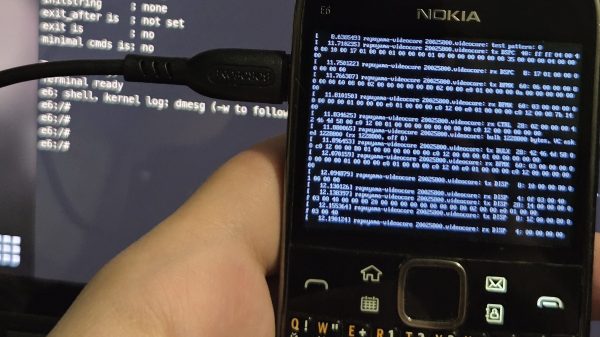
The Nokia E6 is a smartphone from back in the old days when Symbian was a thing. [fluffleswaffled] has been doing the work to get the ancient handset running Linux instead, because that’s ultimately cooler than what the phone shipped with out of the box.

There isn’t an unlocked bootloader on the E6, so instead, [fluffleswaffled] used an altogether different route to boot Linux. A Symbian app is used to load the kernel and device tree into RAM, at which point the MMU and caches are turned off and the device jumps into Linux. It’s a one-way trip, from which there is no way back to Symbian without a power cycle. The setup nets a terminal on the phone’s own screen, and the hardware keyboard and touchscreen are functional. The display is controlled by a Broadcom VideoCore III, with [fluffleswaffled] capturing messages from Nokia’s original display driver to create a custom kernel driver that replays them.

There’s an issue, though. The phone doesn’t stay in Linux land for long — it always resets within a couple minutes of booting into the alternative OS. [fluffleswaffled] believes this is because the phone’s baseband chip is supervising the application processor, and killing things once it’s detected that the Symbian mobile stack has stopped running. They’re hoping that someone with experience with Nokia basebands or the relevant hardware can point them in the right direction to get this hack running for more than 3.5 minutes at a time.

There probably isn’t a great deal of utility in getting Linux running on a 2011 smartphone, but we love the hustle nonetheless. We’ve seen this done before, though, and it’s always interesting to learn what it takes to get the OS booting on a new platform. If you’re whipping up similar hacks in your home lab, don’t hesitate to let us know on the tipsline.

Image

Meshtastic Sniffer For DragonOS

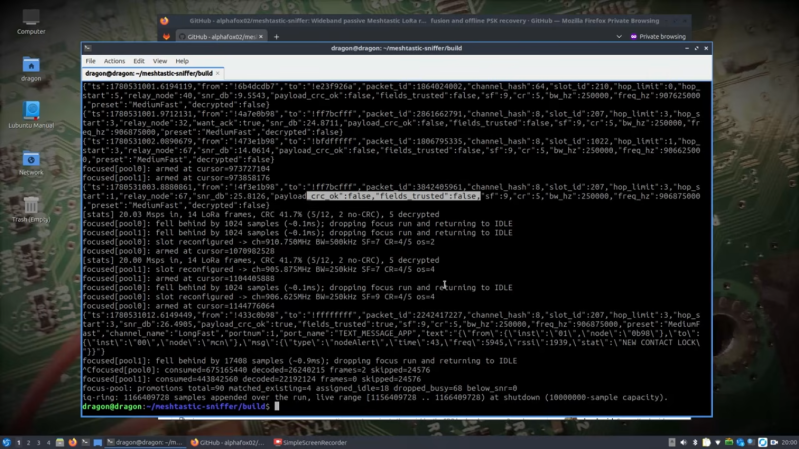
Meshtastic has gained a lot of popularity over the last few years thanks to its low barrier of entry. No licenses are needed and the hardware is dirt cheap, at least when compared to a lot of ham radio gear. But while that physical barrier is low, there is a bit of a learning curve. Part of that comes from the fact that there are a lot of channels and modes that people could be communicating on, and unless the user knows that information up front it can be hard to find where the conversations are happening. [cemaxecuter] noticed this problem and built a Meshtastic sniffer into his radio-forward Linux distribution, DragonOS.

The sniffing software is built in C and comes as a complete standalone binary and does not rely on GNU Radio. With DragonOS up and running and the software loaded, it can look at the entire bandwidth that Meshtastic operates on and detect any traffic and decode it (as long as the key is known). [cemaxecuter] is using a HackRF as a software-defined radio for this project, which he notes doesn’t quite have enough bandwidth to cover every Meshtastic operating frequency, but it can get most of them. After firing up his own node, the software quickly detects it and shows its details in the terminal.

Software like this opens up a lot of opportunities for things that would be tedious, difficult, or impossible to do with with a standard Meshtastic node. Besides finding places where conversations are happening more easily, [cemaxecuter] also suggests that it could be used for wardriving and for locating or finding other networks much more easily. For those who still haven’t tried it out, take a look at this 2023 treatise on the protocol and hardware and then dive right in.

Continue reading “Meshtastic Sniffer For DragonOS” →

Image

This Week In Security: New Spectre Attacks, Crushing Quantity Of Linux Vulns, Google Gets Too Much AI, And Hacking Lawnmowers

Just-in-time, or JIT, compilation could be considered a fundamental backbone of modern computing.  JIT compilation turns scripting languages like JavaScript or intermediary binary forms like Web Assembly into native code on the fly, giving web apps, and things that are web apps under the covers like Electron-based tools, near native speed.  A new paper explores leveraging JIT systems to revive Spectre-v2 attacks against processors.

Most modern processors gain performance by using a trick called “speculative execution”.  The processor guesses the likely result of a compare, and begins executing some of the next instructions before the results are actually known.  If the processor guessed right, things continue and there is a speed gain because it can jump ahead, but if the processor guessed wrong, any instructions that were run and any side effects of running them are discarded and execution resumes on the actual path.  In theory, anyhow.

In practice, the Spectre class of attacks targets branch prediction. It was discovered that when the wrong branch was chosen, not all of the results were truly hidden; Patterns of failures in guessing branches can be used to leak behavior processing encryption keys and other activities. The attacks evolved with the research dubbed Spectre-V2, which showed that non-privileged contexts, like non-root users and virtual machines, could poison the instruction prediction and use it to read arbitrary memory.  Fixes to the Linux kernel and other platforms were required to mitigate the worst of the effects.

The paper shows that by using self-modifying code in the JIT, the processor can be tricked into loading cached versions of the instructions.  The fixes to the kernel to prevent Spectre attacks include identifying malicious code patterns that attack the branch prediction, and stopping or changing them:  By causing the CPU to execute the cached copy of instructions instead of the live copy, the attack ignores the fixed instructions entirely and can attack the branch prediction algorithm.

To prove the attack is feasible in the real world, the researchers targeted several JIT compilers, including the SpiderMonkey JavaScript engine used by Firefox, the eBPF JIT found in the Linux kernel, and GraalVM, the JIT used in Python.  They found success with each, demonstrating that the attack is at least plausible.

Research like this is unlikely to be an instant world-melter, and will help find possible mitigations in the future to prevent these sorts of attacks.  Operating systems that support a high-security “lock-down” mode, like macOS and iOS, often disable JIT entirely, out of concern about these sorts of attacks.  There’s probably no need to start disabling JIT on every system, but attacks like these have a tendency to evolve.

Continue reading “This Week In Security: New Spectre Attacks, Crushing Quantity Of Linux Vulns, Google Gets Too Much AI, And Hacking Lawnmowers” →

Image

No More Windows For The Dutch Government, Ze Kiezen Nu Linux

The events of the last few years have caused many in Europe to re-evaluate their reliance on large offshore technology companies, with a corresponding move to home-grown EU-based alternatives. It’s one thing when individuals or companies do this, but another entirely when it’s an entire country. So the news that the Netherlands is building their own Linux distribution to replace Microsoft Windows in government installations, is not inconsequential. The Tweakers site linked actively breaks out of Google Translate, so you may have to rely on your browser’s translation tool if you are not a Dutch speaker.

The Digitaal Autonome Werkomgeving Overheid, or Digital Autonomous Work Environment, is a distro based upon NixOS, itself originally a product of a Dutch university. It comes complete with all the office and collaboration applications needed to replace Windows, and is reported to have been tested already by a small group of Dutch government workers.

The influence of this move is likely to be a huge one for Microsoft, given that governments have huge numbers of operating system seats. But perhaps more important than the OS itself are the extras that Microsoft would like to sell to its OS customers, such as AI services. We’d expect that there will be managers in Redmond paying close attention to Europe in the wake of this move.

Meanwhile the Netherlands has a vibrant hacker community, and we can imagine that this move will be welcomed in those quarters. All Netherlands government online services are accessed through an ID verification app called DigID, and it’s a lament we’ve heard from our Dutch friends that this only works with Windows, Android and Apple platforms. If this means a Linux version will appear on the back of an NL government Linux distro, we know some people who will be very happy indeed.


NL flag: SpinnerLaserzthe2nd, CC0. Tux: Larry Ewing (lewing@isc.tamu.edu) and The GIMP. Attribution.