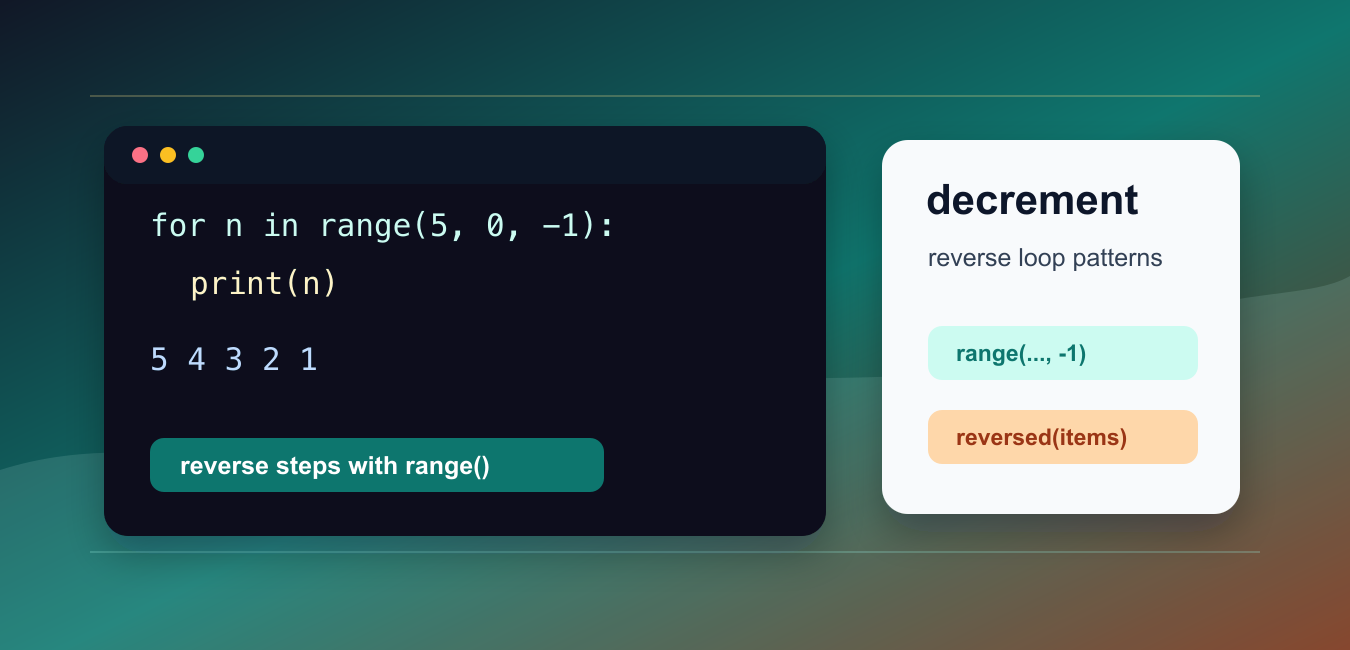
Quick answer: Use range(start, stop, step) with a negative step to decrement through integer values. The start value is included and stop is excluded, so range(5, 0, -1) visits 5 through 1, while range(5, -1, -1) also visits zero. Keep the step nonzero and choose the stopping boundary from the values the loop must actually process.
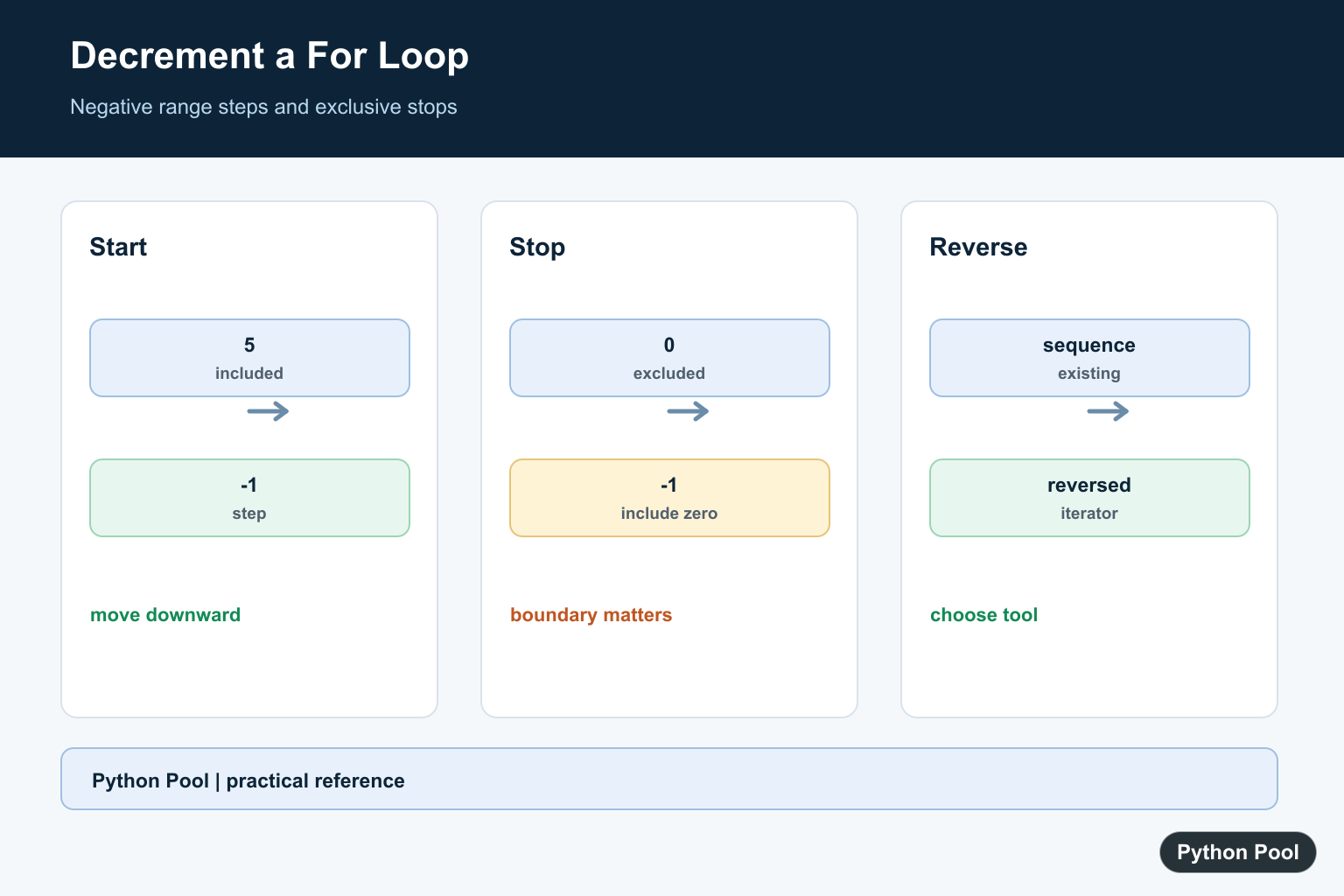
To decrement a for loop in Python, use range(start, stop, step) with a negative step. The loop counts downward when the step is less than zero.
The official Python documentation covers range objects, the for statement, and reversed().
A descending loop is useful for countdowns, reverse index traversal, safe deletion from the end of a list, and algorithms that work from the last item back to the first.
The key detail is that range() stops before the stop value. When counting down, the stop value is still excluded. For example, range(5, 0, -1) yields 5, 4, 3, 2, and 1, but not 0.
Choose the form that matches what you need to traverse. Use range() for numbers or indexes. Use reversed() when you only need items from a sequence in reverse order. Use a while loop when the step can change while the loop runs.
Countdown With range()
The simplest decrementing for loop uses a negative step.
for number in range(5, 0, -1):
    print(number)
This prints numbers from 5 down to 1.
The first argument is the starting number. The second argument is the excluded stopping point. The third argument is the step, and -1 means subtract one after each pass.
If you want to include zero, use range(5, -1, -1). The stop point must be one step beyond the final number you want.
Use A Larger Negative Step
The negative step does not have to be -1. You can count down by two, three, or any other interval.
for number in range(10, 1, -2):
    print(number)
This prints 10, 8, 6, 4, and 2.
The loop stops before it reaches 1. That behavior is the same as a forward range(); only the direction changes.
Use a larger negative step for countdown timers, sampling positions, reverse pagination, or any case where every item is not needed.
Loop Through Items In Reverse
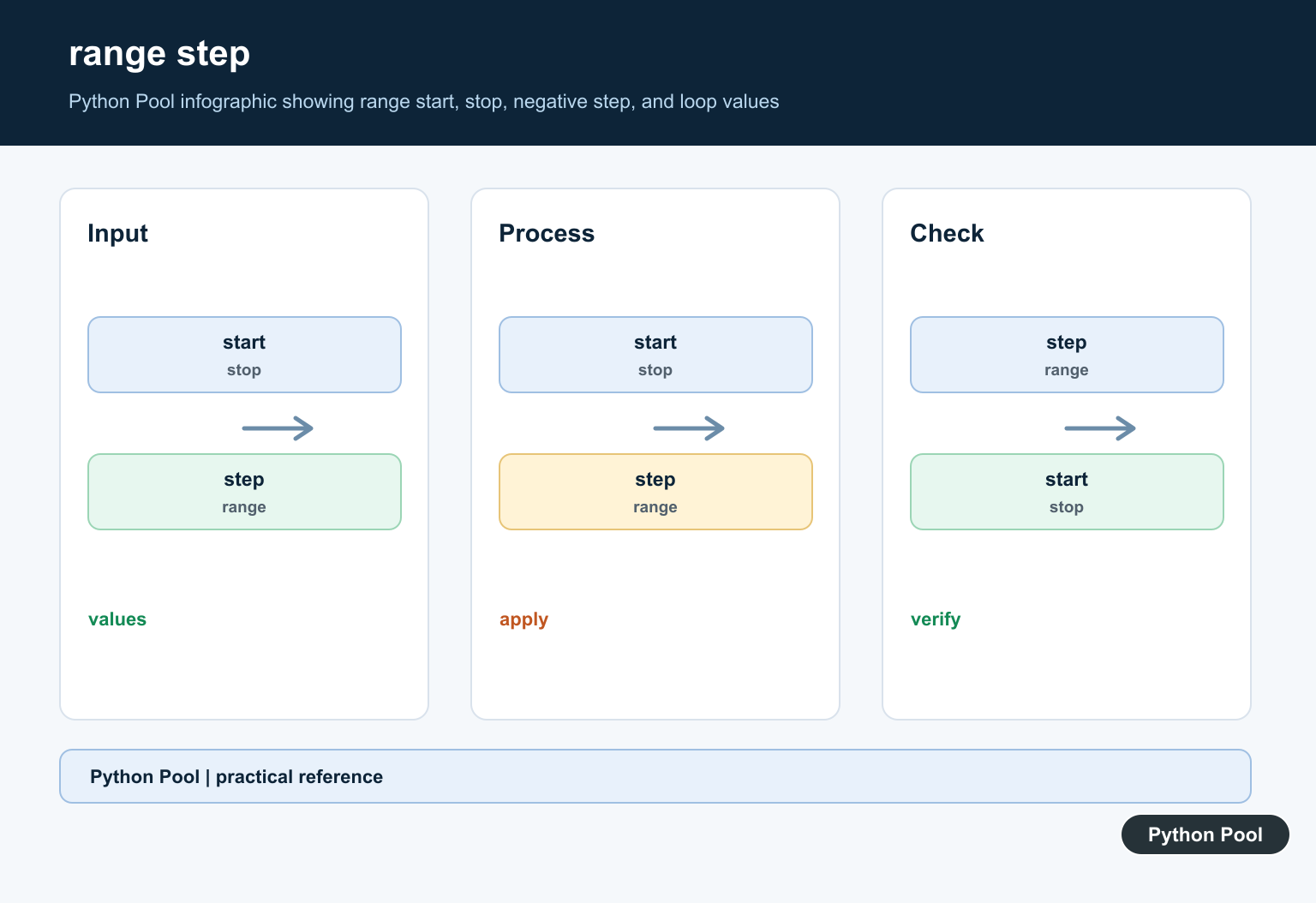
When you only need the items, reversed() is clearer than building indexes by hand.
items = ["setup", "test", "deploy"]

for item in reversed(items):
    print(item)
This prints the list contents from last to first.
reversed() avoids the off-by-one details of index math. It also makes the intent obvious: read the sequence backward without changing the original list.
Use this form for display output, reverse scans, or any read-only pass over a list, tuple, string, or other reversible sequence.
Loop Backward By Index
Use indexes when you need both the position and the item.
items = ["setup", "test", "deploy"]

for index in range(len(items) - 1, -1, -1):
    print(index, items[index])
The starting index is len(items) - 1, which is the last valid position. The stop value is -1 so that index 0 is included.
This form is useful when the position appears in logging, output, validation, or a calculation.
It is also the form you need when you plan to delete or replace items by position while moving backward through the list.
Delete Items Safely From The End
When removing items from a list by index, traverse from the end toward the start. Later positions are processed first, so earlier deletions do not shift items that still need to be checked.
names = ["api", "build", "ui", "release"]

for index in range(len(names) - 1, -1, -1):
    if len(names[index]) <= 2:
        del names[index]

print(names)
This removes short names while keeping the remaining list in order.
For many filtering tasks, a list comprehension is still cleaner. Reverse index deletion is useful when the list must be changed in place because other code already holds the same list object.
Use this pattern carefully and keep the condition easy to read. In-place mutation inside loops should be obvious to the next person maintaining the code.
Use while When The Step Changes
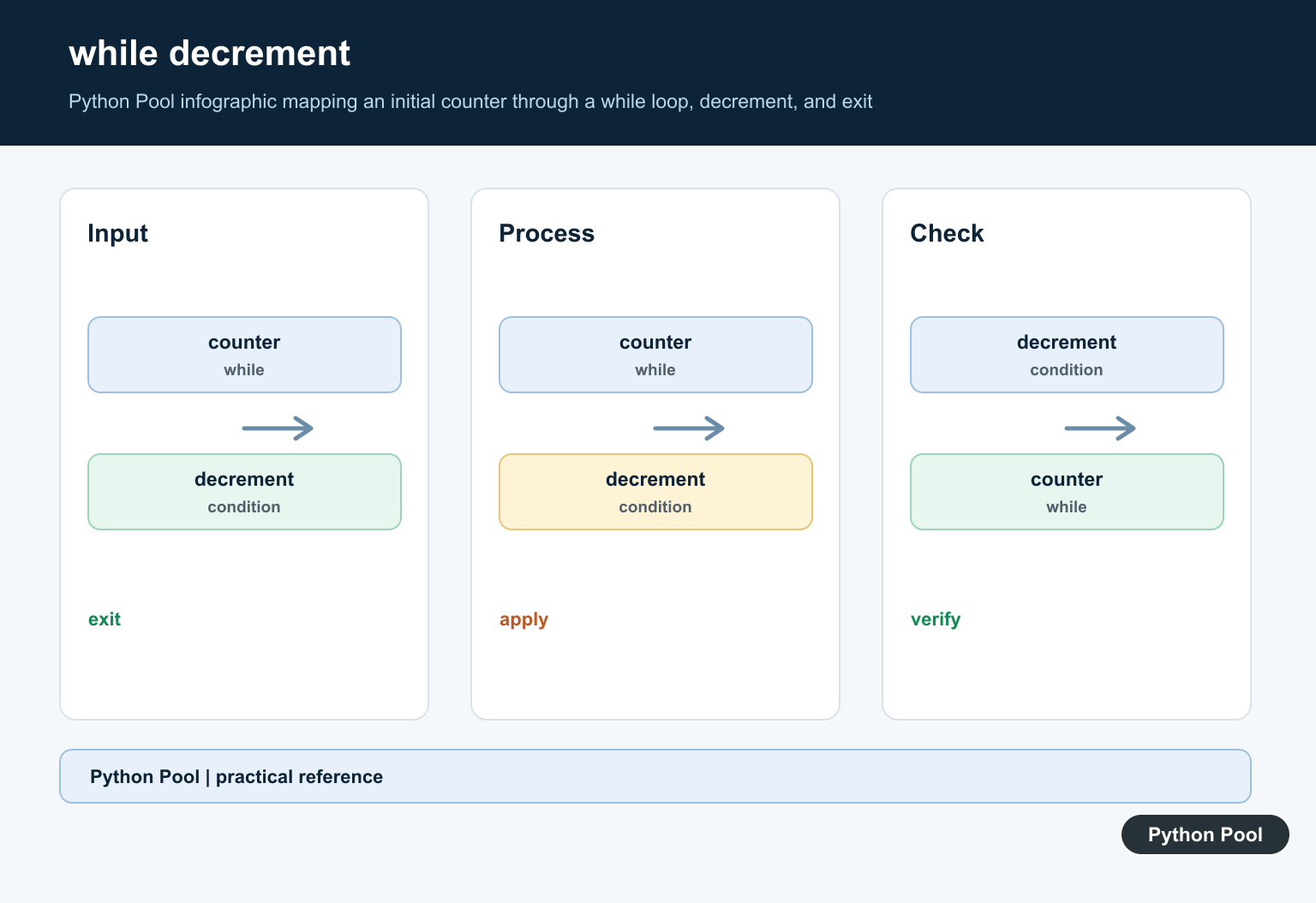
A for loop is best when the sequence of numbers is known before the loop starts. If the decrement amount changes during the loop, use while.
count = 12
step = 3

while count > 0:
    print(count)
    if count <= 6:
        step = 2
    count -= step
This starts by subtracting three, then subtracts two near the end.
A while loop makes the changing step explicit. It also lets you stop based on a condition that is recalculated after each pass.
Use while for countdowns that depend on user input, retry delays, game loops, or logic where each pass can change the next step.
Common Decrement Loop Mistakes
The most common mistake is using the wrong stop value. If range(5, 0, -1) does not include zero, that is expected. Use -1 as the stop value when zero should be included.
Another mistake is forgetting the negative step. range(5, 0) produces no values because the default step is positive and cannot move from five down toward zero.
Also avoid reverse index math when reversed(items) is enough. Index loops are useful, but they are easier to get wrong than direct item loops.
In short, use range(start, stop, -1) for a simple countdown, use a larger negative step when you want to skip numbers, use reversed() for read-only reverse traversal, and use a backward index loop when positions matter.
Use A Negative range Step
range describes an arithmetic progression. A negative step moves toward a smaller stop value, and a positive step with a larger start will not produce the descending sequence you intended.
for number in range(5, 0, -1):
    print(number)
Include Zero Deliberately
Because stop is exclusive, use -1 as the stop when zero must be visited. Writing the expected sequence in a small test makes off-by-one errors easy to detect.
values = list(range(3, -1, -1))
assert values == [3, 2, 1, 0]
print(values)
Decrement By More Than One
The absolute value of the negative step controls the gap between values. It can be used for countdowns, reverse indexes, or processing every other item, but the direction and endpoint must agree.
for number in range(12, 2, -3):
    print(number)
Use reversed For Existing Sequences
reversed returns an iterator over an existing sequence without requiring index arithmetic. Use range when you need numeric values or indices that are not already stored in a sequence.
items = ["first", "second", "third"]
for item in reversed(items):
    print(item)

for index in range(len(items) - 1, -1, -1):
    print(index, items[index])
Python’s official range() and reversed() references define exclusive stops, negative steps, and reverse iteration. Related references include range history, for versus while, and list iteration.
For related loop control, compare range history, for versus while, and list iteration when choosing a descending sequence.
Frequently Asked Questions
How do I decrement a for loop in Python?
Use range(start, stop, -step) with a negative step, such as range(5, 0, -1).
Why does range not include stop?
The stop value is always exclusive, so use one lower boundary when you need to visit zero or another endpoint.
What happens if the step is zero?
Python raises ValueError because a range cannot advance when its step is zero.
Should I use reversed or range?
Use reversed for an existing sequence and range for arithmetic progressions or index values.

These answers are not working for decrement …do we have any version pre requisites
No, this should work on any Python3 version. Is there any specific decrement you’re looking for?
Regards,
Pratik