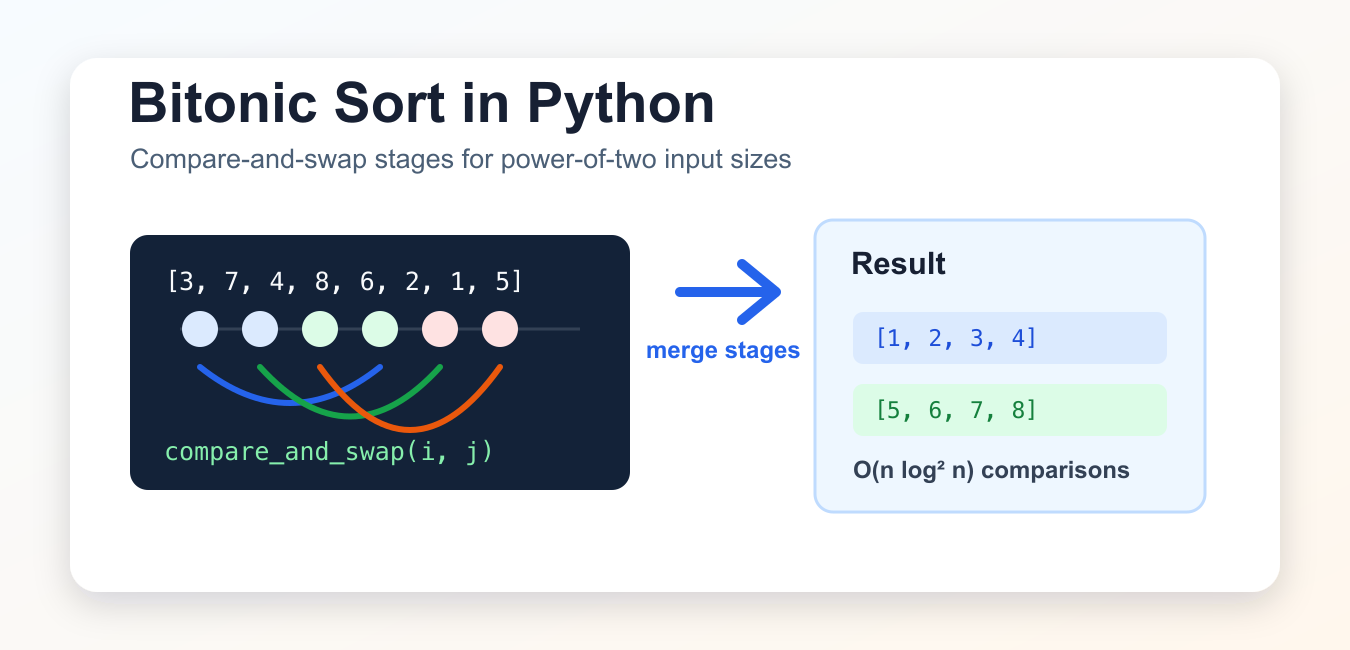
Quick answer: Bitonic sort is a regular comparison network: it builds bitonic sequences, compare-swaps them in stages, and produces an ordered result. The classic form is simplest for power-of-two lengths and is mainly useful when a predictable parallel structure matters, not as a default replacement for sorted().
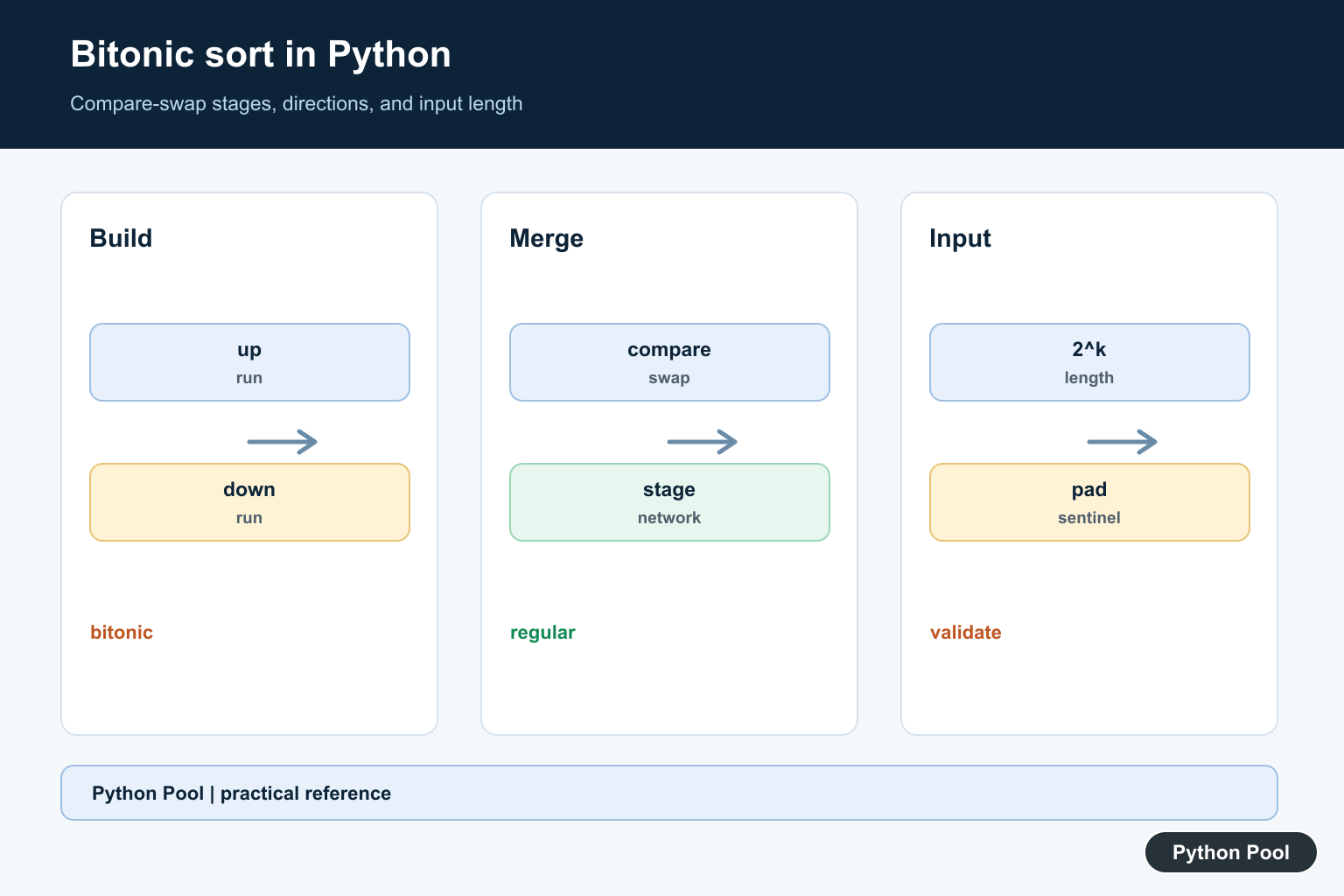
Bitonic sort is a comparison-based sorting network that uses a fixed compare-and-swap pattern. It is mainly interesting when comparisons can run in parallel, such as hardware, GPU, or educational sorting-network examples. For ordinary Python lists, built-in sorted() or list.sort() is usually the right production choice.
What is bitonic sort?
A bitonic sequence first moves in one direction and then the other: increasing then decreasing, or decreasing then increasing. Bitonic sort recursively builds bitonic sequences and merges them with compare-and-swap stages.
The key property is that the comparison schedule does not depend on the data values. NIST describes bitonic sort as comparing and swapping element pairs in parallel while subsets are sorted and merged.
Important limitation
The classic version is simplest when the input length is a power of two: 2, 4, 8, 16, and so on. The implementation below raises ValueError for other lengths instead of silently padding values, because padding can introduce edge cases when the data range is unknown.
Bitonic sort Python code
def _is_power_of_two(n):
    return n > 0 and (n & (n - 1)) == 0


def _compare_and_swap(values, i, j, ascending):
    if (ascending and values[i] > values[j]) or (not ascending and values[i] < values[j]):
        values[i], values[j] = values[j], values[i]


def _bitonic_merge(values, start, length, ascending):
    if length > 1:
        half = length // 2
        for i in range(start, start + half):
            _compare_and_swap(values, i, i + half, ascending)
        _bitonic_merge(values, start, half, ascending)
        _bitonic_merge(values, start + half, half, ascending)


def _bitonic_sort(values, start, length, ascending):
    if length > 1:
        half = length // 2
        _bitonic_sort(values, start, half, True)
        _bitonic_sort(values, start + half, half, False)
        _bitonic_merge(values, start, length, ascending)


def bitonic_sort(values, ascending=True):
    result = list(values)
    if not _is_power_of_two(len(result)):
        raise ValueError("bitonic_sort() needs a non-empty power-of-two length")
    _bitonic_sort(result, 0, len(result), ascending)
    return result


numbers = [3, 7, 4, 8, 6, 2, 1, 5]
print(bitonic_sort(numbers))
print(bitonic_sort(numbers, ascending=False))
print(numbers)
Output:
[1, 2, 3, 4, 5, 6, 7, 8]
[8, 7, 6, 5, 4, 3, 2, 1]
[3, 7, 4, 8, 6, 2, 1, 5]
The function returns a new sorted list. The original numbers list remains unchanged.
How the code works
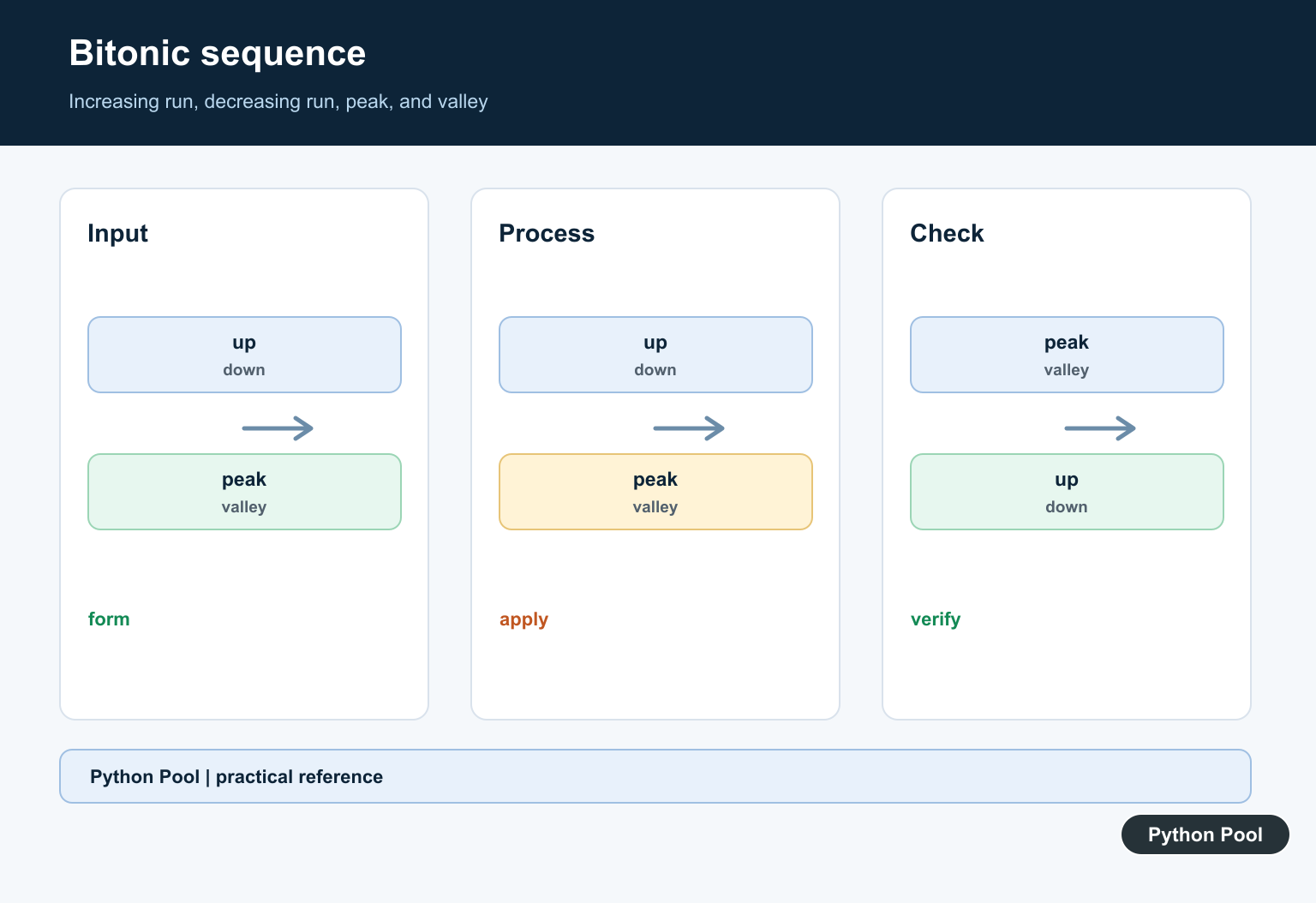
_compare_and_swap()swaps two elements when they are out of order for the requested direction._bitonic_sort()recursively sorts one half ascending and the other half descending._bitonic_merge()merges the bitonic sequence into one sorted sequence.bitonic_sort()copies the input, validates the length, and returns the sorted copy.
Ascending and descending order
Pass ascending=False to produce descending output.
numbers = [3, 7, 4, 8, 6, 2, 1, 5]
print(bitonic_sort(numbers, ascending=False))
This prints:
[8, 7, 6, 5, 4, 3, 2, 1]Complexity
For a sequential Python implementation, bitonic sort performs O(n log^2 n) compare-and-swap work. Its advantage is not normal single-threaded speed; its advantage is that many comparisons in the same stage can be performed in parallel.
NIST notes that bitonic sort takes about O((log n)^2 / 2) stages with n / 2 comparators at each stage. That distinction matters: parallel stage depth and sequential Python runtime are not the same thing.
Bitonic sort vs merge sort
Merge sort is a better general-purpose algorithm for normal Python code. It handles arbitrary lengths naturally and has O(n log n) comparison complexity. Bitonic sort is useful when a fixed comparison network is valuable, especially in parallel environments.
Python’s built-in Timsort is also the practical default for day-to-day sorting. See our guide to Python Timsort for how Python’s built-in sorting behaves.
Common mistakes
- Using it for regular Python sorting: use
sorted()orlist.sort()for production Python lists. - Ignoring power-of-two length: the classic recursive implementation expects power-of-two sizes.
- Mixing up complexity terms: parallel stage depth is different from sequential comparisons.
- Sorting in place accidentally: copy the input first if callers should keep the original list.
- Assuming stability: compare-and-swap sorting networks are not generally stable sorts.
Related sorting guides
- Python Timsort
- Shell sort in Python
- Bubble sort in Python
- Insertion sort in Python
- Pigeonhole sort in Python
- Strand sort in Python
Official reference
Conclusion
Bitonic sort is best understood as a sorting network with a fixed compare-and-swap schedule. It is useful for learning and parallel execution models, but not a replacement for Python’s built-in sorting in normal application code.
Understand The Bitonic Sequence
A bitonic sequence first rises and then falls, or the reverse. The algorithm constructs such sequences from smaller runs, then performs compare-and-swap stages with alternating directions. The regular pattern is the reason bitonic sort maps well to sorting networks and parallel hardware.
Handle The Power-Of-Two Constraint
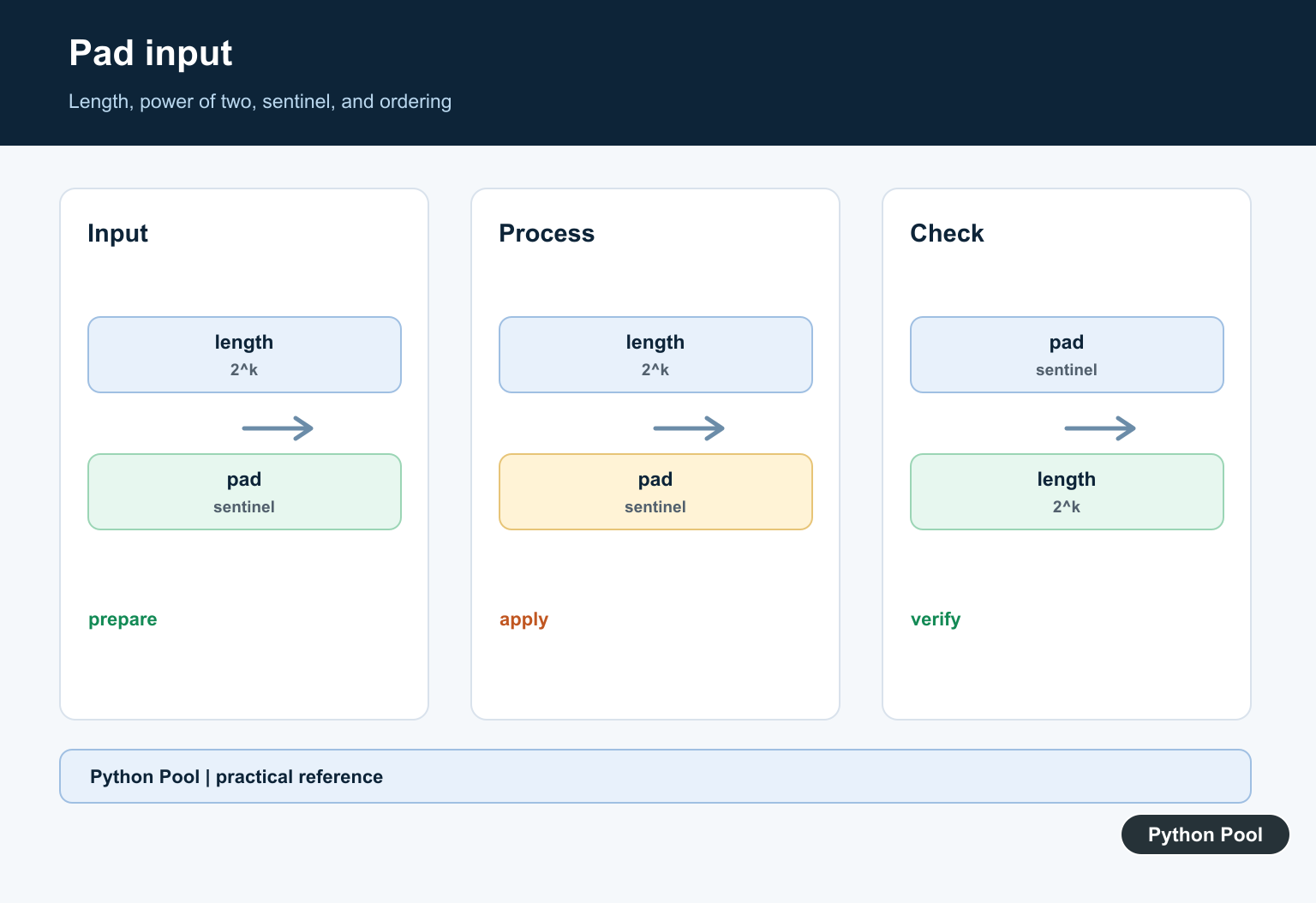
Many textbook implementations assume a length of 2^k. For arbitrary lengths, pad to a suitable power of two with a sentinel that sorts to the correct end, or use a carefully adapted algorithm. The sentinel must be outside the valid data domain and removed after sorting.

Keep Ascending And Descending Phases Clear
Each merge stage has a direction. Mixing the direction flag or the comparison endpoints can produce a result that is almost ordered but fails at boundaries. Name the direction explicitly and test both ascending and descending outputs.
Compare With Ordinary Python Sorting
Python’s sorted() is highly optimized for general application data and is stable. Bitonic sort has O(n log^2 n) comparison complexity and more overhead in a sequential Python implementation, but it offers fixed comparison structure and parallel-friendly stages.
Test The Network, Not Just The Final List
Test already sorted, reverse-sorted, duplicate, negative, power-of-two, non-power-of-two, empty, and single-element inputs. Check the output against sorted() and assert that the implementation does not mutate the caller’s input unless mutation is part of its contract.
The bitonic sorting network overview describes the compare-and-swap structure. Python’s sorting HOWTO explains the standard alternative. Related guidance includes algorithm tests and key-based sorting.
For related sorting choices, compare key-based sorting, algorithm tests, and timing experiments before using a sorting network in ordinary Python code.
Frequently Asked Questions
What is bitonic sort?
It is a comparison sorting network that builds bitonic sequences and repeatedly compare-swaps elements into ascending or descending order.
Does bitonic sort require a power-of-two length?
The classic implementation is simplest for power-of-two lengths; pad or adapt the algorithm carefully when the input length is arbitrary.
What is bitonic sort’s complexity?
Its comparison count is O(n log^2 n), with a regular structure that can be useful for parallel hardware despite being slower than common sequential sorts in many cases.
Should I use bitonic sort for ordinary Python lists?
Usually choose Python’s built-in sorted() for ordinary application data; bitonic sort is mainly educational or useful when a sorting-network structure matters.
