
Quick answer: python-bitcoinlib is a low-level library for Bitcoin data structures, scripts, serialization, and protocol experiments. Keep examples on regtest or other test environments, use deterministic fake data, and never expose real private keys or broadcast transactions from tutorial code.
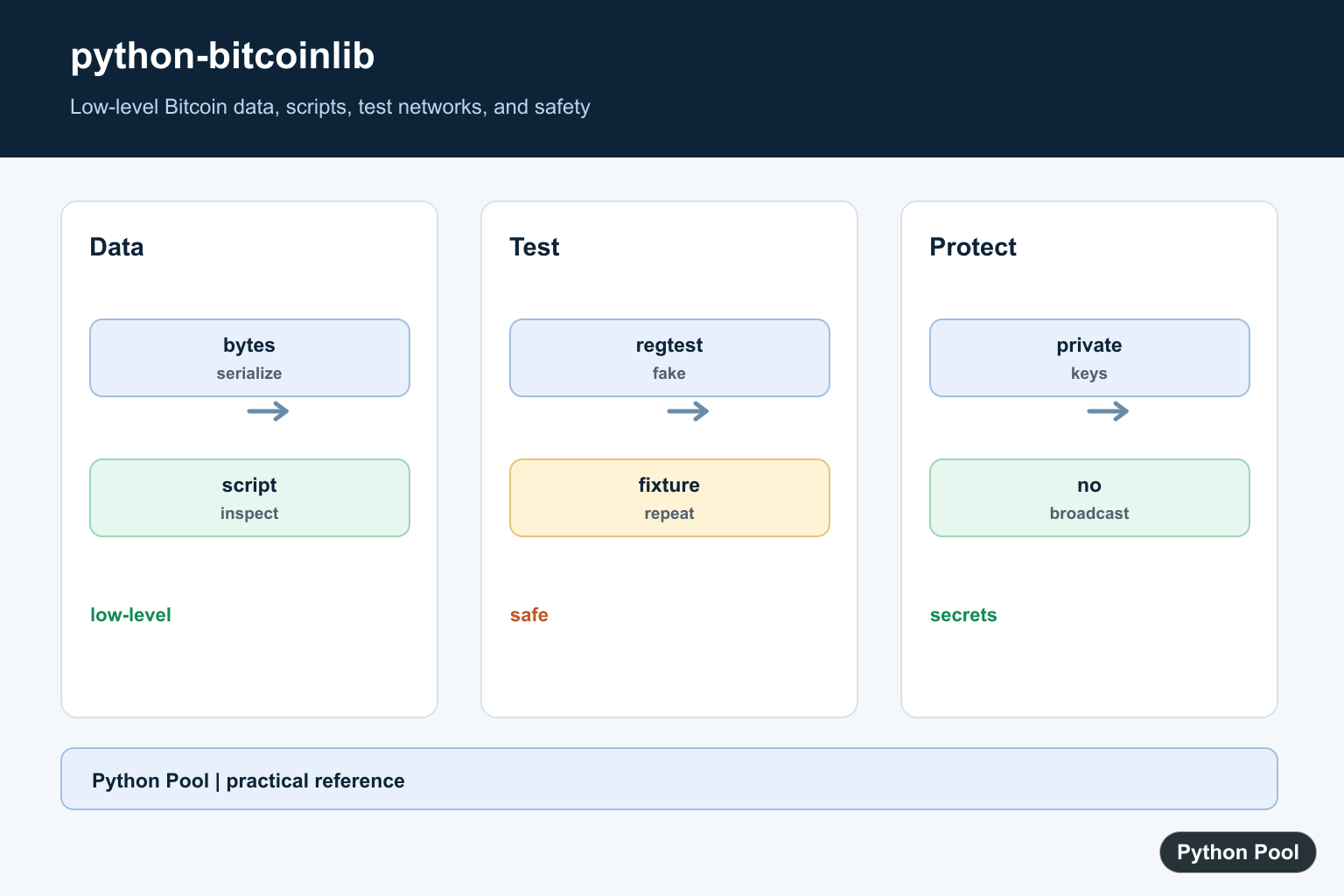
python-bitcoinlib is a low-level Python library for working with Bitcoin data structures and protocol pieces. It is useful when you want to inspect transaction bytes, build scripts, understand address payloads, or experiment with signing concepts in a controlled lab. It is not a shortcut around Bitcoin safety rules, and it is not a place to paste real wallet secrets.
This guide is educational only. The examples use regtest, testnet-style public data, fake transaction identifiers, and deterministic placeholders. Do not use these snippets with real funds, real private keys, production wallets, exchange deposits, customer balances, or live broadcasting code. If you need production wallet software, use a reviewed architecture, hardware-backed key handling, backups, monitoring, and a dedicated security review.
The current project references are the python-bitcoinlib GitHub repository, the python-bitcoinlib PyPI page, and the project examples directory. The README describes the library as low-level and focused on Bitcoin internals, with core modules for data structures, scripts, serialization, and script evaluation. For transaction format background, see the Bitcoin transaction reference.
Install the package with python -m pip install python-bitcoinlib in the interpreter used by your project. The examples below catch ModuleNotFoundError so they still run as safe mock demonstrations when the optional package is not present. That is intentional: the goal is to learn the shape of the APIs without requiring a node, network access, wallet file, or any private-key material.
The package follows many Bitcoin Core naming patterns. For example, mutable transaction classes start with CMutable, immutable classes use names such as CTransaction, and script opcodes are exposed as constants. Chain selection is process-wide, so choose regtest or testnet before creating addresses or scripts in experiments.
Select A Safe Chain
Start every lab session by choosing a non-production chain. Regtest is the safest default for local learning because it is isolated from public Bitcoin networks.
try:
    import bitcoin
except ModuleNotFoundError:
    selected_chain = "regtest"
    package_state = "python-bitcoinlib is not installed"
else:
    bitcoin.SelectParams("regtest")
    selected_chain = "regtest"
    package_state = "python-bitcoinlib chain selected"

print(selected_chain)
print(package_state)
print("educational examples only")
SelectParams() changes how address prefixes and chain-specific constants behave. Use it near the top of short scripts so later code does not accidentally inherit the wrong network choice.
For learning, avoid mainnet. The examples in this article do not connect to a node, do not call RPC methods, do not sign with private keys, and do not broadcast anything.
Handle Transaction Hash Endianness
Bitcoin transaction and block hashes are commonly displayed in little-endian order. The project README calls out helper functions such as lx(), b2x(), and b2lx() because this order difference is a common source of mistakes.
display_txid = "".join(f"{number:02x}" for number in range(32))

try:
    from bitcoin.core import b2lx, b2x, lx
except ModuleNotFoundError:
    raw_bytes = bytes.fromhex(display_txid)[::-1]

    def b2x(data):
        return data.hex()

    def b2lx(data):
        return data[::-1].hex()
else:
    raw_bytes = lx(display_txid)

print(display_txid[:16])
print(b2x(raw_bytes)[:16])
print(b2lx(raw_bytes)[:16])
The displayed hash and the raw byte order are not the same view. When a library asks for raw bytes, do not pass the human-facing string without checking which helper is expected.
Keep this habit separate from signing and wallet work. A hash-order example can be useful with harmless bytes, while signing examples can become dangerous if copied into scripts that hold real keys.
Create An Address From Public Hash Data
A P2PKH address encodes a network prefix and a 20-byte public-key hash. The example below uses repeated bytes as public placeholder data. It does not derive a key pair and does not reveal or create a spendable secret.
public_key_hash = bytes.fromhex("11" * 20)

try:
    import bitcoin
    from bitcoin.wallet import P2PKHBitcoinAddress
except ModuleNotFoundError:
    address_text = "testnet-p2pkh-" + public_key_hash.hex()[:12]
else:
    bitcoin.SelectParams("testnet")
    address_text = str(P2PKHBitcoinAddress.from_bytes(public_key_hash))

print(address_text)
print(len(public_key_hash))
This is enough to demonstrate how address payloads are shaped. It is not a wallet. A real wallet must manage entropy, seed backup, derivation paths, change outputs, fee policy, signing devices, privacy, and recovery.
If an example asks for a private key, seed phrase, wallet import format string, or exchange address, stop and reconsider the source. Beginner learning should not require exposing anything that could move funds.
Build An Unsigned Transaction Skeleton
python-bitcoinlib exposes Bitcoin transaction objects directly. The next example creates one fake input and one OP_RETURN output. It is deliberately unsigned, unfunded, and unsuitable for broadcasting.
try:
    from bitcoin.core import CMutableTransaction, CMutableTxIn, CMutableTxOut, COutPoint, b2x, lx
    from bitcoin.core.script import CScript, OP_RETURN
except ModuleNotFoundError:
    tx_summary = {
        "inputs": 1,
        "outputs": 1,
        "broadcastable": False,
    }
    print(tx_summary)
else:
    fake_txid = "01" * 32
    txin = CMutableTxIn(COutPoint(lx(fake_txid), 0))
    txout = CMutableTxOut(0, CScript([OP_RETURN, b"PythonPool demo"]))
    tx = CMutableTransaction([txin], [txout])

    print(len(tx.vin), len(tx.vout))
    print(b2x(tx.serialize())[:80])
This pattern helps you learn the pieces: a transaction input points to a previous output, and a transaction output contains a satoshi amount plus a locking script. In real spending code, that previous output must exist, the amount must be correct, the fee must be intentional, and the signing policy must match the script being spent.
Keep transaction construction and broadcasting separate while learning. Serialization is a local data exercise. Broadcasting is an irreversible public-network action.
Build A P2PKH Locking Script
Bitcoin script is a small stack-based language. A traditional P2PKH locking script checks that the spender provides a public key matching a 20-byte hash and a valid signature for that key.
pubkey_hash = bytes.fromhex("22" * 20)

try:
    from bitcoin.core import b2x
    from bitcoin.core.script import CScript, OP_CHECKSIG, OP_DUP, OP_EQUALVERIFY, OP_HASH160
except ModuleNotFoundError:
    locking_script = bytes.fromhex("76a914") + pubkey_hash + bytes.fromhex("88ac")
    script_hex = locking_script.hex()
else:
    locking_script = CScript([
        OP_DUP,
        OP_HASH160,
        pubkey_hash,
        OP_EQUALVERIFY,
        OP_CHECKSIG,
    ])
    script_hex = b2x(locking_script)

print(script_hex)
print(len(locking_script))
The hexadecimal form begins with opcode bytes, pushes the public-key hash, and ends with signature-check logic. The byte sequence is small, but its meaning is strict.
Do not treat script examples as policy recommendations. Modern wallets often use SegWit or Taproot outputs instead of legacy P2PKH. P2PKH remains useful for learning because the script is compact and easy to inspect.
Prepare A Signature Hash Without Signing
Signing a Bitcoin transaction means producing a signature over the correct digest for a specific input and script. This final example calculates or mocks that digest, then stops before any private-key operation.
try:
    from bitcoin.core import CMutableTransaction, CMutableTxIn, CMutableTxOut, COutPoint, b2x, lx
    from bitcoin.core.script import (
        CScript,
        OP_CHECKSIG,
        OP_DUP,
        OP_EQUALVERIFY,
        OP_HASH160,
        OP_RETURN,
        SIGHASH_ALL,
        SignatureHash,
    )
except ModuleNotFoundError:
    import hashlib

    previous_script = bytes.fromhex("76a914" + "33" * 20 + "88ac")
    digest_hex = hashlib.sha256(previous_script + b"unsigned demo").hexdigest()
else:
    pubkey_hash = bytes.fromhex("33" * 20)
    previous_script = CScript([OP_DUP, OP_HASH160, pubkey_hash, OP_EQUALVERIFY, OP_CHECKSIG])
    txin = CMutableTxIn(COutPoint(lx("02" * 32), 0))
    txout = CMutableTxOut(0, CScript([OP_RETURN, b"unsigned demo"]))
    tx = CMutableTransaction([txin], [txout])
    digest_hex = b2x(SignatureHash(previous_script, tx, 0, SIGHASH_ALL))

print(digest_hex[:32])
print("signing intentionally omitted")
The important lesson is the boundary. It is safe to study data layout, hash order, script bytes, and unsigned transaction structure with fake values. It is not safe to paste live private keys into snippets, log secrets, use copied transaction code with real UTXOs, or broadcast code you have not reviewed.
Use python-bitcoinlib when you need low-level Bitcoin structures in Python: parsing bytes, building scripts, checking serialization, testing regtest flows, or learning how transaction pieces fit together. Keep real funds out of tutorial code, keep private keys out of source files, and treat signing and broadcasting as separate high-risk steps that need dedicated review.
Keep The Scope Low Level
The library helps inspect and construct protocol objects; it is not a complete production wallet architecture. Understand serialization, scripts, and transaction structure before connecting any higher-risk workflow.
Use Test Networks
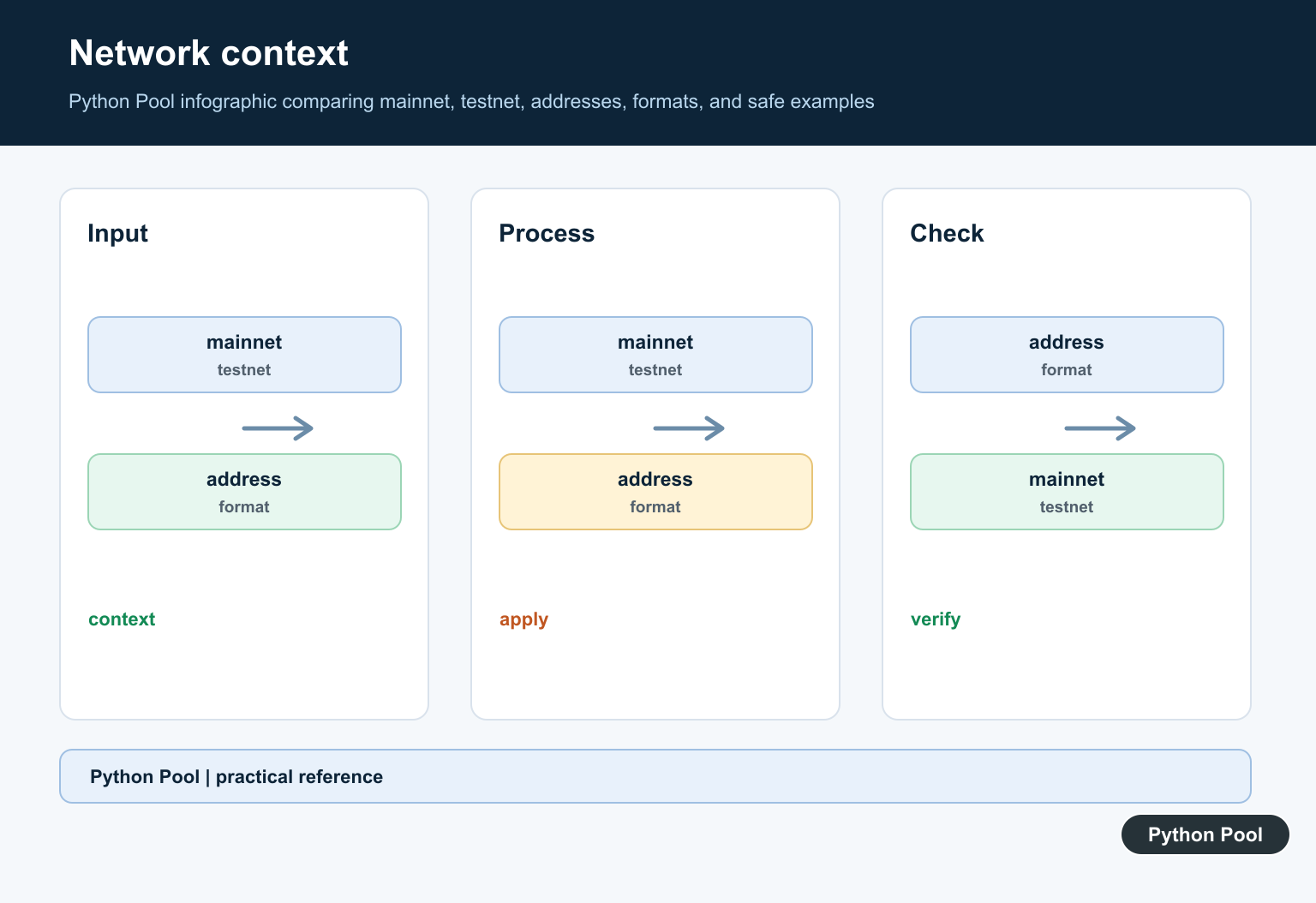
Use regtest or another appropriate test environment with deterministic fixtures. Label fake transaction IDs, addresses, keys, and outputs so a reader cannot mistake them for live funds.
Protect Secrets
Never put private keys, seed phrases, wallet files, or exchange credentials in examples, notebooks, logs, or source control. Keep secrets in an isolated, reviewed key-management path when a real system is built.
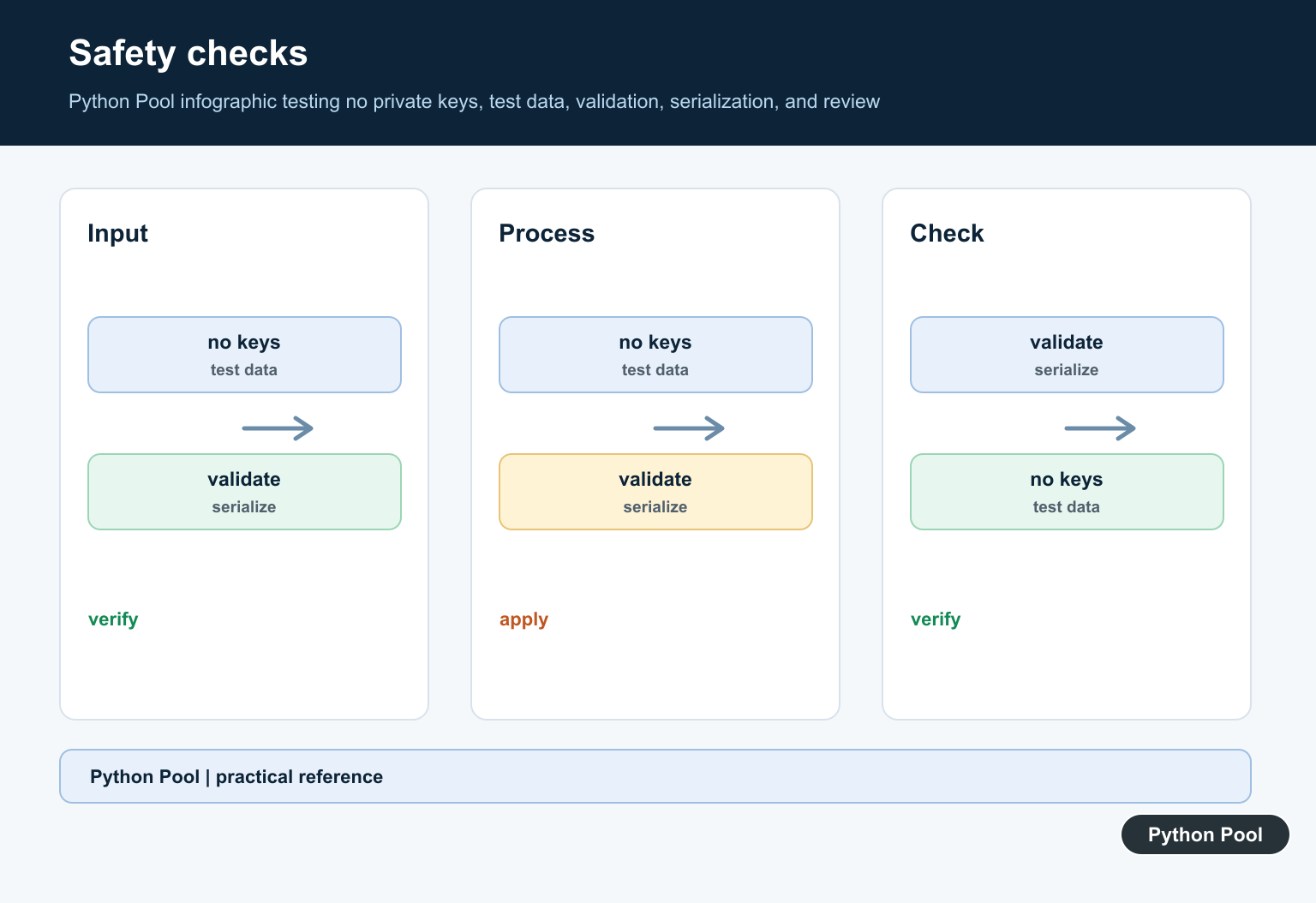
Validate Transactions
Before signing or broadcasting, verify network, inputs, outputs, scripts, fees, change, and serialization. A syntactically valid object can still send value to the wrong destination.
Treat Tutorials As Experiments
Run examples in a disposable environment, pin dependencies, test round trips, and review the library’s current documentation and security posture before using it beyond education.
The python-bitcoinlib project and PyPI package page describe the library and releases. Related references include byte serialization, serialization safety, and test fixtures.
For related protocol data, compare bytes, compact bits, and fixture tests when keeping experiments isolated.
Frequently Asked Questions
What is python-bitcoinlib?
It is a low-level Python library for inspecting and working with Bitcoin data structures, scripts, and serialization.
Should I use real private keys in examples?
No. Use fake deterministic keys and test networks only, with secrets kept outside notebooks, logs, and source code.
Is python-bitcoinlib wallet software?
It is a low-level building block, not a complete production wallet architecture or a substitute for security review.
How should I test Bitcoin code safely?
Use regtest or other appropriate test environments, deterministic fixtures, isolated secrets, and tests that never broadcast real transactions.

In step 3 i get an error
sighash = SignatureHash(txin_scriptPubKey, tx, 0, SIGHASH_ALL)
NameError: name ‘tx’ is not defined
You need to create Unsigned Transaction first by –
tx = CMutableTransaction([txin], [txout])