Substack

Showing posts with label Gender issues. Show all posts

Friday, November 8, 2024

Female labour force participation and marriage penalty

Arguably one of the biggest constraints to sustained high economic growth rates in India is the low female labour force participation rate. Much has been written on the topic, analysing the possible causes and proposing solutions.

A new World Bank working paper by Maurizio Bussolo, Jonah Rexer, and Margaret Triyana points to a marriage penalty. This penalty forces women to drop out of the labour force post-marriage. They used statistical techniques on data from multiple rounds of the nationally representative Demographic and Health Surveys (DHS) from Bangladesh, India, Maldives, and Nepal and isolated the marriage and child penalties for women. They find that the penalty is highest in India. 

These two events are correlated in time for a given individual. As such, estimates of the marriage penalty are obscured by the presence of children, and estimates of the child penalty are likewise capturing at least in part a marriage penalty… We find that South Asian women reduce their labor force participation by 12 percentage points (p.p.) following marriage, even before childbearing. Among women with children, this rises just 4 p.p to 16 p.p. As such, 75 percent of the combined family formation penalty is driven by marriage itself, rather than the burden of childbearing, at least in the first five years of marriage. 

Image

The largest effects are observed in India, while more muted effects are observed in Nepal, where the majority of the combined penalty is driven by children. Dynamic event-study estimates reveal flat trends in employment status leading up to the marriage date, and sharp drops in employment in the first year of marriage. These trends lend additional support to the notion that these estimates represent the causal effect of marriage. Men, in contrast, enjoy a marriage premium. This premium does not depend on the presence of children, consistent with the existing literature showing no child penalties for men… We find that educated women have much smaller marriage penalties, with post-secondary education erasing nearly half the baseline marriage penalty. 

Image

They examine the possible causes

The marriage penalty may represent an optimal solution to a joint household maximization problem. If women have limited outside options in the labor market relative to their husbands, then specialization in home-based tasks might be economically efficient, even without children. However, the value of women’s home production is greatly diminished without children, suggesting a role for social norms in driving the marriage penalty, particularly those that constrain women’s mobility outside the home… Despite the fact that gender norms are more progressive in urban areas in South Asia, we find no significant difference between urban and rural marriage penalties… we argue that a woman’s education affects both household gender norms and her outside employment options. In contrast, her husband’s education affects household norms, but does not directly affect her employment prospects. This suggests that outside options at least in part play a role in determining the marriage penalty… We find strong evidence that women in households with more liberal gender norms experience smaller marriage penalties. The effects of education and social norms appear to be independent, suggesting that both opportunity costs and social norms play a role in driving the marriage penalty.

As a framework, the net penalty on female labour force participation can be considered as a cumulative result of three effects, as captured below.

Image

The marriage penalty is clearly higher in India compared to even its South Asian counterparts like Nepal and Bangladesh, pointing to historical and cultural factors. When faced with such entrenched legacies, public policy might be able to only do so much. Measures like establishing creches at workplaces or providing free bus passes might at best be tinkering at the margins. 

Even a significant increase in access to girl children’s school education might not be sufficient to overcome these penalties. This possibly explains the lack of meaningful improvements in the female labour force participation rate in India despite the considerable improvements in girl’s school enrollment and retention rates. 

Meaningful change in the status quo will require changes in cultural (within the family) and social (in society) norms and sharply increasing access to higher education for girls and good jobs. 

Higher education can enable women to get higher-paying and higher-status jobs and, over time, increase their now negligible proportion in senior management levels in public and private sectors. This kind of economic mobility/status, with several examples of aspirational models across small communities, might be required to have a significant impact on cultural and social norms. The factory-floor jobs in manufacturing, while very important, are more likely to take the long route to change in revising cultural and social norms. 

Public policy should pursue ways to increase access to higher education for female students - scholarships, preferential policies in admissions etc. Simultaneously, the private sector needs to become sensitive to increasing the share of women in senior management positions. 

Saturday, July 6, 2024

Weekend reading links

1. Larry Summers is Exhibit A of how the Democratic Party has been captured by the elite interests, both Wall Street and Big Tech. His views about Open AI is representative.

OpenAI board member Larry Summers says the recursive self-improvement aspect of AI will have a "transcendent" impact and any attempt to slow or stop development will play into the hands of America's enemies.

It's the unqualified embrace of AI (and specifically as a spokesperson of a private company with several questionable corporate governance concerns) that's a matter of deep concern. 

2. Good primer that describes India's entry into the JP Morgan Emerging Markets Bond Index (EMBI) from June 28.

India will gain a 10 per cent weight in the GBI-EM Global Diversified Index in phases, with 1 per cent added each month, reaching the limit by March 2025... Launched in June 2005 as the first comprehensive global local emerging markets index, GBI-EM tracks local currency bonds issued by emerging market governments. It took a long time for India’s $1.3 trillion government bond market, the largest among emerging economies after China and Brazil, to enter the global index... the trigger for the inclusion is more to do with Russia’s exclusion from the index... Russia had around an 8 per cent weight in the GBI-EM index. After its exclusion, Indonesia, Mexico, China, Malaysia, and Brazil – five of the 18 countries in the index – each have a 10 per cent weight. India, the 19th nation with access to the index, will be the fifth member of the 10 per cent-club by March 2025. India will eat into the shares of Malaysia and Brazil, apart from Thailand, South Africa, Poland, Czech Republic, Colombia, and others. Serbia, Uruguay, and the Dominican Republic have the least share – less than 1 per cent each... 

In 2020, the RBI removed limits on foreign ownership in certain bonds by introducing the Fully Accessible Route (FAR). Eligible bonds for JP Morgan indices must have a notional outstanding amount of at least $1 billion and two-and-a-half years to mature. So, only those government bonds that are designated FAR and maturing after December 31, 2026, will be eligible to enter the GBI-EM global index suite. There are currently 29 such bonds... Along with the GBI-EM Global Diversified Index, India is also expected to enter other JPMorgan bond indices such as the Asia (ex-Japan) local currency bond index called JADE Global Diversified Index, Jade Broad Diversified Index, and other aggregate suite of local currency indices. In these indices, India’s weight will be close to 15-20 per cent over the 10-month period until March 2025. Overall, JPMorgan government bond indices for emerging markets have $236 billion in assets under management (AUM)... foreign investors have used just 14.17 per cent of their allowed limit in the general category. Their investment in state development loans (SDLs) is 2.41 per cent of the limit. The aggregate holding of foreign investors in the FAR category is also very low – around Rs 1.86 trillion out of an outstanding portfolio of Rs 40.56 trillion...

One can expect $23-24 billion in foreign funds to flow in over the next 10 months – around Rs 17,000 crore a month. Once Bloomberg and FTSE Russell follow JPMorgan, the flow will increase. The inclusion will also facilitate passive flow to the Indian bond market, similar to index fund investment in Nifty, where every stock of a particular index gets investment according to its weight in the index.

3. Indonesia's EV industrial policy on the back of its vast nickel reserves is starting to bear results. FT reports that Hyundai and LG Energy Solutions have opened a $1.1 bn battery cell plant in Indonesia, the country's first, and with an annual production capacity of 10 GW hours. China's BYD and Vietnam's VinFast have already announced that they will begin making EVs in the country, and China's CATL, the world's largest EV battery maker, has already started construction of a battery plant. 

Hyundai and LG will invest a total of Rp160tn ($9.8bn) in Indonesia’s EV ecosystem in stages, he added. Investment minister Bahlil Lahadalia said the South Korean companies would begin constructing the second phase of the battery cell factory, which will have an annual production capacity of 20 gigawatt hours, with an investment of $2bn. The battery cells from the Indonesian plant will be used in Hyundai and Kia’s EV models. Indonesian officials have also said about 90 per cent of the factory’s products will be exported to South Korea and India...

Widodo’s ban on nickel ore exports in 2020 forced foreign companies to invest onshore. The bulk of that investment has come from Chinese companies into the nickel processing sector. But Indonesia has been offering incentives such as tax breaks to woo nickel and EV-related investments from around the world. Hyundai said in 2021 that the Indonesian government had agreed “to offer various incentives and rewards to support the stable operation” of its battery cell plant.

This graphic captures Indonesia's nickel market dominance.

Image

4. The staggering and disturbing rise of futures and options trading in India

Nithin Kamath, founder of stockbroking firm Zerodha, said on X: “We are in the middle of a period of excess in options trading. Volumes in index options have gone up from Rs 4.6 lakh crore (Rs 4.6 trillion) in 2018 to Rs 138 lakh crore (Rs 138 trillion) in 2024, and, more importantly, the share of retail has gone up from 2 per cent to 41 per cent.

5. Climate change is deeply impacting foodgrain yields and thereby leading to food price inflation.

Over the next decade, some of the world’s most globally important crops may be in short supply as rising temperatures and more frequent extreme weather events hamper harvests. Wheat yields, for example, are drastically reduced once spring temperatures exceed 27.8C, yet a recent study found that the major wheat-growing regions of China and the US were experiencing temperatures well in excess of this increasingly frequently. Heatwaves that were expected to occur once every hundred years in 1981 are now expected every six years in the Midwestern US and every 16 years in northeastern China, according to the research by the Friedman School of Nutrition Science and Policy at Tufts University. Rice, soyabeans, corn and potatoes are among other staples that could see yields plummet. For many crops, higher temperatures mean lower yields...
Image
The changes in climate and weather patterns are also altering growing seasons and creating new pressures from pests and diseases. In Ghana and Ivory Coast, which produce two-thirds of the world’s cocoa beans, heavy rainfall last summer created the humid conditions perfect for black pod disease — a fungal infection which rots cocoa pods — to thrive. This, coupled with other diseases and poor weather, knocked yields and led to a global crop more than 10 per cent smaller than the year before... The ECB researchers, for example, found that temperature increases prompted a sharp decline in productivity and rise in inflation once they exceeded a certain threshold. Depending on the crop, a temperature increase of 5C, from 20C to 25C, might have less impact on yields and inflation than one of 2C, from 34C to 36C, for example.

6. The new-found love for stock market investing among Indians shows no signs of letting up.

Image
7. Shein and Temu the low-cost Chinese clothing and home items retailers who have built their e-commerce business models by selling cheap Chinese imports to households in the US and elsewhere and have captured a rapidly expanding market share may be staring at an end-game. 

Temu and Shein are able to charge low prices partly by shipping items in small packages direct to consumers, thereby avoiding customs duties. The EU, US, and UK apply “de minimis” rules which set a monetary threshold below which imported items are able to avoid duties. The allowances are designed to avoid placing onerous costs on small businesses and households for low-value consignments. Customs procedures for such items are often uneconomical. The European Commission is now exploring scrapping its €150 threshold. American politicians have been considering lowering or removing its generous $800 ceiling too... The strategy gives consumers — especially at a time when they are stretched by a cost of living crisis — access to cheaper products and wider choice... Indeed, while the Chinese retailers compete well on price, deliveries take longer, and the products are not always the most durable... A European toy industry body recently found that 18 out of 19 toys it test-bought from Temu posed a real safety risk for children. “De minimis” rules should not be a back door for unethically sourced items to enter western markets. Shein has faced allegations of forced labour in its supply chain, which the company denies.

And this about sustainability

Shipping $10 dresses from China to the US for free adds up. One estimate puts Temu’s cost of shipping and handling per package at around $11. Between that and the billions spent on marketing, Bernstein thinks Temu made an operating loss of $4.6bn last year. This does not look sustainable.

Instead of letting the two companies burn themselves out, Amazon has announced plans to compete with them by launching its own direct from China retail service.  

8. The UK elections once again highlighted a wildly problematic issue with first-past-the-post voting systems.

Four and a half years ago, Jeremy Corbyn’s Labour party received just over 10mn votes in the UK’s 2019 general election — a third of all that were cast. This performance resulted in Labour winning 202 seats in the House of Commons, its lowest tally since the 1930s. Wind forward to yesterday and Sir Keir Starmer’s Labour party received half a million fewer votes than in 2019, again a third of the popular vote. This performance has been rewarded under our first-past-the-post electoral system with a huge majority and 412 seats so far, the second-highest tally in the party’s history.
Image
As John Burn-Murdoch writes, Labour's sweep should not be mistaken as a conclusive verdict for Labour.
A huge 48 per cent of those who intended to vote for Starmer’s party said the main reason was to get rid of the Tories, with far fewer giving a positive motivation relating to Labour and its policies. Seat counts have dominated the narrative of this election more than any before it, facilitating comparisons to Tony Blair’s 1997 landslide. Look deeper, though, and the similarities with 1997 fade. Starmer has much less public goodwill than the incoming Blair, and is inheriting a country in a far worse state.
Image
This is an apt conclusion.
Labour’s towering majority is capturing attention for now, but it is built on weak foundations. As James Kanagasooriam, chief research officer at polling firm Focaldata puts it, the coalition of voters that has put Starmer in 10 Downing Street is better understood not as a skyscraper but a sandcastle. As the tide comes in over the next few years, it could well be washed away, just as the Conservative party’s has been this week.
“Over the past 20 or 30 years, [geopolitics] has been deflationary, created lower risk and made it easier to invest,” says Ali Dibadj, chief executive of Janus Henderson, the British-American investment group that manages about $280bn in assets. “Going forward it is the complete opposite: it is probably inflationary; it is probably going to create more risk; and it is going to make it harder to invest.” An industry that over the past two decades has been hoovering up mathematicians to devise new trading strategies is now leaning on political scientists for guidance... Last year BlackRock, the world’s largest asset manager, added “geopolitical fragmentation” to its list of the most important trends impacting on global growth and markets, putting it on a par with new technology, global demographic shifts and climate change. When Optiver, the market making firm, kicked off 2024 with a list of “top tail risks” for financial markets, more than half were focused on politics, from a contested US presidential election result to escalation in the war between Russia and Ukraine... Theodore Bunzel, head of geopolitical advisory at Lazard, says the firm set up a dedicated political unit in 2022 as clients were increasingly demanding advice on how to navigate investments in regions such as China... Goldman Sachs followed suit last year with a geopolitical advisory unit.

As to why investors seem to shrug off geopolitical risks and keep pouring money, blame it on the industry's incentive structure.

If the entire market tanks in response to a sudden event, an individual portfolio manager probably would not suffer reputational damage for missing a risk that few people noticed. But if their caution causes the fund to miss out on a marketwide rally, they will be blamed. 

10. Interesting factoid about the rise of manufacturing and women's labour force participation rate

In many Asian economies over the last half-century, the rise of manufacturing has been a powerful force of upward mobility. Incomes rose, poverty lessened and working opportunities opened. Women were at the center of this transformation. In Vietnam, where a factory boom has been especially momentous, more than 68 percent of women and girls over 15 are working for some form of pay, according to data compiled by the World Bank. In China, the rate is 63 percent; in Thailand, 59 percent; and in Indonesia, 53 percent. Yet in India, less than 33 percent of women are engaged in paid work in jobs counted in official surveys.

Saturday, August 26, 2023

Weekend reading links

1. Fascinating article by Sandeep Goyal on the retromania in sneakers, where Addidas is raking in the moolah with its Samba and Gazelle retros. This is interesting about Nike Air Jordans
The Nike Jordans were so popular for so long because they were hard to get. You couldn’t walk into a store and pick one up at the retail price, so your only option was to go to a reseller who would sell the shoes at a premium. Nike figured this out early, and for a long time, they would only produce a limited number of the new Jordan shoes to make sure demand outpaced supply. In the last couple of years, Nike got too greedy and produced too many shoes at too high a price point. It was a kiss of death for Nike’s Jordan.

2. On a possible reason for the mystery of India's low female labour force participation rate

“Once you run out of men, you have to employ some women,” said Alice Evans, a senior lecturer at King’s College London. “But those labor shortages never materialized in India.” Economists say a boom in jobs could help overcome the social stigma that remains a barrier to more women working. Japan and South Korea both had female labor participation rates below 50% before their economies began to take off in the 1970s and ’80s. China’s rise, too, was bolstered by women who joined its labor force. As millions of women flocked to factories in the cities, its female participation rate soared to over 70% by the early 1980s, according to data from the United Nations’ International Labor Organization... Bangladesh had a female labor-force participation rate of 38% last year, up from 28% in 2000.

3. Ireland should be called a rogue economy whose tax policies impose serious negative externalities. This graphic, which highlights how Ireland steals other countries (mostly US) tax returns is stunning.

Image
Image
While a double-digit percentage move in industrial production is rare for most countries, Ireland has recorded 14 of them in the past 24 months.
4. NYT and FT have articles on mispricing of climate risks. The former has an article which describes the consequences of an increase in the pricing of climate risks by reinsurers
Reinsurers’ increased prices have accelerated changes in an industry grappling with a new sense of uncertainty. The world is warming; storms are getting more intense; inflation has increased the cost of rebuilding after a disaster; and a global increase in interest rates is making money itself more expensive. Since the beginning of the year, insurance companies have paid out $40 billion to U.S. customers, putting them on track for another record in yearly losses. At every level, the costs of guarding against risk are rising and everyone... Prices for reinsurance rose as much as 40 percent on Jan. 1 from a year earlier... 

The price increases jolted insurers, who then made changes to where and for what they offered coverage... State Farm announced in May that it would stop accepting new applications for certain policies in California... Allstate... paused some of its activities in California. Last month, reinsurers specializing in agriculture insurance announced that they were pulling out of Iowa, where, three years ago, a severe windstorm caused nearly $4 billion in damage. As a result of rising reinsurance costs, insurers also raised prices where regulations allowed. The cost of insuring big new developments of stick-frame housing... skyrocketed... Severe thunderstorms in the United States have caused nearly 70 percent of the losses that insurance companies around the world have incurred this year from natural disasters.

The FT article talks about a possible 'Minsky Moment' for asset values as they get repriced downwards as climate risks become increasingly apparent. It points to a recent study that explored how a portfolio of 60% of global equities and 40% of bonds would fare over the next 40 years under different climate policies compared to the baseline returns (without assuming these climate risks).   

Image
Morgan Stanley estimated in a report last year that at least 44 per cent of wheat, 43 per cent of rice, 32 per cent of maize and 17 per cent of soyabean production comes from at-risk areas. Climate change-induced disasters could put at least $314bn of annual production in jeopardy... Unilever estimates that extreme weather events could increase palm oil prices by 12-18 per cent by 2050, depending on the extent to which rising temperatures can be limited, and other food and commodities ingredients by 14-21 per cent...

Recently published research suggested that US residential properties exposed to flood risk are overvalued by between $121bn and $237bn... insurance premiums for wildfire protection were just $1.5bn in 2021; damages were six times bigger. A move by insurers to close that gap could result in a drop of up to $495bn in property values... One cubic metre of desalinated water can cost between 40 cents and $1 compared with 10-25 cents for the same measure of normal tap water... For southern Europe, intolerable summer temperatures will force writedowns of hotels and resorts in countries including Spain, Italy, Cyprus, Portugal, France and Greece.

A very high proportion of manufacturers of various kinds are exposed to climate change.

Image
5. Services "shrinkflation" in Japan as the country grapples with labour shortages. 

6. Some facts about the global Lithium ion battery market. About a third of the cost of an EV is in the battery,
Invented in the 1970s by US-based scientists and commercialised in 1991 by Japan’s Sony to power its Handycam video cameras, lithium-ion cells pack far more punch in smaller and lighter units than the lead acid or nickel cadmium units that previously dominated the rechargeable battery market. Having helped give birth to the portable electronics industry, lithium-ion batteries have fought off competing technologies to become the dominant force in electric cars after a 90 per cent drop in cost over the past decade. Total global deployment of the technology could top 1 terawatt-hours this year, equivalent to 17mn average-sized electric cars, according to London-based battery consultancy Rho Motion... Global lithium ion battery revenues will grow to $700bn a year by 2035, according to consultancy Benchmark Mineral Intelligence, by which time $730bn will have to be poured into battery plants, mines and processing facilities to meet the need not just for lithium but for other ingredients including nickel and cobalt.

7. The end of Yevgeni Prigozhin and the putsch within the Russian military leadership has been swift and chilling. 

8. Profile of Jackson Lake Lodge, 30 miles from Jackson town in Wyoming, built by John D Rockefeller Jr on the land he donated to the Grand Teton National Park, which has since 1982 been the site of the Kansas City Fed's annual conference. The Conference is today popularly known as the Jackson Hole meeting of central bank leaders and economists.  

The town was once so remote that it was a go-to hideaway for outlaws. In 1920, when Jackson’s population was about 300, The New York Times harked back to a not-so-distant era when “whenever a serious crime was committed between the Mississippi River and the Pacific Coast, it was pretty safe to guess that the man responsible for it was either headed for Jackson’s Hole or already had reached it”... High on its list of charms, the Jackson Lake Lodge was close to excellent fly fishing — a surefire way to appeal to the Fed chair at the time, Paul A. Volcker. He came, and between the A-list attendees and the location’s natural beauty, Jackson Hole quickly became the Fed event of the year... 

Teton County, home to Jackson (now a bustling town of 11,000) and Jackson Hole, hosts more millionaires than criminal cowboys these days. It has become the most unequal place in America by several measures, with gaping wealth and income divides. The event, billed as rustic, now struggles to pretend that its backdrop isn’t posh. And the Fed gathering itself has gained more and more cachet. Alan Greenspan delivered the opening speech at the conference in Jackson Hole in 1991, when he was Fed chair, and then kept up that tradition for 14 summers until he stepped down. His successors have mostly followed suit.

9. Interesting snippet about ISRO

What draws broad support for ISRO’s missions — with Wednesday’s landing welcomed with prayers, music and special screenings in schools across the country — is a culture of humility, teamwork and efficiency... India has a number of large and famed state-funded technology institutes, whose graduates dominate Silicon Valley. But many of the leaders of the lunar mission are graduates of smaller, more modest engineering schools. The leaders, in their humble tucked-in shirts and plain saris, and the hundreds of scientists clapping for them at the moment of touchdown made for an image that middle-class India could easily relate to... After the successful landing, Indian television channels broadcast emotional images from inside the simple home of P. Veeramuthuvel, the project director. His father, P. Palanivel, a former railway employee, sat in front of his television set wiping tears of joy before visitors came with sweets.

10. Subway, the family owned sandwich chain with more than 37,000 stores, has agreed to sell itself to the US PE group Roark Capital for more than $9 billion in upfront payment and $600 million over the next three years. The sale marks the end of more than 50 years of family ownership of the company, a pioneer in the use of franchised stores to grow quickly with minimal capital costs. 

Over the past decade, Roark has spent more than $10bn to buy restaurant chains including Arby’s, Buffalo Wild Wings and the parent company of Dunkin’ Donuts, among others. The privately held investment group, which is controlled by Neal Aronson, has $37bn in assets under management. It is named after Howard Roark, the protagonist of Ayn Rand’s libertarian novel The Fountainhead, and is known for turnaround efforts that focus on the use of franchises for expansion. The private equity group also owns Driven Brands, a conglomeration of recognisable auto service brands such as Maaco, Meineke and 1-800 Radiator. In addition, it has invested in gyms, fitness centres and petcare clinics that rely on franchises. Roark emerged the winner from a process that included several other private equity bids after Subway hired JPMorgan earlier this year to manage a sale process... Roark will consider options such as securitising some of Subway’s stores after the takeover closes.

Watch this space on the fortunes of Subway going forward.

11. FT long read on three initiatives of Xi Jinping government to build an alternative world order. They are the Global Development,

The key to China’s blueprint is to steadily institutionalise its leadership over the developing world by creating, expanding and funding a raft of China-led groupings of countries, according to Chinese officials and commentators. They add that the aims of this strategy are largely two-fold: to ensure that a broad swath of the world remains open to Chinese trade and investment and to use the voting power of developing countries at the UN and in other forums to project Chinese power and values... Global Development Initiative, which is now gaining recognition as a foundation stone in China’s blueprint for an alternative world order to challenge that of the US-led west... is a Chinese-led multilateral programme to promote development, alleviate poverty and improve health in the developing world... along with two follow-up initiatives also announced by Xi — the Global Security Initiative and the Global Civilisation Initiative — it represents China’s boldest move yet to enlist the support of the “global south” to amplify Beijing’s voice on the world stage and build up China’s profile in the UN, Chinese officials and commentators say... 

A study by AidData, a US-based research lab, shows that the 20 countries... have displayed impressive loyalty to China in the form of votes at the UN. Between 2013 and 2020, each of them have voted with China on at least 75 per cent of occasions in the UN General Assembly, the main policymaking body which issues recommendations on global crises, manages internal UN appointments and oversees the UN’s budget... In the case of Cambodia, Pakistan, Tajikistan, Uzbekistan and Zimbabwe — all of which owe hefty debts to China — their voting alignment with China in the UN General Assembly registered at 80 per cent or above... The correlation between increased lending and greater voting fealty was consistent across the sample. “When countries vote with China in the UN General Assembly, they are richly rewarded,” says Bradley Parks, executive director of AidData. “Beijing is dusting off an old playbook and using its largesse to purchase foreign policy favours. “On average, a 10 per cent increase in voting alignment with China in the UN General Assembly yields a 276 per cent increase in aid and credit from Beijing,” he adds, quoting research on voting patterns from a new book by Axel Dreher and colleagues called Banking on Beijing.

12. Fascinating graphics from John Burn-Murdoch on transportation infrastructure construction costs across countries

Image
If phase 1 of HS2, the high-speed rail project connecting Britain’s capital to its second-largest city, is ever finished, it will be the world’s most expensive such scheme, coming in at a cool £396mn for each mile of track... When neighbouring France opened a new 188-mile stretch of its high-speed network in 2017, it cost £46mn per mile in today’s money, just over a tenth as much, and took 12 years to deliver from the start of planning to the first passenger-carrying train, half the anticipated 23 years for the initial phase of HS2... Averaged over a dozen recent major rail projects, and adjusted for inflation, British schemes cost £262mn per mile, compared with £145mn per mile for Japan’s bullet train network, £92mn in Sweden, £74mn in Italy, £42mn in France, and £34mn in Germany. And it’s a similar picture for roads, where new motorway bridges in the UK cost more than three times as much per lane mile than in France, Denmark or Norway, and additional lanes on existing British roads are twice as expensive as in Germany. In both cases, only the US faces even higher costs.
On the coverage of mass transit services across large cities
Image
And on public transport usage
Image
Sam Dumitriu and Ben Hopkinson have a blog post explaining in detail why it costs much more to build infrastructure in the UK. 
Image

Saturday, July 9, 2022

Weekend reading links

1. Residential real estate prices in major Indian cities have gone nowhere since 2014. Except Hyderabad.

Image

Some interesting facts about housing prices

According to real estate consultancy Knight Frank India, for every 100 basis points increase in interest rates, the EMI (equated monthly installment) on home loans goes up by 7.76%, while the affordability index (EMI/household income) reduces by 2.23%. Not to mention, construction costs have also shot up with the high inflation... the annualised rise in weighted average prices of builder projects in the Mumbai region was about 17% in the 2009 to 2014 period. Between 2014 and 2022, however, it is a negative 1%.

This stagnation has had a positive effect on housing affordability, defined in terms of ratio of EMI to household income, across Indian cities

Image
The rising interest rates threaten to reverse the affordability trend.

2. Debashis Basu points to serious corporate governance issues in India's newly listed startup companies,

A few days ago, online food delivery platform Zomato acquired quick-commerce grocery delivery platform Blinkit (earlier Grofers) for Rs 4,447 crore (about $568 million) in an all-stock deal. The deal has raised a lot of eyebrows. For one, Zomato has just about Rs 1,250 crore on its balance sheet and is badly haemorrhaging, losing Rs 750 crore of cash from its operations in 2021-22 alone. Second, the acquisition comes at a time when Zomato’s own future is cloudy. Last year, it reported a loss of almost Rs 1,100 crore and under the current business model, there is no chance that it will make a profit soon. If so, its own existence is in doubt unless it can find new cash to carry on. Third, there are various conflicts of interest in the Blinkit deal. The chief executive officer (CEO) of Blinkit, Albinder Dhindsa, was the head of international operations in Zomato and is the spouse of Zomato’s cofounder (and former chief financial officer) Akriti Chopra. Zomato owned more than a 9 per cent equity in Blinkit. Zomato and CEO Deepinder Goyal was himself a 10 per cent shareholder of Blinkit until last year before selling it to Tiger Global. Finally, the valuation seems to be based on just two months of unaudited results when even a small-time valuer insists on audited results to even start valuation work.

3. India's impressive export growth rate may be deceptive,

India’s merchandise exports increased strongly to an all-time high of $421 billion in 2021-22... an annual growth of 44.7%, the highest ever since independence... Based on 25 major commodity groups that account for more than 90% of total exports, our calculations suggest that... while nominal exports grew by 25.5% year-on-year in April and May, following a surge of 44.7% in 2021-22, real exports rose by only 2.9% during the two month period, following a growth of 21.4% in 2021-22. Further, although nominal exports have posted a growth of 8.5% in fiscal years 2020-22 (during the covid period), compared with 8% in the pre-covid period (fiscal years 2017-19), real exports have grown slower at 1.2% compared with 3% in the corresponding period... 

It suggests that global inflation has played a very important role in pushing India’s nominal exports higher. This conclusion is also confirmed by the fact that while India’s exports have risen very strongly, its share in global exports moved up only slightly from 1.71% in 2019 to 1.77% in 2021. It means that higher prices have led to higher export numbers almost everywhere in the world... Our analysis suggests neither real exports nor real imports have grown at an exceptional rate in recent months or during the past three years, as inflation has played a major role in driving Indian trade figures to record highs.

4. Rana Faroohar points to the declining labour force participation of women in the US,

Indeed, female labour force participation in the US was 1.4 percentage points lower at the end of 2021 than it was before 2000. This puts America very much at odds with the rest of the rich world. During that same period, women’s labour force participation increased 5.3 percentage points in France, 5.4 points in Canada, 6.7 points in the UK, and a whopping 14.3 points in Japan... What’s going on? To sum it up in a word, childcare — or more particularly, a lack of decent, affordable childcare. Commerce department statistics show that mothers with children under the age of five at home generally have lower participation in work outside the home, but that’s particularly true for women with less education and lower pay.

5. MLA salaries across Indian states

Image

And how it compares with percapita income of the state

Image
6. Interesting graphic from this FT Long Read on the largest private polluters in history.
Image
7. India trucking industry facts of the day
According to a NITI Aayog report of 2021, commercial activities in India generate about 4.6 billion tonnes of freight annually, which results in over 3 trillion tonne-km of road transportation demand at a cost of ₹9.5 trillion. The logistics sector employs more than 20 million people. According to trucking industry estimates, there are nearly 15 million operational commercial vehicles across India... Eight out of 10 trucks that run in the country are owned by small fleet owners, who own just five trucks or less. A fragmented market implies that small fleet owners are unable to optimise driving patterns nor bring in required efficiencies. India is a long-distance trucking market, with 95% trucks moving intercity. But truck productivity is low: a truck travels 300 km a day on an average in India compared to the global average of 500-800 km a day. Much of that—40%—is dead miles. This is a measure of empty trucks out on the road, either because they have no shipment or are travelling empty to pick up freight, or are returning after delivering a consignment but have not found a return load.

In this fragmented market, aggregators like Blackbuck, Truckbhejo, and Raaho have an important role in matching customers wanting to transport goods by road with fleet owners who have ready capacity. 

8. The Economist highlights vertical integration within Tesla through its "digger-to-dealership" control,

Tesla’s industrial system is at first glance an embrace of Silicon Valley’s “full stack”—internalising all aspects of production, and therefore all the profits... In an echo of Fordism, Tesla has struck recent deals with lithium miners and graphite suppliers, and last month confirmed a deal with Vale, a Brazilian mining giant, to purchase nickel... It plans to make more cells on its own at its three other gigafactories around the world... Tesla has also pulled other bits of the powertrain in-house. It makes its own motors and a lot of its own electronics, giving it more control over costs as well as over the technology... Tesla designs its own semiconductors and has closer links than other carmakers with those who manufacture them. That has helped it weather the global chip shortage better than rivals. Tesla’s software engineers have created a centralised computing architecture to run on those chips, ensuring smooth integration with the four-wheeled hardware. Mr Musk has even ditched the dealership-based sales model, instead opening his own swanky Tesla stores... This reverses decades of outsourcing to big suppliers such as Bosch, Continental and Denso in order to concentrate on managing supply chains, integrating separate parts, design and marketing... Mercedes-Benz estimates its value-added split at 70-30 in favour of suppliers. Established car firms now want their ratios to more closely resemble Tesla’s, which Philippe Houchois of Jefferies, an investment bank, puts at 50-50 and rising in favour of in-house.  

9. The student learning loss due to school closures during the pandemic may well turn out to be its longest lasting legacy. It's impact is already very bad.

Image
South Asia was the worst impacted by closures
Image

Wednesday, June 15, 2022

Some interesting reads

Several very good articles in the latest edition the Works in Progress.

1. On the decline and rise of polyester fabric,

Four decades later, polyester rules the textile world. It accounts for more than half of global fiber consumption, about twice that of second-place cotton. Output stands at nearly 58 million tons a year, more than 10 times what it was in the early ’80s. And nobody complains about polyester’s look and feel. If there’s a problem today, it’s that people like polyester too much. It’s everywhere, even at the bottom of the ocean... The problem wouldn’t be about the cloth but about the wearer’s body. The fabric had to be more than color-fast, clean, or cheap. It had to keep the user cool or warm or dry, undistracted by physical discomfort and the energy toll of weight. The imagined customer wasn’t a housewife tired of laundry or a fashionista looking for the next big thing. It was a skier, a jogger, or a basketball player. Polyester triumphed by becoming a performance textile... By answering the demands of outdoor enthusiasts and athletes, polyester developed attributes that pleased just about everyone... Made from polyester, the new material could keep mountaineers warm for long periods, and it dried quickly. Unlike wool or cotton, polyester resists rather than absorbs water... Polyester makes it possible to clothe a world population of nearly 8 billion people at a much lower toll on land and water than cotton or wool would exact. 

2. London transportation history facts,

... the same team had become world leaders in making it hard to drive around London. They brought in London’s first pedestrianized streets and bus lanes. They implemented the world’s largest parking control area and invented the concept of residents-only parking – both ideas designed to discourage car use. They began constructing London’s most recent new Tube line and planned a ‘Crossrail’ twice the size of the line destined to open later in 2022. They pioneered policies which would be considered best practice by their successors today, like integrating land use and transportation planning so as to minimize pressures on the network. They even had plans for a system of road pricing that were so far along that they’d had a draftsman design the permits that would go in car windscreens. As for Peter Stott – the head of the GLC’s transportation department and London’s answer to Bulldozer Bob – he was a shy engineer who seemed painfully conscious of the damage that traffic was doing to London. As early as 1969 – well before it was fashionable – he was trying to convince his counterparts at the Ministry of Transport that the best use for London’s expensive new system of computer-controlled traffic lights would be to slow traffic down, rather than speed it up, in order to balance the flow of traffic across the city as a whole. He was even so worried about exhausting the national supply of trees suitable for roadside planting that he convinced the council to buy its own tree nursery.

The article is about how the grand three Ringways project of the sixties and seventies failed to take off, and in turn replaced by a series of small projects

Despite abandoning its roads, London does possess one of the world’s best public transport networks; Londoners who drive into the central area are freakishly rare. More broadly, car engines are around 10 times quieter than they were; air pollution, though a serious problem, has declined to 20 to 30 percent the level of 1970 even after factoring in all those extra cars... The policy measures that made this happen were nothing like the Ringways – big, bold, and high-risk. London’s buses and Tubes were revived by patient managerialism that focused on providing the public with a service they’d choose to use, rather than glitzy new capital projects. The car was partly scared away from the center by the introduction of a congestion charge in 2003, but much more by the sheer expense and impracticality of finding anywhere to park. Vehicle emissions and noise standards are set to take effect over decades, and are so dull that even post-Brexit Britain has no plans to do anything other than copy its neighbors. Not a single person working on these policies would think they were saving London; but quietly, year by year, they did.

3. Interesting read about how while the kitchens have remained physically more or less the same since the 1960s, though what gets made there and how it's used has changed in very significant ways. 

There was a series of key kitchen appliances that were invented in the early 20th century, facilitated by the introduction of electricity and running water. These included the domestic refrigerator, the electric stove and oven, the dishwasher, the blender, the kettle, and, in 1947, the microwave. Although it took time for many of these to make their way into normal people’s homes, the changes meant that, as the story goes, by the 1960s, home kitchens looked completely different to how they had in 1900... The new wave of cookbooks led to higher ambitions for home cooks, who wanted to create fine food at home... In the kitchen, the new cookbooks made it possible for cooks to replicate traditional recipes at home. But focus tended to be on how to best replicate those recipes that were born in professional kitchens, not to figure out what the home was best suited for. By the 1980s, a new idea began to emerge: that home cooks could even best restaurants if guided by a scientific approach... recipe writers, and sometimes even home cooks themselves, began to wonder if they could improve on traditional techniques instead of just copying them... So began an explosion of popular food science.

4. Another on the heights of buildings

Initially, the practical functionality is limited by the technology itself – what’s built and used is close to the limit of what the technology is physically capable of doing. As the technology develops and its capabilities improve, there’s a divergence between what a technology can physically do and what it can economically do, and you begin to see commercialized versions that have lower performance but are more affordable. Then, as people begin to build within this envelope of economic possibility, capability tends to get further constrained by legal restrictions, especially if the new technology has any (real or perceived) negative externalities... Construction technology also shows this dynamic, with engineering, economic, and legal maximums diverging. The economic height of buildings is lower than what’s physically capable of being built, and once that economic height rises high enough we will start to see legal restrictions spring up that further limit building height.

The arrival of tall buildings,

Two technologies allowed these (historical) limits to be exceeded. The first was the metal skeleton (first iron, later steel), which dramatically increased the height that structures could physically be built. The Eiffel Tower, with its wrought iron skeleton, reached a height of 981 feet, approaching double the height of the previous tallest structure, the Washington Monument. The second was the elevator, which made it feasible to reach those upper floors. These developments dramatically increased the height that buildings could economically reach, enabling the construction of the first skyscrapers. Prior to the metal skeleton, the tallest buildings and structures were built using load-bearing masonry. The taller the building got, the thicker the walls needed to be at the bottom to support the loads above, meaning every additional floor reduced the available space on the floors below... Prior to the elevator, upper floors on tall buildings tended to have lower rents since accessing them was more difficult (this is still true in buildings without elevators, such as New York walk-ups), giving diminishing returns to building taller even if you were physically capable of doing so. The elevator reversed this dynamic and made upper floors, with their better views, and their isolation from the noise and smells of the street below, more valuable.

By the late 1880s these technologies had been fully developed. The Bessemer process, invented in the 1850s, allowed large quantities of steel to be produced in minutes, rather than days. The addition of the Thomas basic process in the 1870s, which removed phosphorus impurities that would make the steel brittle, relaxed the restrictions on the quality of ore required. This allowed steel to be mass-produced economically – the price of steel dropped from $170 per ton in 1867 to $32 per ton in 1884. And while the idea of the elevator wasn’t new (the Colosseum had elevators for raising animals into the arena), the development of the steam engine (and, later, electricity) provided a means for efficiently powering them, and the first steam-powered elevators began to appear in the early 1800s. But it was the development of Otis’ safety brake in 1853 (which prevented the car from falling if the cable snapped) that made them safe enough for passenger use, and commercial buildings with elevators began to appear in the early 1870s.

Image
How externalities brought about restrictions,
As the number of tall buildings in New York increased, residents became increasingly concerned about their negative effects. Tall buildings blocked views and cast shadows, important in an era where nearly all buildings were lit using natural light. People worried about increased congestion, insufficient access to fresh air, and fire safety. New York passed its first zoning code in 1916, which placed limits on building massing. Prior to this, a developer faced no restrictions on how tall or large they were able to build on a parcel of land, allowing for huge buildings that completely occupied their lots... After the 1916 zoning law, a building’s height remained unrestricted, but only up to ¼ of the lot – any construction on the remainder of the lot was required to have a series of step-backs as the building got taller, resulting in a distinct “layer cake” style.

It's interesting that the American cities like New York and Chicago already had several tall buildings at the turn of the 20th century before it started imposing zoning restrictions on height. In contrast, Indian cities have been imposing height restrictions even at their low baseline levels. 

About the economically viable height frontier,

Building taller requires more complex mechanical and plumbing systems, due to the higher water pressure and the complexities of handling outside air (which may, for instance, be moving at a high speed). It requires larger and more expensive lateral resisting systems and foundations. While the building is under construction, it takes more time to move workers and materials to the upper floors, resulting in higher construction costs. This all combines to make construction more and more expensive as the building gets taller. The result is that you see a distinct parabolic shape in the returns on investment for a tall building. The point of maximum return varies depending on the city, the type of construction and the location of building, and real estate professionals go to great effort to determine the economic building height for a given case. For an office building on a piece of valuable urban real estate, this has traditionally been considered to be in the neighborhood of 60 to 70 storeys tall... Lateral design controls building height for a few reasons. For one, while gravity loads increase linearly with building height, wind- and earthquake-induced bending moments rise with the square of building height – doubling your building height increases bending moments by a factor of 4. Deflection and lateral sway is even worse – it rises in proportion to the height to the 4th power. Doubling height (while keeping everything else unchanged) increases lateral deflection by a factor of 16.

And this on the case for taller buildings,

Glaeser et al. 2005... found that the cost of rent in Manhattan was approximately twice the marginal cost of an additional floor, concluding, “the best explanation for why [developers] do not take advantage of this opportunity is the reason they tell us themselves: New York’s maze of building regulations effectively cap their building heights.” Cheshire et al. 2007 found similar magnitudes of rent-to-cost ratios in a variety of major European cities. When Glaeser et al. tried to estimate the size of building height externalities in New York, they concluded it was nowhere near the magnitude of the rent/construction cost difference, suggesting current height limits are far stricter than necessary. 

5. It's widely accepted that the major share of the value of an innovation cannot be appropriated (William Nordhaus estimated just 2% of the long run value is appropriable by the innovator), thereby creating the need for intellectual property protections. This long read discusses the possibility of "buyers of first resort" being able to get new technologies off the ground. Matt Clifford calls them "venture buyers".

It is this idea – of helping to bridge the gap between development and adoption – that being a Buyer of First Resort aims to solve. Most innovation policies focus on the supply side by funding basic research or giving companies subsidies or grants. These are crucial elements, but replicating the success of a lab like Bell Labs may require supporting every stage of the process – including making sure the product makes it to market. This can complement other ways we support early-stage R&D. Subsidising early-stage research via grants or tax credits does not imply that any of this will be successfully translated into useful applications. Subsidising only patentable applications through intellectual property institutions and buying finished products may lead to free riding on basic research. Generating an optimal level of research may require an ecumenical approach that works at all points of the process. Buyers of First Resort work in two key ways that other R&D support systems cannot: speeding up technology transmission and scale-ups, and encouraging firms to apply their technologies in risky ways.

Governments have typically been buyers of first resort. One example from NASA's commercial orbital transportation service program (COTS) which ran from 2006-12 to encourage private sector to provide for resupply on the International Space Station after the space shuttle was decommissioned. In simple terms, it was an attempt to get the private sector to acquire space launch capabilities. 

This was a risky proposition for private companies... To overcome this problem, NASA agreed to be the cornerstone user of launch services provided by the companies it contracted with for a pre-agreed number of years after the shuttle was decommissioned, in order to provide reasonably stable market demand for the successful companies... Because NASA was a Buyer of First Resort, and because it used milestone-based funding that reduced risk for the companies involved, the project was appealing to a wider variety of companies, including, unusually for a contract this size, many startups. One of those startups was SpaceX... Not only did COTS create a global power in the space industry, but it led to a rocket – the SpaceX Falcon 9 – that was ten times cheaper than what NASA would have paid to develop the system in-house itself.

It was replicated in the Covid 19 vaccine development efforts

Buyers of First Resort have also been a crucial part of efforts to develop vaccines for Covid-19. Operation Warp Speed, the American programme to support vaccine development, acted as a Buyer of First Resort when it used advanced purchase contracts to channel funding to vaccine candidates before they were viable in the market. Other countries such as the UK also bought vaccines well in advance of their being approved, shifting future demand to the point at which it was needed to guarantee a higher level of supply.

6. Finally on gender pay gap, this essay points to a study in Denmark which compared the earnings of women who were successful in their first IVF treatment with unsuccessful women (but may have had children subsequently). Its findings highlight the "motherhood pay gap"

Image
This accumulates in the form of a gender pension gap
Image

Saturday, March 12, 2022

Weekend reading links

1. Another consequence of the Ukraine invasion and President Putin's sabre-rattling by putting the Russian nuclear forces on "high alert" may be the return of nuclear weapons to the centre stage of geopolitics. C Rajamohan has a good summary of the moves already afoot,

In an important statement last week, the former prime minister of Japan, Shinzo Abe, called for a national debate on hosting American nuclear weapons on Japanese soil. In South Korea, which is electing its president this week, front-runner Yoon Suk-yeol has talked of strengthening Seoul’s nuclear deterrence against both Pyongyang and Beijing. Taiwan, which is in the cross-hairs of President Xi Jinping’s regional strategy, is reportedly developing a nuclear-powered submarine that could offer some deterrence against a Chinese invading force. Australia, which is working with the UK and the US to build nuclear-powered submarines, is accelerating the project after the Ukraine invasion...

On the nuclear front, the debate in Japan and South Korea is about potential nuclear sharing arrangements with the US. In Taiwan and Australia, the emphasis is on developing nuclear-powered submarines. The US too is debating the deployment of new strategic weapon systems in Asia that might encourage China to pause before trying to emulate Russia’s Ukraine adventure. One way or another, Russia’s war in Ukraine is bound to transform the Asian nuclear landscape.

2. Making a mockery of the proceedings before the Supreme Court on the dispute by Amazon of the planned $3.4 bn purchase of Future Group's retail assets, Reliance physically seized by stealth the assets of Future Group,

Reliance's takeover began with utmost stealth on the night of Feb. 25 when its staff began arriving at Future stores. Many in Future's management were in the dark about the plans as store employees from all over the country frantically began to call, according to people with direct knowledge of the matter. "It was tense, everybody was panicking. We didn't know who they were. They wanted access and seniors didn't know about it," a New Delhi Big Bazaar store employee said, describing what happened around 8 p.m. that day. At a Future store in Sonipat town in northern Haryana state, announcements were made asking customers to leave as Reliance seized control, one source said. In Vadodara in western Gujarat, Future employees arriving for work the next morning were asked to go back home with no explanation, said another source. Citing unpaid payments by Future, Reliance has taken control of operations of some 200 Big Bazaar stores and has plans to seize another 250 of Future's retail outlets. Combined, they represent the crown jewels of Future's retail network and around a third of all Future outlets.

By any yardstick, given prevailing conventions in the Courts, this is a clear contempt of the court. It makes a mockery of rule of law in the country. If the government did something similar, the media would go to town excoriating the government. When it's India's largest corporate group, analysts describe it gushingly as a "coup de grace" delivered on Amazon!

More here

Ambani’s Reliance Industries Ltd. in late-February quietly began poaching employees and taking over rental leases of hundreds of stores once run by Future Retail Ltd. and Future Lifestyle Fashions Ltd., even as Amazon furiously tried to block formal acquisitions through lawsuits and arbitration across India and Singapore. Ambani’s bloodless coup forced Amazon to seek settlement on the bitter dispute and alarmed Future’s investors and lenders wary of asset-stripping... Reliance’s tacit takeover of about 200 stores by signing new lease agreements with landlords owning Future’s stores and sending job offers to 30,000 workers from the Future Group.

3. Even as brands continue their exit from Russia, the Big Tech have, in keeping with their reputations, continued to stay on. Sample this from an FT article,

Social media platforms have given wings to international Kremlin news outlets such as RT television and its video channel Ruptly. On YouTube, RT boasted of billions of viewers, significantly more than via TV. Ruptly was the most watched “news agency” on YouTube in 2020.... Leaders of the Baltic states wrote to YouTube, Google, Twitter and Facebook asking the platforms to demonetise state media accounts, and not to allow accounts to glorify crimes against humanity. The fact that a political appeal is needed to push companies to take a stance against glorifying war and alleged war crimes is devastating.

McDonalds has followed Coco-Cola, Pepsico, Starbucks, and Unilever in halting operations in Russia, closing down all its 850 restaurants. About 300 major companies have joined the "business blockade" of Russia.

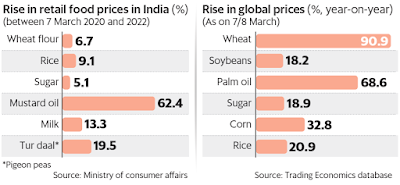
4. The crisis is hitting food prices badly

Image

As the oil embargo by US and UK starts to bite and others join in, oil prices are expected to rise further and also stay elevated for the foreseeable future. Its impact on Indian consumers will be significant, thereby posing a serious problem for the government to absorb some of the increases through excise duty cuts, which in turn would erode its tax revenues.

The cost of the Indian basket of crude, which averaged $69.88, $60.47 and $44.82 per barrel in FY19, FY20 and FY21, respectively, averaged $94.07 in February, according to data from the Petroleum Planning and Analysis Cell (PPAC). The average was at $126.32 a barrel as of 7 March. The Indian basket represents the average of Oman, Dubai and Brent crude... Petrol and diesel have around 2.5% weight in the Consumer Price Index and 13% weight in the wholesale Index. A ₹1 cut in excise duty on petrol costs the exchequer ₹4,000-5,000 crore, while the same for diesel costs ₹14,000-15,000 crore. An ICRA report recently said that India's current account deficit is likely to widen by $14-15 billion, or 0.4% of GDP, for every $10 barrel rise in the average price of the Indian crude basket.

And its impact on inflation in India,

It is estimated that a 10% rise in pump prices or retail fuel prices could lead to a direct impact of 20-25 basis points (bps) on inflation measured by the Consumer Price Index (CPI).

The oil embargo will seriously impact Russia only if European countries follow the US and UK in banning Russian oil imports. 

About 60 per cent of Russia’s oil exports go to Europe, including around 2 per cent to the UK, while 8 per cent go to the US. China accounts for about 20 per cent. 

The crisis has also forced the Europeans to shift away from its dependence on Russia for natural gas

The EU unveiled a plan on Tuesday to cut Russian gas imports by two-thirds within a year. Moscow supplies 40 per cent of the bloc’s gas and a quarter of its crude oil. Brussels aims to import more liquefied natural gas, increase the amount of wind and solar energy, produce biogas and reduce demand by insulating homes and asking people to turn down their central heating.

Oil prices are inching their way to record high.

Image

5. On the topic of oil price increases, a Wood Mackenzie analysis (before the Russian invasion) pointed to three factors,
First, a second successive year of extraordinary demand growth is putting massive pressure on infrastructure and global logistics. Shifting crude from well-head to pump is proving problematic. Second, oil has joined in the general commodity rally of the last 18 months and has had an important interplay with gas along the way. Super-high gas prices in Europe and Asia have encouraged arbitrage and some gas-to-oil switching, albeit much lower volumes than many feared. Both factors helped pull up oil prices. Third, there have been multiple threats to global liquids supply in the last few months: civil unrest in Kazakhstan, which briefly reduced production; political disputes and pipeline outages in Libya; ongoing militant attacks in Nigeria; drone attacks on the UAE; and now the mounting tension in the Russia-Ukraine crisis. Together, these have heightened fears of a supply shortage.
6. Underlining risks associated with futures trading, the London Metal Exchange had to suspend nickel trading following a "short squeeze" sent the price soaring. It arose due to a Chinese metal tycoon, Xiang Guangda, founder of China's leading stainless steel maker Tsingshan Holding Group, accumulating more short position than available inventory. As prices rose due to news of supply disruptions from Russia, it forced margin calls on Xiang which would force losses of billions of dollars.

Xiang had bet that the price of nickel would fall, but when the market moved sharply the other way, he would have been required to either post more cash to cover his losses or buy back the position. The move on Tuesday followed a jump of more than 70 per cent in the previous session as rumours about the size of Xiang’s position swirled around London’s tight-knit metals market. The size of Xiang’s short position is unclear but it is at least 100,000 tonnes of nickel, according to people with familiar with the matter, who said the LME had been forced to act when it became clear that some of its small members were also facing large demands for extra cash to cover trades put on for clients. Several market participants said Xiang faced potential losses stretching into billions of dollars given the size of the trade, but that the figure could change depending on where nickel prices reopen...

Image
The decision to suspend dealings and cancel all trades made on Tuesday is the biggest crisis at the 145-year-old exchange since a rogue trader at Japan’s Sumitomo Corporation racked up huge losses in the 1990s trying to corner the copper market. Unlike most futures exchanges, the LME’s contracts can be settled physically from metal that sits in its network of approved warehouses, which stretch from Rotterdam to Malaysia. This link makes the exchange the leading price setter for industrial metals. Its customers include physical producers and big industrial consumers of metal seeking to hedge their exposure to price moves. Colin Hamilton, analyst at BMO Capital Markets, said it was surprising the LME had let “someone build a short position” in excess of available inventory. “To have such a large short position when there isn’t enough inventory to deliver against it is exchange 101,” he said. “That shouldn’t happen.”

Nickel trading at LME has been suspended since Tuesday morning. The obvious beneficiary is the short position holder, whose margin calls get postponed and allow the markets to get back to normalcy. 

However, the reason for the suspension is certain to become a matter of controversy in the days ahead. It emerges that LME's owner is Hong Kong Exchange, which in turn is owned by Chinese investors, who in turn may have been directed by the authorities in Beijing to shut down the exchange to bail out Xiang Guangda and prevent Tsingshan going bankrupt. The company is the world's leading nickel miner and stainless steel maker. It's now open to the counterparts/brokers who were sitting on the massive gains from Tsingshan's short positions to litigate against being deprived off those gains. It's been remarked that "global markets are being shut down to avoid one Chinese company going bankrupt". 

7. It has been conventional wisdom that Free Trade Agreements are an important requirement for national economic growth. Livemint has a good graphical summary of the effect of FTAs.

For three of the four FTA regions, imports have growth faster than exports after the FTA was signed. Interestingly, the only region with which exports have grown faster is in the South Asia region, where India is the largest and most advanced economy and therefore well placed to benefit from free trade. 

Image

In fact, post-FTA, India's trade gap with ASEAN has diverged, even as exports have stayed flat.  

India’s imports from Asean countries have nearly doubled between 2011-12 and 2018-19. Therefore, India’s ‘terms of trade’ with Asean, calculated as the value of exports relative to imports, have worsened over the past decade, when the FTA has been in place. Amid exports that moved in a narrow band, India’s trade deficit with Asean has widened from $5 billion in 2010-11 to $23.8 billion in 2019-20.
Image

8. Striking graphic about India's very low female labour force participation ratio.

Image
9. A good feature in NYT on where the $5 trillion US pandemic money was spent. 
Image
10. Finally, back to Russia. FT has a long read on President Putin's inner circle, the siloviki. It makes the point about they being motivated by Russian nationalism and deeply resentful of the way in which the Soviet Union collapsed. This is an important motivation,
Ukraine’s place in this doctrine was accurately summed up by former US national security adviser Zbigniew Brzezinski: “Without Ukraine, Russia ceases to be a Eurasian empire.” The Russian establishment entirely agrees. They have also agreed, for the past 15 years at least, that America’s intention is to reduce Russia to a subservient third-rate power. More recently, they have concluded that France and Germany will never oppose the US.