Impressive new report from the MGI on the potential of Internet of Things (IoT), defined as "sensors and actuators connected by networks to computing systems". It analysed more than 150 use cases in nine 'settings' and estimates its total potential economic impact at $3.9 trillion to $11.1 trillion annually by 2025, with the upper estimate contributing to a value addition of 11% of the global economy.
As always with MGI reports, the findings from its summary are summarized with nifty graphics, some of which have been extracted below. The summary of findings from the study,
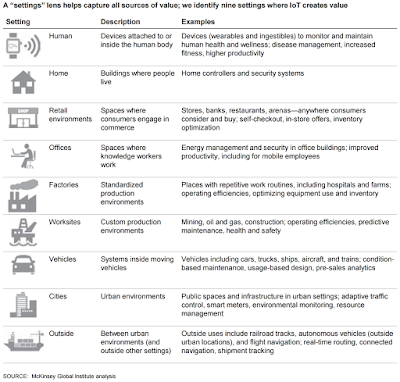
 The report identifies nine 'settings' where IoT offers impressive value creation opportunities.
 The value creation opportunities are far higher in the developed economies.
 An illustrative list of important applications is as follows.
 The opportunities in improving efficiency of existing systems is evidently enormous. The report also draws attention to a few important considerations necessary for the realization of full value from IoT applications like the realization of interoperability between IoT systems, using information from IoT not just to detect and control anomalies but mainly for optimization and prediction etc.
While the IoT offers interesting opportunities and undoubted efficiency improvements, its impact on the work-force may not be benign. The knowledge-workers will naturally find new opportunities and their base will expand. For less skilled workforce involved in terminal health care, shop-floor retail, maintenance and repair facilities, large factory floors, logistics management etc, the potential for shrinkage is considerable. It is also not surprising that the two 'settings' with the highest potential and likely impact in developing countries from IoT, factories and worksites, are also the two largest employers of the middle and lower skilled workers.
As always with MGI reports, the findings from its summary are summarized with nifty graphics, some of which have been extracted below. The summary of findings from the study,


While the IoT offers interesting opportunities and undoubted efficiency improvements, its impact on the work-force may not be benign. The knowledge-workers will naturally find new opportunities and their base will expand. For less skilled workforce involved in terminal health care, shop-floor retail, maintenance and repair facilities, large factory floors, logistics management etc, the potential for shrinkage is considerable. It is also not surprising that the two 'settings' with the highest potential and likely impact in developing countries from IoT, factories and worksites, are also the two largest employers of the middle and lower skilled workers.


