Showing posts with label Bombay. Show all posts

26 March 2025

Photography Review: One Step in their Shoes

The Passerby, a photo exhibition of Indian street scenes, shows us the worlds we are walking past. 

(A short review essay I did for India Today magazine, on this gorgeous show, mounted in mid-2022.)

The 23 still images on display in PhotoInk’s garden-set gallery space in Delhi’s Vasant Kunj are a balm for tired eyes. The black and white—and certainly over fifty shades of grey—help recuperate from the nonstop ocular assault of lives lived on multicoloured moving screens. But the healing and stillness The Passerby offers come from some- thing more than form. Street scenes picked from the archives of Raghu Rai, Sooni Taraporevala, Ketaki Sheth and Pablo Bartholomew, these formally stunning photographs paint a portrait of an urban India that’s swiftly passing (if not already past). They range from 1970 to the early 2000s, but the pre-liberalisation era dominates, letting a quiet nostalgia wash over us.

The street scene has historically been among the most popular photographic genres, the PhotoInk brochure points out, and is easier now without a heavy, obtrusive camera: “Everyone with a mobile phone is now a street photographer.”

Everyone could be, yes. But we aren’t. It is striking just how little the glory and grimness of our streets enter the artfully arranged world of Facebook or Instagram. Perhaps it should be no surprise. Street photography needs you to be on foot, and to actually look around as you walk. And while the Indian street remains infinitely more interesting than anything the German philosopher Walter Benjamin imagined when writing of the flaneur in 1930s Paris or Berlin, the upper middle class that controls image-making in our digitally-divided republic has withdrawn indoors. India remains full of street weddings and street-side shrines; the poor—of necessity—still work and sleep and fight and make love in the street.

But between Uber/Ola and app-based delivery, urban white-collar Indians needn’t put foot to asphalt, for taxi, auto-rickshaw or groceries. The few who do either make no images, or pirouette and fetishise.

The Passerby yields many insights into our recent past, and how photographers saw it. For instance, beasts of burden are often juxtaposed with motorised transport. An Ambassador and a bullock cart share in Rai’s majestic 1984 Delhi downpour; a white Fiat faces determinedly away from Taraporevala’s 1977 camel on Marine Drive. These animals have disappeared from city streets, as have these vehicles. Gone, too, is the sidecar-style scooter in which a 1976 Shravan Kumar transports his aged parents (Bartholomew’s ‘Family on a scooter’). Taxi drivers no longer nap with doors ajar; they use the car AC.

But much remains the same. Rai and Bartholomew both capture cart pushers to devastating effect, moving mountains with their bodies. Horses stand in symmetry in Rai’s Turkman Gate, their blinkered gazes evoking that of the purdah-clad woman beside them. Hijras still pose performatively, while few women on the street meet the photographer’s gaze— Sheth’s shy mother and child and Taraporevala’s striking tableau of Kamathipura sex workers both needed women behind the lens.

Given our increasingly enclosed present, The Passerby images are not just a way into the past, but a call to the future— what do we want for our streets, and ourselves?

(The Passerby is on view at PHOTOINK, New Delhi, till June 26)

Published in India Today, May 2022. 

Note: Pablo Bartholomew's photographs, included in the show and discussed above, are not available for view on the PhotoInk gallery website to which I have linked above. 


12 July 2021

Dilip Kumar exemplified an idea of India we've lost

My Mirror/TOI Plus column dedicated to the actor Dilip Kumar, who passed on this week:

Born in Peshawar and brought to Bombay, he was the true child of a country that revelled in its linguistic and regional variety, rather than craving to homogenise it.

Like the country it claims to represent, the public culture of Bollywood has a tendency towards hagiography. We like to anoint heroes, inflating even their minor talents into grand achievements, and painting an unrealistically spotless picture of their greatness. Bhakti leaves no room for considered evaluation of a person’s strengths and flaws, or even for placing someone in the context of his time, looking at how he may have responded to his professional and historical milieu. It is as if we have never got our heads around the relationship between the individual and society: Either the individual’s achievements are credited entirely to his being from x community or y institution, or else he is pronounced sui generis in some unbelievable way.

The actorly legend of Dilip Kumar is no different. The stories of his dedication abound - of his being a ‘method actor’ before Marlon Brando, or learning to play the sitar in reality from Ustad Abdul Halim Jaffar Khan for the 1960 film Kohinoor, or refusing the role that eventually went to Omar Sharif in Lawrence of Arabia. Some of these narratives say less about Dilip Kumar than about the Indian desire to lay claim to an actor who was the equal, nay superior, of anyone Hollywood could throw at us.

That path of global comparison, though, feels to me like a red herring - not because Dilip Kumar was not a fine actor, but because the style he developed was so specifically Indian. He may have been understated, using a mixture of gently caustic dialogues and brooding silences and dropping his booming voice to a whisper in the throes of love or pain, but there was never any doubting the intense ebb and flow of emotion under that surface. Dilip Kumar was drama – just conducted with dignity.

Still, it is true that he was among the first Indian leading men to step away from our previously theatrical histrionics – and I mean theatrical here quite literally; the exaggerated gestures and loud oratory were characteristic of the spectacular Parsi Urdu theatre, from which early Bombay cinema emerged. Actors like Motilal and Ashok Kumar were his predecessors in this change. Ashok Kumar, in fact, was the first actor he met at Bombay Talkies, telling him to “just do what you would do in the situation if you were really in it” – and young Yousuf took the big star’s naturalistic instructions to heart.

Despite a rocky start with the lost 1944 film Jwar Bhata (in which the outspoken FilmIndia critic Baburao Patel called him “the new anaemic hero” whose “appearance on the screen creates both laughter and disappointment”), by 1947, Dilip Kumar had made the screen his own.   

Image

But to me, what made Dilip Sahab a true legend (and he was always called Dilip Kumar Sahab, making the PM’s condolence tweet calling him “Dilip Kumar ji” sound strangely off) was not his acting, or even his perfectionist attention to detail, or even his undeniable mastery of both voice and language. Though that last quality was shaping, both of him and the film industry he strode like a colossus for decades. Born in Peshawar in 1922 and brought to Bombay as a toddler by his fruit-merchant father, Dilip Kumar was a true child of that polyglot city -- and of an India that revelled in its regional and linguistic variety rather than craving to homogenise it.

Other than his renowned flair for Urdu (he told a young Tom Alter that the secret of good acting was “sher-o-shairi”), he was fluent in Hindi/Hindustani, Pashto, Punjabi, Marathi, English, Bengali, Gujarati, Hindko, Persian and the Awadhi and Bhojpuri dialects. You can watch the words roll off his tongue in old YouTube interviews, or read the many remembrances in which he made people feel deeply at home by speaking, literally, in their language. For 10 years from 1960 on, a special train ran annually from Bombay to Poona on which people bought tickets for the sheer pleasure of travelling with Dilip Kumar – but it seemed he took enormous joy in it too, talking to people in Tamil, Telugu, Konkani and all of the languages mentioned above. 

Which brings me back to the qualities that really seem to define Dilip Kumar: His warmth and integrity and feeling for people, across the bounds of religion and background and age. You didn’t need to know him personally to be able to see the strength of his relationships. It is enough, for instance, to read Rishi Kapoor talk about his father Raj Kapoor’s lifelong camaraderie with “Yousuf Uncle” - extending from their shared Pashto-speaking childhood to the superb playing-off of their personas in the hit love triangle Andaaz (1949), through the many schemes they hatched to raise funds for national causes, all the way to Dilip Kumar addressing an unconscious Raj Kapoor in his hospital bed just before Kapoor passed away in 1988 – as filmi as it gets, and yet real and deeply felt.

It is enough, also, to watch Dilip Kumar reach out, mid-speech on stage and hold the hand of the much younger Shah Rukh Khan, turning what might have been just another filmi commemoration into something memorable and intergenerational and true. Or Dharmendra, visiting for his birthday a few years ago, clasping his hands with a fraternal love you could not stage – or cradling the late thespian’s head after his death, tweeting “Maalik mere pyaare bhai ko Jannat naseeb kare”.

Dilip Kumar came of an age in a film industry that was, as anthropologist William Mazzarella points out, then in a rare period of organic synch with the nation-state. If filmmakers between the ’30s and early ’60s seemed to voice the hope and popular enthusiasm of the new nation, the nation could also see itself in the cinema. In 1955, the chair of a Sangeet Natak Akademi seminar could welcome Prime Minister Nehru as “the Director of one of the greatest films in history – the film of New India’s destiny…”.

Dilip Kumar was a great admirer of Nehru, whom he called Panditji, like so many of his generation. In his memoir, he speaks fondly of Nehru singling him out on a rare visit to a film set, and in later years, giving his 1961 film Ganga Jumna a hearing against decisions by Nehru’s own information and broadcasting minister BV Keskar. Screenwriter Salim Khan, writing at the end of Dilip Sahab’s memoir, makes the fascinating argument that the legendary pauses in his dialogue delivery were modelled on Nehru’s Hindi speeches, where the pauses were because he was translating from English in his head.

In 1962, Nehru only had to say the word for Dilip Kumar to agree to campaign for the Congress Party, for the great VK Krishna Menon. Kumar later served for a year as Sheriff of Bombay and as a nominated INC member to the Rajya Sabha from Maharashtra from 2000 to 2006. This was also a man whom Pakistan had awarded the Nishan-e-Imtiaz, leading Shiv Sena leader Bal Thackeray to cast public aspersions on his nationalism. And yet Dilip Kumar’s book makes a point of mentioning not only his hurt, but also the Thackerays’ later invitations to him and his wife Saira Banu.

In his grace and his depth of feeling, for India and the cross-subcontinental culture he spoke for, Yousuf Khan had few equals. Dilip Kumar exemplified an era, and his life and character seem to sum up what was best about it. He could only have emerged in a time and a place where we believed in stitching things together – not tearing them apart. Long may his memory live.

Published in TOI Plus/Mumbai Mirror, 10 July 2021.

4 April 2021

Why our enduring romance with the railways makes for great cinema

My Mumbai Mirror column:

Awtar Krishna Kaul's 27 Down, which won two National Awards in 1973, remains a visually arresting reflection on India's train journeys 

Image

The connection between films and trains dates back to cinema's origins. One of the Lumiere brothers' first films was of a train arriving at the station in La Ciotat, a small French town near Marseilles. Arrival of a Train, shot in 1895, is central to the mythology of the movies. The claim (made in several film histories) is that early audiences leapt from their chairs in alarm as Lumiere's locomotive seemed to race towards them. Even in soundless, jerky black-and-white, the story goes, the power of the moving pictures was such that people – almost -- couldn't tell them apart from life.


In recent times, film historians have cast doubt on this narrative, some pointing to confusion with a later stereoscopic version that Louis Lumiere exhibited in 1934. But what is indubitable is that there was something endlessly watchable about this simplest, single shot of a train. Trains had screen presence.


Both the railways and the cinema arrived in India soon after their invention, swiftly becoming integral to our social and cultural life. So it's no surprise that trains are a fixture in our films: The staging ground, as much for crime and thrills as romance and recreation.


But perhaps the most devoted train film we've ever had is Awtar Krishna Kaul's 1973 feature, 27 Down. Kaul, who had left his diplomat job to study filmmaking in New York, returned to India in 1970 and became part of the Indian New Wave: A spectrum of directors ranging from Basu Chatterjee to Mani Kaul, beginning to make their mark in an era popularly defined by Bobby and Yaadon Ki Baraat. 27 Down was Kaul's first feature, made with the encouragement of Filmfare editor BK Karanjia, who was then chairing the Film Finance Corporation.


Based on a Hindi novel called Atharah Sooraj Ke Paudhe, the film stars a young MK Raina as the ticket-checker protagonist Sanjay, and Rakhee as his girlfriend Shalini. Filmed in atmospheric black and white by cinematographer AK Bir (who had just graduated from FTII at the time and never shot a film before), it won National Awards for Cinematography and Best Hindi Feature -- days after Kaul died tragically in a drowning accident.


The film begins with the familiar drone of the Indian Railways announcer: “Number Sattaaees Down platform number teen se jaane ke liye taiyyar hai”, and is shot very substantially on trains and in stations. Often assembling his shots to accompany a meditative monologue, Kaul's work seems closer to the more experimental end of the New Wave. 27 Down starts off ploddingly, in a self-consciously literary voice: “Phir koi pul hai kya? Shaayad pul hi hai [Is it a bridge again? It's probably a bridge],” Sanjay thinks to himself, lying supine on a berth as the train moves. “It feels like I'm constantly crossing bridges...”. But there are playful moments, too. The song Chhuk chhuk chhuk chalti rail, aao bachchon khelein khel adopts the train's rhythm to create a visual and aural paean to it, with shots of the locomotive moving through tunnels juxtaposed with children lining up to form a train.


Son of an engine driver, Sanjay's life seems to keep circling back to the railways. Born between two stations, as a child he is insatiably curious about trains. He tries to study art in Bombay, but his father urges upon him the stability of a railway ki naukri. As a ticket checker, Sanjay discovers anew his love of trains. He starts to eat and sleep on trains, even when not on duty. Neighbours, landlords, even his father finds his peripatetic existence strange. “Tumhare liye toh train hi ghar ho gayi hai,” his father writes him.


It is on a train that he meets Shalini, who lives alone in a rented room in Kurla and works in the Life Insurance Company of India. It is a railway romance: She takes the train to work, he takes the train as work. When his life plans are again forcibly aborted by his father, Sanjay surrenders himself to the trains again – in metaphor and then in reality.


“I wanted a long path, instead I got these iron roads, where the direction is already decided,” Sanjay muses sadly. A minute later he's grateful for the effortlessness of the journey: “Chalti train hi sahara hai [The moving train is my only support].” But then, there's the sense that he isn't really getting anywhere. “Main guzar jaata hoon, aur jagah khadi reh jaati hain [I move past, and places stay where they are].”


Then he gets on a train to Banaras, looking to beguile himself with women and wine, his beard getting scragglier. The sequence echoes so many tragic Indian heroes, and yet it feels distinct. He looks at an old man on the train, the old man looks intently back at him, and we imagine (wordlessly, like Sanjay) that he is Shalini's long-lost father who may have become a sadhu in Banaras. In a more conventional melodrama, Sanjay's echoing of Shalini's father's escape from an unchosen domesticity would end in discovery, reunion. Here, it ends in a dream of death.


Perhaps what 27 Down's languid melancholy really captures is the duality of the long-distance Indian train ride: You're in a crowd, yet alone; relentlessly moving, but not of your own accord. And yet, the solidity and predictability of India's trains makes them feel like something to believe in. Get on a train, and the country seems to stretch out before you: Distant, but somehow accessible. When Sanjay says, “Mera train aur bheed se vishwas uthh gaya hai [I've lost my faith in crowds and trains]”, we know it's over.


Published in Mumbai Mirror, 4 Apr 2021.

Awtar Krishna Kaul’s 27 Down, which won two National Awards

Read more at:
https://mumbaimirror.indiatimes.com/opinion/columnists/why-our-enduring-romance-with-the-railways-makes-for-great-cinema/articleshow/81893897.cms?utm_source=contentofinterest&utm_medium=text&utm_campaign=cppst

20 January 2021

A love that breaks class barriers

My Mumbai Mirror column:

An unlikely relationship reaches across social boundaries in Rohena Gera's understated romance Sir.

Image

It may seem difficult to recall in the cold light of the present, but cross-class romance once warmed the hearts of Hindi film audiences. The poor boy who won the heart of the rich girl (and the wrath of her family), was a staple of the single-screen era. Even then, the rich hero-poor heroine equation was less frequent -- and for that fantasy to extend to the master-servant relationship was rarer still. Rohena Gera's lovely film Sir, completed in 2018 and released online earlier this month, tries to turn that dream into reality.


Ratna (Tilottama Shome) works as the live-in domestic help for Ashwin (Vivek Gomber), who is due to get married to his girlfriend Sabina. When the wedding – and the relationship – suddenly falls through, the quiet Ashwin finds himself being hectored from all quarters. His overweening mother wants him to reconsider, his father seems to assume he can't handle his part in the family business and his friends want to steer him into dating again. Increasingly isolated, he begins to notice the unobtrusive warmth of Ratna's presence. She comes from a space of experience far removed from Ashwin's upper class Mumbai universe – a poor rural family, a hurried marriage, early widowhood with its attendant social and economic fallout -- but her halting words are both genuine and wise. The gulf between them is huge, but Sir manages to make us believe in the possibility that it might just be bridgeable.


The America-returned Ashwin has never been anything but polite to Ratna. But as his appreciation of her grows, he baulks more and more at the rudeness of those around him. Gera's deft script and direction is aided by the wonderful understated performances she draws from both Shome and Gomber, Shome in particular delivering scenes of great devastation with a quiet wallop – such as when a boutique manager responds to Ratna's entry by yelling for the watchman, or Ashwin's party guest makes a scene over her spilt wine. Gera makes clear that nothing said or done to Ratna is out of the ordinary; it is what the servant-keeping classes in India mete out unthinkingly. From Ashwin's businessman father dissing his construction workers to the neighbour who insults her child's ayah (Geetanjali Kulkarni in a great supporting role) rather than chastise the child, the film throws into relief Indians' constant othering of those less privileged than us. It is upper middle class common sense to think of servants as 'lazy' or 'cheats' or inept, 'morons' who need to be kept in check with low salaries, stark boundaries and harsh punishments. The more we want to exploit the poor, the more it suits us to think of them as less than human.


It is against this usual wall of invisibility that Ashwin's gestures – that would be common courtesy if Ratna were not a servant – stand out as excessive. It isn't just in his class that they attract attention, but also in hers. Offering to wait for a servant to finish eating, asking if she needs a ride home -- these are acts so unthinkable on an employer's part that they arouse the mockery and suspicion of other servants. And for Ratna, made vulnerable by both class and gender, they can lead to social extinction.


And yet, it is in Ashwin's spontaneous crossing of that wall, his apparently unconscious transcendence of the very boundaries society wishes us to guard, that the possibility of any real relationship lies. Because even as Ratna fears the weight of social censure, she demands the respect of social acknowledgement. “Main ganwaar hoon [I may be a country bumpkin],” she tells Ashwin, “Lekin main aapki rakhail ban ke nahi rahoongi [But I won't live here as your mistress].”


In Zoya Akhtar's powerful segment of the 2018 anthology film Lust Stories, another quietly efficient domestic help (Bhumi Pednekar) finds herself taking care of her young male employer (Neil Bhoopalam). The intimacy between them feels far from furtive, and the banter that accompanies such frank, lusty sex holds at least the glimmer of equality. But that distant promise is shattered when Bhoopalam's middle-class parents arrive, with a suitable girl in tow. In front of his parents and prospective in-laws, the good middle-class boy behaves impeccably – which is to say he betrays not the barest hint of his real relationship with the maid.

But perhaps that's the point. When something only exists behind closed doors, is it ever really real?


In contrast, it is Ashwin's insistence that he isn't afraid of what people might say that makes his attraction to Ratna so heartwarming. It may seem utopian, but that's why it feels like love.


Published in Mumbai Mirror, 17 Jan 2021.

20 November 2020

Short of nothing

My Mirror column for Sun 8 Nov:

Among the hundred-odd films screening till tonight in the online edition of the Dharamshala International Film Festival are a variety of accomplished shorts – Indian, foreign, fiction, documentary, animation.

Image
Aditi Bhande's devastating Ghaziabad-set short film Did You Do It? traces one building's waste as it leaches into the surroundings

There are many exceptional films in this year's Dharamshala International Film Festival, but this column focuses on the shorts: films under 30 minutes. Some of the ones I really liked include:

1) Sudhamayee -- Megha Acharya's observational film is composed of family vignettes that may seem artless, but speak volumes. The film starts with a woman describing how she ended up becoming the primary caregiver for her father: her brother declared he was “scared of hospitals” and couldn't “bear to see those things.” “As if, we like seeing those tubes. We don't,” he voice trails off. There is a momentary lull in the conversation, as though the two women are absorbing these facts of life: the ugliness and pain of hospitals, but also the easily declared inability of so many men to perform the labour that surrounds illness and death. Or any domestic labour at all. As if on cue, a man emerges from the bedroom, retreating when he sees the women. The women, in turn, immediately rise with their plates - the man's entry is a sign that time for real conversation is over, and everyday labour must resume now. Again, later, when the couple discuss the woman's promotion sending her elsewhere, she knows she cannot. The man remains, as always, oblivious.

Image
Sudarshan Suresh's brilliant 17-minute fiction is a chilling comment on who loses and who gains from the spectre of "love jihad"
 
2) Mizaru -- A young couple in a Mumbai park become a target for a group of unemployed men, but no-one comes to their aid. It is the sort of incident that is stiflingly familiar to any young person who has ever conducted a romance in India. By zoning in on it in film, Mizaru makes us question what we apparently don't in life: what have the couple done to deserve this treatment? Ah, they have displayed physical affection for each other. And since anything sexual in India is automatically shameful, they can be publicly humiliated by a bunch of louts. As self-appointed guardians of Hindu morality, the men feel entitled to bully them in every possible way. We live in a country in which the villains are confident that their actions will find support from society (the members of a laughter club in the park) and the state (the cops who show up and seem quite happy to have been delivered up some easy victims). Shot in one remarkable fluid take, Sudarshan Suresh's 17 min fiction is a searing indictment of everything that is wrong with India.

3) Did You Do It? -- This disturbing, largely dialogue-less film manages to be somehow programmatic and a mood piece. It begins with a characteristically North Indian dust-storm. The strange menacing half-light, the distant flocks of birds, the persistent slapping sound of the rain may have no diegetic purpose, but the aandhi is dark, slow and harrowing, just like the journey the film sets out to trace: a single day's worth of garbage emerging from an apartment complex in Ghaziabad and leaching inexorably back into our water, earth, air.

Aditi Bhande's Did You Do It? forces us to look at the processes we Indians so expertly turn away from in reality: the unsegregated dumping of garbage, the rising mountains of plastic, the barefoot young workers who do the irreplaceable work of clearing our surroundings, the stinking lorries, the overflowing landfills, and the ridiculous vision of middle class citizens in denial, marching against the municipality. Winner of the Best Editing award for Student Documentary at the Dadasaheb Phalke Film Festival 2020, Bhande is remarkably adept at delivering the facts as a quiet punch to the gut. “The water here has high levels of iron, nitrate, fluoride and aluminium,” reads a subtitle, going on to enumerate the diseases caused by such minerals in water, the depleting ground water levels, the pumping of semi-treated water back into the Hindon river. On screen, water continues to flow down the drain.

Vividly shot, with superb sound, the film constantly unravels our increasingly delusional expectations from nature and the natural. The deceptively attractive rushing sound of water takes us not a river but to the swirling pool of the sewage plant; the green piles of bhindi look poisonously greener in the unearthly tubelit glow of the street market. This film made me restart my lapsed composting bin. It might be the wake-up call you need, too.

Other shorts at DIFF that deserve more than a mention: Stray Dogs Come Out at Night, in which we meet a Pakistani sex worker; Irani Bag, a clever 8-minute essay on the purpose women's bags serve in post-revolutionary Iranian cinema; Anonymous, which movingly maps the stark realities of the Indian construction site; and the stunningly animated dystopia of Wade, in which a group of human scavengers navigate a flooded future Kolkata.

If you think an immersive film necessarily means an hour and half of plotted drama, try these out.

Published in Mumbai Mirror, 8 Nov 2020.

28 June 2020

Shelf Life: High Heels, Parkar-Polka and Other Dressing Dilemmas

My Shelf Life column for June 2020:

Clothes mark the lines between modest and modish in theatre actor Vandana Mishra’s memoir, translated from Marathi by Jerry Pinto

Thespian Vandana Mishra, née Sushila Lotlikar, was born on January 26, 1927, years before her birthday became known as India's Republic Day. Some of the loveliest parts of her vivid memoir, I, the Salt Doll, unfold in a time before that – her 1930s childhood in a chawl, her initiation into 1940s Bombay theatre. In her recounting, from the very start, her life seems like a stream flowing alongside many others, into the vast sea that was India.

The Mumbai of Mishra’s childhood held open the doors to that India, in all its glorious variety. And clothes were crucial to parsing that city. The Parsi ladies little Sushila admired in their “georgette saris and blouses without sleeves”, were clearly marked off from her teachers at the Lamington Road Municipality Boys and Girls School, who all wore nine-yard sarees – but “differently from the Saraswats”. Dr. Saibai Ranade, her mother's gynaecologist employer, wears the more modern five-yard sari, always in pastel shades: yellow, blue or pink. The girls wore frocks when very young, but shifted to “parkar-polka: a blouse and long skirt” in the fifth standard. Girls' clothes changed again at puberty: “By the time a girl was 14 or 15, she would move from parkar-polka and would be swaddled in saris forever after.”

Clothes in Mishra’s telling always mark the categories people are born into – gender, age, caste, community. But they must not mark you, the individual. If anything, they are a way of not standing out. Her municipal school has no uniform, but she says that “you couldn't tell the rich kids from the poor ones”. There is remembered beauty in the collective sight of clothing: the chawl's young women dancing in their parkar-polkas are like “a series of yellow, green and jamun-purple fountains...” But individual clothing is rarely mentioned. If it is, it must have a purpose beyond vanity. Her Aai's (Marathi for mother) silk sari is worn for ritual purity. Young Sushila's own outfits get mentioned only when marking a first: her first parkar-polka, “Dharwadi khunn with a broad border”, and her first sari, “pink with a green border”, bought for two rupees.

Two rupees was standard for an ordinary (cotton) saree, as against fourteen for a long-lasting “but flashy” georgette one. Flashiness was a constant danger—one that the middle-class girl-child internalised early. Sushila once tells a classmate's mother she is wearing too much powder. She gets slapped for rudeness, but the school's Pathan guard comes to her rescue. That moral front against make-up, in which little Sushila and the Pathan are on the same side, is a funny story. But it presages the book's repeated emphasis on modesty, on not dressing up, not attracting attention. It is boundary work that only gets exacerbated when the middle-class Marathi girl finds herself in a space meant for professionally dressing up: the theatre. 

Mishra came from a Konkani family of Saraswat Brahmins. When she was two, her accountant father died suddenly. Sushila's Aai – clearly a remarkable woman – refused to stay in the village, shave her head or stop educating her daughters. The family returned to Bombay. Aai did a midwifery course, and began educating three children on her nurse's salary. Then tragedy struck again: a horrible acid attack which kept Aai three months in hospital. Once home, she needed care. With her elder sister in Pune training to be a nurse, and her elder brother about to matriculate, it was Sushila who left school.

There is a powerful simplicity to the way Mishra describes these momentous events. One wonders if there was an equal simplicity to life itself. During her Aai's recovery, for instance, neighbours simply take over the family's upkeep, like others did when her father died. The family then scrapes by on savings, until an opportunity knocks: the chance to join Parshwanath Altekar's Little Theatre Group, at ₹30 a month.

Within months, on Nov 1, 1942, Sushila was asked to fill in for an actress who had stalked out, and found herself in a Mama Warerkar play. She was a hit, and soon became an actress of some repute on the Gujarati stage, and later, in the city's Marwadi theatre.

Suddenly, she is accosted everywhere: an admiring tailor offers to make her four blouses for free; a shoe-man offers her sandals. These are good working men. But there is also the local lech-cum-astrologer who offers to build her career, wooing her with an “expensive sari”. In the narrative of middle-class self-preservation, Sushila must throw that 'gift' in his face. She does.
Image

But the real turnaround comes when she begins to wear high-heeled sandals “which made a tick-tock sound”. The chawl's caretaker tells her mother she is “walking around with a lot of pride”. Her mother warns her, she switches to Kolhapuri slippers, and simplicity is enforced.

In Krishna Sobti's autobiographical Hindi novel A Gujarat Here, A Gujarat There, another young middle-class woman born in the 1920s is forced to abandon her education midway. Sobti's narrator recalls quarrelling with her hostel roommate over her high-heeled sandals “clacking about at night”. But in the book's last scene, as she walks to a job interview, it is “the click of her heels” on the asphalt that bolsters her confidence. Sometimes it is nice to feel like you stand out.

This column was first published in The Voice of Fashion, 18 Jun 2020.

11 June 2020

Faces in the crowd

My Mirror column (17 May 2020):

As we are schooled ever more to view India's labouring poor as an undifferentiated mass, Kamal K.M.'s I.D. and Geethu Mohandas's Liar's Dice help us see our co-citizens in their individual humanity.


Image
A still from Kamal K.M.'s film I.D., in which an upper middle class migrant is forced to think about the life of a poorer one

“A painter came to this house. I did not even ask his name. I mean, who does, right?”

The young female protagonist who says these words in the thought-provoking 2012 film I.D. is speaking to a male friend, who has to strain to understand what she’s on about – and not just because they’re in the midst of a raucous party. “I don't get you,” he responds at one point. Even to Charu (Geetanjali Thapa), her own words feel like the verbal equivalent of a shrug. There is a niggling sense that she could have done better – but following close behind is an attempt to reassure herself, that her lack of interest in the working class man who came to her upper middle class apartment wasn’t out of the ordinary.

The opening scenes of Kamal KM’s astutely crafted film have already established Charu as an ordinary member of her class and gender. She is a migrant, too, but that status does not mark her. Having moved to Mumbai recently from her home state of Sikkim, she shares a rather nice three bedroom apartment in Andheri with two other women her age. We hear her telling a friend on the phone that she has already booked a new car, though we know she’s still at the interview stage for a telecom marketing job. Meanwhile, through the glass walls of her bedroom, we see a city brimming with construction and labour. One man leads a buffalo through the streets, another kneels on the road to repair his auto, yet another carts eggs on a bicycle. Two urchins make a possibly obscene gesture as a young woman in a form-fitting dress climbs into her car.

When a man arrives to repaint a wall in the house, Charu lets him in, a little grudgingly, asking only one question: how much time will the work take? She is not exactly rude, but she displays the wariness that the upper middle class, likely upper caste Indian woman has internalised about the poor or lower middle class man. When the painter squats beside her to help her pick up some broken glass, she is standoffish. She does not offer him water until he asks. When she hears a thud, her first instinct is to tiptoe out of her bedroom looking for signs of violence, as if she fears a dacoity or worse. So distant does she feel from this stranger's humanity that she can't bring herself to touch him to revive him. She doesn't even think to sprinkle water on his face. Instead her only instinct is to call for help – the aunty downstairs that she has never before spoken to, the old security guard whom she has never before accompanied to the roof where he has to go each time the building lift misbehaves.

Image
Gitanjali Thapa sets out to trace an unknown man's identity in I.D.
But the painter has fallen unconscious in her presence, and Charu is now the only person who can take him to a hospital, pay the bill, file a police report. She begins to feel compelled to find out who the man is, so she can inform someone who knew him. From inquiring after this nameless man at the labourers’ naka near her home, to following the contractor home when he stops taking her calls, to following a possible lead to the desperately filthy lanes of the Mankhurd slum he might possibly have lived in, Charu becomes our route into the beeping, blinking city whose SOS signals she – like all of us reading this paper – have learnt to keep switched off.

Image
A still from Liar's Dice, India's official entry to the Oscars in 2013.
I.D. is about how extraordinary circumstances force one woman out of her ordinary privileged cocoon, from suspicion to empathy. Another woman is forced out of a different cocoon in Liar’s Dice (2013), India’s official entry to the Oscars that year. Also starring Geetanjali Thapa and produced by JAR Pictures (in association with whom the Kochi-based Collective Phase One produced I.D.), Geethu Mohandas’s pensively framed road movie views the migrant labourer in the city from the other end of the telescope. Thapa won a National Award for her role as Kamala, a barely-literate woman who leaves her Himachali village to search for her construction worker husband who hasn’t answered his phone for five months. Mohandas makes us painfully aware of the dangers the outside world poses to a woman like Kamala, forcing her to rely on a stranger. The limping, unkempt Nawazuddin (played with relish by Nawazuddin Siddiqui) has a taciturn, unreliable presence: himself a possible threat that Kamala must bet on. The film could have been better written, and banks too much on a cherubic child actor (Manya Gupta) and a baby goat for charm and watchability. It also turns a predictable cinematic gaze on Old Delhi, all rickshaws and dingy hotel rooms bookended by picturesque shots of street performers and the Jama Masjid.

But it works as a companion piece to I.D., both films bringing into focus the India we consider normal – in which a man can simply disappear, with no-one held responsible for what happened to him. As even our existing labour laws are suspended in state after state, with governments using the pandemic as a cover for less regulation and oversight of working conditions, the lives of our nameless, faceless co-citizens are being pushed ever more out of sight. I.D. and Liar’s Dice give us a rare chance to start seeing.

Published in Mumbai Mirror, 17 May 2020

10 June 2020

Tell Me How Long The Train's Been Gone

My Mirror column (10 May 2020):

As India's labouring poor are locked into cities and die tragically in their unaided attempts to get home, Muzaffar Ali's 1978 migrant classic Gaman acquires new layers of meaning.

Image

In an early scene in Gaman, a hesitant Ghulam Hasan (Farooque Shaikh) gets off a train at VT Station and manages to find his way to the jhopadpatti that appears to be his childhood friend Lallulal's (Jalal Agha) Mumbai address. He pauses beside a group of young men chatting by the roadside. “Sunoh bhaiyya,” says Ghulam softly, his tongue still travelling along the slow perlocutionary path of his native UP village. “Woh kya hai ki kya Lallulal Tiwari yahan rehta hai?” 

The retort is quick and stinging, and the word now jumps out at us, an untranslated social footnote that will not be suppressed: “Apun tumko bhaiyya dikhta hai?

One of the others deigns to direct the lost newcomer to the tin-roofed shanty (“third gali after the municipal toilet”) that the affable Lallu shares with several other men, and Ghulam quickly becomes one of its occupants. But Muzaffar Ali's 1978 directorial debut, a film made three years before his much more famous Umrao Jaan, never lets his viewers forget that this rickety roof over their heads is both temporary and tenuous. Shelter in the big city is so precious a thing that Lallu's labelling of it as his “Taj Mahal” is both a bad joke and thoroughly heartfelt. And the emotion only heightens through the film, as Lallu and his sweetheart Yashodhara (Gita Siddharth, of Garm Hava fame) yearn ever more for a place of their own so they can marry, while even the rented kholi is threatened with demolition.

For Ghulam though, it is the village home he has left behind that calls out to him, in the shape of letters bringing news of his ailing mother and his lonely wife Khairun (Smita Patil), whose face drifts up from his memories and looms large over the cityscape that he learns gradually to traverse. Aided by older men from his native region, so-called bhaiyyas, Ghulam becomes, like Lallu, a taxi driver in Mumbai. The film is full of shots of Shaikh in a taxi, his sad eyes seeing but not quite seeing the urban crowd he is now part of. “Hiyan bheed ka kauno hisaab naahi,” as he tells Lallu wonderingly.

Muzaffar Ali's use of songs is perhaps his most affective talent, and it is powerfully evident here. In the picturisation of the film's magisterial anthem of urban desolation “Seene mein jalan, aankhon mein toofan sa kyun hai/ Is sheher mein har shakhs pareshaan-sa kyun hai? (Why does the heart burn, why is there a storm in my eyes/ Why is everyone troubled in this city?)”, our gaze travels past blocks and blocks of urban housing, and cars seen from above, like unending queues of ants, and we hear Shahryar's line: “Ta-had-e nazar ek bayabaan sa kyun hai?” “Why is there a wilderness as far as the eye can see?”

One of Gaman's achievements as a film about the migrant experience is that the distance between the village and the city feels insurmountable, despite the technologies that bridge the two. That feeling is gestured to in the film's very first shot, when a letter is being laboriously typed with one finger (on a typewriter that, in one of those surreal moments that populate the watching of so much in 2020, bears the brand-name Corona), and the camera moves up from there to the telegraph lines that stretch across a bucolic rural landscape. A great deal of screen time is spent on trains and buses – and at moments of particular emotion, Ali inserts a distant shot of a plane in the sky, like some imagined modern-day pigeon-post of the heart.

Conditions of labour and lack of money make it nearly impossible for the poor migrant to go back home, even when nothing is ostensibly stopping him. In the third month of a shockingly unplanned and heartlessly implemented lockdown, when lakhs of India's working poor are being forcibly kept from going back home, Gaman's final sequence bears a terrible new weight. Farooque Shaikh bundles up his few belongings in his lovely old-style trunk (the objects of the feudal Awadh village were still beautiful) and arrives at VT, hoping to depart as spontaneously as he had arrived. But more than half the money he has saved in a year will go on just the journey home, he thinks, and his feet stop where they are. We leave him standing behind the collapsible gate that enters the platform, locked down in the city while his mind climbs onto the train, over and over.

I'd like to end this column with another moment from Gaman, when Ghulam is actually on a train. He and Lallu are going to meet Yashodhara. They are already late when the train suddenly stops. What happened, asks Ghulam the newbie. Must be an accident, says Lallu. It turns out a man has been killed under the train’s wheels. “The bus would have been faster,” says Lallu. “Yahi gaadi mili thhi marne ke liye! (Did he have to choose this train to die under?)” rues another man. “Patri se hataane ka aur gaadi start karne ka. Passenger log ka kaahe ko time barbaad karne ka (Get him off the tracks and start the train. Why waste the time of passengers?)” says a third voice.

Ghulam looks distraught. “Wait and watch,” says Lalloo. “You’ll get used to it like all of us.”

Watching Gaman in mid-2020, it feels sickeningly clear that all of us are now passengers, whose time can’t be wasted on mourning those the train rolls over. The numbers rise every day.

Published in Mumbai Mirror, 10 May 2020.

8 June 2020

Book Review: Lost in translation

This review of a new book on Sahir Ludhianvi and his poetry was commissioned much before the lockdown. It finally appeared in print this week, in India Today magazine's now-restored Leisure Section.

Image


Sahir Ludhianvi was among India’s most talented Urdu poets. After joining the film industry in 1950, he also became one of the most popular. If you’ve grown up with Hindi film music, you’re likely to know many of Sahir’s poems, even if you don’t know they’re his. You might know the multi-religious “Allah tero naam, ishwar tero naam, Sabko sanmati de bhagwaan” from Hum Dono or the critical-nostalgic “Yeh mahalon yeh takhton yeh taajon ki duniya” from Pyaasa. You might have sung one of his immortal love songs, from the irresistible “Yeh raat yeh chaandni phir kahan” (Jaal, 1952) or the wistful “Chalo ik baar phir se ajnabi ban jaaye hum dono” (Gumraah, 1963), all the way to “Kabhi kabhi mere dil mein khayaal aata hai”, an early Sahir poem around which Yash Chopra crafted his 1976 romantic classic Kabhie Kabhie. Nearly 40 years after his death, it is high time that Sahir was attentively translated, analysed, studied.

But Surinder Deol’s Sahir: A Literary Portrait does not deserve to bask in the late lyricist’s reflected glory. Deol, who left India in 1983 to work at the World Bank in Washington, DC, now lives in Maryland. Other than his most recent book, The Urdu Ghazal: A Gift of India’s Composite Culture, he has previously published a novel, a collection of poems and a book-length rendering of Ghalib’s poetry into what he calls “American free verse” (The Treasure, 2014). I have not read these other books. But Deol’s translations of Sahir are lacklustre at best and often distressingly unpoetic. He is painfully literal, and even then, not always accurate. “Sard jhonkon se bhadakte hain badan mein shole,/ Jaan legi yeh barsaat kareeb aa jao” becomes, in Deol’s inexplicable rendition, “Cold flames, hot flames engulf my body,/ This downpour will end my life./ Come up to me!” Meanwhile the crisp simplicity of “Chalo phir aaj usi bewafaa ki baat karein” gets stretched into a torturous “Today, let us talk once again/ about the graceful one/ who lacked constancy”.

In his preface, Prof. Gopi Chand Narang, former president of the Sahitya Akademi, whose book on Ghalib Deol translated in 2017, proclaims Deol’s translations to be “effortless”. But translating Ludhianvi is no easy ride. Deol at least seems to recognise that when he mentions reading Pablo Neruda in English and Coleman Barks’ renditions of Rumi. But these inspirations notwithstanding, Deol remains preoccupied with the dictionary meanings of Sahir’s Urdu usage, with little sense of what sounds poetic in English. So we get a book strewn with such lines as “It is just a demand of my wreckings” or “I want an answer/ from the foggy spoilers/ of my wishes and dreams”.

Deol is no literary scholar: his comments on individual poems are banal and unsatisfying. He is no biographer either, merely compiling a few snippets into an introduction. If you’re looking for a Sahir Ludhianvi biography to read, Akshay Manwani’s The People’s Poet (2014) is still your best bet.

Published in India Today, 6 June 2020.

22 March 2020

A Wizard of Song - II

The second part of my Mirror column on Sahir:

Did the great lyricist Sahir Ludhianvi, who would have turned 99 on 8 March, lead a life filled with inconsistencies? 


Image


Sahir Ludhianvi, whose 99th birth anniversary this column commemorated last week, appears at first glance to have been a bundle of contradictions. He was a great romantic, a man whose depth of feeling cannot be doubted if you listen to his poetry – and yet he remained a confirmed bachelor who did not seem able to sustain a long-term relationship. His love life was a series of brief encounters, a candle that (to adapt the words of poet Ella Wheeler Wilcox) may have burnt at both ends, but did not last the night. He was a Progressive Urdu poet with socialist leanings, but aspired to write lyrics for the highly commercial Hindi film industry. A great friend of Sahir's, Hameed Akhtar, remembered in later life that the young Sahir's repeatedly stated ambition was "Bada songwriter banoonga". He was notorious for disagreements with friends and collaborators that he then refused to climb down from – but he was also renowned for going all out for his friends, and his loyalty to particular people could last forever. 

But if one looks carefully at each of these aspects of Sahir’s life, one might evaluate them differently: not as contradictions inherent to Sahir, but as bearing true witness to the irreparably fractured world in which we live. It is true, for instance, that the young Sahir seems to have fallen in love quite a few times, and perhaps had a little more courage than other young men of his age, declaring his attachments to the objects of his affection – sometimes using the support of the poetic medium he had just begun to master, but sometimes actually managing real meetings with them. Real meetings between young lovers were, in the middle class milieu of late 1930s-early 1940s India, a necessarily clandestine affair, and the social stakes were high.

After one such secret assignation at his college in Ludhiana during the summer vacation, the girl in question was apparently expelled from the college, and Sahir seems to have left as well, though it seems that the college has no written record of expelling him. A poem he wrote in this period of his life encapsulates the frustration and real-world angst of trying to follow through on romance in the stultifying India of arranged marriage: “Jab tumhein mujh se zyada hai zamaane ka khayaal, Phir meri yaad mein yun ashk bahaati kyun ho, Tum mein himmat hai toh duniya se baghaavat kar do, Varna maa-baap jahan kehte hain shaadi kar lo.” Later in life, among other briefer affairs, Sahir conducted a long (and mostly long-distance) romance with Punjabi poetess Amrita Pritam. Amrita was already married when she met him, and stayed so – and unfulfilled longing, as all lovers know, is often the best way to keep romance alive.
On the question of his ego, it is clear from reading Akshay Manwani’s very useful account of his life that Sahir found it difficult to collaborate with people who had egos as big as his. So he worked with the industry’s most feted music directors, but not for long. As early as 1957, for instance, he ended a highly fruitful partnership with SD Burman, that had produced such astounding work as ‘Baazi’, ‘Taxi Driver’, ‘House No. 44, ‘Funtoosh’, ‘Devdas’ and ‘Pyaasa’. That same year, with both of them having produced the brilliant lilting soundtrack of ‘Naya Daur’, another fine music director, OP Nayyar, told BR Chopra that he did not want to work with Sahir any longer.

Sahir went on to work with competent and even good music directors, like N Datta and Ravi, but he continued to have clear ideas about who he could collaborate with. His partnership with the Chopras was lifelong, first with the socially conscious films of BR Chopra, and then the changing oeuvre of Yash Chopra, from such films as ‘Dhool Ka Phool’ and ‘Dharmaputra’ to the romances for which he is better known. Sahir needed to know he came first. When Yash Chopra made ‘Kabhi Kabhie’, for instance, Sahir and his poem came on board first, and Chopra was persuaded by him to drop the commercially more successful Laxmikant-Pyarelal duo in favour of Khaiyyam, whose literary sensibilities Sahir decided were needed for a film about a poet. Sahir’s behaviour throughout his lifetime was perhaps read as mere arrogance, but today it is hard not to see it, at least partially, as a response to an industry that did not value writers. A call made by Sahir to BV Keskar, it seems, may have been responsible for All India Radio’s announcers beginning to mention the lyricist’s name alongside the film and the singer.

The gravest charge of contradictoriness, of course, is that a poet should not want to write for films, and that the idealistic socialism of Sahir’s verse was muddied by being picturised on screen by stars and filmmakers who made a great deal of money. The purists can never be satisfied on this. But Sahir seems to have had no doubt that film songs were the best way to make Indians think as well as feel. The poet who wrote “Hum amn chahte hain, magar zulm ke khilaaf/ Garr jung laazmi hain toh, phir jung hee sahi” was not compromising when he subverted Iqbal’s grandiosity into the vividly sarcastic “Cheen o Arab hamara, Hindustan hamara/ Rehne ko ghar nahi hain, saara jahan hamara”, or crafted the undying call to humanism of “Tu Hindu banega na Musalmaan banega,/ Insaan ki aulaad hai, insaan banega.” He was communicating with his compatriots – in all their glorious and inglorious variety.

Published in Mumbai Mirror, 13 Mar 2020. (First part published on 8 Mar 2020)

A Wizard of Song

My Mirror column:

Sahir Ludhianvi, whose 99th birthday it is today, brought remarkable sophistication to the Hindi film lyric, yet never lost the simplicity of the popular. The first of a two-part column.


Image
A collage of Sahir Ludhianvi's letters, poetry and photographs recovered from a scrap shop in Juhu by archivist Shivendra Singh Dungarpur in 2019.
Sometime in 1937, a young man who had just taken his matriculation examination in Ludhiana read the words of the poet Mohammad Iqbal bemoaning the loss of the 19th century poet Daagh Dehlvi, and found in them the pen-name by which he would be known forever. The words were these: “Is chaman mein honge paida bulbul-e-shiraz bhi,/ Sainkdon sahir bhi honge, sahib-e-ijaaz bhi... /Hubahu kheenchega lekin ishq ki tasveer kaun?/ Uth gaya nawak fagan, maarega dil pe teer kaun?” [“There will be many nightingales born in this garden/ Countless magicians, men who work miracles as well... But who will sketch such a vivid portrait of love, Who will enchant the heart, now that the marksman is gone?”]

Young Abdul Hayee decided that he would henceforth be ‘Sahir’, and in the well-worn tradition of Urdu poets, he took the town of his birth as the second part of his name.
Akshay Manwani’s book on Sahir Ludhianvi, from which the above anecdote is taken, cites the poet’s reasons for this decision from Naresh Kumar Shaad’s ‘Sahir Ke Saath Ek Shaam’ – “Since I never had much of an opinion about my poetry and always considered myself one amongst several poets, the word “sahir” and its use in the poem immediately caught my attention and I chose it as my takhallus”.

The story seems to me to reveal a great deal about Sahir, his personality and his politics. In drawing his pen-name from the words of one great Urdu poet about another, Sahir placed himself squarely within a grand literary tradition. And calling himself a magician was a lofty claim to make. Yet he simultaneously undercut the claim to uniqueness, because Iqbal had spoken of “sainkdon sahir”. That self-deprecation suggests a political position: a man who holds that poets, too, are a class: a class of those who do magic with words. It is also an early glimpse of a man who could make himself immortal with a song about being a poet of the moment. “Main pal do pal ka shayar hoon, pal do pal meri kahaani hai”, picturised on Amitabh Bachchan’s poet hero in Yash Chopra’s ‘Kabhie Kabhie’, became one of Sahir’s most popularly sung lyrics: “Kal aur aayenge naghmon ki khilti kaliyan chunnewale,/ Mujhse behtar kehnewale, tumse behtar sunnewale,/ Kal koi mujhko yaad kare, kyun koi mujhko yaad kare?/Masroof zamana mere liye, kyon vaqt apna barbaad kare? [Tomorrow there will be more who can pick buds that bloom into songs/ Speakers better than me, Listeners better than you,/ Tomorrow if someone remembers me, why would someone remember me,/ The future will be too busy to waste its time on me.”

There was something of the romantic hero about Sahir, and very occasionally, that quality seeped through into the films that used his verse. That this happened even in an industry that rarely gives writers their due speaks to the power of Sahir’s words as much as his persona, his close – if often fraught – relationships with colleagues. Much before Kabhi Kabhie – a film whose very title comes from a poem from Sahir’s hugely successful book ‘Talkhiyan’ that director Yash Chopra had read as a young man in Jalandhar – there was ‘Pyaasa’, in which Guru Dutt’s hero Vijay is a young poet who goes from youthful romantic idealism to bitter disillusionment with the world around him. Sahir’s own trajectory as a Progressive poet – his critique of feudalism and capitalism, his attacks on social hypocrisy, especially around prostitution – gave Vijay his poetic voice.
Sahir’s songs for ‘Pyaasa’ also displayed his unrivalled range. “Jaane woh kaise log thhe jinke pyaar ko pyaar mila” is an anthem to unrequited love that could make anyone feel sorry for themselves. “Jinhe naaz hai Hind pe woh kahan hain” and “Yeh duniya agar mil bhi jaaye toh kya hai” are two of the most trenchantly critical songs ever written for the Indian screen. But ‘Pyaasa’ also contains the immortal “Sar jo tera chakraye”, a tel maalish song which manages to be socially sharp, and “Aaj sajan mohe ang laga le”, a love song in the form of a Vaishnava lyric, allowing us to see the sex worker Gulab’s (Waheeda Rehman) longing for Vijay as Radha’s for Krishna.

There were many things that made Sahir Ludhianvi unusual, and certainly this was true of the songs he sometimes put into the mouths of female characters. Poetry everywhere, and Urdu poetry especially, is filled to the brim with paeans to the physical beauty of women, and Sahir wrote many such love lyrics, often sung by Mohammad Rafi.

But only Sahir could make the heroine sing in praise of the hero’s beauty. So Vyjayanthimala could sing with perfectly believable abandon about Dilip Kumar’s hair “Ude jab jab zulfein teri,/ Kunwaariyon ka dil machle, jind meriye”. Or Reena Roy could describe herself as lost in Rakesh Roshan’s eyes in ‘Dhanwan’ (1981): “Yeh aankhein dekh kar hum/ Saari duniya bhool jaate hain,/ Inhein paane ki dhun mein/ Har tamanna bhool jaate hain”

Published in Mumbai Mirror, 8 Mar 2020. (Second part follows.)

13 December 2019

The Catholic Dress: Bombay to Goa and Back

My Shelf Life column for TVOF:
 

The dress-wearing Catholic girl was an object of Indian male fantasy, but as Jane Borges’ Bombay Balchão makes clear, the reality was more complex than the stereotype

Image

At the beginning of her just-published debut novel Bombay Balchão, the Mumbai-based journalist Jane Borges sets us down in the Catholic neighbourhood of Cavel on Christmas Eve 1945. Before we hear the midnight mass, we hear of Karen Coutinho, whose tailor Francis (“from John D'Souza and Sons”) has made her “a long yellow silk gown, which swept the road as she walked to church”, and of her husband Alfred, who is glad that his wife’s gold lace mantilla covers her “heavily powdered face and the crimson lips she had painted with cheap lipstick”. And we hear, almost simultaneously, of the Hindus on Dr D' Lima Street who “sneakily peered from the gaps between the iron rods of their windows, gawking at the dressy Christian women”. 

Borges doesn't dwell on her wartime setting, but a 2017 piece on 'aunty chic' by Cheryl-Ann Coutto published on Scroll points out that knee-length skirts were a wartime trend for economic reasons. “There was rationing, food coupons, there was less food, less cloth and so the hemlines too were shortish,” an 80-year-old Elettra Gomes tells Coutto. “Then after the war ended, Christian Dior came out with calf-length swirling full skirts and tiny cinched waists [this lavish, ultra-feminine aesthetic... became known as the New Look]”.

But even if the length of Karen Coutinho's gown could have been seen as a legitimate post-war luxury, Bombay Balchão makes it clear that she was up against other forms of moral censure: such as the local Hindu patriarch accusing Christians of having “sold their souls to the gori chamdi” (white skin) by dressing like Europeans--at a time when the Gandhian campaign for Khadi was at its acme.

Image
A still from the film Baaton Baaton Mein.

The real source of censure, however, lay far deeper than nationalism or economy. Bombay's Catholic women – whether the East Indians, as the original Catholic inhabitants of Bombay and Salcette called themselves, or the Goans who came to the city later–were invariably marked by the wearing of dresses. 
 
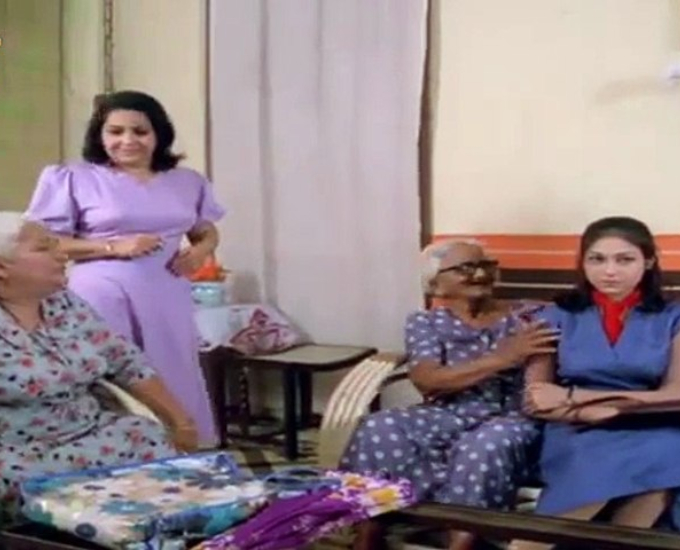
By exposing the legs to view, and simply by fitting around the female upper body, the dress seems to have sparked the sexual imaginations of generations of Indian men whose own wives and daughters were never without the protective drape of the pallu or the dupatta. Borges writes, “In the darkness, numbed by furious lovemaking, (the Hindu man) would latch on to his wife's waist, and in between suckling her breasts ask if she would wear one of those dresses, just for him. She would agree coyly, but as an afterthought dredge up the same feeling her husband had exposed in front of the family when he saw the Christian women strut on the roads.” That particular Hindu male fantasy made its way firmly into Hindi cinema via such depictions of Catholic girlhood as Raj Kapoor's Bobby and Basu Chatterjee's Baaton Baaton Mein, and lasted well into the 1980s, when Salman Khan made that 'secret' dress-wearing request of his long-haired, 'traditionally Indian' heroine Bhagyashree in the epoch-defining Maine Pyar Kiya (1989).

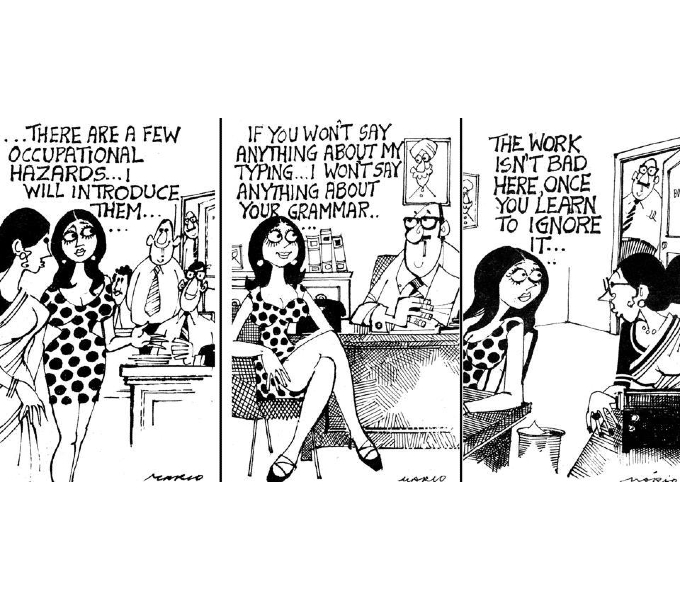
“For repressed Maharashtrians and Indians like me, Jesus Christ, this was where heaven began!” declared the late Kiran Nagarkar in Paromita Vohra's charming short film Where’s Sandra?, which addresses the precise question of what the office-going Bandra girl represented to the rest of the city. One of the real 'Sandras from Bandra' that Vohra tracks down makes the crucial point that the Christian girl was the object of Indian male fantasy also because women from most other urban Indian communities weren't allowed to go out to work. The Christian secretary in the form-fitting dress became embedded in the collective Indian psyche, with even such pillars of the Goan community as cartoonist Mario Miranda essentially reinforcing the stereotype with his polka-dotted Miss Fonseca.
Image
The dress-wearing Goan Christian secretary was immortalised by cartoonist Mario Miranda in the busty figure of Miss Fonseca.

Of course, the stereotype of the Christian girl as open in her morals didn't quite fit the facts. Bombay Balchao is full of Catholic boys bemoaning their fate while the Catholic girls they're dating scratch them for trying to sneak a kiss. In Vohra's film, too, the late poet and professor Eunice D'Souza argues with efficiency that the Christian family and school-going milieu could be as orthodox as the non-Christian ones, policing female sexuality with just as much middle class paranoia. Dress-wearing was no marker of (im)morality. 

Not all Christians wore dresses, either. For instance, the Portuguese insistence “that converts adapt to the European style of dressing” led to such innovations as the pano bhaju, which Borges calls a “middle ground” created by orthodox Brahmin women. Now 'traditional' when dancing to sad Konkani love songs called mando, this particular Goan Christian outfit consists of a sarong-like lower garment (pano), worn with a loose gold-embroidered blouse (bhaju) and a stole called the tuvalo. The hybridity is India at its best: the pano draws on the South Indian lungi/mundu/veshti, the bhaju is Portuguese, while the gold thread work owes something to the Mughals. 

One of the pleasures of Borges' book is its mini-ethnography of Bombay's different Christian communities. The Goans and East Indians express disdain for the Mangaloreans as calculating, not so comfortable with English, not good dancers or good at Western music. The Mangaloreans, meanwhile, saw the Goan absorption of Westernised mores as a cop-out, too easy a surrender to their colonial masters. Mangalorean rebelliousness, not surprisingly, was expressed most vividly in their women's clothes: the community may have converted to Christianity, but the women still wore their heavily embroidered sarees and jasmine venis (floral garlands) in their buns – rather than floral dresses and bouffants.

Beyond Bombay, too, the dress-clad Christian working girl was the focus of Hindu male anxiety: think of the Anglo-Indian Edith, who becomes the heroine Arati's office colleague and then friend in Satyajit Ray's Mahanagar. For the two Calcutta women, lipstick marks a bond between them. For the Hindu husband waiting edgily at home, the same lipstick becomes emblematic of the 'corruption' of his wife. Clearly, as non-Christian women ventured tentatively into the workforce, the dress-wearing Christian girl was now a terrible threat. For on what women wear, as always, the whole burden of civilisation comes to rest. 

Thankfully, as Vohra suggests, Sandra the stereotypical good-time girl doesn't have a reason to exist anymore. Because we all a have a bit of Sandra in us now. Something to think about each time you wear a dress – and can even let the camera see you in it, unlike Bhagyashree.