Showing posts with label Mahanagar. Show all posts

13 December 2019

The Catholic Dress: Bombay to Goa and Back

My Shelf Life column for TVOF:
 

The dress-wearing Catholic girl was an object of Indian male fantasy, but as Jane Borges’ Bombay Balchão makes clear, the reality was more complex than the stereotype

Image

At the beginning of her just-published debut novel Bombay Balchão, the Mumbai-based journalist Jane Borges sets us down in the Catholic neighbourhood of Cavel on Christmas Eve 1945. Before we hear the midnight mass, we hear of Karen Coutinho, whose tailor Francis (“from John D'Souza and Sons”) has made her “a long yellow silk gown, which swept the road as she walked to church”, and of her husband Alfred, who is glad that his wife’s gold lace mantilla covers her “heavily powdered face and the crimson lips she had painted with cheap lipstick”. And we hear, almost simultaneously, of the Hindus on Dr D' Lima Street who “sneakily peered from the gaps between the iron rods of their windows, gawking at the dressy Christian women”. 

Borges doesn't dwell on her wartime setting, but a 2017 piece on 'aunty chic' by Cheryl-Ann Coutto published on Scroll points out that knee-length skirts were a wartime trend for economic reasons. “There was rationing, food coupons, there was less food, less cloth and so the hemlines too were shortish,” an 80-year-old Elettra Gomes tells Coutto. “Then after the war ended, Christian Dior came out with calf-length swirling full skirts and tiny cinched waists [this lavish, ultra-feminine aesthetic... became known as the New Look]”.

But even if the length of Karen Coutinho's gown could have been seen as a legitimate post-war luxury, Bombay Balchão makes it clear that she was up against other forms of moral censure: such as the local Hindu patriarch accusing Christians of having “sold their souls to the gori chamdi” (white skin) by dressing like Europeans--at a time when the Gandhian campaign for Khadi was at its acme.
Image
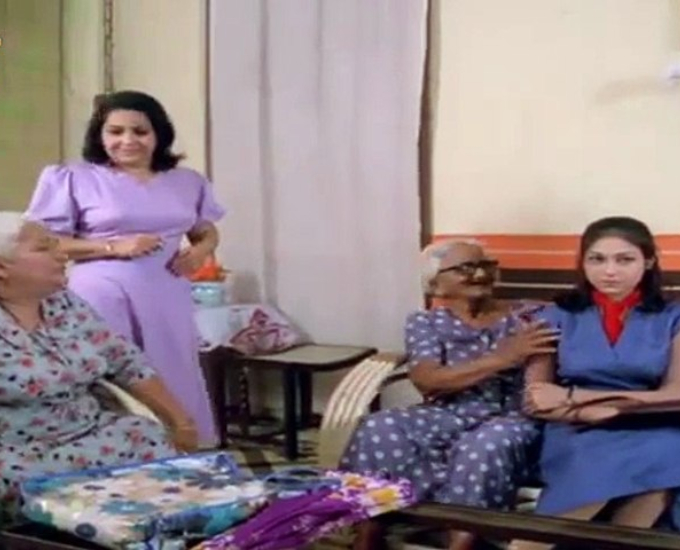
A still from the film Baaton Baaton Mein.

The real source of censure, however, lay far deeper than nationalism or economy. Bombay's Catholic women – whether the East Indians, as the original Catholic inhabitants of Bombay and Salcette called themselves, or the Goans who came to the city later–were invariably marked by the wearing of dresses. 
 
By exposing the legs to view, and simply by fitting around the female upper body, the dress seems to have sparked the sexual imaginations of generations of Indian men whose own wives and daughters were never without the protective drape of the pallu or the dupatta. Borges writes, “In the darkness, numbed by furious lovemaking, (the Hindu man) would latch on to his wife's waist, and in between suckling her breasts ask if she would wear one of those dresses, just for him. She would agree coyly, but as an afterthought dredge up the same feeling her husband had exposed in front of the family when he saw the Christian women strut on the roads.” That particular Hindu male fantasy made its way firmly into Hindi cinema via such depictions of Catholic girlhood as Raj Kapoor's Bobby and Basu Chatterjee's Baaton Baaton Mein, and lasted well into the 1980s, when Salman Khan made that 'secret' dress-wearing request of his long-haired, 'traditionally Indian' heroine Bhagyashree in the epoch-defining Maine Pyar Kiya (1989).

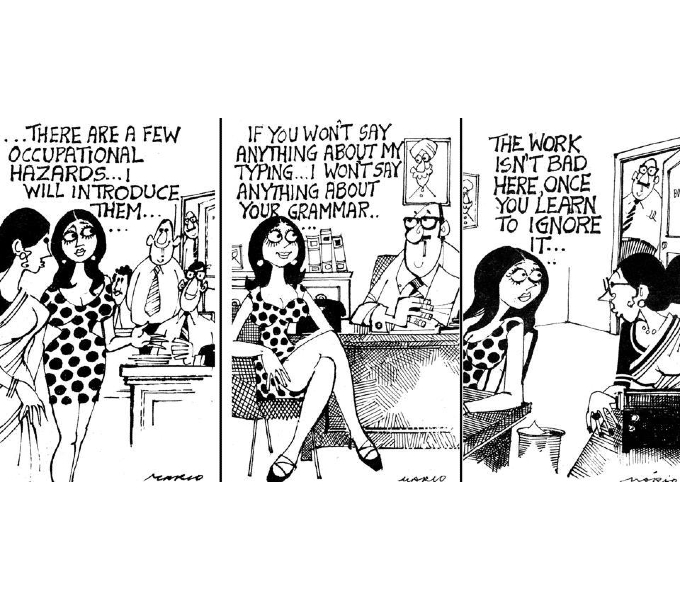
“For repressed Maharashtrians and Indians like me, Jesus Christ, this was where heaven began!” declared the late Kiran Nagarkar in Paromita Vohra's charming short film Where’s Sandra?, which addresses the precise question of what the office-going Bandra girl represented to the rest of the city. One of the real 'Sandras from Bandra' that Vohra tracks down makes the crucial point that the Christian girl was the object of Indian male fantasy also because women from most other urban Indian communities weren't allowed to go out to work. The Christian secretary in the form-fitting dress became embedded in the collective Indian psyche, with even such pillars of the Goan community as cartoonist Mario Miranda essentially reinforcing the stereotype with his polka-dotted Miss Fonseca.
Image
The dress-wearing Goan Christian secretary was immortalised by cartoonist Mario Miranda in the busty figure of Miss Fonseca.

Of course, the stereotype of the Christian girl as open in her morals didn't quite fit the facts. Bombay Balchao is full of Catholic boys bemoaning their fate while the Catholic girls they're dating scratch them for trying to sneak a kiss. In Vohra's film, too, the late poet and professor Eunice D'Souza argues with efficiency that the Christian family and school-going milieu could be as orthodox as the non-Christian ones, policing female sexuality with just as much middle class paranoia. Dress-wearing was no marker of (im)morality. 

Not all Christians wore dresses, either. For instance, the Portuguese insistence “that converts adapt to the European style of dressing” led to such innovations as the pano bhaju, which Borges calls a “middle ground” created by orthodox Brahmin women. Now 'traditional' when dancing to sad Konkani love songs called mando, this particular Goan Christian outfit consists of a sarong-like lower garment (pano), worn with a loose gold-embroidered blouse (bhaju) and a stole called the tuvalo. The hybridity is India at its best: the pano draws on the South Indian lungi/mundu/veshti, the bhaju is Portuguese, while the gold thread work owes something to the Mughals. 

One of the pleasures of Borges' book is its mini-ethnography of Bombay's different Christian communities. The Goans and East Indians express disdain for the Mangaloreans as calculating, not so comfortable with English, not good dancers or good at Western music. The Mangaloreans, meanwhile, saw the Goan absorption of Westernised mores as a cop-out, too easy a surrender to their colonial masters. Mangalorean rebelliousness, not surprisingly, was expressed most vividly in their women's clothes: the community may have converted to Christianity, but the women still wore their heavily embroidered sarees and jasmine venis (floral garlands) in their buns – rather than floral dresses and bouffants.

Beyond Bombay, too, the dress-clad Christian working girl was the focus of Hindu male anxiety: think of the Anglo-Indian Edith, who becomes the heroine Arati's office colleague and then friend in Satyajit Ray's Mahanagar. For the two Calcutta women, lipstick marks a bond between them. For the Hindu husband waiting edgily at home, the same lipstick becomes emblematic of the 'corruption' of his wife. Clearly, as non-Christian women ventured tentatively into the workforce, the dress-wearing Christian girl was now a terrible threat. For on what women wear, as always, the whole burden of civilisation comes to rest. 

Thankfully, as Vohra suggests, Sandra the stereotypical good-time girl doesn't have a reason to exist anymore. Because we all a have a bit of Sandra in us now. Something to think about each time you wear a dress – and can even let the camera see you in it, unlike Bhagyashree.


27 September 2015

Picture This: Adaptation par excellence

My BL Ink column this month: 
Image

How Satyajit Ray’s Mahanagar (1963) reworked Narendranath Mitra’s original Bangla short story in a manner both fine-grained and sweeping
There’s a crucial scene in Satyajit Ray’s sublime film Mahanagar (1963), in which the Bengali, middle-class, sari-clad heroine Arati Mazumdar (Madhabi Mukherjee) is urged by her Anglo-Indian skirt-wearing colleague Edith Simmons to try on some lipstick. The two are in the women’s restroom, where they have just conducted a funny little exchange with their salaries — five of Arati’s crisp new notes for the same number of Edith’s crumpled, dirty ones. Clearly touched by Arati’s unhesitating sweet response to her somewhat childish desire, Edith offers her the lipstick. It’s new, she says, I haven’t used it (as if it matches the fresh-minted-ness of Arati’s notes).
Arati, who has until then been speaking Bangla to Edith’s English, now switches awkwardly to Hindi, shaking her head in embarrassment. “Woh le ke hum kya karega (What will I do with it)?” “Use it, stupid!” exclaims Edith, who has suddenly gone from being childish to the more experienced one. “What’s wrong with using a little lipstick? You put red here, red here, why not here?” continues Edith, pointing first to Arati’s hair parting, then her forehead, then her lips. Arati agrees: silently, but with dancing eyes and an impish smile, locking the door from inside.
That vision of Madhabi’s face, eyes lifted nervously upwards as Edith carefully applies the colour to her lips — became one of Mahanagar’s iconic stills, originally as a lobby card [above] and then as a poster. By 2013, when a restored print was released on the film’s 50th anniversary, Edith had been neatly cropped out, making Arati seem like she’s putting the lipstick on herself. Also, the original black and white is thrown into relief by making the lipstick (and Arati’s lips) scarlet.
But that’s another story. The point of my long rendition is simpler: that this scene between Edith and Arati, which became one of the film’s most well-known — and produced perhaps the most vivid visual encapsulation of Mahanagar’s themes — did not exist in the original story.
Narendranath Mitra’s story Abotaronika, which Ray adapted, was first published in Anandabazar Patrika’s Puja edition of 1949. It appeared in English in 2014, as ‘The Prologue’, in 14 Stories That Inspired Satyajit Ray, translated by Bhaskar Chattopadhyay. Abotaronika does contain an Anglo-Indian officemate called Edith, but she is ‘Mrs. Simmons’, and introduced with a great deal more presumption and malice than in the film: she is “probably a couple of years older” than Arati, but “the way she dressed and made up her face made her look much younger,” Mitra writes. “Edith generously applied lipstick, Edith painted her nails, Edith wore beautiful skirts.”
This authorial judgement is quickly followed, in Mitra’s story, by a warning from Arati’s husband, Subrata: “Be careful! Don’t mingle with such girls.” Arati’s clarification is immediate. She doesn’t “mingle with her”, she says. In fact, she tries “to keep our conversations to a courteous minimum”, even while insisting that Edith must deal with Arati’s half-baked English because “[a]ll these years, we have tried to speak in your accent and tolerated your broken Bengali.”
Ray does away with the mutual suspicion. The cinematic Arati never justifies her friendliness with Edith. She understands her English, but responds comfortably in Bangla. While keeping some things intact — such as Edith’s spiritedness in pushing her Bengali colleagues to demand their commissions — Ray makes Edith unmarried and younger than Arati. Despite linguistic, religious and ethnic differences, the film suggests, Arati empathises with Edith. Not out of some grand principled embrace of otherness, but simply, with Ray-style humanism, as another woman striving to earn an honest living and fulfil similar dreams — Edith in the film is saving up money to be able to marry her boyfriend.
Class, also expressed in the ramshackleness of both their homes, thus seems to be part of what brings them together. In place of the office peon in the story, in the film it is Arati who visits Edith’s house. This allows Ray to have Arati witness Edith’s domestic circumstances, and be able to vouch for her illness. Arati’s climactic quarrel with her boss Mr Mukherjee — over his unfair treatment of Edith — thus becomes more believable.
There are other transformations I haven’t touched upon, such as Ray’s elaboration of Subrata’s father, a patriarch, into a weak-willed, embarrassing old man. The retired schoolmaster starts visiting his former students, begging for monetary help. This arc completes the family’s financial humiliation. In another instance of Ray’s tweaking, the East Bengal connection between Subrata and Mukherjee is deepened by the particularity of place: “Pabna”. But the gulf between them is also strengthened — by Mukherjee’s explicit references to his well-connectedness, and by a sequence where he drops Arati home in his car, while describing his wife’s “mania” about germs, and his “guilt” about pedestrians.
Mitra’s original narrative contained all the film’s eventual conflicts. I don’t mean only the ones you first notice — between Arati and Subrata, and Arati and Subrata’s parents — but also between Mukherjee and Edith, and Mukherjee and Arati. None of these conflicts are softened in the film, and yet Mahanagar is much more optimistic.
Abotaronika ended with Subrata offering only a nasty crack at his wife’s impulsive decision to resign over Edith being fired. “The actual culprit would have started office by now, with a cigarette dangling from her red lips. She’s not a sentimental Bengali woman after all.” Mahanagar’s Subrata does not cast aspersions on the Anglo-Indian character. In fact, he tells Arati she has stood up for injustice in a way he couldn’t have done. Arati vocally seeks support from her husband, and he, chastened by her open-faced honesty, actually responds. The niggling prejudice and cynicism of Mitra’s world becomes, in Ray’s, a cultural self-confidence (Arati’s Bangla) that rejects the parochial (Mukherjee) while embracing a new, just, egalitarian future (where husband and wife will both have jobs).
Like an old coat, Ray had made the story his own, ironing out some creases and refitting some badly-worn bits. He had made it new.
Published in the Hindu Business Line, 26 Sep 2015.

8 July 2015

Picture This: Days and Nights in the City

My Picture This column in BL Ink this month:

Aditya Vikram Sengupta’s ambitiously wordless debut feature, Labour of Love, displays a striking grasp of sound and image


Image
A still from Labour of Love, which won the National Awards for Best First Film and Best Audiography
At first you see nothing. The screen is dark, and all you have is the voice of a TV newsreader announcing in Bangla that “in the last week, approximately 1,200 people have lost their jobs in West Bengal. In a state of fear, panic and rage, people are taking to the streets to rally and protest”. The broadcast is followed by the titling, with the camera travelling slowly down a dirty yellow wall to the rising notes of the shehnai. When the titling ends, the music does too, and it is in the hush of early morning that we see a young woman in a printed yellow sari, walking purposefully away from us. The only sound is that of little children singing, perhaps from a nearby school. The camera follows the woman as she moves briskly through a narrow lane, allowing us to look at her red half-sleeved blouse, her batik tote bag, a thick plait hanging down her back, before she boards a tram. We see her change to a bus, and finally arrive at her destination, almost running up the stairs as a bell goes off to declare the working day open.
Meanwhile, in a room somewhere, a young man drinks his morning cup of tea. He emerges from his bath with a few washed clothes, and we see a cotton sari and a maroon petticoat. A little while later, when he heads out on a bicycle to buy groceries, we hear the children singing again.
Of such little clues is Aditya Vikram Sengupta’s debut film made, weaving the most undramatic actions into an intriguingly wordless tapestry of everyday life. The Bangla title, Asha Jaoar Maajhe, would translate literally to ‘between coming and going’, and it becomes clear that the woman and man we see departing and arriving are a couple. One works in a bag factory during the day, the other in a printing press at night.
In both workplaces, the cinematography (by Sengupta and Mahendra Shetty) and sound design (by Anish John) come together to produce a tangible sense of the repetition, even boredom of labour. The woman tallies boxes full of bags against a list. She has a solitary lunch from her tiffin box, and returns to the desk with not much to do except daydream until the bell announces end of the day. The man watches over the rumble and clatter of the press as it spews out a steady stream of newspapers. He, too, has a solitary dinner. Sengupta alternates between the lonely silences of the home and the mechanical noises outside. But noise can be political, and quiet isn’t always melancholy. After the night-long rattle of machinery, the pre-dawn street is deliciously still, and the tinkling bells from a passing herd of goats positively bucolic — though they’re likely heading to the butcher’s.
Released in some Indian cities last week, Labour of Love comes with the recommendation of Best Debut Director prize at Venice Days, held alongside the Venice International Film Festival and modelled on the prestigious Directors’ Fortnight at Cannes. It also won National Awards for Best First Film and Best Audiography.
Sengupta certainly has a gift for visual and aural detail, and his remarkable refusal of both plot and dialogue focuses our attention successfully on each sound, each image he places before us. A fish still breathing heavily as it awaits death by boti (a cutting instrument used by Bengali fishmonger and traditional housewife alike), coins slipped into an earthen piggy bank, a perfect crescent of moon in the night sky — the last, with rueful irony, accompanied by Geeta Dutt singing Nishi raat banka chaand akashe, when the only sign of the beloved is his crushed kurta.
Some sequences seem metaphorical: are our protagonists like the goats, going peacefully to slaughter? Or are they like the water in the pan, which must sizzle and disappear before the oil is poured in: one must vanish before the other appears. For each, the house is haunted by the other, and the film shows this playfully. The man, looking into the mirror, suddenly sees the woman’s face behind her stick-on bindi; the woman, entering the bedroom at night, is alarmed by the man’s trousers hanging from the bed rail.
Sengupta has mentioned being influenced by Satyajit Ray, and one visual of a tramcar cable certainly brings to mind Ray’s Mahanagar (1963), which famously opened with a staccato titling sequence with shots of just such a cable, and ended with the husband and wife melting into the big city, buoyed by the belief that they could both get jobs. By cutting his shots of the cable to the sound of a workers’ rally against job cutbacks, Sengupta marks the distance we have travelled from that optimistic moment.
But the economic backdrop is also the film’s weakest link: surely India, and particularly West Bengal were relatively insulated from the effects of the recent global recession? A revealing subtitling error translates the newsreader’s moddhobitto — middle income — as ‘working class’. The film can also seem contrived in its deliberate old-world feel, and in having both protagonists refrain from calling each other, even refusing to pick up the mobile phone when the other calls from work.. There is a similarity here to The Lunchbox (2013) where, too, the premise of separate spheres for the protagonists required the artificial absence of phone contact.
The tribute to youthful coupledom recalls more traditional tales, like O Henry’s The Gift of the Magi. But there is no neat resolution, tragic or comic, to Asha Jaoar Majhe. What it achieves with quiet beauty is the feeling of nights and days, stacked up in a ceaseless queue — all that time spent waiting for the one moment when the solitariness of routine might be ruptured.
Published in the Hindu Business Line, Sat, 3 July, 2015.

6 September 2013

A Home in the City? Women in Mahanagar and beyond

I wasn't quite done with Mahanagar. An essay on women, work and lakshman rekhas, published in the Asian Age, here

Image
Satyajit Ray's original artwork for Mahanagar
Satyajit Ray's Mahanagar (The Big City), which released exactly half a century ago, in September 1963, is about a Calcutta housewife who steps out to work for the first time, and the tumult that this causes in her middle class family. The film is built around the central character of Arati, played to perfection by Madhabi Mukherjee in her first Ray film; she would go on to star in Charulata the year after.


Arati is very much the assured housewife, but she has never held a job before. Nothing in her experience has prepared her for this particular form of adulthood. On the momentous morning of Arati first going to work, when her husband Subrata laughs at how clammy her hands are, she says, “It's happened once before. On the day of our marriage.” On the same morning, when Subrata and Arati are eating, Ray underlines his point. Subrata's younger sister (Jaya Bhaduri making a wonderful bespectacled debut), fondly fanning the couple, points out they've never eaten together after the ritual feast of their wedding day – until now. The scene foreshadows what the film is poised to explore: how Arati's new engagement with the wider world might reshape her marriage, turning ritual parity into real partnership. 

Because Subrata, while forced by straitened circumstances to encourage his wife to work, is still in denial about the permanence of the changes to come. “What's the point?” he teases his sister about studying so hard for an exam. “You'll grow up and have to push cooking pots around. Like your boudi.” The 14-year-old makes some reply about having domestic science as a subject in school. We don't quite know what to think: is cooking's new scientific status reflective of changing social attitudes to women's work? Or is it just a dressing-up to delude women into carrying on with hard domestic labour?

Certainly, Ray does not yet visualise a future in which women might not run the home. All three generations of women in his film take pride in cooking. The mother-in-law looks thrilled when her son knowingly insists that she cook the fish curry. Arati acquiesces with a smile, confident that her own cooking is not being berated. For the young sister-in-law, too, adulthood means being trusted to cook a meal. The joint family back-up makes Arati's absence possible: as her husband says, it's not as if Pintoo won't get bathed on time.

Off-stage, seemingly beyond the arena occupied by primary middle class actors, is another kind of working woman: the maid. Her pay is discussed, as is the need to keep her on. But we never see nor hear her. We hear her being addressed, but she is not granted the privilege of a name, only the demeaning appellation 'jhee'. That silence is not incidental. It prefigures a world 50 years into the future, in which a million Aratis go to work only by leaving their homes and children in the care of the still nameless, faceless maid. But we have still not got to the point of wondering who the maid leaves her children with.

There is another kind of woman in Mahanagar: the Westernised woman. Here Ray refuses easy binaries. He forges unexpected connections. And he quietly places the curiosity and openness of Arati's friendship with her Anglo-Indian colleague Edith against their boss Mukherjee, whose prejudices are clearly distasteful to Ray. Mukherjee is the kind of man whose cosmopolitan veneer has failed to alter an older mindset: he will help a stranger from his hometown (“Apni-o Pabnar, ami-o Pabnar”), but won't even hear out the firingi girl he assumes is amoral.

Ray ended Mahanagar on a remarkably upbeat note. The in-laws see the error of their ways, and the image of husband and wife walking off side by side, as equals, is not far from the idealistic-romantic ending of a Shree 420 or a Pyaasa -- though Arati and Subrata walk into the city, not away from it. As they melt into the urban crowd, the camera pans suggestively up to the street lamp.

Rituparno Ghosh's Dahan (1997), made in less optimistic times, burrows down a dark tunnel at the fraught heart of middle class life. Dahan's powerful comment on the unfreedom of women feels, if anything, stronger in 2013. The father-in-law does not come round. The husband does not half-jokingly call himself “bhayanak conservative, like my father”. It is the young wife, Romita (Rituparna Sengupta), who ribs her husband about not letting her buy a skirt and blaming it on his parents. You’re the one who’s conservative, not them, she says. And the husband, instead of laughing at himself as in Mahanagar, implodes in anger. The city in Dahan is more threatening than Mahanagar's respectable white-collar world, but so is the home. Romita is not doing anything so outre as wearing a skirt, but a sari and a husband are no shield against molestation on the street. And marriage is no shield against rape at home. When Arati steps out from behind a clothes-line to join her husband, Ray evokes (with characteristic lightness) her breaking of a lakshman-rekha. But Romita's balcony is the boundary of her prison. When she breaks out, she must leave alone. 

Violence is not just a sign of terrible times. It is also a sign of growing resistance. The parity so tentatively offered to the middle class woman in Mahanagar is now demanded as a right. But clearly the world will not give us that right without a fight. We must wrest safe homes from the city, and the city from our safe-keepers. Oh, and the jhee? She still remains invisible.

(My previous piece on Mahanagar -- for the Sunday Guardian -- is here. And more on Rituparno Ghosh's films here and here. Also an old op-ed on women in the Hindi film city, here.)

2 September 2013

Post Facto - Watching Ray’s Mahanagar in 2013

My Sunday Guardian column, on the 50th anniversary of Satyajit Ray's Mahanagar.

Image
Image
A still from Mahanagar
he tired bank clerk arrives home from work and a few minutes pass before his wife brings him his tea. "Earning member ke erokom bhabe neglect korchho... (You're neglecting the earning member this way..." he grumbles, deadpan. He's not angry, but he's not entirely joking. What could I do, she replies, we'd run out of tea leaves, I had to go borrow some. And in that quiet exchange, Satyajit Ray has introduced his theme with ineffable economy: the man's claim to superior status is as breadwinner. But it is the 1950s, and the lower middle class in Calcutta is beginning to find that a single person's earnings are no longer enough to run a household. The father-in-law needs a new pair of glasses, the child's school fees haven't been paid, the mother-in-law wants zarda.
But a double income would mean the gharer bou going out to work. And once she steps outside, once she earns her own money, who knows what might happen then? It is those inherently radical possibilities that Mahanagar (The Big City) sets out to capture. At the centre of the film is Arati (the marvelous Madhabi Mukherjee), the housewife bustling about her home, urging tonics upon her father-in-law, putting a sweater on her little son, comforting her teenaged sister-in-law (Jaya Bhaduri in an endearing debut). When Subrata (Anil Chatterjee, also superb) can't get a second part-time job, he indirectly floats the idea of his wife working. But having planted the seed, Subrata is ambivalent about what fruit it might bear. When a nervous Arati asks him point-blank whether he really wants her to get achakri (job), he first sings "Mane chaakar raakho ji" at her, then says fondly, "I might have, if you were less attractive. Having a woman like you around will distract your colleagues." It is easy sexist banter in a pre-feminist world, delivered with proprietorial husbandly affection. When he goes on to laughingly claim that he's "fearfully conservative, just like his father", and thinks that "gharer bou should stay in the ghar and not bicharan (wander)", we don't quite know whether to take him seriously. Neither does Arati. Nor, perhaps, does Subrata himself. That layering is what makes Ray's staging so masterful – gentle humour takes any edge off the moment, and yet Subrata's anxieties are revealed, coded as comedy.
Image
rati gets a job selling a new knitting machine, and her natural forthrightness and efficiency soon begin to earn praise from her astute though possibly dodgy boss. The film swiftly inverts the earlier dynamic – Arati's diffidence gives way to confidence, while Subrata's sudden unemployment turns him into an increasingly insecure, jealous wreck. Mahanagarworks beautifully in a symbolic register, using objects to signal relationships, lifestyles, ways of belonging. On her first day at work, for instance, Arati's outspoken new Anglo-Indian colleague, Edith, asks her if Subrata is her boyfriend. Arati is bemused; her English is not quite up to a quick retort. Then, with a flutter of relief, she points to the bindi on her forehead. At which the laughing Edith says, "Oh, husband", then points to the ring on her own finger, saying, "Do you know what this means?"
If the bindi signals wifely status, the ghomta flags her daughter-in-law role: she never appears in front of her in-laws without her sari pallu drawn over her head. But even though these traditional symbols of womanhood are unlikely to have been a personal choice, Arati seems to own them, rather than they her. When outside the house, for example, she never covers her head. She does not – yet – want to shed the sari itself, or the bindi. But she is happy to add new accoutrements to her persona: a purse, sunglasses - objects that represent her newly-independent status. Ray does wonderful things, for instance, with lipstick. When Edith first puts it on her, Arati demurs. You have red on your forehead and in your parting, then why not your lips, Edith asks. Arati accepts, and then rather likes the look of it. She begins to wear it regularly, but after reaching the office: knowing instinctively that it will not meet with approval at home. Then one day, Subrata finds it in her bag. He says nothing until she is preparing to leave, then lets loose a single, well-aimed taunt: "Thhonte rong maakhbe na? (Won't you paint your lips?)" The arrow finds its mark; a stung Arati tosses the offending object out the window.
It is a painful moment, the lipstick an almost predictable conduit for the husband's disapproval of his wife's newly fashionable — read Westernised — ways. But Ray has provided another layer. Much earlier, before Arati's job interview, Subrata warns her not to show up at office having eaten paan. "Why?" she says archly. "Are red lips bad?" The associations here are hard to miss. The courtesan, antithesis of domesticated femininity, was renowned for paan-stained lips. Earlier, Edith has made the link between red lips and "that old Indian book about sex".
And in that oblique, unspoken way, Ray has upturned all our easy cliches about the traditional Indian woman and the "firingi". Symbols of marital domesticity, that might have been used to separate 'us' from 'them', are used to forge a connection instead. So, too, the symbols of sexual agency, of shringar. It is not Westernisation, Ray seems to be saying, that is transforming us. Arati's lack of English does not affect her self-confidence.
Mahanagar released in September 1963, a full 50 years ago – but we have by no means moved on. You have only to watch English-Vinglish to see that we may even have reversed the flow.
(PS: I have another Mahanagar piece coming up in a few days, so as they say, watch this space.)