Showing posts with label Goa. Show all posts

13 December 2019

The Catholic Dress: Bombay to Goa and Back

My Shelf Life column for TVOF:
 

The dress-wearing Catholic girl was an object of Indian male fantasy, but as Jane Borges’ Bombay Balchão makes clear, the reality was more complex than the stereotype

Image

At the beginning of her just-published debut novel Bombay Balchão, the Mumbai-based journalist Jane Borges sets us down in the Catholic neighbourhood of Cavel on Christmas Eve 1945. Before we hear the midnight mass, we hear of Karen Coutinho, whose tailor Francis (“from John D'Souza and Sons”) has made her “a long yellow silk gown, which swept the road as she walked to church”, and of her husband Alfred, who is glad that his wife’s gold lace mantilla covers her “heavily powdered face and the crimson lips she had painted with cheap lipstick”. And we hear, almost simultaneously, of the Hindus on Dr D' Lima Street who “sneakily peered from the gaps between the iron rods of their windows, gawking at the dressy Christian women”. 

Borges doesn't dwell on her wartime setting, but a 2017 piece on 'aunty chic' by Cheryl-Ann Coutto published on Scroll points out that knee-length skirts were a wartime trend for economic reasons. “There was rationing, food coupons, there was less food, less cloth and so the hemlines too were shortish,” an 80-year-old Elettra Gomes tells Coutto. “Then after the war ended, Christian Dior came out with calf-length swirling full skirts and tiny cinched waists [this lavish, ultra-feminine aesthetic... became known as the New Look]”.

But even if the length of Karen Coutinho's gown could have been seen as a legitimate post-war luxury, Bombay Balchão makes it clear that she was up against other forms of moral censure: such as the local Hindu patriarch accusing Christians of having “sold their souls to the gori chamdi” (white skin) by dressing like Europeans--at a time when the Gandhian campaign for Khadi was at its acme.
Image
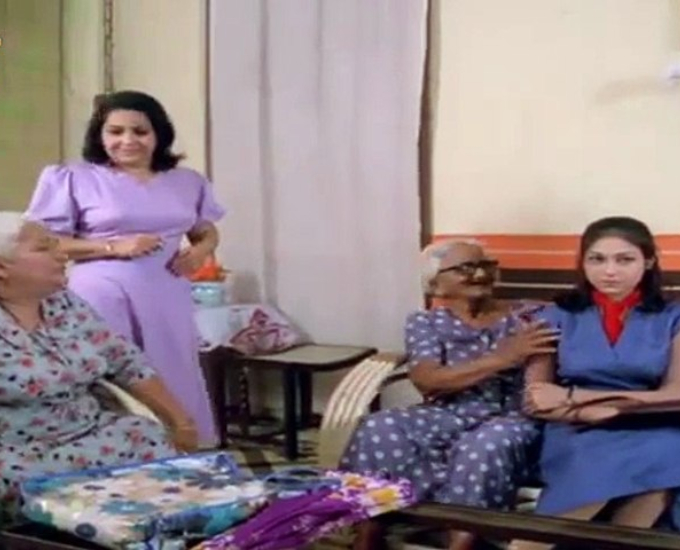
A still from the film Baaton Baaton Mein.

The real source of censure, however, lay far deeper than nationalism or economy. Bombay's Catholic women – whether the East Indians, as the original Catholic inhabitants of Bombay and Salcette called themselves, or the Goans who came to the city later–were invariably marked by the wearing of dresses. 
 
By exposing the legs to view, and simply by fitting around the female upper body, the dress seems to have sparked the sexual imaginations of generations of Indian men whose own wives and daughters were never without the protective drape of the pallu or the dupatta. Borges writes, “In the darkness, numbed by furious lovemaking, (the Hindu man) would latch on to his wife's waist, and in between suckling her breasts ask if she would wear one of those dresses, just for him. She would agree coyly, but as an afterthought dredge up the same feeling her husband had exposed in front of the family when he saw the Christian women strut on the roads.” That particular Hindu male fantasy made its way firmly into Hindi cinema via such depictions of Catholic girlhood as Raj Kapoor's Bobby and Basu Chatterjee's Baaton Baaton Mein, and lasted well into the 1980s, when Salman Khan made that 'secret' dress-wearing request of his long-haired, 'traditionally Indian' heroine Bhagyashree in the epoch-defining Maine Pyar Kiya (1989).

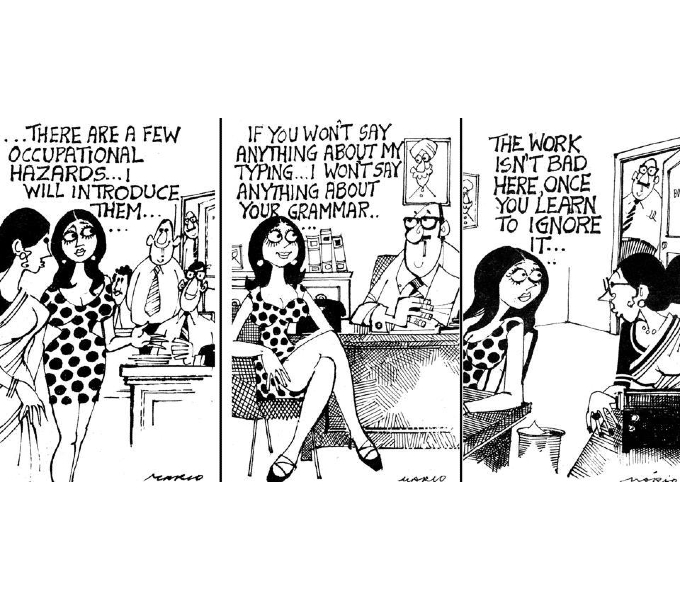
“For repressed Maharashtrians and Indians like me, Jesus Christ, this was where heaven began!” declared the late Kiran Nagarkar in Paromita Vohra's charming short film Where’s Sandra?, which addresses the precise question of what the office-going Bandra girl represented to the rest of the city. One of the real 'Sandras from Bandra' that Vohra tracks down makes the crucial point that the Christian girl was the object of Indian male fantasy also because women from most other urban Indian communities weren't allowed to go out to work. The Christian secretary in the form-fitting dress became embedded in the collective Indian psyche, with even such pillars of the Goan community as cartoonist Mario Miranda essentially reinforcing the stereotype with his polka-dotted Miss Fonseca.
Image
The dress-wearing Goan Christian secretary was immortalised by cartoonist Mario Miranda in the busty figure of Miss Fonseca.

Of course, the stereotype of the Christian girl as open in her morals didn't quite fit the facts. Bombay Balchao is full of Catholic boys bemoaning their fate while the Catholic girls they're dating scratch them for trying to sneak a kiss. In Vohra's film, too, the late poet and professor Eunice D'Souza argues with efficiency that the Christian family and school-going milieu could be as orthodox as the non-Christian ones, policing female sexuality with just as much middle class paranoia. Dress-wearing was no marker of (im)morality. 

Not all Christians wore dresses, either. For instance, the Portuguese insistence “that converts adapt to the European style of dressing” led to such innovations as the pano bhaju, which Borges calls a “middle ground” created by orthodox Brahmin women. Now 'traditional' when dancing to sad Konkani love songs called mando, this particular Goan Christian outfit consists of a sarong-like lower garment (pano), worn with a loose gold-embroidered blouse (bhaju) and a stole called the tuvalo. The hybridity is India at its best: the pano draws on the South Indian lungi/mundu/veshti, the bhaju is Portuguese, while the gold thread work owes something to the Mughals. 

One of the pleasures of Borges' book is its mini-ethnography of Bombay's different Christian communities. The Goans and East Indians express disdain for the Mangaloreans as calculating, not so comfortable with English, not good dancers or good at Western music. The Mangaloreans, meanwhile, saw the Goan absorption of Westernised mores as a cop-out, too easy a surrender to their colonial masters. Mangalorean rebelliousness, not surprisingly, was expressed most vividly in their women's clothes: the community may have converted to Christianity, but the women still wore their heavily embroidered sarees and jasmine venis (floral garlands) in their buns – rather than floral dresses and bouffants.

Beyond Bombay, too, the dress-clad Christian working girl was the focus of Hindu male anxiety: think of the Anglo-Indian Edith, who becomes the heroine Arati's office colleague and then friend in Satyajit Ray's Mahanagar. For the two Calcutta women, lipstick marks a bond between them. For the Hindu husband waiting edgily at home, the same lipstick becomes emblematic of the 'corruption' of his wife. Clearly, as non-Christian women ventured tentatively into the workforce, the dress-wearing Christian girl was now a terrible threat. For on what women wear, as always, the whole burden of civilisation comes to rest. 

Thankfully, as Vohra suggests, Sandra the stereotypical good-time girl doesn't have a reason to exist anymore. Because we all a have a bit of Sandra in us now. Something to think about each time you wear a dress – and can even let the camera see you in it, unlike Bhagyashree.


3 November 2019

Poetry in stealth mode


Fifty years after its release, Saat Hindustani feels both like a time capsule and a swinging pendulum: showing what has changed forever, and what we seem doomed to repeat. 

(The second of a two-part column.)

Image

Last Sunday, a week after Amitabh Bachchan’s 77th birthday, I wrote about his first film as an actor, Saat Hindustani, and how he landed that role. KA Abbas, who wrote and directed his debut, has written of how the tall, thin Amitabh matched his personal imagination of the character, who was modelled on an old Aligarh mate of his.

But watching the film, one has a sense that there was more to the casting. As the real-life son of a poet, Amitabh had cultivated the art of recitation. He was likely better equipped to play one than most debutante actors. His father Harivansh Rai Bachchan was a highly-regarded Hindi poet from Allahabad. Saat Hindustani's fictional Anwar Ali was an Urdu poet from a little further east: Ranchi, a city then in Bihar and now in Jharkhand.

The idea of poetry is crucial to the film. Syeda Hameed, co-editor of Abbas’s voluminous writings, has pointed to his abiding relationships with poets, and the importance of lyrics in his films. “The best poets of the 1960s and ’70s wrote for Abbas’s films, and that too for very little money: Ali Sardar Jafri, Kaifi Azmi, Majrooh Sultanpuri and Prem Dhawan, to name a few,” Hameed writes. The lyrics of Saat Hindustani were by Kaifi Azmi, and it was Azmi’s words that Amitabh spoke on screen as the sensual, lanky Anwar Ali.

Quite early in the narrative, six of the seven Hindustanis board a train headed to Goa to provide secret support to the Goan freedom struggle. A young and purposeful Amitabh shuts the compartment window as instructed, then turns to his companions with a marvellous air of having something to say, and declaims:
Aandhi aye ya toofaan koi gham nahi,
Hai abhi aakhiri imtehan saathiyon.
Ek taraf maut hai, ek taraf zindagi,
Beech se le chalo kaarwaan saathiyon.”

A half-smile flutters at the corner of his lips, and he looks pleased as punch. It was at that moment that I realised that although this was an ensemble cast, Amitabh was as close to being the film’s hero as possible. But what an unusual hero he was. The youngest and tallest of the assembled men – but also the one least capable of handling a gun, the one who hopes there will be no killing involved, who goes into shock when the security of the mission demands that a spy actually be eliminated. Weeping, Anwar actually has to be held back and comforted by the kindly Jogender (played, in Abbas’s anti-stereotype casting scheme, by Utpal Dutt). Traditional masculinity dies a quick death.

There are times in Saat Hindustani when the nazaakat of the North Indian gentleman-poet is served up for mockery – such as the laughter when Amitabh turns to the group and complains that the truck driver who has just dropped them off on the Goa border is “namakool” because he has just turned around and driven off “without even saying khuda hafiz”.

But later, captured by the Portuguese, Anwar is tortured and taunted by a faintly comic interrogator who has been informed of the young fellow’s diary: “Achha toh tum poet hai, kya kehta hai use, shaayar?” Hands and legs tied, Amitabh narrows his eyes disdainfully. “Hamare mulk mein har shaks shaayar hai.”

Abbas knew, though, that that mulk of poets, of possible empathetic connections across communities, was already threatened. In one scene set in the late 1960s present, an older Anwar Ali hears his house has been burnt down by anti-Urdu fanatics. Like his creator KA Abbas, who could simultaneously laugh at “jaw-breaking” Hindi and see it as a language a Tamilian Dalit might use as a way of entering the nation, the optimistic Anwar Ali immediately wants to write to his old comrade-in-arms, the Hindi campaigner Sharma. But his hope for civility is quickly dashed when his wife points him to a virulently anti-Muslim editorial by Sharma, directing all Urdu speakers to Pakistan.

In his more considered moments, Abbas presents an unusually calibrated idea of what constitutes leadership – and what courage might mean. The Gandhian model of non-violent resistance, satyagrah, is of course at the film’s muddled heart. But there’s more here than non-violence. For one, there is a clarity of goals, over and above a declared ideological arsenal of means: one man can be murdered if it means saving the lives of seven. For another, neither action nor leadership is to be trumpeted. No one is appointed to a position of permanent captaincy; members of the team are its “commanders” turn by turn. 

And crucially, what has to be done is done, preferably without announcement. When the selected men set out from the satyagrah camp, their departure is not flagged, they simply melt away. What will everyone at camp think of us, they ask their trainer. “That you are cowards who have run away,” he responds. "But the mission will succeed."

In that world, it was preferable to be thought of as a coward and succeed, than proclaim one’s heroism from the rooftops and fail. The past truly was another country.

Published in Mumbai Mirror, 27 Oct 2019.
 

The seventh satyagrahi

My Mirror column:

A look back at KA Abbas’s Saat Hindustani (1969), in the 50th year of its release, must begin with its most famous participant


Image


On October 11, 1942, in the city then called Allahabad, a child was born to a Hindi poet and his wife. The Quit India movement, launched by Gandhi with his ‘Do or Die’ speech on August 8, was in full swing. Despite the immediate arrest of the Congress leadership, mass protests took place all over the country. These were not always successfully non-violent: police stations, railway stations, railway and telegraph lines and other symbols of colonial government were attacked. The British cracked down, making some 100,000 arrests and killing hundreds of civilians. Born into that mood of national revolt, the boy was named Inquilab: revolution.

The story goes that it was another Hindi poet, Sumitrananandan Pant, who later suggested the name Amitabh. And Dr Harivansh Rai ‘Bachchan’ decided that his poetic pseudonym – not the family name of Srivastava – would be his children’s last name. On November 7, 1969, the 27-year-old Amitabh Bachchan made his screen debut, in a film about another nationalist revolt: Saat Hindustani.

Saat Hindustani, scripted and directed by the indefatigable KA Abbas, is by no means a great film. Abbas was a great screenwriter, responsible for much of Raj Kapoor’s seminal work from Shree 420 and Awara to Mera Naam Joker and Bobby, as well as such diverse scripts as Jagte Raho and  Achanak, a film on the Nanavati case, which Gulzar directed. But his own direction could leave something to be desired, even in such fascinating projects as Gyara Hazaar Ladkiyan (1962), dedicated to urban working women, or Bambai Raat Ki Baahon Mein (1967), in which an aam aadmi journalist tries to hold out against corruption. Saat Hindustani is more ham-handed than these. And yet, like all Abbas’s films, it has a certain inexorable honesty, unusual in his time and our own.

The film is about the liberation of Goa from Portuguese rule. The plot contrivances are almost silly: a young woman called Maria, admitting herself for a heart surgery, insists the doctor wait a week. She makes a nurse write telegrams to six men, each from a different community and part of the country, urging them to come to Goa. As she dictates each of their addresses from memory, we cut to each man in the present, and then from each man’s memory into their collective past: the month and a half they spent together on a mission. The bulk of the film involves six men crossing into Portuguese-controlled Goan territory where, together with Maria, they hope to hoist the Indian flag at various places, inviting possible arrest and torture.

Akira Kurosawa’s Seven Samurai are here turned into seven satyagrahis. Their modus operandi is non-violent resistance, and their ideology is nationalism (actual footage of a Nehru speech appears). Abbas’s casting, too, was crucial to his Hindustani project: as he later described it, he “wanted to prove... that there was no particular Hindu or Muslim, Tamilian, Maharashtrian or Bengali ethnic type”. To that end, he would transform “the smart and sophisticated and versatile Jalal Agha into the Maharashtrian powada singer”. His assistant “Madhukar, who hails from Meerut, would be a Tamilian; Sharma (Brahmin by caste) would also undergo a similar transformation; and Utpal Dutt, the cigar-chewing admiral, would be the tractor-driving Punjabi farmer” called Joginder. The Malayalam hero Madhu, fresh from the national success of Chemmeen, played “the sensitive Bengali” – a Mohun Bagan Club football player called Subodh. The Goan Christian Maria was played by Shahnaz Vahanvaty.

The two characters left to cast were a Hindi fanatic and an Urdu fanatic respectively. “Jalal one day brought with him his friend Anwar Ali (brother of the comedian Mehmood), in whose eyes I saw the Jana Sanghi fanaticism. So I decided to make him the Swayam Sevak who hates Urdu and speaks jaw-breaking Hindi,” wrote Abbas in an essay collected in the posthumous volume Bread Beauty Revolution.

The final character was an Urdu wallah, a man who when we meet him in the present, is getting his associate Mr Sinha to read out a letter from his son because he cannot read Devanagri. He was to be a poet from Bihar – whom Abbas named Anwar Ali – and who, he decided, “had to be thin, also corresponding to the thin image of my friend, the late Asrarul Haque ‘Majaz’”.

When a young man was recommended for the role, Abbas apparently looked at his photograph and asked that the fellow come and see him in person. “On the third day, punctually at 6 pm, a tall young man arrived who looked taller because of the churidar pajama and Jawahar jacket that he was wearing.”

After being told the story, he first asked after the Punjabi’s role. But then, told of Abbas’s cross-casting policy, he grew excited and said he would like the Muslim role “specially because he is under a cloud of suspicion” that is only removed at the end.

It was after offering him the standard fee of five thousand rupees that Abbas realised that the young man had actually arrived from Calcutta, and had apparently resigned his job to do so. “I was astonished. ‘You mean to say that you resigned a job of sixteen hundred rupees a month, just on the chance of getting this role! Suppose we can’t give the role to you?’ He said, ‘One has to take such chances’ with such conviction that I said, ‘The role is yours.’”

(To be continued next week.)

Published in Mumbai Mirror, 20 Oct 2019.

2 August 2015

Not the Usual Suspects

This week's Mumbai Mirror column

Thoughts on cops and the everyman, on the cop as everywoman: from 'Singham' to 'Drishyam' via 'Mardaani'


Image
Tabu as IG Meera Deshmukh, with her posse of policemen, in Drishyam

Drishyam is by no means a great film. It's not even a particularly good film. Several performances and locales leave much to be desired. But having not been previously exposed to any of the previous versions - neither the 2013 Malayalam film of the same name, starring Mohanlal, nor the Japanese or Korean films that were more faithful renditions of the original inspiration, a Japanese novel called The Devotion of Suspect X - I found it watchable. It has a plot (which is already more than one can say for most big-budget Hindi releases), it has some suspense, and even posits something like an ethical dilemma. 


But this is not a review. Readers trying to decide if they should watch Drishyam are unlikely to find this piece helpful. What I want to think about is Drishyam's depiction of the police. The first interesting fact here is that the film casts Ajay Devgn - the very man who has made a career out of playing an outlandish supersize cop in Rohit Shetty films like Singham and Singham Returns - as the supposed everyman, a guy who finds himself in a tight spot, ranged against the police. Had Devgn been a little bit more in touch with his acting self (and I'm convinced he used to have one), he could have had some fun with this rolereversal, especially since even the location is the same as those films: a Marathi-fied Goa. It's a pity he's now so used to sleepwalking his way through the larger-than-life muscleman parts that he can no longer seem to convey either vulnerability or middle-class-ness with any degree of conviction. 


Second attention-grabbing tactic: Drishyam makes its tough cop a woman. The figure who must match Devgn's moves, play the cat to his mouse, is played by Tabu. It's not that Tabu hasn't played a cop before - I can think offhand of Fanaa (2006), where she had a small but effective role as an anti-terrorist bureau agent. But as IG Meera Deshmukh, she must marshal a different combination of attributes. There is an obvious comparison to be made here, between Meera Deshmukh and the last policewoman heroine we've seen on the Hindi film screen, Shivani Shivaji Roy, in last August's Mardaani. On the surface, they aren't similar at all. Rani Mukherjee's Shivani, as I had noted in these pages at the time, always appears in masculine garb: either in uniform or in loose collared shirts and trousers, with her hair tied back and her fists ready to hand out a punch or two. Tabu's Meera, in contrast, makes her 'entry' in near slow-motion, clad in an uber-flattering uniform that clings to her curves, and for much of the film's latter half, appears in fashionable churidar-kurtas and perfectly draped saris, her lovely auburn hair flowing loose even while she supervises the 'interrogation' of Devgn and his family by a violent junior. Meera, unlike Shivani, doesn't like to get her hands dirty. 


But there's one way in which both these characters mirror each other: their 'feminine' instincts are written into the roles in the most obvious fashion. If the childless Shivani Shivaji Roy, for all her mardaangi, is accused by male colleagues of taking things "too personally", and proves it by being pushed over the emotional edge by the abduction of an orphaned girl with whom she has a nurturing, quasi-filial relationship, Meera Deshmukh is more straightforwardly cast in the maternal mould. Her actions, which might be unforgiveable as a police officer, are meant to be condoned as those of a mother. And eventually, it is a failed mother that her character is judged. 


Outside this though, Tabu remains the unexamined Bollywood supercop: "Hum policewalon ko aadmi ke baat karne se pata chal jaata hai ki woh sach bol raha hai ya jhooth," she declares in one of the film's more dangerous ideological moments. And beyond the major characters, Drishyam offers a glimpse of a darker vision of the police. The film's small town of Pondolem, despite having flattened Goa's mix of communities into a Hindu milieu (complete with a Swamiji and a satsang in Panjim), comes across as rather idyllic. From the start, the only unpleasantness in town is created by the police. The bullish, corrupt Gaitonde (wonderfully played by Kamlesh Sawant) doesn't ever pay his bills at the eatery he frequents, and has illegally locked up a young man for defaulting on a loan payment to a company owned by Gaitonde's cousin. Most of Devgn's early exchanges with Gaitonde and his more amenable senior point out how unfortunate it is that the public fears policemen instead of trusting them. 


Charmy Harikrishnan's helpful comparison of the Hindi film with the Malayalam version points out that [spoiler alert] "Mohanlal protects his family precisely because he knows the boy is a police offer's son and the entire police force will come after them." This "grave mistrust between the ordinary man and the police" which, as Harikrishnan correctly points out, is "blurred" in the Hindi film. Thinking about this reminded me of another recent Malayalam film in which a policeman's family is the focus, albeit from the very different perspective of a policeman's son becoming witness to a murder. That film, Rajeev Ravi's superb, haunting Njan Steve Lopez (2014), suggests that Malayali filmmakers recognize the chilling fact that the police in this country often function as just another gang of thugs -- and are willing to engage with it with some complexity. Hindi filmmakers, still so abjectly tied to heroes and villains, could really learn a lesson or two.
Published in Mumbai Mirror

26 June 2015

Book Review: To the Farthest Rock

A book review published in last week's BL Ink:

Travelling Light
An impeccable translation of the Hindi writer Mohan Rakesh’s travelogue Aakhiri Chattan Tak brings 1950s India vividly to life

Image

At the age of 27, having quit his recently-acquired position as Hindi teacher at the Bishop Cotton school in Shimla, Mohan Rakesh decided to travel. Here is how he describes it: “I had long wanted to travel by coastal roads along the sea. Sometimes I had time, sometimes money, but seldom both together. Then I resigned from my teaching job and time and a little money became available. I set out for the seacoast immediately.”
It was December 1952. To the Farthest Rock, translated from Rakesh’s Aakhiri Chattan Tak, details his three-month journey along India’s western coast, starting with a train ride from Delhi to Bombay, and ending in Kanyakumari. Rakesh went on to become a major Hindi writer — his best-known works are the Delhi-set novel Andhere Bandh Kamre, and the plays Adhe Adhure, Ashadh ka Ek Din and Lehron ke Rajhans, all regarded as 20th-century classics. At the time he made this journey, though, he had published only one book of stories: Insan ke Khandahar.
But reading this book, one does not often feel that one is reading a 27-year-old. If anything, there is an admirable maturity in the way Rakesh holds out against the temptation to hold forth. There is a definite authorial voice here: observant, sensitive, and open to experience. But his refusal to marshal authority — either journalistic or writerly — is what makes this an unusual travelogue. It is not that Rakesh isn’t interested in places, or history, or art; it is rather that he is more interested, always, in people.
There is no ‘point’ to this book except as the travel diary of a young writer. It goes where he decides to go, and much of it unfolds as everyday conversations between strangers, on trains, in boats, in hotels, or just walking around a village. It has little in common with the judgmental audacity of a similar travelogue written by a young Indian man at the start of his writing career: Pankaj Mishra’s Butter Chicken in Ludhiana. The sympathetic, observational tone put me more in mind of Upendranath Ashk’s 1940 short story ‘Furlough’, also set in a train compartment, a decade or so before Rakesh. 
Image
To the Farthest Rock, by Mohan Rakesh
Translated from Hindi by Satti Khanna
Rs. 299, 192 pages, HarperCollins, 2015.
There is no pretence here of neutrality, of being a fly on the wall. Of course, Rakesh describes what he sees and hears, and does so with both precision and poetry. But what makes his pen-portraits of encounters with people so appealing is that he is always present in them: a quiet, sometimes surprised, occasionally irritable interlocutor. 
The muscular old boatman who rows him across the Bhopal lake, for instance, only gradually acquires a personality — and Rakesh describes the process with charming transparency: “We had been addressing him as ‘Boatman’. At the end of his recitation of Ghalib I asked him his name. “My name is Abdul Jabbar Pathan,” he replied, emphasising the surname Pathan.” When Rakesh says to Abdul Jabbar, “I would not have expected somebody your age to enjoy romantic poetry,” he is being candid about his own youthful tactlessness. Later, when Abdul Jabbar says he has “sworn off carnal desires”, and asks if they have the time to listen to “something different”, Rakesh again lets us in on his eyeroll: “I thought we were in for Sufi preaching”, before telling us how wrong he was.
While it does not consciously seek to locate itself in time, To the Farthest Rock is charged with a post-independence melancholy. There is the teenager travelling ticketless, who describes his life’s Partition upheavals with not a glimmer of complaint. The many unemployed young men Rakesh meets in Kerala are perhaps the strongest indicator of the national mood: an English-speaking, Sanskrit-reciting beggar; the jobless ‘debating society’ that gathers at Tellicherry’s railway station.
But even those who have jobs seem to have all the time in the world. Perhaps this is what the world was like in the 1950s, or perhaps it would still be like this if we were to only try getting on a train without a hotel booking or a return ticket. From the middle-class Karvakar, who persuades him to stay a night in Vasco, in his house, to the labourer Govindan who leaves his work to show Rakesh a coffee plantation, locals seem to go out of their way to spend time with him. Perhaps because Rakesh seems genuinely interested in their lives — from the young man who has decided not to marry “to avoid changes in his and his mother’s peaceful routine”, to the travelling salesman whose work keeps him away from his wife and child, the less he asks of people, the more they confide in him. But he also captures, with quiet poignancy, the experience of linguistic alienness.
The mention of language brings me to what is perhaps the most attractive thing about this book: the writing. I have not read the Hindi original, but in Satti Khanna’s excellent rendering, the language feels crisp even when the thought is meditative. The descriptions are crystal-clear, never indulgent with imagery. When there is an image, it is memorable. “Waves rose from the water like sharks.” Or when describing a spontaneous harmonica competition on a steamer from Goa to Mangalore, he writes: “The contest shifted from the quality of playing to the volume of ovation.”
The black-and-white sketches by Trinankur Banerjee add an attractive new layer of imagery. Satti Khanna’s ‘PS’ — a wonderful feature of HarperCollins’ translations — insightfully locates Rakesh in the Hindi literary context, and adds another visual layer: photographs, among which I was delighted to discover one of Rakesh with Ashk. It made for a perfect end to a book of companionable conversations.
Published in the Hindu Business Line, 19 June, 2015.

1 January 2015

Picture This: Top of the World

My BLink column, published 15 Dec 2014: 
'Tis the season to be jolly for world-cinema buffs. A pick of five best films at the International Film Festival of India this year.
A film festival is about drowning your sorrows in cinema — and coming up with something like joy. Ever since we lost the International Film Festival of India (IFFI) to the bracing seaside air of Goa, and then witnessed the sad, stuttering demise of our locally grown Osian’s Cinefan, Delhi’s world-cinema buffs have been robbed of their annual rite of submergence. I’m part of this large, deprived population (and if you’re one of the snooty lot, reading this column in what you think is a more cultured city, you’d be surprised at just how many of us there are). I suffered silently for a bit, and then, as someone who makes a living by writing about cinema, decided it was legitimate to allow myself an annual winter pilgrimage.
In the last five years, I’ve been twice to Thiruvananthapuram, where Beena Paul Venugopal oversaw the most fabulously curated international festival in India until she resigned earlier this year (it would have been her 13th as the artistic director of International Film Festival of Kerala or IFFK) — and twice to Panjim for IFFI. This year was an IFFI year. And while the retrospectives weren’t as exciting as IFFK’s, Goa in November is a glorious thing, and even committed types like me who don’t wander too far from the stretch of road between Kala Academy and INOX can get our fill of prawn curry, sanna idlis and homemade coconut-jaggery sweets, thanks to the wonderful women’s cooperative stalls at the venue. Also, in Goa — where the state policy on alcohol is the happy opposite of Kerala’s ridiculous current one — Kingfisher gets to run a practically cost-price stall in the INOX complex, holding IFFI visitors in its warm, captive embrace. (Couldn’t get into the film you just queued up for? A beer is the answer. Insanely jolted by the film you just came out of? A beer is the answer.)
But the main thing about a film festival, of course, is the films. So without further ado, here are the best five films I saw at IFFI this year — in no particular order.
Image
A still from Winter Sleep.
The Turks won the day, as they have often done at film festivals in the last decade, with two superb films. Nuri Bilge Ceylan, with his penchant for putting an increasingly complicated cast of characters under his dispassionate lens, served up the three-hour-long Winter Sleep, which won the Palme d’Or at Cannes this year. Partially inspired by three Chekhov stories, the film uses the eerie, striking landscape of Cappadocia for Ceylan’s leisurely unpacking of his signature concerns: the tension between age and youth, rural and urban, men and women, and of course, between the classes. A minor incident pushes the upper-class protagonists — an ageing ex-actor-turned-hotel owner, his youthful wife and his bitter, divorced sister — to examine the cocoon they inhabit, and each other. But as they squirm under Ceylan’s unforgiving lens, it becomes clear that the lives of others, to which they are ordinarily so oblivious, are not within easy reach of their charity. 
The other Turkish film, Silsile (translated as ‘consequences’, but I think of it as ‘a chain of happenings’, based on Hindi/Urdu), also catapults its oblivious rich characters into a series of events. Set in the mixed Istanbul neighbourhood of Karaköy, Silsile is more tightly focused on class. Compared to Ceylan’s slow deliberation and endless talk, Ozan Açiktan’s film might seem all thrilling set pieces and beautiful people, but it is razor-sharp. Neither film lets anyone off. 
I also loved writer-director Yi’nan Diao’s Black Coal, Thin Ice, a laconic murder mystery set in a cold, bleak Chinese industrial town. An alcoholic ex-cop gets interested in a woman who is a suspect in an unsolved case. The plot is gripping, and the mystery both gory and strange (the limbs of victims show up on conveyor belts in coal mines across the country). But what keeps the film running in your head long after are the haunting visuals — dimly lit, snow-packed tunnels, groups of ice skaters in a bleak silent outdoor rink, neon-lit bar signs. 


Image
A still from Black Coal Thin Ice.
Continuing the winter theme (an unplanned effect of this year’s IFFI), my fourth pick is Force Majeure, Ruben Östlund’s brilliantly discomfiting take on masculinity and marriage. A Swedish family — husband, wife and two kids — on holiday at a French ski resort find the happy family veneer peeling off as the after-effect of a split-second moment of danger. It’s full of incisively observed moments of conversation that are often acutely, guiltily funny — but this is no filmed play. Östlund makes masterful use of his sheer white skiing locales, interspersing pin-drop silence with almost operatic moments without seeming gimmicky.*
Image

Finally, there was Narges Abyar’s Track 143, an unexpectedly understated, moving portrait of a mother waiting for her son to come home from a war that has long ended. This is a film about a woman whose tenuous connection with the outside world, and with hope, is kept alive by a radio she ties around her waist. It is a film that does what no Iranian films had done for me before — gave me a sense of growing old with its protagonist, realising how the world can change while you cling to the past.

*Force Majeure is one of 9 films just placed on the Oscar shortlist in the Foreign Film category, in the company of another exquisite film from 2014, the Polish director Pawel Pawlikowski's Ida

15 September 2014

Things I Found Out About Fanny

Yesterday's column for Mumbai Mirror (also Pune, Ahmedabad, Bangalore Mirror):

If we are going to make films in Indian English, we need to recognise that it has dialects. But then, slipping accents aren't the only disappointing thing about the movie Finding Fanny.

Image

I was as excited about Finding Fanny as everyone else. “Everyone”, that is, who belongs to that minuscule class of people in this country who can be described as English-speaking, and would like Bollywood to occasionally acknowledge that 1) they exist and 2) that actually it is, too. I was particularly excited because Homi Adajania had already shown, back in 2006, that he could make fully Indian characters speak fully in English, and make it funny, too.

Admittedly, he still felt the need to set his narratives in communities that everyone concedes as English-speaking. In Being Cyrus, that narrowly circumscribed milieu was Parsi Panchgani (with detours into Parsi Bombay), and now, in Finding Fanny, it is Catholic Goa. Sure, many more non-posh Parsis and Goan Catholics are comfortable with English than your regular middle-class North Indian family, and so it doesn't ring false when family squabbles or lovers' tiffs among them take place in English. Certainly no more false than the absurdly translated-sounding conversations that Bollywood produces so often now, with Hindi words greater than three syllables sticking in the gullets of characters (and actors) who would in real life be speaking largely in English.

But really, watch Finding Fanny and tell me that you didn't feel it had travelled too far over to the other side, just exchanging a forced Hindi for a forced English. Everyone speaks English all the time, transforming what I'm sure is a vibrantly polyglot Goan world into a monolingual one. On the possibly five occasions where a phrase of Konkani is spoken, English subtitles appear. Of Hindi there is not a word. Not even a cussword. Worst of all, though the actors strive diligently for a not-too-correct informal delivery, they don't sound Goan. Barring Pankaj Kapur, they all sound like themselves: big city Bombay/Bangalore people, most with North Indian inflections to their English, trying to sound small-town Goan, and failing.

If we are going to make films in Indian English, we need to recognize that it has dialects. Everyone who is reading this article knows this. The way English is spoken in Goa is different from how it's spoken in Delhi, or Nagpur, or Kottayam. And I'm not even going into how its inflected by class and community and generational influences – how the Irani cafe owner speaks English is different from how the Chinese beauty parlour lady does; the retired Bengali Anglophile has an accent and vocabulary rather distinct from his granddaughter in Bombay.

The slipping accents aren't the only disappointing thing about Finding Fanny. The quirkiness Adajania put to such stellar use in the darkly funny and genuinely surprising Being Cyrus seems to have been regurgitated in a kind of baby-food version. Secrets here aren't held up for the great reveal, they're confided to trustworthy friends. So when sweet old Pocolim postman Ferdie (Naseer) realizes he's been single for forty-six years because a letter in which he proposed to the love of his life never actually reached her, he tells Angie (Deepika). Angie, being the angelic daughter Ferdie never had, decides to do a good deed by arranging a road trip to find Ferdie's long-lost love, Stefanie Fernandes, alias Fanny. The widowed Angie's own long-lost childhood flame Savio (Arjun Kapoor) is designated driver, and along for the ride, for different reasons, are Angie's busybody mother-in-law Rosalina (Dimple Kapadia) and Don Pedro (Pankaj Kapur), a supposedly 'world-famous' artist who's set his painterly sights on Rosalina's posterior.

Sadly, these characters spend the film drifting in search of Stefanie Fernandes -- and of a plot. And their oddball eccentricities, while making us giggle occasionally, never make us cry or want to scream. Only Kapur's Don Pedro, deliverer of grandiose compliments with a crazed gleam in his eye, provides a glimpse of true cruelty. And elicits a moment of pure devastation from Dimple's Rosalina. But the power of that scene is not allowed to stay with us: it is as if Adajania wants us to forget it as soon as it happens, literally get in the car and move on. The wicked pleasures of Being Cyrus are gone, lusty intrigue replaced by an almost soppy quest for love.

In 2012, when Adajania directed Cocktail, a loose-limbed, good-looking love triangle based on a script by Imtiaz Ali, many critics said he'd sold out to Bollywood. I'll save my defence of Cocktail for another piece, but whatever you thought of its politics, for Homi Adajania that film was a risk. As he said around that time, making a full-on romantic Hindi film, complete with songs and heavy-duty conversations, was a challenge – and he acquitted himself admirably, managing to leaven the film's emotional heft with a cocky humour that was all his own.

Finding Fanny, on the other hand, feels like he's lost his bite – or worse, thinks it's too risky to have truly dysfunctional characters, so they're all reduced to sweet old biddies or fresh-faced hopefuls. With a picture-perfect Goa that feels frozen in time, its vague air of melancholy wrapped in an uplifting soundtrack that is in Punjabi-Hindi for obvious reasons, I think it's this film that's the sell-out. And it might just be working. As the two Punjabi ladies said to each other as they walked out ahead of me, “Very cute film, hai na?”.


9 April 2014

To Catch a Star

A short piece I wrote for Nat Geo Traveller
To experience Goa’s most laid-back pleasure, look to the heavens.
Image

“The Starry Night” (top) by Dutch artist Vincent van Gogh, has drawn multiple interpretations by art historians. Unlike the swirls of the painting, where the stars appear to be in motion, the Goa night sky is clear and perfect for studying celestial phenomena for most of the year.

December in Delhi portends fog. December in Goa is an endless expanse of clear skies. After a marvellous evening of festivities at the Taleigao Club, a late night drink in the open air seemed just the ticket. I followed the friends with whom I was staying up the dimly lit staircase of their home in Dona Paula, stepped onto the terrace, and emerged into a glittering new universe. The midnight sky was a deep, cloudless indigo, lit up by more stars than I’d seen in a very long time.

As I stood there in a happy haze, I willed the stars to arrange themselves into long-forgotten constellations. My boyfriend in high school had been an astronomy fiend, and stargazing camps had been joyful pit stops in our adolescent romance. Between the boy who would go on to graduate studies in physics, and the quintessential arts student whose brain shut down at the mention of anything mathematical, the night sky was a reasonable meeting point. Unlike Madeline Bassett, the P.G. Wodehouse character, I didn’t quite think the stars were God’s daisy chain, but the names—Orion, Cassiopeia, Arcturus, Aldebaran—held a strange magic. So long as I had some Greek myths to wrap around the stars, even I could convince myself that I was interested in black holes and red giants.

All these years later, my memory didn’t serve as well as I’d have liked. I could see Orion the hunter, with broad shoulders and a gleaming dagger dangling from his waist. I could see the Great Bear, though the uneven trapezium with a tail had never made its ursine qualities apparent to me. My friend Vishal and I agreed on which luminous object Venus was, only to then decide it was actually Jupiter. Despite our enthusiasm, none of us could identify anything more.

The next evening, returning from the mela at the Feast of St. Francis Xavier we drove to Panjim and stopped the car in front of a musty-looking building. “This is Junta House,” he announced, “and there’s supposed to be an observatory at the top.” It was past sunset and the offices in the area had closed. I followed Vishal suspiciously, past a leaking water pipe and up a not-too-clean staircase, convinced that nothing in this building could possibly be open.

I was wrong. On the second-last floor was a sleepy public library, and above it the Public Astronomical Observatory. The observatory is run by volunteers of the Association of Friends of Astronomy out of one sparsely furnished room that serves as office, library, and hangout. Welcomed by two young A.F.A. enthusiasts, we climbed a final narrow metal staircase to a terrace, where two large white telescopes awaited us.

A young man of about 19 told us we would be seeing certain things with the naked eye as well as through the telescope. Another volunteer, about 14, positioned the telescope and then invited us to climb a small ladder so that we could look through the eyepiece. Our guides were young but wonderfully well-informed, providing introductions to each object they showed us, and answering questions with enthusiasm. We began with Venus, and moved on to the stunning Andromeda galaxy, with a hazy ring around it. We saw the Summer Triangle constituted by the stars Altair, Deneb, and Vega, each the brightest star of a different constellation. The cluster called Pleiades, or Seven Sisters, was visibly lovely to the naked eye, but through the telescope it seemed like an enchanted blue world.

I was brought down to earth by a booming sound. I went to the edge of the terrace and saw the large baroque white church that defines Panjim’s central square. The bells at the Church of the Immaculate Conception were chiming eight o’clock. An hour had passed in what seemed like a flash. But a whole new universe had opened up.


The Public Astronomical Observatory is open from 14 November-31 May (Junta House, 6th Floor, 18th June Road, Altinho, Panjim, Goa; [email protected]; astrogoa.blogspot.in/p/about-us.html; daily 7-9 p.m.). Visit during fair weather only.