Showing posts with label DIFF. Show all posts

20 November 2020

Short of nothing

My Mirror column for Sun 8 Nov:

Among the hundred-odd films screening till tonight in the online edition of the Dharamshala International Film Festival are a variety of accomplished shorts – Indian, foreign, fiction, documentary, animation.

Image
Aditi Bhande's devastating Ghaziabad-set short film Did You Do It? traces one building's waste as it leaches into the surroundings

There are many exceptional films in this year's Dharamshala International Film Festival, but this column focuses on the shorts: films under 30 minutes. Some of the ones I really liked include:

1) Sudhamayee -- Megha Acharya's observational film is composed of family vignettes that may seem artless, but speak volumes. The film starts with a woman describing how she ended up becoming the primary caregiver for her father: her brother declared he was “scared of hospitals” and couldn't “bear to see those things.” “As if, we like seeing those tubes. We don't,” he voice trails off. There is a momentary lull in the conversation, as though the two women are absorbing these facts of life: the ugliness and pain of hospitals, but also the easily declared inability of so many men to perform the labour that surrounds illness and death. Or any domestic labour at all. As if on cue, a man emerges from the bedroom, retreating when he sees the women. The women, in turn, immediately rise with their plates - the man's entry is a sign that time for real conversation is over, and everyday labour must resume now. Again, later, when the couple discuss the woman's promotion sending her elsewhere, she knows she cannot. The man remains, as always, oblivious.

Image
Sudarshan Suresh's brilliant 17-minute fiction is a chilling comment on who loses and who gains from the spectre of "love jihad"
 
2) Mizaru -- A young couple in a Mumbai park become a target for a group of unemployed men, but no-one comes to their aid. It is the sort of incident that is stiflingly familiar to any young person who has ever conducted a romance in India. By zoning in on it in film, Mizaru makes us question what we apparently don't in life: what have the couple done to deserve this treatment? Ah, they have displayed physical affection for each other. And since anything sexual in India is automatically shameful, they can be publicly humiliated by a bunch of louts. As self-appointed guardians of Hindu morality, the men feel entitled to bully them in every possible way. We live in a country in which the villains are confident that their actions will find support from society (the members of a laughter club in the park) and the state (the cops who show up and seem quite happy to have been delivered up some easy victims). Shot in one remarkable fluid take, Sudarshan Suresh's 17 min fiction is a searing indictment of everything that is wrong with India.

3) Did You Do It? -- This disturbing, largely dialogue-less film manages to be somehow programmatic and a mood piece. It begins with a characteristically North Indian dust-storm. The strange menacing half-light, the distant flocks of birds, the persistent slapping sound of the rain may have no diegetic purpose, but the aandhi is dark, slow and harrowing, just like the journey the film sets out to trace: a single day's worth of garbage emerging from an apartment complex in Ghaziabad and leaching inexorably back into our water, earth, air.

Aditi Bhande's Did You Do It? forces us to look at the processes we Indians so expertly turn away from in reality: the unsegregated dumping of garbage, the rising mountains of plastic, the barefoot young workers who do the irreplaceable work of clearing our surroundings, the stinking lorries, the overflowing landfills, and the ridiculous vision of middle class citizens in denial, marching against the municipality. Winner of the Best Editing award for Student Documentary at the Dadasaheb Phalke Film Festival 2020, Bhande is remarkably adept at delivering the facts as a quiet punch to the gut. “The water here has high levels of iron, nitrate, fluoride and aluminium,” reads a subtitle, going on to enumerate the diseases caused by such minerals in water, the depleting ground water levels, the pumping of semi-treated water back into the Hindon river. On screen, water continues to flow down the drain.

Vividly shot, with superb sound, the film constantly unravels our increasingly delusional expectations from nature and the natural. The deceptively attractive rushing sound of water takes us not a river but to the swirling pool of the sewage plant; the green piles of bhindi look poisonously greener in the unearthly tubelit glow of the street market. This film made me restart my lapsed composting bin. It might be the wake-up call you need, too.

Other shorts at DIFF that deserve more than a mention: Stray Dogs Come Out at Night, in which we meet a Pakistani sex worker; Irani Bag, a clever 8-minute essay on the purpose women's bags serve in post-revolutionary Iranian cinema; Anonymous, which movingly maps the stark realities of the Indian construction site; and the stunningly animated dystopia of Wade, in which a group of human scavengers navigate a flooded future Kolkata.

If you think an immersive film necessarily means an hour and half of plotted drama, try these out.

Published in Mumbai Mirror, 8 Nov 2020.

10 November 2020

Dharamshala International Film Festival 2020: From Pearl of the Desert to Yalda, five must-watch picks

Late to put this piece I wrote for Firstpost up on the blog, this year's online edition of DIFF is over. But these five films are totally worth looking out for.

Dharamshala International Film Festival 2020: From Pearl of the Desert to Yalda, five must-watch picks
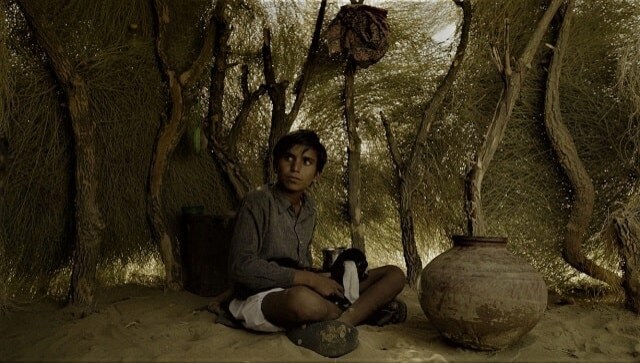
Still from Pushpendra Singh's wonderful film Pearl of the Desert, 2019, about a Manganiar boy musician called Moti

The Dharamshala International Film Festival went online this year, making its thoughtfully curated mix of features, documentaries and short films available to anyone in India with a screen and an internet connection, offering both season tickets and a daily Binge pass. Sunday, 8 November, is the last day of this year's festival. I've picked out five unusual films worth the price of admission:

Pearl of the Desert, 2019

Documentary | Rajasthani | 1 hour 22 mins

A boy is walking home with a group of other boys, all wearing that familiar dull blue shirt that is the uniform of countless government schools across India. Suddenly he falls behind, telling the rest to go ahead. “You do this every day!” complains another boy in the group. But they carry on, and the boy settles himself on a crooked tree trunk and begins to sing. As the rich, rugged notes emerge from his throat, the desert seems to spring to life. In case the sound doesn't thrill you, the filmmaker catches a black buck leaping up at the sound of Moti's voice. Then another. Animals seem to respond to the beauty of Moti's music, evoking mythical depictions of cattle gathering to listen to the flute-playing Krishna.

It is the sort of coded, powerfully cinematic image that makes Pushpendra Singh's hybrid documentary on the Manganiars such a layered, resonant piece of filmmaking. Time and again the film reminds us, without a word, that we live in a country of remarkable admixture: a country in which Muslim musicians have for centuries been the appointed bards to the upper caste Hindus of the Thar Desert.

It is something to listen to these men singing the praises of their Hindu patrons: enumerating the heroic exploits of their ancestors, laying out their genealogies, mourning the departure of their daughters — all in words profoundly redolent of the desert. If one song describes the carriage of the camel, another pays tribute to the dusky beauty of the lover in the courtyard, while one particularly stunning verse asks the stubborn lover to come back home, saying, “I have written you a carnival, at least now return”.

Whether the occasion is a birth or a marriage or any other celebration, the Manganiars are always called upon. They sing songs to the goddesses their patrons worship, and they also sing songs to the pirs of the Thar desert. The film closes with a group of Manganiar men harvesting cluster beans, singing in joyful unison a song that invokes Allah. In one of the film's reenacted scenes, Moti's grandfather is asked to relate the community's history — he connects them with Parashuram, with stories about asking for necklaces (maangan, haar), and their name to the Sanskrit word “mangal”, meaning auspicious.

Whenever the increasingly misguided votaries of Hinduism insist that their vengeful politics of purity is the only defense of Indian tradition, it is worthwhile bringing up the Manganiars — for this, too, is our tradition. One we must now fight to keep alive.

Dharamshala International Film Festival 2020 From Pearl of the Desert to Yalda five mustwatch picks
Still from the delightful Gaza Mon Amour, 2020

Gaza Mon Amour, 2020

Fiction Feature | Arabic | 1 hour 27 mins

Set in the small, densely populated Palestinian territory of Gaza, this film about an ageing fisherman who decides he has had enough of singledom is a quiet delight just for the stellar performances by Salim Daw as the externally crotchety but secretly romantic Issa and Hiam Abbas as the serious-faced widowed seamstress whom Issa finally gathers the courage to court after a naked ancient statue lands in his fishing net — that feels like a sign. Atmospherics are provided by the rundown location, where checkpoints, power cuts and bombings are the norm — as is the fact that many of the younger people want to escape to Europe even via the dangerous illegal route. Directed by Tarzan Nasser and Arab Nasser, this gently comic romance comes to DIFF after a premiere at this year's Venice Film Festival and the NETPAC award for best Asian film at Toronto.

Dharamshala International Film Festival 2020 From Pearl of the Desert to Yalda five mustwatch picks
Still from the documentary Influence, 2020, a film about the dangerous directions in which advertising and PR have taken us

Influence, 2020

Documentary | English | 1 hour 45 mins

Tim Bell was a British advertising man who went from being part of the founding team of Saatchi & Saatchi to Margaret Thatcher's campaign manager, his “Labour's Not Working” hoardings held responsible, among other things, for the decimation of the British Labour Party in that election. Diana Neille and Richard Polak's ambitious documentary portrait of Bell unpacks the rise and fall of a morally dubious man who created and ran the world's most influential political consultancy for decades. Bell Pottinger's clients ranged from the Chilean dictator Pinochet to South African Presidents FW De Klerk and Jacob Zuma. He was hired by the Pentagon to create a flood of propaganda videos in post-Saddam Iraq and by the Gupta Brothers to stir up racial violence in South Africa using hired bots to tweet and post on #whitemonopolycapital.

The film's watchability is aided by its incorporation of an interview with an aged Bell, who died in the summer of 2019 — perhaps precisely because Bell gives away so little, even as he has supposedly decided to tell his story. But its true impact lies in using Bell's life to trace the transformation that characterises our era perhaps more than any other: the dangerous transformation of advertising and marketing from an “art form into a science — and in many respects, into a workable weapon”. Those words belong to Nigel Oakes, an ex-Saatchi & Saatchi man now infamous as the founder of the SCL group, the parent company for Cambridge Analytica. The untrammelled rise of “strategic communication”, alongside social media, is the story of our times, altering political outcomes across the globe for several decades, and now scarily part of our present in India. In Oakes' words, what was once “just democracy” is now a “controlled democracy, maybe available to the highest bidder.”

Dharamshala International Film Festival 2020 From Pearl of the Desert to Yalda five mustwatch picks
Still from the gripping Yalda, 2019: Iranian realities filtered through the drama of a reality TV show

Yalda, 2019

Fiction Feature | Farsi | 1 hour 39 mins

Winner of the World Cinema Grand Jury Prize (Dramatic) at the Sundance Film Festival this February, Massoud Bakhshi's film Yalda, A Night for Forgiveness is a gripping drama that manages to reveal a great deal about the contradictions and hypocrisies of present-day Iran. The film unfolds on the set of a TV show called 'Joy of Forgiveness', during which a woman convicted for killing her husband might receive a pardon from her husband's daughter — and thus be saved from the death penalty.

Bakhshi based his fictitious show on a real show called Mah-e-Asal that aired daily on Iranian television during the month of Ramadan from 2007 to 2018, and does wonders by alternating between the scripted reality we see on TV and the real drama taking place off-camera. The story of why the 20-something Maryam Komijani married her late father's 65-year-old employer and became pregnant with his child brings into view not how skewed Iranian law is against women — the permissibility of 'temporary marriage', the greater claims of sons over family property — but also the deep fault lines of class in Iranian society. Dominant social morality and the law may see Maryam a certain way, but it is hard to look away from the alternative picture the film shows us.

Ghar Ka Pata, 2020

Documentary | Hindi, Kashmiri, English | 1 hour 7 mins

The filmmaker's search for the home she left at six is the basis of a personal essay about a very political place. Madhulika Jalali's family home was a traditional house in the neighbourhood of Rainawari in Srinagar, among the areas in the city that was home to the Kashmiri Pandit community. Like thousands of other Pandit families, Jalali's Hindu parents found themselves forced to leave the valley by the events of the early 1990s, when militancy in Kashmir took a dangerously communal turn. Like the others, they were never to return. The film makes this tragic political-communal context visible through a very personal keyhole. As if to compensate for her own lack of memory, Jalali tries to find an image of the house she can't see in her mind. When her own family albums are exhausted, the search leads her to cousins and relatives — and eventually to Srinagar.

Dharamshala International Film Festival 2020 From Pearl of the Desert to Yalda five mustwatch picks
Poster for Madhulika Jalali's moving personal documentary Ghar Ka Pata, 2020

The film splices these journeys with Jalali's two elder sisters reminiscing, about the house but also about the traumatic nights leading up to their departure, when proclamations of violence made from the neighbourhood mosques made their father dig out his hunting rifle — but eventually take his close Muslim friend's advice to leave.

Her parents, like most adults Jalali speaks to, remain reticent. But those who were younger then, seem happy to speak. Jalai's sisters talk about how happy and peaceful their childhoods had been in the Srinagar of the1980s: the fruit trees in their garden, the snow they used to try to make into ice cream, the neighbourhood shop from which they bought dahi, the walking route they'd try to take home to get their hands on any festive meetha chaawal being distributed. But even within this gently nostalgic past, one can see the inevitable seeds of the future. In one remarkable anecdote, one of the sisters recalls how in those months that Doordarshan telecast Ramanand Sagar's version of the Ramayana, Hindu and Muslim children alike used to come out onto the streets of their neighbourhood with homemade bows and arrows, taking aim with a "Jai Shree Ram".

Jalali doesn't dwell on it, or on anything really. Her film has a lightness that sometimes feels surprising. Is sorrow filtered through time and distance and forgetting still sorrow? Perhaps the answer is, sometimes.

Published on Firstpost, 8 Nov 2020.

25 October 2020

Taking the festivities online

With the pandemic raging on, film festival organisers are making the most of the digital space.
 

Image
Gaza Mon Amour, above, is part of the line-up for DIFF 2020. Passes to this year's online film festival: www.online.diff.co.in

Among the many communities barred from assembling by the coronavirus is that of devout Indian film buffs. Movie theatres have been shut for eight months, and even the very occasional new film ‘dropping’ on an OTT platform makes for sad, solitary viewing. Theatres cautiously reopened on October 15, but it might be a while before audiences, and thus filmmakers, risk a Friday release in the cinema. Even worse is the fate of that critical mass of film buffs who eagerly await the annual Indian film festival season, held from October to January, with big and small festivals taking place across the country. Given the new social distancing and hygiene norms, organisers have had to grapple with whether to go digital, cancel, or postpone and hope for the pandemic to reduce in intensity. The bigger festivals, which attract larger crowds and members of an international film fraternity, have almost all chosen the latter two options.

The Jio MAMI Mumbai Film Festival was the first to cancel its 2020 edition, rescheduling to October 2021. Two other highly-awaited festivals, the International Film Festival of India (IFFI) and the International Film Festival of Kerala (IFFK), have postponed. IFFI, organised by the Directorate of Film Festivals and the Entertainment Society of Goa, has been pushed from November to January 16-24, 2021, and IFFK from December to February 12-19, 2021.

The start of the lockdown saw an explosion of energy online with many film archives and commercial sites making selected films free to stream, like Criterion expressing its support for the Black Lives Matter movement by removing its paywall on classic black cinema. In June, when 21 festivals including Berlin, Locarno and Cannes, collaborated on We Are One, a free 10-day digital festival, MAMI contributed three films. Festivals like KASHISH, the Mumbai International Queer Festival and the International Documentary and Short Film Festival of Kerala held successful online editions. The Dharamshala International Film Festival (DIFF) ran an online Viewing Room for months, screening critically-acclaimed Indian and world cinema previously shown at DIFF.

“At that time, many said [the virtual] was the new normal. Online screenings got huge audiences as people were starved,” says Bina Paul, artistic director, IFFK. “But we are busier now, and the distractions are many. It is harder to take time out for an online festival.” There are also piracy concerns, especially for new films, since India has a particularly well-developed network of hackers. “Most crucially, people are realising that films are only part of the festival experience,” adds Paul. “That sense of community is not there online. For filmmakers, the feeling of the film finding its audience cannot come from a scattered, anonymous viewership.” Subasri Krishnan, curator of the Urban Lens festival (Delhi and Bengaluru) for the Indian Institute of Human Settlements (IIHS), agrees that a festival is a space of validation for independent and documentary filmmakers, and 100 people gathering in a dark room is integral to that. But IIHS is moving Urban Lens 2020 online, to be held over six days in December. “One cannot substitute for the other,” says Krishnan, but adds, “Real spaces can sometimes be exclusionary; an online festival may find new audiences. Also, geography becomes irrelevant.”

For DIFF co-founders Ritu Sarin and Tenzing Sonam, too, the prospect of attracting new viewers across South Asia makes their upcoming digital version exciting. “We love the warmth of the physical festival, but we realised that both for indie filmmakers ready with new films this year, and for viewers, there aren’t many options,” says Sarin. DIFF 2020, which will run online from October 29 to November 4 at Online.diff.co.in, is larger than the previous eight editions, with over 100 films screening over a week. Acclaimed international films include Babyteeth (2019), Air Conditioner (2020) and the Wuhan-set documentary 76 Days (2020). There’s an exciting new section of Indian documentaries and an extended programme of shorts, including Ashmita Guha Neogi’s CatDog, the only Indian film selected for Cannes this year. “Without the logistical constraints of time or venue size, we could accommodate more films. And we’re starting an Audience Award for Best First Film, which seems easier to achieve online,” says Sarin. “Next year’s festival may well be a hybrid of online and off.”

For smaller independent or crowd-funded film festivals, going digital can open up exciting possibilities, says Nitya Vasudevan, co-organiser of the Bangalore Queer Film Festival (BQFF). “There’s the prospect of inviting international filmmakers that we would find impossible non-virtually, while freeing up time and money spent on venue hire, brochures and tech. But as a queer festival, the roles it plays are many,” says Vasudevan of BQFF. But she may speak for all film festival regulars when she says, “People look forward to attending because it’s a space of intimacy: you can dress a certain way, have certain conversations you can’t have outside.”In true community spirit, BQFF is currently contemplating an audience poll of the festival’s regulars to decide on whether the festival should be held online in February-March, or wait until it can be held safely offline. Of course, the poll itself would be online.

Published in India Today magazine, 23 Oct 2020.

28 April 2020

The Rules of the Game

My Mirror column:
 
A neighbourhood chess tournament provides both setting and metaphor in the Ektara Collective’s sharp and delightful indie Turup (Checkmate), currently free to stream online. 

Image

“Unless, like Thelma and Louise, you plunge off the side of a canyon, there is no escaping the everyday,” wrote Geoff Dyer in his marvellously idiosyncratic sort-of biography of DH Lawrence, Out of Sheer Rage (1997). “To be free is not the result of a moment’s decisive action but a project to be constantly renewed,” he added. “There are intervals of repose but there will never come a moment of definitive rest where you can give up because you have turned freedom into a permanent condition. Freedom is always precarious.”

Dyer’s riffs on freedom and the everyday came back to me this week as I watched, for the second time, a lovely film called Turup (Checkmate), made in 2017 by an unusual group of filmmakers who call themselves the Ektara Collective. Turup is currently free to stream online in the ‘Viewing Room’ set up by the organisers of the Dharamshala International Film Festival and addresses both the precariousness of our freedoms and the mundane, unglamorous, repetitive settings in which we must fight for them.

Set in the Bhopal neighbourhood of Chakki Chauraha, the film uses a public neighbourhood chess-board as narrative and metaphorical anchor for its fine-grained take on a set of interlocked lives. It is very much a feature film, with a script, characters, and often sharp turns of dialogue –but it has a documentary-style sensitivity to its chosen milieu, attending carefully to the faces, spaces and sounds that bring it to life.

Some of Turup’s attention to the everyday is about catching playful moments of enjoyment. A man pauses to watch a woman he likes tying up her hair. A child hides some ber where an old man can find them. One young man cajoles another into betting on a chess game he’s not even party to. More often, though, what the film places under its observational microscope are aspects of Indian daily life that too often go unnoticed.  An upper caste man tells a little girl to move away from her spot at a public chessboard with a wordless gesture of caste distancing, adding that she should take “her pieces” with her. An upper middle class woman fails to recognise the sweeper who cleans the street outside her house. A husband thinks nothing of conducting large financial transactions from a marital ‘joint’ account without consulting his wife. A younger brother invites a potential groom’s family home to ‘see’ his elder sister because he disapproves of her choice of romantic partner.

That quasi-anthropological gaze, defamiliarising the familiar, forcing us to look at the inequities to which we usually turn a blind eye, is one part of what makes the film powerfully political. The other thing I think Turup gets right is how the local, the personal and the everyday are inextricably wound up with wider social, public and historical currents flowing through the country and shaping our times. Like a well-executed piece of ethnography, the film’s focus is small – one urban neighbourhood – but its socio-political canvas is large. It also manages to gesture to the ways in which our ‘local’ reality is now in constant conversation with mass media (Though I am less optimistic than Turup’s makers about the relative reach and effect of newspaper journalism and bigotry-filled WhatsApp forwards).

Made three years ago, the film is attuned to the rising tide of rightwing Hindu majoritarianism that now threatens to drown out all other political voices. At several points in the film, we see the mobilising of men – especially those who are unemployed, poor or in whatever way insecure — around the totem of the endangered cow mother, and the endangered Hindu daughter. The bogey of ‘love jihad’ is the apposite bedrock of Turup’s plot, revealing gender as the fault line along which fictional ‘us’ and ‘them’ narratives can most easily be spun. “Apni ladkiyon ko kaaboo mein nahi rakh paye toh izzat gawaayenge,” says one man. “Nahi maan rahi hai? Arrey toh manwaao,” says another, talking of a girl who is resisting a forced arranged marriage in favour of studying further and eventually marrying the man of her choice. A young Dalit man is shown as susceptible to such gendered messaging, especially when religion is thrown into the mix – but the film also reveals how caste is often the limit of Hindutva’s imagined solidarities. The same young man, who thinks he’s being enjoined to be part of a movement for dharam raksha, finds himself being urged to sacrifice a morning’s work to ‘help out’ with a blocked septic tank.

Turup offers no large victories. What it holds out are small incremental achievements in what the Italian political philosopher Antonio Gramsci would have called a War of Position, a process in which cultural activities and social interactions are the locales in which people can begin to imagine new ways of being. The young Dalit man refuses the work for which his caste is seen to make him automatically ‘qualified’. A woman starts to claw back some power in her marriage by re-establishing some professional self-worth. An upper caste local bigwig finds himself losing a final to the young ‘outsider’.

The wresting of freedom, as Dyer suggested, is part of the daily grind. But it is also a game in a continuing tournament.

Published in Mumbai Mirror, 26 Apr 2020.

19 November 2019

Dispatch from Dharamshala – 2

My Mumbai Mirror column:

Films about animals at this year's edition of the Dharamshala International Film Festival had powerful things to say about the state of our humanity
 

Image
The monkey as metaphor: a still from Prateek Vats's film Eeb Allay Ooo

You can never watch all the films at a film festival. What you can do is to make your choices, whether based on frontbencher commitment (read high-intensity googling of film titles) or a more backbencher attitude (what the lady in the loo queue seems excited about) and hope that the darkness of the auditorium will end up illuminating something you haven't quite seen before.
 
One of the things this year's DIFF threw into focus for me was age and ageing. There's no single model of the good life, but observing old people throws up possibilities to aspire to – or guard against. Archana Phadke's stunning documentary portrait of her grandparents and her parents, About Love, is as brutal as it is affectionate, letting us see these long-term relationships as the simultaneous safety nets and shackles they are. The bent, ancient fisherman of Kazuhiro Soda's Inland Sea smiles wryly about how the years can sneak up on you: “I thought I was still 50 or 60, turned out I had turned 90.” 

The other theme that seemed to me to emerge serendipitously from DIFF 2019 was animals. Zooming in on the non-human seemed, in film after film, to be a way of 
opening up the human condition. Sometimes the association felt subtle, like the gleaming night hauls of fish in Inland Sea that the old man disentangles from his net and tosses into the boat's watery hold, so they might live a little longer. The persistent slippery toughness of their bodies, leaping for life even at death's door, struck me as akin to their captor. 

Elsewhere, the weight of the beastly allegory seemed too much for the narrative to bear. The acclaimed Malayali director Lijo Jose Pelissery was at DIFF with his latest, Jallikattu, in which a buffalo due for slaughter runs amok, destroying plantations and shops in its wake. As the village men set off in pursuit, armed with nothing but ropes and their egos, it becomes clear that the film is only ostensibly about the buffalo.  

Pelissery's last two films, Angamaly Diaries and Ee Ma Yau,  demonstrated a talent for richly orchestrated set pieces, but Jallikattu feels more like a runaway display of that ability than a controlled experiment. For most of the film's running time, we watch men with flaming torches tramp through acres of hilly woodland and splash through streams, yelling, leaping, tearing at each other, with increasingly less rational cause. The buffalo seems almost forgotten as long-held internecine rivalries bubble up. The energy of the crowd is both majoritarian and masculine – “We will take it! There are more of us!” The thrill of the hunt, the performative frenzy of competition, the adrenaline and the testosterone – these, Jallikattu drills into us, are what drive humanity at its basest. And somehow, humanity at its most primitive is signified by animality. 

“Even now, with us here, this place belongs to animals,” says a goggle-eyed old man in Jallikattu. The sentiment is echoed at one point in Prateek Vats's stellar feature debut, Eeb Allay Ooo!, when Mahinder the monkey repeller of seven generations declares to the befuddled new recruit Anjani (Shardul Bhardwaj) that he has been asked to help train: “This is the neighbourhood of Raisina, traditionally ruled by monkeys.”  

But neither Pellisery nor Vats seem actually interested in our relationship with the animal world. What Vats's film does brilliantly is to use the monkey as metaphor, creating a multifarious web of associations that traverse the distance between animal and god – but elude the human. The bonnet macaque monkeys of Lutyens' Delhi, as elsewhere in India, have exploded as a population partly because they are worshipped and fed as a form of Hanuman – and as a bit of video footage in the films repeats, “The gods become pests.” 

Combining real locations and non-actors with a sharp script and a core of trained actors, Eeb Allay Ooo! follows the travails of a Bihari migrant who is hired to shoo away monkeys from the national capital's most grandly symbolic architectural corridor. There are several interwoven strands that combine to make this such a scathing indictment of the state of the nation: the humour of a young man's masculinity seemingly pitted against monkeys, the deeply unfair conditions of contractual labour, the absurdity of bureaucratic rules that defeat all of Anjani's innovations on the job. Meanwhile, the performative masculinity of the state at both the lowest level: Anjani's security guard brother-in-law being forced to wield a rifle that he can barely carry – and the highest: the Republic Day parade – emerge as equally farcical. 

It is only when the man pretends to be an animal – in a man-sized monkey costume, in blackface imitation of the lion-tailed macaques of Karnataka's R-Day tableau – that he manages to scatter the monkeys. We watch him wander through the streets, a modern-day Hanuman in his own sad Ramleela

His success is because the monkeys cannot tell the difference between a real langur and a fake one. Mahinder's real death at a mob's hands goes unmourned. Meanwhile, towards the film's end, the real rifle ends up in a costume tailor's shop, its value as limited to the performative as the fake costume. When, in the last scene, the jobless Anjani joins the parade of Hanuman impersonators, we know acche din has made monkeys of us all.

Published in Mumbai Mirror, 17 Nov 2019

13 November 2019

Dispatch from Dharamshala – 1

My Mirror column:

The Dharamshala International Film Festival, now in its eighth year, is still the most intimate, charming setting in which to encounter films and filmmakers in India


Image


I arrived early at DIFF this year, walking up the 20 minutes from McLeod Ganj’s main chowk and making it into the campus of the Tibetan Institute for the Performing Arts (TIPA) just before the first sharp shower of the day. In the main auditorium, Tenzing Sonam and Ritu Sarin, wonderful filmmakers and creators of this extraordinarily delightful film festival in the mountains, were supervising the last-minute arrangements to make sure the eighth edition of the Dharamshala International Film Festival (DIFF) began without a hitch.

The opening ceremony was two hours away, and DIFF’s truly international team of youthful organisers – “Tibetan, French, Punjabi, Bengali, Telugu, Ladakhi, Italian and Malayali!” said Sarin in a Facebook post – were hard at work. At DIFF, details are everything. Two people were pasting black chart paper to reduce reflection from the auditorium balcony, while others made sure the two DIFF banners on either side of the screen were at the same height. The festival trailer and the opening film were test-run, the projection evaluated for sound and stretch and quality of image. Only when all had been approved did Sarin and Sonam make a dash for it, hoping to get a bite to eat (they had missed lunch), change and return to the venue in the 40 minutes left.

It’s my fourth consecutive year at DIFF, and as always, I am warmed not just by the carefully handpicked mix of independent films – shorts and features, documentary and fiction, Indian and international – but by the atmosphere of conversation and camaraderie in which they are screened. Like most film festivals, DIFF is a great place to talk cinema: you will encounter both gushing enthusiasm and agitated criticism over parathas and hot ginger lemon tea in the flag-bedecked courtyard. But there seems something self-selecting about DIFF audiences – the vibe is always more generous and open-ended than nerdy and competitive.

One of the first screenings is Agnes Varda’s last film, an autobiographical, self-evaluative work called Varda by Agnes, the very title evoking the playfulness and joie de vivre that marks much of Varda’s work as a director. Completed in early 2019, a few months before her death, Varda by Agnes allows us to spend two hours in the company of a charming, sensitive filmmaker who was never afraid to embrace her eccentricities. The film opens with Varda seated in a director’s chair, addressing an audience in the grand environs of an opera house. The opera-house-turned-movie-theatre intimidates her: the children of paradise might be up there, she says, laughing and simultaneously bringing in with that one sentence the ghosts of cinemas past – Carné’s delightful 1945 Les Enfant du Paradis, in which the courtesan Garance juggles various loves against the backdrop of the 1830s Paris theatre scene. Like Garance, Carné has an enviable lightness of touch, and so does Varda.

The film has her speak of her love of documentary, of her preferring to explore the nearby and familiar – the bakers and butchers of her Paris neighbourhood, or the murals of Los Angeles where she spent some time – than making “big documentary journeys”. She talks of her love of recycling, something at the heart of her marvellous film The Gleaners And I as well as various artistic projects showcased here, including an arched gate made with old film canisters. “I’ve learnt that recycling brings joy,” she says, because you can preserve things that might otherwise be lost. Then there is her abiding interest in the question of time – from immersion in the everyday art of the baker to the experience of time for her heroine Cleo (in the classic Cleo from 5 to 7) on the nerve-wracking day when she is awaiting the results of a medical test. About Cleo, she says she wanted to bring in both objective time – the universal, fixed clock time that we have no control over – and subjective time: how time actually feels to each of us, an experiential thing that changes all the time.

The passage of time is also integral to the film in a personal sense. Varda made it at the incredible age of 90, and yet age appears in it fleetingly, with that marvellous light touch. There is a moment with footage of her at a protest holding a sign that says “It hurts everywhere”. Varda comments, I could still hold up that sign, it’s still true. She does speak of the experience of turning 80 as paralysing, saying that it felt like a train that was going to crash straight into her. But ten years later, she seems to have made peace with her body.

The question of ageing – the many ways we might age if we set ourselves free to do so – is also at the centre of several other films at the festival this year. The documentary Golden Age, directed by Beat Oswald and Samuel Weniger, is set in an ostentatious retirement home called The Palace, where residents are invited to continue to party into eternity. Kazuhiro Soda’s lovely elegiac documentary Inland Sea takes us into the Japanese seaside village of Ushimado, presenting in a dream-like black and white the real and imagined lives of its many “late-stage elderlies”. RV Ramani’s documentary Oh That’s Bhanu maps the personal and performative life of the 90-something Bhanumathi Rao, once well-known as a dancer and theatre actor. Most radical of all is the superb Aise Hee, the first fiction feature from the writer-director Kislay, in which an old Allahabad housewife responds to the death of her husband by learning to live life anew — thereby rattling everyone around her.

To watch old people live — and to examine their lives — is somehow among the most wonderful things you can do as a young person. Doing so at a film festival is the next best thing to doing so in life.

(The second instalment of this column will appear next wee

Read more at:
https://mumbaimirror.indiatimes.com/opinion/columnists/trisha-gupta/dispatch-from-dharamshala1/articleshow/71988360.cms?utm_source=contentofinterest&utm_medium=text&utm_campaign=cppst
(The second instalment of this column will appear next week.)
(The second instalment of this column will appear next wee

Read more at:
https://mumbaimirror.indiatimes.com/opinion/columnists/trisha-gupta/dispatch-from-dharamshala1/articleshow/71988360.cms?utm_source=contentofinterest&utm_medium=text&utm_campaign=cppst

Published in Mumbai Mirror, 10 Nov 2019.

20 November 2018

Streets full of dreams

My Mirror column:

Two recent city films, one from Delhi, the other Bangalore, make us think about the role fantasy plays in the lives of the poor.


Image
Image

The memorably named Ghode Ko Jalebi Khilane Le Jaa Riya Hoon (I’m Taking the Horse to Feed It Jalebis) is a welter of visions. “This film is culled from interviews and dreams of pickpockets, street vendors, small-scale factory workers, daily wage labourers, domestic workers, loaders, rickshaw pullers and many others labouring in the city of Shahjanabad, Old Delhi,” reads the opening text of Anamika Haksar’s debut film. A long-time theatre person and activist, Haksar has said in interviews that the film germinated in her mind soon after her marriage, when she first began to spend time in Old Delhi and had a window looking out on a roof where three men slept every night.

Watching Ghode at the Dharamshala Film Festival earlier this month, it was clear to me that Haksar had spent many years with that memory, trying to turn that real window into a metaphorical one.

Ghode retains her originary three men on a roof, giving them professions and roots — the pickpocket (Ravindra Sahu) and the sweet seller (a tragically under-used Raghubir Yadav) are from UP, while the loader (K Gopalan) is Malayali. But she surrounds them with a cast of 400 non-actors from Purani Dilli. An unorthodox mix of animation, fiction and documentary, Haksar’s film has a clear political aim: expanding an uncritical, vaguely nostalgic gaze (afforded by her upper-middle-class Kashmiri family’s Old Delhi connections) into a perspective simultaneously sharper and more broad-based.

A crucial conduit in that politics of representation is the portly figure of Akash Jain, a well-off resident who serves as guide to Old Delhi, and as faux-sutradhar to the film. Played by real-life theatre person Lokesh Jain (who with his partner Chhavi did the interviews on which the script is based), “Awaragard Akash” sings the city’s praises in highfaluting clichés as familiar as they are fake. To watch him shepherd clueless visitors through this overburdened, garbage-filled, drug-addled place of poverty and backbreaking work, while declaring it “Tehzeeb ki jannat (A heaven of civilization)” is to both laugh and cry at the ironies we live with.

Less successful is the film’s shunning of a linear narrative and near-total jettisoning of psychological realism. Ghode’s multitude of dream visions can be surreal and cheeky — levitating corpses bandaged in white; a calendar-style Lakshmi contending with a lehrata hua Communist flag, or my favourite: a labourer’s fantasy of his exploitative boss turning into a lizard. But there’s also a hyperreal mode that tries too obviously to grab our attention: for instance, that same labourer’s muscles shown pulsing exaggeratedly, at excruciating length.

Dreams animating the dreary lives of the poor are also the subject of Indu Krishnan’s 78-minute documentary, Good Guy, Bad Guy, which was screened at the Urban Lens Festival in Delhi yesterday. Like the 59-year-old Haksar, Krishnan spent over five years with a much younger working-class man who is her central character. She first meets Zakhir in Cubbon Park, that island of quiet in the raucous tide engulfing Bangalore. He is feeding the monkeys — not by strewing food on the ground, but feeding each individually.

Krishnan finds this unusual and decides to get to know him. A runaway who left home many years ago, Zakhir works as a ragpicker in Bangalore’s scrap-sorting area, Jolly Mohalla. By day, he trawls the city’s streets for reusable trash. By night, his primary concern is to find a safe place to sleep. The animals he befriends — monkeys in Cubbon Park, street dogs, even pigeons that roost above a house where he sleeps — are a refuge in a hostile city, and Zakhir imagines their lives as implicitly better than his own. “No one bothers these creatures,” he tells Krishnan. “They can do what they want. If they show up at Cubbon Park, they’ll get fed, too.”

That imagined life is quite different, however, from that of a caged animal. In one of the film’s oddly moving juxtapositions, when Zakhir ends up in jail in a murder case, the filmmaker manages to track him down and asks him if he might want to work in a zoo upon release since he likes animals so much. Zakhir’s response is characteristically gentle but immediate: “It is a sin to keep animals captive.”

Later in the film, he ends up working for a piggery. But with Krishnan’s help, he also embarks on an attempt to fulfil what he tells her is his real dream: directing a feature film. In contrast to Ghode’s biting sarcasm and rambling excess, Good Guy is a gentler, simpler film, a bit like Zakhir. Like Haksar, Krishnan remains a privileged outsider, never really exposing herself. Still, despite some unnecessary drama and bad background music, her honesty about her own position vis-à-vis Zakhir — bailing him out or connecting him with a Kannada filmmaker because “without that there would be no film” — disarmed me.

Watching the near-illiterate Zakhir create a script and songs for his film, with at least one featuring himself as a sort of anti-hero, it was hard to know how I felt about his dream life. The question is similar to the one implicitly raised in Haksar’s film: do dreams keep people from being crushed by hopeless conditions? Or are they a perpetual escape from reality?

16 November 2018

In the Family Way

My Mirror column:

Films about parental figures — real and imagined — made revealing viewing at the Dharamshala International Film Festival.


Image
Actor Manoj Bajpayee occupies the front row at the 2018 edition of DIFF, which took place in November at the Tibetan Children's Village school in McLeodganj

The seventh edition of the Dharamshala International Film Festival (DIFF), which ran from November 1 to 4, was full of films about parent-child relationships. It wasn’t a consciously chosen theme. “As in previous editions, a pattern emerged organically from the choices we made,” wrote DIFF’s directors Ritu Sarin and Tenzing Sonam in their festival brochure.


Deliberate or not, even just the names of the films on this year’s schedule made for a recurring motif. In many conversations at the fest, the multi-generational, multi-linear Taiwanese drama
Father to Son was mistaken for Of Fathers and Sons, a documentary based on exiled Syrian filmmaker Talal Derki’s two years shooting with a radical Islamist family in a north Syrian village. The Sri Lankan debut feature House of My Fathers added to the confusion.


Beyond the films whose titles declared themselves, however, there was Ee.Ma.Yau, Lijo Pellissery’s brilliant satirical drama about a Malayali Catholic man trying to arrange the grand funeral he promised his fisherman father, and the spare, rather too studied The Red Phallus, Tashi Gyeltshen’s symbolic unpacking of patriarchy in rural Bhutan through the tale of an atsara (a traditional clown) and his unhappy teenaged daughter. Dominic Sangma’s debut feature Ma.Ama, which I didn’t get to watch, ‘resurrects’ the filmmaker’s late mother (and casts his real-life father as the 85-year-old Philip Sangma, who has waited 30 years to be reunited with his dead wife).

The non-fiction films, too, gravitated towards this filial theme: Avni Rai’s documentary about her father, 
Raghu Rai: An Unframed Portrait, is as much about his photography as their relationship, while the fascinating, blackly funny The Beksinskis: A Sound and Picture Album (2017) reconstructs the complicated relationship between a famous Polish painter Zdzislaw and his radio journalist son Tomek, drawing on 300 hours of private video footage that extends from the period before Tomek’s birth till after his death. (The Beksinskis were also the subject of a more traditional biopic in 2016: Jan P Matuszynski’s feature The Last Family, which I saw at IFFI last year, didn’t have the advantage of ironic self-examination made for more harrowing viewing.)


Image
Image
Stills from Namdev Bhau: In Search of Silence & Hamid, respectively the opening and closing films at DIFF 2018.

What was uncanny to me, though, was something else: the fact that in so many of the other films, child protagonists created a cross-generational bond with an older adult — often in lieu of a parent. In the Ukrainian filmmaker Dar Gai’s road movie 
Namdev Bhau: In Search of Silence, the festival’s opening film, a Mumbai chauffeur frustrated with the cacophony of the city sets out a solo trip to Ladakh’s Silent Valley, only to find himself in the insistent company of a twelve-year-old boy travelling mysteriously alone in Ladakh. The boy’s ceaseless confident chatter contrasts starkly with the silences of Devashish Makhija’s Bhonsle, in which a retired Marathi constable takes a fearful Bihari child under his wing.


Makhija’s Mumbai, all shadowy corridors and low-lit, barely-furnished rooms, couldn’t be more different from Dar Gai’s picture-postcard mountain vistas. Even when the locale is comparable, the effects are far apart. Namdev Bhau’s chawl always looks bright, the sunlight as inescapable as the chatter of Namdev’s family and neighbours, while Manoj Bajpayee’s Bhonsle occupies what must be the most silent chawl ever seen on the Hindi film screen: a place where even make-or-break fights about chauvinistic community claims on the city don’t spill over beyond the few carefully chosen protagonists. Stagey as that often felt, and despite the predictable turning of its sole female character into fodder for competing masculinities, I was far more moved by the connection between Virat Vaibhav’s petrified Lalu and the taciturn but fair Bhonsle than by Dar Gai’s too-neat, emotionally manipulative conclusion.

Image
Child actor Virat Vaibhav in a still from Devashish Makhija's disturbing Bhonsle (2018)

Emotional manipulation and tidy coincidences also reigned in DIFF’s closing film, Aijaz Khan’s drama
Hamid, set in Kashmir. An eight-year-old boy whose father has joined the state’s growing list of ‘‘disappeared persons” tries to phone Allah to send his father back, and ends up calling a Central Reserve Police Force (CRPF) man called Abhay stationed in Kashmir. Abhay’s initial dismissal of it a prank is jettisoned by Hamid’s touching faith. The angry, aggressive Abhay is quite far from being God. But, as the film cloyingly suggests, the goodness of adults might be a function of children’s faith in them.


Image
A still from the sassy, satisfying 'children's film' Cross My Heart (2017, dir. Luc Picard). 
I was more wholehearted charmed by the Canadian film Cross My Heart, in which a girl threatened with the prospect of herself and her beloved little brother being split up into different foster homes abducts an old lady. Director Luc Picard cleverly makes twelve-year-old Manon’s act unfold against the 1970 October crisis, when political kidnappings by the Quebec Liberation Front had won some victories for Quebecois autonomy. But what makes the film moving is the imminent breakdown of the family and Manon’s heartfelt, if childish, desire to create a replacement for it — complete with a surrogate grandmother. What the children require of their baffled abductee is to read aloud bedtime stories — and make them a Mickey Mouse costume.

Fictive kinship, in most of these films, serves as a bridge across social and political barriers: the 
Bhaiyya-Marathi divide in Mumbai, the Kashmiris and the Indian state, and the English-French division in Canada. Perhaps the family — even in the imagination — does still have the power to summon our best selves.

Published in Mumbai Mirror, 11 Nov 2018.

18 December 2017

Girls, Interrupted

My Mirror column:

Two disturbing 2017 films — one set amidst Norwegian Pakistanis, the other among Russian Jews — present gripping portraits of young women fighting to not be sacrificed at the altar of community.


Image

A teenager brought up in Norway is suddenly transplanted to a Pakistani small town and finds herself the subject of prurient attention. “Why have you come here?” hiss her headscarf-wearing new classmates. Aware that she is on display, the new arrival tamely offers up what she thinks is the good-girl response expected of her: “I’ve come to learn about my parents’ culture”. But what’s flung back at her is a stinging accusation: “Not your parents’ culture! Your culture!”

It is a relatively minor moment in what is a film full of harrowing scenes. But that misrecognition goes to the heart of Iram Haq’s What Will People Say: What happens when your parents’ culture doesn’t feel like your own? One answer – a wrenching, difficult one – is that sometimes, then, your parents don’t feel like your own.

 
Haq’s film stars Ekavali Khanna and Adil Hussain as Pakistani immigrants who are happy to educate their daughter Nisha (the affecting Maria Mozhdah) and even imagine a career for her – until they come to suspect that she is leading the life of the Norwegian teenager: dancing, drinking, dating. At home, she obeys when told to wear a jacket over a revealing blouse; she serves snacks to the aunties; she pretends her texting exchanges are all about school work. But Nisha is indeed leading that life, just secretly. All hell breaks loose when her father discovers a boy in her room.


The film paints a depressing picture of the Pakistani community in exile, but it doesn’t ring false. If you’ve grown up in South Asia, you don’t need to be told that Haq based her film on a traumatic episode from her own Pakistani-Norwegian childhood to be convinced by Adil Hussain’s finely wrought transformation from loving, indulgent father to uncontrollably violent patriarch. The father who proudly displayed his academically bright daughter now feels only burning shame on her behalf: “Sab log hum par hans rahe hain.”

The community’s solution is to send her ‘home’ — to a country she has never lived in. Under the tutelage of her stern Phuphi (the always effective Sheeba Chaddha), Nisha learns to roll rotis, drape a dupatta and keep her head down. But the sexual awakening that was sought to be crushed in Norway happens instead in Pakistan, with worse effects. Now the only way to deal with such a wayward daughter is to marry her off, to trade her freedom in for the family’s honour.

Haq’s film was shown at the Dharamshala Film Festival in early November.

At the International Film Festival of India a few weeks later, I saw a stunning Russian film called Closeness in which, too, a young woman is sought to be clamped into conformity. Set in the late 1990s in the filmmaker’s hometown of Nalchik in the Northern Caucasus, Kantemir Balagov’s film won the International Critics’ Prize for best film in Un Certain Regard at Cannes. It centres on the tomboyish Ilana (the superb Darya Zhovner), who likes nothing better than helping her mechanic father fix cars. But as in Haq’s film, a young woman of a certain age must start behaving a certain way, and it is her mother who lays down those rules. In a celebratory family scene with strong echoes of WWPS, a sulky Ilana is made to change her overalls for a dress and help her mother in the kitchen.


Image

Ilana is also carrying on a clandestine affair with a boy from the town’s Kabardian community, which has a tense relationship with the Jewish community to which she belongs. Where Haq largely uses marked shifts in body language to register the contradictions of her heroine’s life, Balagov unsettles us by alternating between the raw, barely-lit seediness of Ilana’s secret backstreet life and the family’s domestic interiors, whose rich rusts and deep greens have the dramatic shadows of a Caravaggio painting.

Nalchik’s Jews are different from Norway’s Pakistanis, but Ilana’s clash with her parents resonates strongly with Nisha’s. In one exceptional scene, Ilana’s mother instructs her angrily, “You won’t be with him. He’s not from our tribe.” Ilana’s response is fierce and wordless — she puts her hand to her mouth and produces a long ululation, mocking her mother’s use of the word ‘tribe’. Unlike WWPS, the crisis in Closeness is not bought on by Ilana’s sexuality – but her insistence on displaying proof it certainly causes the sensation she intends it to.

These are not films that will be viewed as similar, and indeed they are far apart in pitch and tenor. But both produce for us the disturbing figure of the young woman forced to recognise that she is not quite as human as her brothers; that her social value lies not in what she might desire —but only in who can be made to desire her.


Published in Mumbai Mirror, 10 Dec 2017.