Showing posts with label China. Show all posts

6 October 2020

The medical missionary

My Mirror column, the first in a series on films about doctors:

V Shantaram’s 1946 film about the legendary Dr Dwarkanath Kotnis sheds an odd light on the contemporary India-China moment and our pandemic year

Image

2020 has been a year of medical heroism. It might be a good time to remember a heroic doctor from a very different period in the history of India and the world: Dr Dwarkanath Kotnis, whose valiant medical service in Communist China from 1938 to 1942 is still enshrined in that country's public memory. On August 28, even as Chinese and Indian soldiers faced off in a border conflict that remains far from being resolved, it was reported that a statue of Dr Kotnis was to be unveiled outside a medical school in North China named after him: the Shijiazhuang Ke Dihua Medical Science Secondary Specialised School. (‘Ke Dihua’ is Kotnis’s Chinese name.)

Kotnis is not often remembered in contemporary India, but barely four years after his death, his life and work were made the subject of a film by the great Indian director V Shantaram. Free on YouTube as well as available to stream on one subscription-based platform for world cinema, Dr Kotnis Ki Amar Kahani makes for interesting viewing for many reasons.

Released in 1946, a year before independence, Shantaram’s film commemorates Kotnis's as the ideal nationalist life: a life led – and lost – in the service of the nation. As one of the rousing patriotic songs from the film’s rather wonderful lilting soundtrack put it: “Jaan dene ka hi naam hai zindagi (Giving up your life is what living is really about)”. A film called The Immortal Tale of Dr Kotnis was clearly not shying away from either myth-making or propaganda.

What is fascinating to me, though, is that Kotnis’s nationalism is presented as what leads the youthful doctor to another country, where he helped their war effort. Heeding a Congress leader’s call for Indians to come to China’s aid during the Second Sino-Japanese War (Mao Zedong had apparently made such a request of Jawaharlal Nehru), the young graduate from Mumbai’s Seth GS Medical College decided to join a five-member medical mission to China in 1938. Watching Shantaram’s film in 2020, it is impossible not to be struck by the way Indian nationalism in the 1940s could be so naturally folded into an internationalist milieu of cooperation between what were then two poor Asian countries in a still-colonised world. (Some villains do exist: fittingly for a post-Second World War Indian film, it’s the Japanese, who are called ‘shaitan’ but shown as buffoons, in the almost classic tradition of the war movie.)

Scripted by the great KA Abbas, Dr Kotnis opens with the handsome young doctor (played by Shantaram himself) returning from Mumbai to announce to his shocked parents that he has just pledged to serve in China. His ageing father, caught off-guard while proudly displaying the clinic he’d had made for young Dwarka in their hometown of Solapur, has a teary turnaround. It’s a remarkable propagandist scene, where Shantaram and Abbas take the figure of the obedient son and finesse the resonant Indian idea of filial duty into duty to the motherland. The sacrifice is dual, because Dwarka’s father too must give up his ‘budhaape ki laathi’. The Hindi phrase about children as the support of one’s old age is propped up by an actual laathi that Dwarka presents to his father – which falls symbolically from the old man’s hand as his son boards the ship to China. The dramatic foreboding has a reason: the father will die without seeing his son again, and Dwarka will never return.

Shantaram cast himself as Kotnis, and the actress Jayashree – who had become his second wife in 1941 – as Kotnis’s assistant Qing Lan (pronounced Ching Lan), whom he married and had a son with. The relationship between them is tenderly depicted, though it doffs its hat quite obviously to both nationalist propaganda and Hindi film romance. For instance, Qing Lan first meets the good doctor disguised as a boy, and there must be some singing and dancing before love can be declared. But it is striking for a mainstream Indian film in the 1940s to have a foreign, Chinese, heroine, who wears trousers and a shirt all through (except a sweetly comic interlude when she attempts to wear a sari during their wedding) and is as deeply devoted to her work as her husband is to his. It helps that Vasant Desai’s lively, memorable soundtrack is so superbly integrated into the narrative: I loved Jayashree’s ‘Main hoon nanhi nayi dulhan’, though it is clearly not a traditional song sung by Chinese brides, and one of the film’s enduring images for me is the sight of the good doctor watching lovingly as his pregnant Chinese wife sings a rousing song to lead the Red Army to its next destination: “Ghulam nahi tu, josh mein aa / Yeh desh hai tere, hosh mein aa”.

The Chinese-Indian relationship and the internationalist iteration of patriotism apart, the film is remarkable for the way that the medical profession is celebrated. Dr Kotnis’s heroism is no less integral to the national war effort than the Red Army general whose camp he joins – he is captured by the Japanese, endangers his own life to create a vaccine for a plague that breaks out among the Chinese population, and succumbs to epilepsy, but after having saved the general from certain death of his bullet wounds. An internationalist nationalism that talks about saving lives, rather than merely laying down one’s own or killing one's enemies: that's propaganda almost worth having.

Published in Mumbai Mirror, 20 Sep 2020

2 December 2019

Mothering desires

My Mirror column:

At this year’s International Film Festival of India (IFFI), the desire for children emerged as a preoccupying theme for directors from China to Turkey


Image

 In Kantemir Balagov’s memorable second feature Beanpole (2019), which won the Un Certain Regard Best Director Award and the FIPRESCI Prize for Best Film in the Un Certain Regard section at Cannes, a young woman called Iya undertakes motherhood as a favour for her friend. It is the half-starved world of post-war Leningrad, and the friend, Masha, has had and lost a child. She has also had so many abortions that she can no longer get pregnant.

For a while, Masha seems unable to grasp this fact, leading her to seek out sex in the vain hope that a man might yet successfully impregnate her. “I want to have another human being inside me,” she tells Iya. Finally, giving up on that possibility, she persuades Iya to subject herself to sex with a man and carry the child to full term on her behalf.

The man that Iya requests to be her biological aid in this pursuit wants to know why she so badly wants to have a baby. “I want to be the master of her,” says Iya, talking of Masha. Having a baby may seem purely functional here, not something that Iya is invested in, except as a route to preserving her relationship with another woman. Yet, when she discovers she is not actually pregnant, the words Iya uses have an all-encompassing devastation. She is “empty”, she tells the doctor. Later she tells Masha that she feels “meaningless inside”. “There is no one inside me,” she continues.

The expressions I quote are the English subtitles, translated from the film’s original Russian dialogue. But that feeling of emptiness, the gnawing desire for a child, the all-consuming aspiration of motherhood, spanned across several films at this year’s edition of IFFI, which ended last Friday in Goa.

In Anthony Chen’s Singapore-set Wet Season, his much-awaited second feature after 2013’s Camera D'Or winner Ilo Ilo, a middle-aged teacher of middle school Mandarin is quietly distraught because she hasn’t conceived a child despite eight years of trying. Chen’s gentle, melancholy film is full of sharply observed moments that make her husband’s absentee status clear: her solo attempts to keep up with his side of the family and her increasingly lonely visits to the fertility clinic, where the extent of his potential contribution is frozen sperm – a perfect metaphor. When a newborn she is holding bursts into tears, a callous female relative is quick on the draw: “Why would she know? She hasn’t had one.” Between these draining medical and familial contexts, childlessness seems to have become the only relevant thing about her.

If Balagov took it into the past, director Gabriel Mascaro projects the desperation for a child into an imagined dystopic future, where a state-sponsored evangelical religiosity has made itself at home not just within the family, but within the sexual bond of coupledom. Divine Love is Mascaro’s vision of Brazil in 2027, where scanners on all public buildings reveal women’s pregnant status as they walk through the doors. Mascaro’s narrative centres on a bureaucrat called Joana, who deeply enjoys her work as the first port of call for potentially divorcing couples, but whose own marital life is under great stress from her inability to conceive. When she does, the husband – whose first reaction to the pregnancy news is to yell “I did it!” – is devastated to find out that he might not actually be the child’s biological father.

That almost total preoccupation with the biological role emerges, in the Turkish slow-burn thriller Chronology, as a primary symptom of male insecurity and self-absorption. In the very first scene, a woman tells her husband that the doctor has finally said they can’t have a child. She seems terribly weighed down. But the husband’s only question is: “On whose account is it not working?” He can only express sympathy or consolation with his partner once he has established that the situation is somehow her fault. As the film progresses, we see that that is a pattern. Paternity, it seems, is only something to be displayed as proof of one’s masculinity – and the needle of suspicion can easily pierce right through a marriage.

Perhaps the saddest film about the loss of and desire for a child at this year’s IFFI was the magisterial Chinese film So Long, My Son, in which the lives of a childless couple are revealed as inextricably entwined with the history of the country. Wang Xiaoshuai’s three-hour drama uses a long-range view of one family to impugn the one-child policy, while telling a compelling story.

In all these films, across time and space, pregnancy emerges as a tragic contest at which people either win or lose. The less control we have over our circumstances, it seems, the more we are willing and able to blame ourselves.

15 October 2019

The Silk Route Between the Covers

My 'Shelf Life' column for October:

The unreal lustre of silk has long been the stuff of fantasy, in life and in fiction, from Alessandro Baricco’s Silk to Amitav Ghosh's River of Smoke

Image

Cloth has been among the most ubiquitous items of exchange in the history of human civilisation—but silk is the only cloth to have had a trade route named for it. The legendary Silk Road was, of course, neither singular nor physical. It was more a name for a network, a direction in which goods travelled between China and the Mediterranean, with Xi’an and Samarkand as nodes. Jonathan Clements, in his book The Silk Road: A Biography (2016), points out that all manner of objects—gemstones, glass, tulips, spices, slaves—were traded on the route, but the commodity most likely to travel the entire length from East to West, was silk. The reason was its value in the West, but also its portability and durability. 

The moth called Bombyx mori was first cultivated in China, where the first evidence of silk goes as far back as 3000 BC. During the Han dynasty, silk became a form of currency in China. Arriving in the Central Asian steppes and deserts as bribes, gifts, soldiers’ salaries or just in lieu of cash, bolts of silk often carried on westwards, with tribesmen using them as payment for livestock or luxuries. Soon silk began to appear in the ancient Graeco-Roman world (332 BC -395 AD). But it was not common, and the fabric’s marvellous quality of light and shade, of movement, could alarm those who saw it for the first time. As late as 53 BC, Roman soldiers were so unnerved by the sight of the shimmering silken banners carried by the Parthian troops at the Battle of Carrhae that they took to their heels. 

By the 3rd century AD, it had become the cloth of kings. The Roman Emperor Heliogabalus, who reigned 218-222, reportedly wore nothing but silk. In Amita Kanekar’s superb fictional reimagining of the time of Ashoka, A Spoke in the Wheel (2015), all bhikkhus (monk) wear brown robes, as ordained by the Buddha. But those worn by the Thera of the Sanchi Stupa, made from “this amazing cloth from the lands of Chin”, mark him out as the first among equals. 

The Thera’s robes, like the Parthian banners, “looked alive”: “the same saffron-brown colour shimmered in the lamplight, making dark gold and orange pools that continuously changed shape and direction”. By the early centuries AD, Korea, Japan and India had also begun to practise sericulture. Silk appears twice more in Kanekar’s novel, both times more local. Once “pieces of stiff, shiny material” are hidden in a monk’s mattress, inscribed with a message in the Kharosthi script from Taxila. Another time, a conquered people forced to shift south from eastern India sport lengths of rough-textured golden mugga, “woven long ago on home-made bamboo looms and reserved for special occasions – for wild silkworms with their shining cocoons were not to be found in the Vindhyas, Bhima insisted.”

But even as silk earned the favour of the rich and powerful, it scandalised others. The Roman writer Seneca was appalled by the “glass togas” on sale: “I see silken clothes, if one can call them clothes at all, that in no degree afford protection either to the body or to the modesty of the wearer, and clad in which, no woman could honestly swear she is not naked.” 

Centuries later, when the Europeans had started to produce it, the sheen, softness and smooth drape of Eastern silk still retained an erotic charge. In Alessandro Baricco’s novel Silk (1996), translated from the Italian by Ann Goldstein, a 32-year-old French merchant travels to Japan to acquire silkworm eggs that have been spared from the damaging effects of a Pébrine epidemic. It is 1861, and it takes him three months. “How is the end of the world?” asks his associate Baldabiou. “Invisible,” responds Hervé Joncour. 

For his wife Hélène, Joncour brings back a silk tunic that she, “out of modesty, never wore”: “If you held it between your fingers, it was like grasping nothing.” Published in 1997, silk in Baricco’s novel is very much part of an erotic European fantasy of the East—but self-consciously so. In the house of Hara Kei, the Japanese lord who privately agrees to sell him the eggs, he is bathed daily by three old women whose hands are “gnarled, but very tight”, who dry him off with “warm silk cloths”. On his last day there, they are replaced by “the lightness of a silk veil” and unseen hands that caress his skin, “not the old hand of an old woman”. Joncour spends his life in the grip of those hands—never realizing the flesh-and-blood Hélène's rôle in stoking that fantasy.

In Amitav Ghosh's River of Smoke (2011), another mid-19th century merchant travels halfway across the world and brings back silk for his wife. Shireenbai does wear the pale brocaded China silk as a sari, and even the scarlet Jinliang slippers. Like the unhappy Hélène, though, Shireen knows that her opium-trading Parsi husband's heart lies in the East, even when he is in Bombay. 

But unlike Joncour's Japanese memory, the woman Bahram Modi becomes attached to in Canton is the opposite of ethereal. Chi-mei is warm, domestic, comfortable, she wears cotton not silk. She, not Shireen, bears him a son. And even in Bahram’s last pipe-dream, her fingers on his chest are rough and callused—as if to say that this Canton life has always been his real one. 

Silk’s very luxuriousness makes it a permanent figment of the imagination. Reality, it seems, feels rougher.

Published in The Voice of Fashion, 9 Oct 2019.

13 January 2019

Blue-sky filmmaking

My Mirror column:

The late Mrinal Sen’s career took off with a 1959 film, Neel Akasher Neechey, a rare portrait of a Chinese protagonist in Indian cinema.

Image


Mrinal Sen’s directorial career started with a hiccup. Raat Bhore, starring Uttam Kumar and Sabitri Chatterjee as the lead pair, was released the same year as Sen’s contemporary Satyajit Ray released Pather Panchali (1955). But while Pather Panchali made Ray the immediate toast of the town (and the world), Raat Bhore sank at the box office and was panned by the critics.

In 1959, however, Mrinal Sen made a second film,
Neel Akasher Neechey, and this one gained him both popular approval and acclaim from high places. Even here, though, Sen was not the first choice as director. The singer-composer Hemanta Mukherjee (known to Hindi film-viewers as Hemant Kumar) was starting his own film production house and initially approached Sen only to write the script. It was only later, when he had disagreements with the director he had chosen, that Hemanta decided to offer the job to Sen.

Based on a piece called ‘Cheeni Feriwalla’ from the famous Hindi writer Mahadevi Varma’s book Smriti ki Rekhayein (Lines of Memory), the film traces the unexpected connection that develops between an itinerant Chinese peddler and a Bengali housewife who is an active participant in Gandhi's Civil Disobedience Movement. The treatment of the central relationship tugs unabashedly at heart-strings – Mrinal Sen later looked back at it as embarrassingly sentimental. But the thematic content is interesting even today.

Neel Akasher Neechey
 opens in the Kolkata of 1930, and in bringing that historical-political context to life with shots of newspaper headlines, nationalist speeches, and street-corner protests, Sen shows glimpses of the full-frontal political filmmaking that he would later be identified with. The first time we see our protagonist, Kali Banerjee as Wang Lu, he is but a blip on a screen dominated by a horde of schoolboys chanting, “The policeman’s stick, we don't fear it!” The city is in the grip of nationalist fervour, and the Chinese street seller is caught unawares. But the policeman who grabs him also lets him go almost immediately, recognising an outsider even as they both speak in Hindustani – as Calcuttans used to call the hybrid Hindi of the city’s streets, a lingua franca likely shaped by the Bengali speaker’s inability to handle the high genderedness of Khari Boli Hindi, and spoken by the polyglot city of Biharis and Anglo-Indians and Armenians and yes, the Chinese.

Among the first interactions the film shows between Wang and the locals is another troupe of children following him in the streets, yelling, “Here comes the Chinaman, he’ll take you away!” The scene offers up the first of the urban myths that seem to follow the foreigner in India. One little girl tries to stop the other kids, but even her childish sweetness is based on the belief that if you call a Chinaman a Chinaman, you’ll turn into one yourself, conjuring up what is to her clearly a horrifying vision (“Chinaman ke Chinaman bolle, shobai Chinaman hoye jabe”). Another weird Chinaman myth is provided by a household help called Haran, who claims they save their ill-gotten gains as gold teeth.

The exchange between Wang and the little girl evokes another important film of the period, Kabuliwala, which was made in Bengali in 1957 and in Hindi in 1961. Based on Tagore’s 1892 short story, it was also centred on a man from a distant country who walks the streets of Calcutta selling things. And sure enough, this is borne out by what happens next. Where the Afghan Kabuliwala saw his far-away daughter in the figure of little Mini, Sen’s lonely Chinese-silk-seller begins to see his long-lost sister in Basanti, the Bengali bhadramahila whose colloquial use of “bhai” Wang hears literally.

The sister-brother theme is, of course, one that has particular resonance in Bengali cinema, from Pather Panchali’s Durga and Apu to Ritwik Ghatak's Subarnarekha and Meghe Dhaka Tara. But here Sen uses it to a broader effect, suggesting a bond of kinship across class and language and country. He even brings in the rakhi-tying that was adopted by Bengal’s Swadeshi movement to produce a ritual bond between communities.

Calcutta’s Chinatown appeared in several big Hindi films of the period, notably Howrah Bridge (1958) and Chinatown (1962), both made by Shakti Samanta. But it served primarily as a setting for illegalities, with the depiction of the Chinese community stopping at Helen singing ‘Mera Naam Chin Chin Chu’ and Madan Puri as a Chinese villain named John Chang. In Neel Akasher Neechey, that depiction feels more substantial: the Tiretta Bazar ghetto where Wang lives, the Chinese temple where he once prays, the dhaba where a mix of locals and Chinese men eat, the latter eating their rice with chopsticks from a bowl. Together with a running stereotype of all Chinamen being involved in the opium trade, Sen creates a vivid picture of life in Calcutta as a Chinese alien.

And yet, in what might be the film’s most wonderful exchange, when the Swadeshi khadi-wearing woman tries to tell the Chinese man she doesn’t wear foreign stuff, he insists he is not a foreigner: “Eyes not blue, not foreigner, Chinaman!” Released in the era of Panchsheel, the film’s unspoken message of Indians and Chinese as being on the same side of a colonial divide was much appreciated by Nehru, who told Sen: “You have done a great service to the nation.”

It is a sad comment on how little faith our state has in our people that declining Sino-Indian relations after 1962 led the same film to be banned, albeit briefly.

Published in Mumbai Mirror, 13 Jan 2018.

16 October 2018

The Chairman and the Mahatma

Walter Bosshard’s photographs of Gandhi and Mao at the Kiran Nadar Museum of Art offer a provocative contrast between the leaders of different mass movements
Image
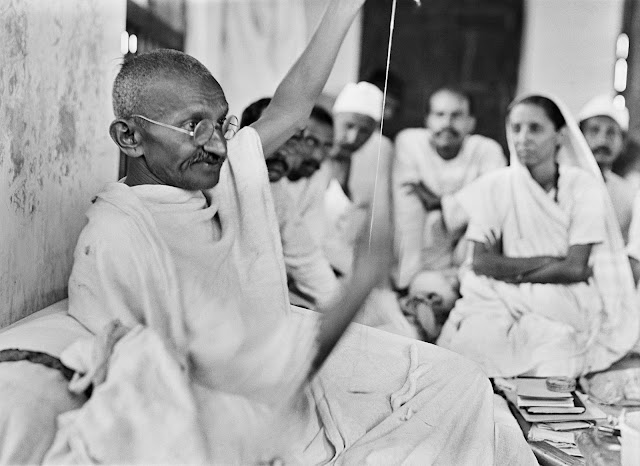
 Gandhi spinning at Dandi, April 2018. (Photo Courtesy: Fotostiftung Schweiz/Archiv fu.r Zeitgeschichte and Kiran Nadar Museum of Art)

Gandhi and Mao are not names often spoken together. So dissimilar do these giants of Asia seem, as men and leaders, that even thinking of them as contemporaries demands an imaginative leap. Luckily, Walter Bosshard met them both, and his pictures live to tell the tale.

Peter Pfrunder, co-curator of 'Envisioning Asia', the first-ever Indian showing of Bosshard's photojournalism, cheekily suggests in his brochure essay that "Bosshard himself could be seen as the link between Gandhi and Mao". Certainly, the 51 photographs and one silent film on show at Delhi's Kiran Nadar Museum of Art (KNMA) make clear that both men "welcomed this foreign photojournalist with open arms", at shaping moments of their careers. Bosshard met Gandhi in 1930 at Dandi, after the Salt March. In a piece of historical serendipity, he also met Mao after a march: in 1938, when he journeyed six days from the provisional capital of Hankou to Yan'an, the closely-guarded 'Red Capital' where Mao had withdrawn after the Long March.
Image
Yan'an City Gate, entrance to China's Red Capital, 1938. (Photo Courtesy: Fotostiftung Schweiz/Archiv fu.r Zeitgeschichte and Kiran Nadar Museum of Art)

Unlike his legendary subjects, Bosshard never marched the length and breadth of a country to mobilise his people. But if we set aside for a moment his position as a white man in an imperialist world, Bosshard's own travels are quite impressive. A Swiss primary school teacher from 1908 to 1912, he studied art history in Zurich and Florence and did military service in Italy during World War I. Bosshard's life after 1919 would be the envy of any experience-hunting millennial: he worked on a plantation in Sumatra, as a gem dealer in East Asia, and as a merchant in India and Thailand. In 1927-28, he was a photographer on a German expedition to Central Asia. By 1930, he had so established himself that the Munich Illustrated Press sent him to India on a 'study trip'. Between February and October, Bosshard travelled over 20,000 km, gathering enough material for his 1931 book, Indien Kampft! (India Fights!).
Image
Preparation at Congress Headquarters for 'Boycott Week', Mumbai 1930 (Photo Courtesy: Fotostiftung Schweiz/Archiv fu.r Zeitgeschichte & KiranNadar Museum of Art

The highlight of Bosshard's India trip, though, was reaching Dandi in time to shoot the coming of Gandhi. With 78 volunteers, Gandhi had walked for 24 days along the coast, crowds joining him to protest the British monopoly on salt. The power of these pictures is still undeniable: hundreds wading into the water to pick up salt; a child walking jauntily off with a cloth bundle of dripping, salty mud. The presence of women is striking. In one great image, Bosshard captures rural women marchers mid-stride, one end of their white saris wound over their heads, the other end hoisted up to reveal their calves. Here is the female Indian form cast for once as a labouring body in political action, unselfconscious and thus, unfetishisable. There are also women leaders: a stoic Mithuben Petit at an anti-alcohol protest in Navsari; Sarojini Naidu, the poet and Congress leader, who had urged Bosshard to visit Gandhi at Dandi, saying "he will have time".

It appears Gandhi did. In Bosshard's images, the 60-year-old fighting the world's most powerful empire appears utterly relaxed: grinning at a satirical The Times of India editorial, spinning, eating onion soup, cackling with uninhibited laughter, shaving. "At this stage of his career in 1930, he is the only world leader who treated the camera like a confidant of his inner circle, to be trusted, silently," co-curator Sinha said in an email interview. "There is a heartwarming naturalness and spontaneity in these pictures. By the time Margaret Bourke-White or Kanu Gandhi were to shoot Gandhi at the charkha or in public meetings, he was much older, much more studied before the camera." In the KNMA brochure essay, Sinha argues that these images also highlight Gandhi's "most pronounced areas of reflection and engagement": his astute grasp of the media, his obsession with diet and the body, spinning the khadi as integral to his idea of swarajya (self-rule). Whether it was the photographer or the Mahatma who determined its elements, Bosshard's pictures established a Gandhi iconography that still holds sway.


Image
1938: Mao in front of the Red Academy (Photo Courtesy: Fotostiftung Schweiz/Archiv fu.r Zeitgeschichte and Kiran Nadar Museum of Art)
The Yan'an images are a stark contrast to the Indian ones. Whether it's a young, serious Mao Zedong standing scrupulously straight before the camera, the cold mountainous expanses through which the Eighth Route Army marches, or simply the short hair, trousers and jackets both men and women wear, Bosshard's 1938 visuals reveal how China and India's paths diverged. "China broke from an older civilisation in a way India did not," says Shilpa Sharma, a PhD scholar in Delhi University's department of Chinese Studies. "Also, Gandhi was responding to a bureaucratic state, where there was law and order. China's many bloody wars meant ahimsa (non-violence) could not have emerged there. Mao standing strong physically in pictures was part of a show of strength needed to win," she adds.
Despite differences, "these were mass leaders who led their illiterate, poor societies out of feudal and colonial oppression," says Hemant Adlakha, who teaches Chinese Studies at the Jawaharlal Nehru University. "There is comparable poverty, a shared idealism, the instruction of followers," says Sinha. "[Both had] a vision for change for their countries."


Nearly 90 years later, both India and China have diverged greatly from these men's visions.

'Envisioning Asia: Gandhi and Mao in the photographs of Walter Bosshard' runs at the Kiran Nadar Museum of Art from 1 to 30 Oct 2018.

12 June 2015

Book Review: The Long Voyage of the Ibis

My (long) review of Amitav Ghosh's Flood of Fire. Published in the Wire.
Image

A recent article in Slate on the surprising survival of “the very long novel” suggested that it works as counterprogramming. In these times of avowed attention deficit, reading a VLN feels ever more like resistance. The novels that make up Amitav Ghosh’s Ibis Trilogy, at 550-600 pages each, don’t quite qualify as VLNs. But a trilogy goes one further, by returning us to the committed seriality that was once de rigueur for literary consumption.
At the Delhi launch of Flood of Fire, one gentleman in the audience managed to ask the question on many people’s minds. “If I want to read this book, do I have to first buy and read the other two books?” Ghosh smiled and assured him that he didn’t. I wasn’t quite convinced: as one of those devoted Ghosh readers who read Sea of Poppies with great excitement and River of Smoke with a patience born of waiting, I’m not the ideal candidate to test this claim. But having now read Flood of Fire, I think it actually does manage to be a stand-alone narrative. This is a remarkable feat, given that it is also within these 600-odd pages that all surviving loose threads from the previous two books must be tied up.
Several characters from the previous books reappear, many having transformed themselves, chameleon-like, as they travel through time and space. Neel, an English-educated Bengali who was once the Raja of Raskhali, is now a translator in Canton; the Bengali-speaking French orphan Puggly has emerged fully formed as the botanical collector Paulette; the ‘half-caste’ son of a Parsi seth and a Chinese woman has gone from being the convict Ah Fatt to the rather less threatening Freddy Lee. Among those who undergo truly radical change in this book are Mrs. Burnham, who acquires both a past and an interiority one might never have suspected, and Seth Bahram Modi’s wife, who emerges from a sequestered, literally purdahed existence at the top of the Bombay mansion she was born in, to take her place in a new world. (Ghosh helps her along, slyly dropping the “Shirinbai” of the previous books for the more contemporary “Shirin”.)
There are new characters, too, none more important than Kesri Singh, the elder brother of Deeti,  who was the centre of the first book, and whose invisible presence continues to haunt the third. I will refrain from naming the other new characters, but what is remarkable to me is the degree to which Ghosh is invested, in this book, in chance reunions. The coincidental coming together of long-lost characters–lovers, siblings, parents, children–after a long and complex plot involving their separation, is very much among this book’s narrative pleasures, both Shakespearian and filmi.
A petarrah of words
One of the other pleasures of the Ibis Trilogy has been the joyful proliferation of multiple Englishes, allowing the hybrid speech of a polyglot colonial world to roll off our tongues. Sea of Poppies made enjoyable use of this, having characters switch from one sort of language to another—I think particularly of ship’s mate Zachary, moving from the slangy American “What the hell you pesticatin me for at this time o’night?” to the sahebi civility of “If I may be so bold”. River of Smoke contained not just negotiations, but even flirtation and lovemaking in the pidgin-English of Canton’s boat-people. Flood of Fire is no different. Some characters make do with a couple of signature interjections, like the young banjee-boy Dicky’s use of “ya” and “bugger”, and Freddy Lee’s “lah” and “ne”. But the book bubbles over with the vocabulary of the Raj, in which English met Hindustani to create a unique lingo used not just between English masters and native servants, but between white colonialists themselves: the Burnhams, thus, are looking for a mystery (mistri) for the purpose of bunnowing (banaoing) their boat, and are willing to offer a good tuncaw (tankhwah).
Certain aspects of Raj life threw up a greater number of hybrid words, such as the British Indian army, whose workings form the most engaging chunk of Flood of Fire. Within the first two pages of the book, we’ve already seen the tamasha of a paltan going by, with ox-drawn bylees and a host of army camp-followers: dandiawallas, syces, berry-wallahs, bhisties, naach-girls, mess-consummers (a combination of the English ‘mess’ and the Hindustani ‘khansaama’) and bangy-burdars (“men who are each obliged to carry forty pound weight, in small wooden or tin boxes, called petarrahs,” says my Hobson-Jobson). On page 5, we encounter ‘badmashes’, ‘coolie’ and ‘subedar’ as part of a (fictitious) report in the Calcutta Gazette. By page 22, Ghosh brings this linguistic hybridity explicitly into his narrative, when Neel is asked for help by an Englishman in Canton who is puzzling over the many Indian words in an article on opium production in the Chinese Repository: maund, tola, seer, chittack (all weights and measures), arkati (a kind of agent), ryot (raiyat, peasant) and carcanna (karkhana, meaning workshop or factory).
In Ghosh’s compelling vision, words emerge as aides to love—and to war. We giggle at Mrs. Burnham’s Hindustani-inflected sexual banter, describing her lover’s “bahawder sepoy” as “a lathee always ready to be lagaoed” and informing him that “In India, chartering is what you do with… your jib”. We also wonder at how conflict can result from deliberate misconstruals, even at the level of states: as when Compton accuses inaccurate translators of “twisting the Chinese language in order to make trouble” with the British. Still, when Neel writes of being “besotted with words”, one imagines Ghosh’s own voice, reaching out to readers who might share that particular intoxication.
Not quite a peace pipe
Although the trilogy is named for the Ibis, the schooner on which its disparate cast of characters first come together, the ship plays less of a role in the second and third books. What in fact does unite the books is opium. Opening in the poppy fields of Ghazipur, by the Ganga, the first book offered an arresting account of opium production: how the sap from ripe poppy bulbs was harvested to be made into opium in the East India Company’s factory. The second book described its transportation, and how large a role opium played in financing British rule in India. In Flood of Fire, more layers emerge: we observe an opium auction in Calcutta, discover a trade in opium futures, and learn that Indian sepoys often took a form of opium known as maajun to calm their nerves before battle.
Opium is the intricate web that links these characters: Deeti and Kesri belong to a district where most fields have been opium-growing since they were children; there is Deeti’s addicted first husband, and her discovery of how the opium she harvests for a living can be put to more surreptitious uses. There are Bahram Mody and Benjamin Burnham, whose trade is built on opium exports to China, and Ah Fatt, who smokes it. Opium, finally, is the link that brings Britain, India and China together—or drives them apart—in the First Opium War.
That war forms the climax of Flood of Fire, and much of the book’s second half is taken up with the slow-burn build-up, as merchants, soldiers and ordinary folk prepare themselves for upheaval. One of the reasons why River of Smoke didn’t entirely work was that it felt like a middle, and often a slow, meandering one. Also, despite its vivid descriptions of Fanqui-town and its strange rules (no foreign women, for instance, were allowed in), or the flowering plants that went from Canton to the West, the primary characters – Paulette and her botanist mentor, Bahram and the Co-Hong merchants, and the overly chatty Robin Chinnery – just weren’t that interesting. Or they needed a grander Grand Finale.
Flood of Fire moves much more purposefully. As I said, it is full of uncanny reunions, and the outbreak of war provides a crescendo of sorts (although Ghosh is not the writer to pretend that everything happened in one fell swoop; he plays the war out, with at least some of the tortuous waiting that it actually involves). But the new characters, too, take you along with them. The strongest of these is Kesri Singh, through whose eyes Ghosh offers a fine-grained sense of the life of an East India Company sepoy.
Castes of mind
I cannot begin to describe here the book’s impeccable research (as a snarky friend once said, Amitav Ghosh writes novels for graduate students). But unlike in The Hungry Tide, or River of Smoke, the historical detail never weighs this book down. Let me offer one example: that of caste in the army.
In a superb monologue early on, an army recruiter explains to Kesri’s father that the English, contrary to his anxieties, care “more about the dharma of caste than any of our nawabs and rajas ever did”. Earlier armies, he points out, were routes for caste mobility, but the Angrez are very clear about hiring only Brahmins and Rajputs. “Under the sahib’s guidance every caste will once again become an iron cage,” the recruiter says, and one can only applaud how Ghosh distils years of academic scholarship by the likes of Bernard Cohn into the fictive brilliance of this passage. Later,  a group of Ghazipur-born sepoys decide to act as a caste-panchayat, which is also an informal court martial. And caste is the unspoken reason for sepoys balking at carrying loads.
Why is this important? To anyone who reads the Trilogy—or in fact anyone who’s read In An Antique Land, or The Shadow Lines—it will be clear that for Ghosh, the draw of historical fiction is to create a version of the past in which old shackles are broken, and unexpected connections made. This can lead him to underplay or ignore the ways in which his characters might realistically have behaved with each other. One feels this less in Flood of Fire. Here, when a memsahib recognizes a sepoy, or a Rajput lets an untouchable feed him when sick, the characters are strong enough to make us believe in the uniqueness of their actions. Perhaps because we have seen how stratified their world is, we strive – with Ghosh – for them to forge another.

6 June 2015

Book Review: Red riding hoods

A new book review, for India Today:

Bengal becomes a protectorate of China in Shovon Chowdhury's splendid satire, with its recognisable absurdities stretched to their logical limits


Image
Murder With Bengali Characteristics
By Shovon Chowdhury
Aleph, 204pp, Rs. 395
On the morning after I finished Shovon Chowdhury's second book, I had to run an errand in Delhi's Nehru Place. As I walked through, the stall-owners were setting up their displays of pen drives and mobile phone covers from giant cardboard cartons held together by layers of melting brown sticky tape. I saw a young salesman hawking his wares: "Software, Software! Windows, Windows!" In Asia's largest IT market, the E-Future beckons from every signboard -- if one can just avoid the piles of garbage, the attendant flies and the puddles slowly streaking their way across the vitrified pavements.
It felt like I had just seen the world through Shovon Chowdhury's eyes.
Chowdhury's first book, The Competent Authority (2013), was stunning dystopian fiction, expertly plonking us down in a future so ludicrous and yet so perfectly recognisable as a version of the present that one doesn't know whether to laugh or cry. (One laughs. Crying would be too draining.) It is circa 2033. Having bombed Bombay and large parts of India, the Chinese run Bengal as a protectorate, maintaining friendly relations with the Maoists who control much of what remains of the subcontinent. The police are now openly hireable. The prime minister, a rather recognisable woman "related to a long line of PMs", is the TV-friendly figurehead of the Indian government. But the army and any remaining government functions are actually controlled by an anonymous bureaucrat called the Competent Authority. "It was a temporary arrangement. Normal service would be resumed as soon as reconstruction was complete. But the contractors were very incompetent. He had expected far more progress in the last ten years."
In Chowdhury's post-nuclear New New Delhi, only the hardiest Bungalowpur ladies now risk radiation hazards to hunt for bargains in the once-central shopping hub of the Dead Circle. The privatisation of medical services has reached its acme: the rich now buy their private doctors straight from Slaves R Us, and any new body parts they need from the Bank of Bodies (BoB). In Delhi, the BoB's Medical Military Commandos harvest these from 'donors' in Shanti Nagar, a semi-independent neighbourhood that had "sprung up on the outskirts of the city around 10 years ago, soon after the Chinese nuked New Delhi, after the Dalai Lama was reincarnated on Indian soil and the prime minister had publicly fed the child a small piece of dhokla with peppermint chutney".
Having launched us into this universe with a fabulous plot involving two small boys and the BoB, Chowdhury breezed through 450 pages with ceaseless wry humour, a string of memorable characters, and some remarkably moving episodes of time travel in the opposite direction.
At 200-odd pages, Murder with Bengali Characteristics is much slimmer, and the plot slightly less multi-pronged. It is set in the Bengal Protectorate, where a minor character from the previous book -- mining magnate and Bungalowpur resident Sanjeev Verma -- has arrived for a crucial strategy meeting with his business partner, Agarwal. Like before, this is a world perfectly realised in its details. A hapless Chinese governor rules under the expertly befuddling advice of his executive assistant Ganguly, the Party has returned to power if not hegemony (the influential mass leader Pishi has been put in a mental institution as an opponent of the Party), and Lalbazar Police Station is home to a contingent of Chinese-born police  officers, including our primary protagonist Inspector An Li.
Like Delhi in the previous book, this is a Bengal with its recognisable absurdities stretched to their logical limits. The waiters in Park Street's OlyPub are now in their nineties ("The unions were strong here"); the Party boys miss the old days so much that they have weekly exhibition matches in physical and verbal violence, acting both as themselves and as the late Opposition; and membership of the Calcutta Club continues to play a disproportionate role in influencing public events.
Of course, not everything is logical: most delightfully mad is the vision of Indian IFCL cricketers being pushed to unprecedented levels of fitness by merciless Chinese coaches ("There were rumours of the death penalty for failure"); the ancient ex-Party boss Bijli Bose being "regenerated from some DNA found on a whiskey glass"; and an episode involving a talking cat.
I have to confess that while I enjoyed this book thoroughly, I found myself less than moved by its central narrative premise. This might be for the terribly prosaic reason that the hard-boiled detective at its heart is rather too hard-boiled, and dare I say it, impermeably Chinese.
Chowdhury's scathing humour, though, has lost none of its bite. Here is Agarwal, admiring Ganguly in a silent stream-of-consciousness: "Such judgment. They didn't manufacture officers like him any more. Most of them were very low quality people. All they wanted was flats, premium SUVs and American passports for their children. The Chinese ruling classes were very similar. It was true what his guru-ji said. They were all becoming one." This is a brilliant writer who can transport us to an effortlessly imagined future and make it a mirror for the present we can't bear to look in the face. I'm waiting for the next Delhi instalment.

Published in India Today. 

8 December 2014

Post Facto -- Unforeseen effects: Why I love film festivals

My Sunday Guardian column (written after IFFI 2014):
Image
Queuers, conferrers and posers: Outside the INOX complex, at the 2014 IFFI in Goa.
It's hard to describe the lure of a film festival to people who've never done one. And yes, it is something you do. Like a drug. I'd never quite thought about it before I started to write this column, but clearly my subconscious has known all along — I often call myself a film festival junkie.

A film festival isn't somewhere you show up for an evening because you're bored, or something to which you make an obligatory social visit, politely applauding the efforts of the organisers. No, you plan for it in advance, having taken leave from work and from all social responsibility. Sure, you meet people, but the bright light of day soon begins to feel like something to scurry away from. It's in the velvety darkness, as the screen flickers to life, that you do, too. And as you go from one darkened theatre to another, cinema seeps into your veins.

In close to two decades of film-festivalling, I've often been asked how I can possibly absorb five films a day, or even four. Don't they start to bleed into each other? Don't I zone out by the third film, or fall asleep in the fourth? Doesn't every [worthwhile] film I watch make me want to pause for the day and analyse it, instead of rushing to grab a quick lunch and hurtling into the next film? In short, these people want to know, isn't the film festival the very antithesis of the ideal film-watching experience?

The answer to most of these questions is yes, of course, sometimes. Sometimes I zone out, sometimes I decide a particular film is the one to take a nap in, sometimes all I remember from a hectic festival day is a single climactic scene. But the films you remember are ones that have managed to stand out in a sea of images. And anyway, does the leisurely, sit-down, one-film-at-a-time mode really give a film its due? Of course films need free time — but doesn't the multiplex visit, with its absurdly powerful popcorn-and-soda ritual, muffle every film we watch with the unvoiced expectation of sameness? The film festival might seem frenzied, but it rescues film from the domesticated tedium of packaged leisure — by turning it into something a little like work.

And by juxtaposing all kinds of narratives, from all kinds of places, it reinstates some of the unruliness and unpredictability of cinema. Where else but at an international film festival could I go from watching a Russian postman on his rounds of a sleepy lake-edge settlement (
The Postman's White Nights), to experiencing the joys and sorrows of a group of sightless Chinese masseurs (Blind Massage), and then on to Iran in the 1990s, waiting endlessly with a mother whose son never came back from the Iran-Iraq War (Track 143)?

Of course, I understand that there is such a thing as a festival film. Capitalism being the sophisticated thing it is, it has built the so-called "niche" into the market. If you've ever looked up films on the internet to decide what you're watching at a festival, you've read those 
Variety and Hollywood Reporter reviews with their pithy summing up of the film's chances. Here's one such evaluation of a Greek film I fell in love with at this year's IFFI: "It should appeal to festivals and distributors with a mainstream or more female-oriented sensibility as well as broadcasters of classy European fare." 

This film, called
 Mikra Anglia (Little England), is an atmospheric period piece set in (and shot on) the craggy island of Andros. The plot centres on two sisters who fall in love — unwittingly — with the same man. But this is no generic love triangle: after a point, we barely see the man. And then he dies (somewhere off-screen), and it is his death that tears the sisters' lives asunder. If this is a women's picture, it is so in the most gloriously literal way: Andros in the 1930s and '40s is almost entirely female, because most men are sailors, out at sea, sometimes at war, while the women hold the fort at home — often for most of their lives.


A festival can paint a portrait of a country you've never been to. The other Greek film I saw this year, for instance, would seem to have nothing at all in common with 
Mikra Anglia. Set in present-day Athens, Xenia is about two brothers who dream of winning a national musical talent search. The film uses their marginal status — poor, orphaned, half-Albanian, one of them queer — to highlight the fascist, racist intolerance of contemporary Greece: in one early scene, we hear street thugs harassing some unseen people with the line: "This is not your Bollywood".

But placing 
Xenia next to Mikra Angliaone sees a country that remains recognizable in many ways — a place where family still counts for a great deal, where high drama is normal. Watching random films back-to-back can make you see patterns — a Chinese murder mystery and a Turkish romantic thriller emerge as unlikely partners in neo-noir; you begin to notice how often filmmakers in cold countries use snow and ice to create a sense of emotional desolation.

In a world of torrents downloadable at will, the film festival is no longer about enabling access. Choices, in fact, are limited by the programming. But what you end up watching at a festival can create unintended, powerful effects. It's as close as one can get to fate.
Published in the Sunday Guardian, 7th Dec 2014.

25 April 2014

Post Facto - The Long Dark Tea-time of the Indian Soul

Image
Vintage tea ad suggests tea instead of alcohol.
From my Sunday Guardian column:
Do you drink tea? If you're Indian and your answer is no, you're probably (a) from one of those lucky parts of the country that grows coffee; (b) ridiculously young, with enough spare cash for the coffee chains; (c) a champion of milk who thinks tea is an artificial stimulant (and makes you dark); or (d) a freak healthy type who favours aloe vera juice or something equally odd.
Because despite Montek Singh Ahluwalia failing to declare tea our national drink in 2012 (apparently the coffee manufacturers objected), India is the world's largest tea-drinking nation. It was also the largest tea-producing one, until China recently outstripped us. Though that is perhaps as it should be: it was to break the Chinese monopoly on tea production that the British, already becoming a country of tea-drinkers, first introduced the plant on a commercial scale in Assam (and later North Bengal and the Western Ghats). Remarkably for something first grown here in the 1820s, and initially intended only for export, tea is today our most consumed beverage. An ORG study in 2012 said 83% Indian households drink tea. According to the Cambridge World History of Food, 70% of India's immense crop is now consumed locally, with Indians averaging half a cup of tea daily on per capita basis.
The half-cup of tea might just be an Indian speciality, anointed in some parts of the country with its own memorable name: cutting chai. Elsewhere in India, that three-sips-worth of hot, sweet, concentrated brown liquid might not have a name, but it's the usual amount — unlike the British working class, which drinks its tea in a large mug, most of India favours the small glass tumbler.
Image
"Tea is Swadeshi." 
Poster made for the Indian Tea Market 
Expansion Board, 1947.

The brown sahibs who first learnt to drink tea from colonial Englishmen adopted the upper class ceremony. The cost of full-leaf tea and its accoutrements kept tea out of reach for much of the populace — all Lipton print advertisements as late as the 1940s show a proper bone china tea service. The democratisation of tea in India only really dates to the mid-20th century, when aggressive marketing achieved the symbolic transition from "imperial brew" to "swadeshi", and the Crushed, Torn and Curled (CTC) technology made it possible to make more cups of strong tea from less leaf.
The late Rituparno Ghosh, adapting Tagore's novel Chokher Bali to the screen, had much fun with the depiction of tea-drinking as a memsahebi innovation. Aishwarya Rai's young widow Binodini intrigues and then woos the household's more conservative older women — with tea. The cleverness of Ghosh's touch lay in evoking the sensuous pleasure of an elaborate afternoon tea ritual, associating it with the guilty secret it was for a 19th century Hindu widow to enjoy anything at all.
Today depriving someone of tea might be popularly understood as something of a human rights violation. In September 2013, when a sub-inspector in Kolhapur arrested a man called Vijay Patil for "drinking tea in a suspicious manner", the Bombay High Court, was not impressed. Mr Justice Gautam Patel's ruling, as reported in the media, was a marvellously eloquent paean to tea: "We were unaware that the law required anyone to give an explanation for having tea, whether in the morning, noon or night. One might take tea in a variety of ways, not all of them always elegant or delicate, some of them perhaps even noisy. But we know of no way to drink tea 'suspiciously'."
Jyoti Dogra's brilliant solo theatre performance Notes on Chai, which I recently watched in Delhi, is ostensibly about that "variety of ways" in which we might take our tea. Dogra has suggested in interviews that tea was a way of approaching the everyday; that differences in tea-drinking habits are indicative of class, cultural origins, social status. And it is true that Dogra's character sketches — the old Punjabi lady so endearingly proud of her Lahore college degree who will endure no water in her tea; the government clerk for whom tea-break means stopping mid-sentence, like an automaton; the woman who insists on pressing Malaysian green tea and favours upon a reluctant acquaintance — are about those things.
But Dogra does herself injustice. The people she brings to life do mention tea. Sometimes they return to tea over and over. But their talk is not really of tea. It is of time, and of the self. For the old person with not much to do, tea is a filler of time. For the body looping through unalterable cycles of work, it is "me-time" that makes the daily grind bearable. And yet it is a ritual pause, as sharply demarcated and routinised as labour. For the woman whose life is lived at the "suggestions" of her father and husband, to drink her morning cup of tea in the balcony — and to refuse to wake her husband until she's finished — is her single act of everyday resistance. "Mujhe subah ki chai milti hai balkoney mein, toh phir main sab kucch lightly leti hoon." Tea is the assurance that things are running as they always do. But just below the surface of Dogra's performance is a profound, disturbing unease: will things never run any other way? Does tea simmer so we stay calm?
Published in the Sunday Guardian, 20th April, 2014.

24 June 2013

Post Facto - Gastro-gallivanting: Culinary capers in Calcutta

My Sunday Guardian column this fortnight:

Image
Image
Dacres lane, Calcutta
n Calcutta in June, you invariably sleep to the sound of rain. Having thumped and clattered its way through the night, it arrives at a civilised pitter-patter by morning. But by then it has already succeeded in waking you up.
The fitfulness of such a morning can be compensated for — as can most things in Calcutta — by food. In this case, by an early expedition to Bentinck Street for the traditional Chinese breakfast, which members of the city's longstanding Chinese community produce and sell by a street corner, at the mouth of a lane called Chhata Gulley. At 7am, the wide stretch of the street around Poddar Court is occupied by a series of fish and vegetable sellers. Displayed on plastic sheets on the ground are the many varieties of summer gourds that grow in Bengal — potol, dhondhol, lau, jhinge, chichinge, uchhe, korola — and the even greater varieties of leafy vegetables — kolmi shag, notay shag, lal shag, palon shag. Amid this proliferation of raw stuffs, we nearly miss the breakfast stalls. Their number has diminished to about five, of which only one makes what to me seemed the highlight: large vats of soup, one with meatballs that seem substantially made of pork, and one with fishballs. A thirty-something woman, with features that are an appealing mixture of Bengali and Chinese, sits on a low seat on the pavement, her skirt hiked up to her knees so she can sit comfortably, spooning out the soup. Two generous-sized meat or fish balls are spooned into each bowl of soup. A sprinkling of chopped spring onions and your 30 rupee breakfast is ready. The fishballs are firm and springy (and thankfully not too fishy), while the meatballs are a little fattier but very tasty. The soup itself is mild, yet flavourful and full-bodied in the way that only good stock can make it: not quite as thin as broth, but neither subjected to the ignominy of thickening with cornflour. Refills of the soupy liquid are free, but we decide to get another meatball each. There are also fish and prawn shuimai, which are not too bad in terms of the thinness of their wrappers, but aren't prettily finished: they make for rather dumpy dumplings.
They ought to have been supplemented by what I have hitherto eaten in Chinese restaurants in both Delhi and New York as 'bao', but what everyone in Calcutta seems to know as 'pao' — large, soft steamed buns stuffed with a sweet and spicy pork or chicken filling. But there were none that morning. There was one (Indian) woman with a small board that advertised them among her wares, but she didn't have any. Instead she offered us chicken momos, which we didn't venture to try — not even to figure out whether they were actually shuimai being sold as momos, which would be an odd reversal of a practice frequent in mid-range Delhi restaurants.
Image
eanwhile in Lake Gardens, the middle class South Calcutta neighbourhood in which my mother's family has lived for years, the superb hot shingaras made by a one-man-show called Swapan da now vie in the local popularity charts with a highly-regarded new momo-stall. "There are a whole lot of northeastern students who have moved into our neighbourhood," said my aunt by way of explanation.
{
The city has always been a place of mixture and substitution, and food is its most active laboratory.
Another afternoon we found ourselves on Dacres Lane, in the office district of Esplanade, where lunchtime sees a flood of low- and mid-level office workers arrive for a piping hot meal. On offer is the now quintessential list of sinful Calcutta snacks whose origins lie in the fusion of British food with the Bengali love of deep frying — fish chop, fish fry, mutton and chicken cutlet. But what Dacres Lane is really famous for is a hot plateful of stew — chicken or mutton in mild gravy, with a couple of carrots and a big piece of potato, served with two hunks of bread to sop it all up. There is something quite remarkable about the fact that something as recognisably European in origin is a street food in Calcutta, available for fifty rupees. "Our food has pepper, not red chilli powder," said the friendly Bubai, frontman at the popular Chitto'r Dokaan. And yet their chops and cutlets are always served with a very Indian accompaniment — slices of raw onion and a fiery chutney of some sort, or else the super-pungent Bengali mustard sauce known as kashundi.
The city has always been a place of mixture and substitution, and food is its most active laboratory. As we stood around our small table on Bentinck Street, eating hot spoonfuls of soup, our companions were a group of Manipuri students and two little local Chinese children. The little boy downed his soup somewhat angrily and then wandered around with his head butting out, like a bull looking for something to knock down. The little girl, his elder sister, had rejected the boring Chinese items on offer in favour of a large plate of kochuri and aloor-dom.