Showing posts with label sari. Show all posts

24 November 2020

Shelf Life: Out of Vaidehi's Closet

My Shelf Life column for October 2020:

The link between clothes, sexual attractiveness and power is incestuous and can be unnerving. Kannada writer Vaidehi’s stories literally disrobe it.

Image

Vaidehi's stories shocked me when I first read them. I don't mean in the manner that the 1945-born writer has apparently “sometimes shocked Kannada intellectuals”, by publicly declaring such things as 'The kitchen is my guru, that's where I have learnt many lessons'. The incongruity there, as a critic cited by editor-translator Tejaswini Niranjana in her introduction to Vaidehi's Gulabi Talkies and Other Stories (2006) points out, lay in one of modern Kannada's most successful writers speaking like a 'full-time grihini or housewife'. And yet, what Vaidehi was doing by adopting such a public stance was precisely why her fiction jumped out at me: she was forcing the (male-dominated, genteel, largely upper caste) world of Kannada letters to engage with the world of women as she knew it. She refused to be co-opted into literariness as they knew it. 

Since the late 19th century, women have been writing fiction about women's lives, not just in Kannada, but in Bengali, Marathi, Tamil, Urdu, Hindi and more. So Vaidehi, also Janaki Srinavasa Murthy, born 1945, married to KL Srinivasa Murthy at 23, and mother of two daughters, wasn't the first. But her words lift the ceaseless labour of women's lives out of the domestic space and onto the page with a ringing clarity. Somehow, the closer she sticks to the materiality of these circumscribed, cyclical lives – food and rituals, weddings and babies, illness and mortality – the more starkly we see their political, even philosophical ramifications. As she puts it: “What is important to us [women] is not whether the world is truth or lie. But work, work and more work.”

Image
A still from the film Gulabi Talkies (2008), adapted from Vaidehi's short story by the director Girish Kasaravalli.

Among the material objects that recur in Vaidehi's stories are clothes. At one end of the spectrum is what is ritually and socially prescribed for women: the red saris encumbent on shaven-headed Brahmin widows; the gold jewels to measure a bride’s status. At the other are clothes as markers of individuality, the body as a canvas on which fashion can paint new identities.

But what was fashion in this India of sleepy villages and one-street towns, where the age-old injunctions of caste and age and community controlled so much of what people wore? In the title story Gulabi Talkies the opening of a local cinema triggers new dreams: “Day by day the bangle shop began to stock various kinds of face powder and other cosmetics...the seamstress struggled to tune her skills to the new fashions and her creations were passed off as fashionable, causing a commotion in the world of clothing which crossed over into the speech and gait of women...”.

The fashions of Vaidehi's tales may seem basic to us – but oh, how women wanted them. And how willing they were to suffer the consequences, because fashion felt like freedom. In ‘Remembering Ammachi’, for instance, the child narrator helps the grown-up Ammachi pleat her sari pallu “so that both its borders could be seen”. They set out for a neighbour's puja, but are barred by Venkappaya, who has arrogated to himself a status somewhere between adoptive brother and future husband. “How coquettishly you're going to town,” he rages. “That pallu has been pleated in such a way as to show both the breasts.”

Image
Kannada writer Janaki Srinavasa Murthy, also known as Vaidehi. (Photo: Wikimedia Commons)


The poorer the women are, the more meagre their aspirations – and the more excruciating their non-fulfilment. In Tale of a Theft, the hungry Bachchamma thinks of the prohibitive price of glass bangles while sitting next to women covered in gold. In Vanimai, the titular central character is a woman with mottled, flat feet whose “biggest dream was to own a pair of slippers”. This is nothing short of radical in a milieu where a man called Narasimha can tell Vanimai’s elders never to buy her slippers, declaring with perfect assurance: “Those who use footwear are either the prostitutes of Bombay or the mistresses of the town. Not decent people...” 

The spectre of the whore, in fact, is ever-present in these tales. Whether it's Narasimha taunting Vanimai or Venkapayya deliberately ruining Ammachi's secretly-tailored back-button sari blouse, being fashionable makes women attractive – too attractive. 

The late Nirad C. Chaudhuri, one of our most politically incorrect writers, once speculated that Indian women have historically had so little free contact with men that they dress only to compete with each other, that is they are acquisitive and overdressed. “It follows from this tradition,” wrote Chaudhuri in 1976, that “a woman in “very smart or piquant dress”... “must be fair prey”. To prove his point he recounted two anecdotes, in both of which “lower-class” men associate being well-dressed with sluttiness. 

But of course it isn't only poorer men, or even only men, who tar women for wearing certain clothes. In Vaidehi's Chandale, watching Beena “climbing up the compound in her short skirt” makes the older Rami “want to scream”. In a stunning image, the nervous housewife suddenly imagines the carefree teenager “winking at [her son Satisha] in the style of a Mumbai prostitute”. So obvious is the link between clothes and sexual attractiveness, and between sexual attractiveness and power, that it is all we can do to suppress it in those we believe don’t deserve power. Mostly, that’s other people. Sometimes, it includes ourselves.

Banner: A book cover of Gulabi Talkies and Other Stories (2006)' a still from the film Gulabi Talkies. (2008)

Published in The Voice of Fashion, 23 Oct 2020.

13 December 2019

The Catholic Dress: Bombay to Goa and Back

My Shelf Life column for TVOF:
 

The dress-wearing Catholic girl was an object of Indian male fantasy, but as Jane Borges’ Bombay Balchão makes clear, the reality was more complex than the stereotype

Image

At the beginning of her just-published debut novel Bombay Balchão, the Mumbai-based journalist Jane Borges sets us down in the Catholic neighbourhood of Cavel on Christmas Eve 1945. Before we hear the midnight mass, we hear of Karen Coutinho, whose tailor Francis (“from John D'Souza and Sons”) has made her “a long yellow silk gown, which swept the road as she walked to church”, and of her husband Alfred, who is glad that his wife’s gold lace mantilla covers her “heavily powdered face and the crimson lips she had painted with cheap lipstick”. And we hear, almost simultaneously, of the Hindus on Dr D' Lima Street who “sneakily peered from the gaps between the iron rods of their windows, gawking at the dressy Christian women”. 

Borges doesn't dwell on her wartime setting, but a 2017 piece on 'aunty chic' by Cheryl-Ann Coutto published on Scroll points out that knee-length skirts were a wartime trend for economic reasons. “There was rationing, food coupons, there was less food, less cloth and so the hemlines too were shortish,” an 80-year-old Elettra Gomes tells Coutto. “Then after the war ended, Christian Dior came out with calf-length swirling full skirts and tiny cinched waists [this lavish, ultra-feminine aesthetic... became known as the New Look]”.

But even if the length of Karen Coutinho's gown could have been seen as a legitimate post-war luxury, Bombay Balchão makes it clear that she was up against other forms of moral censure: such as the local Hindu patriarch accusing Christians of having “sold their souls to the gori chamdi” (white skin) by dressing like Europeans--at a time when the Gandhian campaign for Khadi was at its acme.

Image
A still from the film Baaton Baaton Mein.

The real source of censure, however, lay far deeper than nationalism or economy. Bombay's Catholic women – whether the East Indians, as the original Catholic inhabitants of Bombay and Salcette called themselves, or the Goans who came to the city later–were invariably marked by the wearing of dresses. 
 
By exposing the legs to view, and simply by fitting around the female upper body, the dress seems to have sparked the sexual imaginations of generations of Indian men whose own wives and daughters were never without the protective drape of the pallu or the dupatta. Borges writes, “In the darkness, numbed by furious lovemaking, (the Hindu man) would latch on to his wife's waist, and in between suckling her breasts ask if she would wear one of those dresses, just for him. She would agree coyly, but as an afterthought dredge up the same feeling her husband had exposed in front of the family when he saw the Christian women strut on the roads.” That particular Hindu male fantasy made its way firmly into Hindi cinema via such depictions of Catholic girlhood as Raj Kapoor's Bobby and Basu Chatterjee's Baaton Baaton Mein, and lasted well into the 1980s, when Salman Khan made that 'secret' dress-wearing request of his long-haired, 'traditionally Indian' heroine Bhagyashree in the epoch-defining Maine Pyar Kiya (1989).

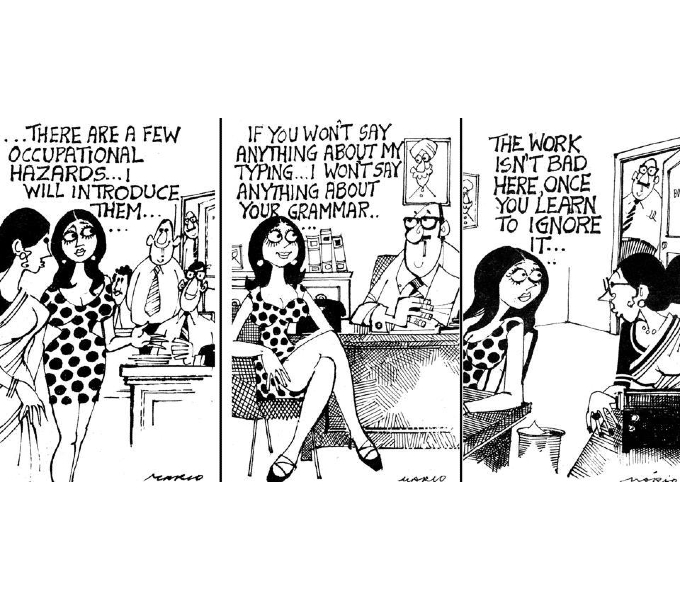
“For repressed Maharashtrians and Indians like me, Jesus Christ, this was where heaven began!” declared the late Kiran Nagarkar in Paromita Vohra's charming short film Where’s Sandra?, which addresses the precise question of what the office-going Bandra girl represented to the rest of the city. One of the real 'Sandras from Bandra' that Vohra tracks down makes the crucial point that the Christian girl was the object of Indian male fantasy also because women from most other urban Indian communities weren't allowed to go out to work. The Christian secretary in the form-fitting dress became embedded in the collective Indian psyche, with even such pillars of the Goan community as cartoonist Mario Miranda essentially reinforcing the stereotype with his polka-dotted Miss Fonseca.
Image
The dress-wearing Goan Christian secretary was immortalised by cartoonist Mario Miranda in the busty figure of Miss Fonseca.

Of course, the stereotype of the Christian girl as open in her morals didn't quite fit the facts. Bombay Balchao is full of Catholic boys bemoaning their fate while the Catholic girls they're dating scratch them for trying to sneak a kiss. In Vohra's film, too, the late poet and professor Eunice D'Souza argues with efficiency that the Christian family and school-going milieu could be as orthodox as the non-Christian ones, policing female sexuality with just as much middle class paranoia. Dress-wearing was no marker of (im)morality. 

Not all Christians wore dresses, either. For instance, the Portuguese insistence “that converts adapt to the European style of dressing” led to such innovations as the pano bhaju, which Borges calls a “middle ground” created by orthodox Brahmin women. Now 'traditional' when dancing to sad Konkani love songs called mando, this particular Goan Christian outfit consists of a sarong-like lower garment (pano), worn with a loose gold-embroidered blouse (bhaju) and a stole called the tuvalo. The hybridity is India at its best: the pano draws on the South Indian lungi/mundu/veshti, the bhaju is Portuguese, while the gold thread work owes something to the Mughals. 

One of the pleasures of Borges' book is its mini-ethnography of Bombay's different Christian communities. The Goans and East Indians express disdain for the Mangaloreans as calculating, not so comfortable with English, not good dancers or good at Western music. The Mangaloreans, meanwhile, saw the Goan absorption of Westernised mores as a cop-out, too easy a surrender to their colonial masters. Mangalorean rebelliousness, not surprisingly, was expressed most vividly in their women's clothes: the community may have converted to Christianity, but the women still wore their heavily embroidered sarees and jasmine venis (floral garlands) in their buns – rather than floral dresses and bouffants.

Beyond Bombay, too, the dress-clad Christian working girl was the focus of Hindu male anxiety: think of the Anglo-Indian Edith, who becomes the heroine Arati's office colleague and then friend in Satyajit Ray's Mahanagar. For the two Calcutta women, lipstick marks a bond between them. For the Hindu husband waiting edgily at home, the same lipstick becomes emblematic of the 'corruption' of his wife. Clearly, as non-Christian women ventured tentatively into the workforce, the dress-wearing Christian girl was now a terrible threat. For on what women wear, as always, the whole burden of civilisation comes to rest. 

Thankfully, as Vohra suggests, Sandra the stereotypical good-time girl doesn't have a reason to exist anymore. Because we all a have a bit of Sandra in us now. Something to think about each time you wear a dress – and can even let the camera see you in it, unlike Bhagyashree.


25 February 2017

Manly Women, Womanly Men

My Mirror column, on Akshayambara and Harikatha Prasanga:

A new play and a new film step into the world of Yakshagana performers to sharpen our sense of what it means to be a man — or a woman.

Image
A still from Sharanya Ramprakash's play Akshayambara
The seated figure, stage right, is in the middle of buttoning a blouse over a patently false bosom. It is a tightly fitted sari blouse, closing laboriously over the hardness of the fake breasts, and yet transforming them before our eyes into an imagined curvaceousness. Still, when the man – for of course it is a man who turns this intimate act into something so frontal, so prosaic – stands up, what draws the eye is the line of hair that runs down his muscled torso, between where the blouse ends and the petticoat begins.

But then he covers himself with more of the paraphernalia of femininity: the twinkling nose ornament, the brilliant green sari swirling, the long thick plait that snakes down to the waist, the girdle that circles it. And lo and behold, we have before us Draupadi — on the morning of her swayamvara, picking flowers from her father's garden to weave into a veni for her hair. We are enchanted, thinking about how the humming Kshatriya princess is just another girl. Then our performer ambles back into his corner, hoists up his gorgeous sari and pisses – standing, like a man. Just as swiftly as the spell was cast, it is broken. The audience breaks into laughter.

The scenes above are part of Sharanya Ramprakash's remarkable Kannada play Akshayambara, staged in Delhi during the National School of Drama's annual theatre festival last week. Ramprakash is a Bengaluru-based theatre practitioner who started exploring the traditional folk form of Yakshagana with the Udupi-based Guru Bannanje Sanjeeva Suvarna after receiving an Inlaks fellowship in 2013. Akshayambara, which emerged out of this interaction and won Ramprasad the Best Original Script META award last year, casts long-time Yakshagana performer Prasad Cherkady (who won at META for Best Male Performance) in the role of a male actor who plays Draupadi. The play deals with his response to the arrival of a female actor (Ramprakash herself) who has been cast in the role of Kaurava (Duryodhana).

Performing in public has been socially stigmatised for women in South Asia. So most traditional dramatic forms, from Ramleela in the north to Yakshagana in the south, have a long history of men who play popular female roles. In the Kannada cultural sphere, the female impersonator of Yakshagana has clearly emerged as a lens through which gender and performance -- and gender as performance – can be thought about.

Akshayambara
pushes Yakshagana's seeming embrace of cross-dressing to its political limits by bringing in a woman. When it is a woman who takes on a male role, the play asks, why does that seem to shake the traditional structure? Ananya Kasaravalli's debut feature film Harikatha Prasanga (Chronicles of Hari), itself based on a short story by Gopalakrishna Pai, approaches the same subject from a different angle.


Akshayambara needed to bring in a (biologically) female actor to push the man-acting-as-a-woman to actually encounter his vulnerability. Harikatha, in contrast, gives us a male protagonist who is vulnerable because his performative engagement with femininity has transcended the stage.


Image
A still from Ananya Kasaravalli's film Harikatha Prasanga
What makes someone or something feminine is a recurring question here, too. The one time Hari (an affecting Shrunga Vasudevan) tries out a more vigorous style on stage, his jumping attracts his guru's ire as signifying the 'masculine'. “What kind of dance is that? When you act like a woman, you should make your gestures like a woman.”

Hari complies on stage. But soon he finds it harder and harder to persuade others – and soon, himself – of his masculinity off-stage. A proposed wedding falls through because a seasonal Yakshagana performer does not fulfil the traditional masculine role of breadwinner. He goes to see a sex worker, only to be distressed by her charmed reiteration of what she sees as his feminine softness. Gradually, he finds himself adopting female garb daily: a long skirt, and later a sari. Again, like with Akshayambara, we encounter the question of what makes up femininity: soft hands, long hair, feminine clothes?

While challenging us to think about what femininity and masculinity mean, Kasaravalli's film occasionally compresses both into stereotypes — and deliberately lets the moments ring out, waiting to watch if they will resonate. “[Women] need women to share agony with, and men for pleasure,” says a woman who has come to watch Hari act. Akshayambara moves more in the direction of an essential selfhood: “You can never be disrobed,” says the woman to the man.

What makes a man a man? Or a woman a woman? Is it about who struts and who mocks? Who performs, who applauds? Who deflates, who builds up? Who steps back? Must vulnerability be identified with the feminine? Both play and film, happily, do not provide pat answers. It is enough that they ask the question at all.


Published in Mumbai Mirror, 19 February 2017.

26 April 2015

Living by the loom: Shyam Benegal's Susman

My column in Mumbai Mirror today: 

Shyam Benegal's Susman offers a portrait of the handloom weaver's predicament, sadly relevant even today.

Image
Om Puri and Shabana Azmi, in Susman (1987)

At one point in Shyam Benegal's Susman (1987), two ikat weavers are walking back from a meeting with an agent and a city-based buyer. “Why didn't you ask the buyer for an advance?” says the younger brother Laxmayya (Annu Kapoor). “Apne munh se paisa maang ke kaahe apne ko chhota banayein? (Should I have demeaned myself by asking for money with my own mouth?)” responds the elder brother Ramulu (Om Puri). “Would have been better not to take the order.”

Susman is one of Shyam Benegal's less-watched films. It is part of his clutch of issue-defined films commissioned by government bodies or cooperatives. It has its limitations: Benegal's regular stable of 'alternative' actors can feel a little too starry. Watching Shabana Azmi and Om Puri and Pankaj Kapur play impoverished Pochampally weavers speaking in Dakkhani, can feel like a stretch – Azmi, in particular, looks and acts far too urbane. But Benegal has always had the ability to craft fictions that offer a nuanced, thoughtful picture of the situation he has chosen to depict, and Susman is a good example.

It is a film that deserves to be watched this week, as the central government contemplates a policy shift that might endanger the very existence of the handloom weaving sector. Scroll.in reported on Friday that “the Ministry of Textiles is looking into a memorandum submitted by power loom owners to ease provisions in the Handloom Reservation Act of 1985 that allow only handloom weavers to make certain textile products.” Over the years, the 22 handloom-only items originally listed by the Act has already been reduced to 11. Also, it is well-known that power loom weavers manufacture these reserved products, passing them off as handloom. Further de-reservation is likely to price handloom goods out of the market, and threaten the survival of what is the world's most stunningly diverse, skilled range of hand-crafted textiles.

Benegal seeks to draw in the middle class viewer with a display of handloom weaves, each sari covering the screen as we hear the unmistakeable voice of Neena Gupta applaud the particular finesse of each to a less-knowledgeable but terribly opinionated man. When we finally cut away from the saris to Gupta, she turns out to be a designer called Mandira: the handloom sari-wearing, big-bindi-ed figure we all know, directing some sort of sari-based fashion show.

Mandira is hard to please, and when she clicks her tongue at some of the work that master weaver Narasimha (Kulbhushan Kharbanda) brings her from Pochampally, Narasimha suggests that she explain her demands to the weavers herself. So it is that our English-speaking designer, accompanied by her even more English-speaking boyfriend, Jayant Kripalani, encounters Ramulu and his household.

It is after this slightly ham-handed beginning that the film comes into its own. Benegal cleverly uses the household's particular situation as illustrative of a larger socio-economic reality. In Ramulu's perfectionism as a craftsman, in his inability to bargain with agents, in his silent resentment of his situation but his fatalistic approach to dealing with it, we see the tragic predicament of the handloom weaver who doesn't have a head for the market. And while Ramulu is profoundly attached to the work he does, he displays what little realism he has in refusing to let his little son sit at the loom.

Because the financial pressures upon him are such that Ramulu has begun to see his attachment to his work as a form of bondage. “Ukhaad ke phenk doonga isko ek din. Yeh kargha nahi jail hai jail. Ismein bandh karke daal diya hum ko,” shouts Om Puri in one moving scene. And as we watch him, framed behind the long horizontal bar of his loom, it feels as if he is indeed boxed into a corner of the world. 

Image
Roti deti so cheez ko aisa nahi bolte (Don't say such things about the thing that feeds you),” says his wife Gouramma (Azmi) worriedly. But the film makes clear that weaving is failing to fill stomachs. The cooperative societies set up to save weavers from the clutches of agents and touts have quickly been corrupted from within, beholden to the powerful. Big orders don't come to the co-op because they require deposition of advance monies, funds the co-op can't risk. The co-op secretary loans the Society's supply of silk thread to Narasimha on the sly, and is bribed to sell off discounted saris in bulk to Laxmayya, who intends to resell them in Hyderabad and set up as an agent.

Through Ramulu's prospective son-in-law Nageshwar, we also see the new workspaces created by the powerloom. The village of individual homes in which weavers work at their own pace, often in conjunction with other family members, is replaced by a cramped all-male factory space, and the regular thak-thak of the handloom by the raging sound of the powerloom. In the factory, warns Nageshwar, a man cannot leave his machine. Benegal doesn't say it, but it's clear why: because the machine isn't his any more. It owns him, rather than the other way around.

But while Benegal's leanings are apparent, he is clear-eyed about how unsustainable handloom has become for even its most skilled practitioners. The tragic irony of a weaver having to steal thread in order to weave a silk sari for a daughter's wedding is a powerful one, one which recurs in Priyadarshan's Tamil film Kanchivaram (2008). Kripalani's computer-type boyfriend also represents the view against handloom, demanding of Mandira how long the artificial “sahara” of government loans and the “sentimentality” of people like her will keep it alive.

The film manages to end on an upbeat note. But the government's answers to these questions, asked nearly twenty years ago, remain as tragically short-sighted as ever. Handloom can thrive and grow, if we only do right by it. As Ashoke Chatterjee, ex-head of the Crafts Council of India, asked recently: “Why are powerloom lobbyists so eager for their fabric to appear handmade if demand is falling?”