Showing posts with label coffee. Show all posts

19 March 2018

Coffee Break: thoughts on Stuart Freedman's pictures of Indian Coffee Houses

The Palaces of Memory: Tales from the Indian Coffee House is Stuart Freedman's visual journey of urban India.


The Indian Coffee House, Kollam (now closed), 2013

When Stuart Freedman first arrived in Delhi in the mid-90s, it felt overwhelming. "I'd been to Pakistan, I'd been at the siege of Kabul, but India was something else," laughs the British photographer, now a veteran of many visits. "When I needed a break from the relentless push and pull of the city, I'd go to the Coffee House and be quiet. It was a refuge." But it wasn't till about 2010 that he picked up his camera inside one of them. Soon after, on assignments in Jaipur and Kolkata, he ended up photographing the Indian Coffee Houses there. "Then I knew it was a book," says Freedman, in Delhi for the Indian launch of his photo-exhibition and accompanying book, The Palaces of Memory: Tales from the Indian Coffee House (Tasveer/ Dauble, 2017).

If you grew up in urban India before liberalisation, the Coffee House, or at least the idea of it, is likely to have been part of your coming of age. Set up by the British government in the 1930s as a response to the Depression-era decline in coffee exports, the India(n) Coffee House chain did much more than create a local demand for the beverage. Its outposts across India became places where middle-class people met, to drink coffee, yes, but also to discuss politics and poetry and the day's gossip, to meet classmates after class or colleagues after work, or to conduct a romantic rendezvous in a place that offered anonymity but also safety. In short, to do all those things that not many places in the 20th century Indian city yet enabled, and to do so in a public place, inexpensively.

Yet, while the Coffee House experience captured something of modern western urbanity, it also represented India's unabashed, wholehearted claiming of it. Here, we produced our own version of modernity: where the coffee came in white ceramic cups (with saucers) but the kettles were aluminium; where you might cut up a mutton cutlet with a knife and fork but happily eat sambar-vada with your hands. Palaces of Memory does the much-needed job of making us look afresh at these remarkable places in our midst, their unpretentious formica tables and faded Gandhi-Nehru images offering a magical window into a vanished past. As the post-liberalisation city around it grows ever more brash and shiny, the more the Coffee House seems like a holdout: the last surviving outpost of what Amit Chaudhuri's 'Prologue' calls a "deliberately, almost jealously protected austerity".
Image
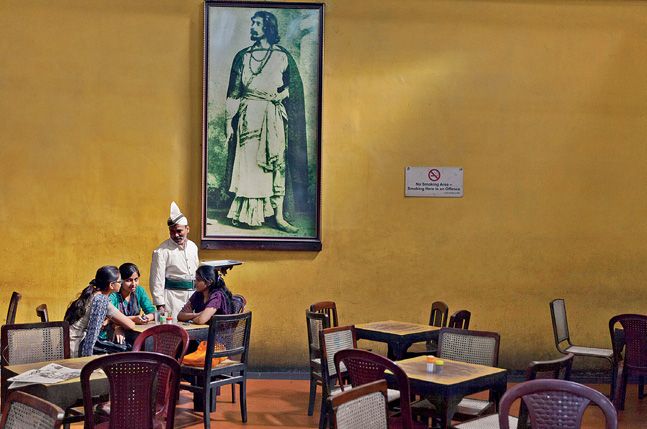
A waiter serves schoolgirls beneath a portrait of Rabindranath Tagore in the Indian Coffee House, Kolkata, 2013

Freedman's images do not shy away from this plainness, or signs of age: the peeling walls, the fraying pockets of uniforms, the blackened switchboards, table legs balanced in empty Amul cheese tins. But his gaze is affectionate, forgiving, even celebratory. Even a fly sitting in a bowl of sugar seems innocuous, yet another visitor to the Coffee House who hasn't been turned away. "I'm not romantic about India, the nonsense about elephants and maharajas. But there is a romance about what the Coffee Houses allow people to do. You can sit all afternoon with a cup of coffee and no one's going to tell you to leave," Freedman says. "I'm from Hackney, from a working class background. The Coffee House became this kind of translation device for me because I saw the same people there as in the cafes at home."

Of course, Coffee Houses are not all the same. "South Indian ones have much more substantial food," says Freedman. And one Coffee House might cater to different constituencies: retired old men, college students, middle-aged couples or a family on a ritual outing, young lovebirds. But what all these people are likely to have in common is that they are lower middle class.
Image
Men sit and talk in the Indian Coffee House, Baba Kharak Singh Marg, New Delhi, 2010

Freedman is clearly drawn to places that democratise leisure. If England's greasy spoon cafes summon up an era of post-war rationing that he didn't quite witness, his book on another dying British institution, the Eel, Pie and Mash shop, "is really about [his] past" and "that section of London's working class that feels dislocated". He has also photographed the cafes of Cairo "as a way to examine the Egyptian revolution". Does he see Indian Coffee Houses as resisting the neoliberal economy? "Modern cities privatise space," Freedman agrees. "Places where people gather and are not monetised like Starbucks are places where people discuss. And discussion is dangerous to the state. Indira Gandhi knew this; she closed the Coffee House during Emergency, saying it was seditious."
Image
Indian Coffee House, Chandigarh, India, 2013

What also makes the Indian Coffee Houses unique is that they are worker-run. In the 1950s, after the Coffee Board decided to privatise 43 outlets and fired many employees, the workers formed cooperative societies and persuaded the management to let them run the outlets.

Freedman's many superb portraits of waiters and kitchen staff are testament to the wonderful sense of ownership that pervades the Coffee Houses as a result. In one image in Palaces, a frail old man in a dhoti sits with his back to a man in collared shirt and trousers. As they raise their identical cups of coffee to their lips, one has the sense of a world in perfect balance, something sadly missing in the world outside.

9 October 2017

A Place in the Crowd

My Mirror column:

A new film looks at our striving for space in the city — and the solidarities that might help us find it.


Image


Those of us who live in cities spend most of our time being unhappy in them, and about them. Tu Hai Mera Sunday sets out to show us how we might reverse that, if we try. It’s a goal worth striving for — the happiness, as well as the idea of a film that tries to spark city-love in us — and Milind Dhaimade manages to take us with him much of the way.

It's true that the premise is a little too obviously metaphoric: a group of middle class Mumbaikars are aching to play their Sunday football game, but suddenly find all their options closed off. The search for a space where they can play together provides the literal and emotional underpinning of Dhaimade's narrative. And since his intentions are clearly warm and fuzzy, one probably shouldn't grudge him the by-the-numbers representativeness of the all-male gang he places at the film’s centre. There’s one Muslim (Avinash Tiwary), one Goan Christian (Vishal Malhotra), one Parsi (Nakul Bhalla), one Gujarati Hindu (Jay Upadhyay) — and a fifth (Barun Sobti), whom we assume to be Hindu and North Indian precisely because he is presented as unmarked by community or region to the point where he can be coded merely as “accha aadmi”.

The way to watch this film is to stop being cynical, and summon up instead that moment of wonder you have in the Mumbai local or the Delhi metro, when you look around you and see yourself as part of the marvellous mixture that is our urbanity: the sabzi-chopping working women heading to the end of the line, the graceful Gujarati matriarchs with their seedha palla saris, the burkha-wearing young woman on the way home from college, the salwar-kameez-clad officemates venting about their terrible boss. It doesn’t happen often, true, but surely you’ve had those moments, too — in which strangers come together for purposes great or small, and make the city seem, for that infinitesimal instant, a place we all inhabit together.

Dhaimade chooses sport as his unifier across community and to a lesser extent, across class, age and gender — and frankly, it isn't a bad narrative device through which to examine both the possibilities and the limits of our togetherness. It seems quite believable that the Muslim man about- town Rashid, who could never marry his Hindu sweetheart, can have two Hindus (and Parsis and Christians) as football buddies. Or that Gujju family man Jayesh, running from his family, might spend his Sundays with a bunch of unattached younger men. Or even that Arjun, the self-proclaimed “accha aadmi”, might woo a potential love interest by taking her aged dad off her hands and into his football game every Sunday.

But the film is juggling many things, and so at some point the football is abandoned in mid-air, while we follow each of our protagonists into their particular struggles. Some of these individual tracks are spelt out as romantic — such as the sweetly winsome one between Barun Sobti’s Arjun and Shahana Goswami’s hard-to-impress Kavi, or the awkward but heartfelt rescue attempt by Nakul Bhalla’s Mehernosh when his colleague is being mistreated by their asshole boss. Others contain unspoken questions, and are the more interesting because of that: like the connection between the very single Rashid and his mother-of-two neighbour (the sparkly-eyed Rasika Dugal); or Dominic, so used to his mother’s anxiety and his brother’s antagonism that he finds himself confused by the easy warmth of his brother’s new girlfriend.

Spatially, too, the film alternates between private or domestic spaces where class particularities are invariably more marked — the posher variety of cafe that keeps unground coffee beans on the table, a chawl where loud quarrels are the norm, a joint family home overrun with children and rituals — and the sort of gathering-places that would make up an ideal Habermasian public sphere: a city beach, a relaxed Irani cafe, a train station, a dive bar.

Dhaimade's film makes quite clear his attachment to these free or at least not-too-expensive public spaces, sites that also represent the culture of a pre-liberalisation era.

There is nothing wrong, exactly, about such a desire; many middle class people share it, which is why the closure of a Samovar in Bombay or a Volga in Delhi is greeted with a flood of nostalgic reminiscences. But perhaps we ought to look unequal access in the eye: an Arjun can choose to go to the Irani cafe or the expensive new one, a Rashid or a Jayesh Bhai, not so much. And there is something striking and sad about the fact that the search for space in Mumbai must eventually land the characters — and the film — in Goa.

Still, this is fiction, after all, and several happy endings are provided. One of them makes what is, I suppose, a practical suggestion: find a terrace from which to gaze out at the city skyline, and the height might make it seem less oppressive. But well, as Shahana Goswami's character tells us, even to access a building rooftop like that you need to know the name of someone who actually lives there.


Published in Mumbai Mirror, 8 Oct 2017

25 April 2014

Post Facto - The Long Dark Tea-time of the Indian Soul

Image
Vintage tea ad suggests tea instead of alcohol.
From my Sunday Guardian column:
Do you drink tea? If you're Indian and your answer is no, you're probably (a) from one of those lucky parts of the country that grows coffee; (b) ridiculously young, with enough spare cash for the coffee chains; (c) a champion of milk who thinks tea is an artificial stimulant (and makes you dark); or (d) a freak healthy type who favours aloe vera juice or something equally odd.
Because despite Montek Singh Ahluwalia failing to declare tea our national drink in 2012 (apparently the coffee manufacturers objected), India is the world's largest tea-drinking nation. It was also the largest tea-producing one, until China recently outstripped us. Though that is perhaps as it should be: it was to break the Chinese monopoly on tea production that the British, already becoming a country of tea-drinkers, first introduced the plant on a commercial scale in Assam (and later North Bengal and the Western Ghats). Remarkably for something first grown here in the 1820s, and initially intended only for export, tea is today our most consumed beverage. An ORG study in 2012 said 83% Indian households drink tea. According to the Cambridge World History of Food, 70% of India's immense crop is now consumed locally, with Indians averaging half a cup of tea daily on per capita basis.
The half-cup of tea might just be an Indian speciality, anointed in some parts of the country with its own memorable name: cutting chai. Elsewhere in India, that three-sips-worth of hot, sweet, concentrated brown liquid might not have a name, but it's the usual amount — unlike the British working class, which drinks its tea in a large mug, most of India favours the small glass tumbler.
Image
"Tea is Swadeshi." 
Poster made for the Indian Tea Market 
Expansion Board, 1947.

The brown sahibs who first learnt to drink tea from colonial Englishmen adopted the upper class ceremony. The cost of full-leaf tea and its accoutrements kept tea out of reach for much of the populace — all Lipton print advertisements as late as the 1940s show a proper bone china tea service. The democratisation of tea in India only really dates to the mid-20th century, when aggressive marketing achieved the symbolic transition from "imperial brew" to "swadeshi", and the Crushed, Torn and Curled (CTC) technology made it possible to make more cups of strong tea from less leaf.
The late Rituparno Ghosh, adapting Tagore's novel Chokher Bali to the screen, had much fun with the depiction of tea-drinking as a memsahebi innovation. Aishwarya Rai's young widow Binodini intrigues and then woos the household's more conservative older women — with tea. The cleverness of Ghosh's touch lay in evoking the sensuous pleasure of an elaborate afternoon tea ritual, associating it with the guilty secret it was for a 19th century Hindu widow to enjoy anything at all.
Today depriving someone of tea might be popularly understood as something of a human rights violation. In September 2013, when a sub-inspector in Kolhapur arrested a man called Vijay Patil for "drinking tea in a suspicious manner", the Bombay High Court, was not impressed. Mr Justice Gautam Patel's ruling, as reported in the media, was a marvellously eloquent paean to tea: "We were unaware that the law required anyone to give an explanation for having tea, whether in the morning, noon or night. One might take tea in a variety of ways, not all of them always elegant or delicate, some of them perhaps even noisy. But we know of no way to drink tea 'suspiciously'."
Jyoti Dogra's brilliant solo theatre performance Notes on Chai, which I recently watched in Delhi, is ostensibly about that "variety of ways" in which we might take our tea. Dogra has suggested in interviews that tea was a way of approaching the everyday; that differences in tea-drinking habits are indicative of class, cultural origins, social status. And it is true that Dogra's character sketches — the old Punjabi lady so endearingly proud of her Lahore college degree who will endure no water in her tea; the government clerk for whom tea-break means stopping mid-sentence, like an automaton; the woman who insists on pressing Malaysian green tea and favours upon a reluctant acquaintance — are about those things.
But Dogra does herself injustice. The people she brings to life do mention tea. Sometimes they return to tea over and over. But their talk is not really of tea. It is of time, and of the self. For the old person with not much to do, tea is a filler of time. For the body looping through unalterable cycles of work, it is "me-time" that makes the daily grind bearable. And yet it is a ritual pause, as sharply demarcated and routinised as labour. For the woman whose life is lived at the "suggestions" of her father and husband, to drink her morning cup of tea in the balcony — and to refuse to wake her husband until she's finished — is her single act of everyday resistance. "Mujhe subah ki chai milti hai balkoney mein, toh phir main sab kucch lightly leti hoon." Tea is the assurance that things are running as they always do. But just below the surface of Dogra's performance is a profound, disturbing unease: will things never run any other way? Does tea simmer so we stay calm?
Published in the Sunday Guardian, 20th April, 2014.