Showing posts with label Electric Moon. Show all posts

28 June 2021

Saving the tiger and wildlife will take more than a few Shernis

My TOI Plus column:

The man-animal conflict in India is a complex, burgeoning problem, and one that is left unaddressed both by our national forest policy and by our mainstream politics
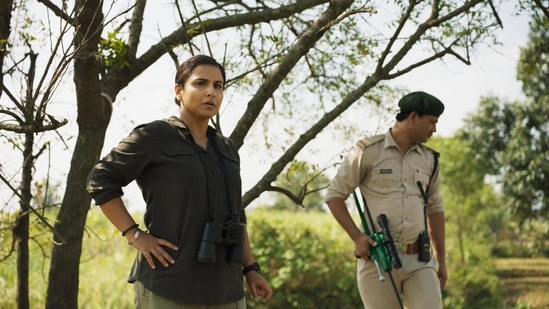
 

https://images.hindustantimes.com/img/2021/06/17/550x309/vidya_balan_sherni_1623932168804_1623932179349.jpg
Vidya Balan plays an ethical Indian forest service officer in Sherni (2021)

Amit Masurkar's new film Sherni has some things in common with his award-winning 2017 film Newton -- the central Indian jungle setting, the town-bred government official working against the odds in an unfamiliar setting, and unlikely collaborations among people striving towards something larger than themselves. The plot in one sentence: When a tigress named T2 starts to attack villagers in the vicinity of a Protected Forest area, an idealistic new forest officer named Vidya Vincent (Vidya Balan) struggles to prevent more human deaths, while also keeping her thoughtless, corrupt bosses from letting a self-appointed hunting hero kill the tigress.

Where Newton tackled the state of Indian democracy with pitch-dark humour and a sometimes-manic edge, Sherni approaches the tragic impasse of environmental conservation with enthusiastic sincerity, tempered by something akin to haplessness.

Perhaps that is inevitable, given that the man-animal conflict in India is a complex, burgeoning problem, and one whose roots are left unaddressed both by our national forest policy and by our mainstream politics.

To try and summarise a complicated history: India spent the first 25 years after Independence wooing parties of tiger-hunting foreign tourists, getting them to pay for the privilege of what sahibs and maharajas had always done. A 1964 New York Times article reported 15 government-approved jungle camps (up from only three in 1954) that organised these expensive shikar holidays, complete with “clean, tasty Western-style food” and liquor. “It is estimated that 3,000 tigers roam the forests, and they are multiplying fast enough to support the present shooting rate of about 300 a year,” the NYT declared.

That proved catastrophically untrue, and in 1972, the government did an about-turn. According to a 2017 article by the Kumaon-based butterfly expert Peter Smetacek, a group of hunters and naturalists had petitioned for a three-year break from tiger hunting to let populations recover, but in response Indira Gandhi's government promulgated the Wildlife Protection Act, under which hunting of any species was banned permanently.

Smetacek, like some others, has questioned the wisdom of this wholesale outlawing of hunting. For one, it made it illegal for farmers to protect their hard-earned crops from incursions by wild boar, monkeys, porcupines, nilgai, bears or birds without permission from a forest officer, pitting locals against the animal world they had cohabited with, while leaving them at the mercy of a corrupt state.

Also, if hunting was strictly regulated instead of being banned, allowing permit-based hunting of animals whose populations were growing too large, we would actually have records of animal populations besides the tiger -- and in fact be able to track and respond better to their declining numbers. That suggestion, outlandish and violent as it may sound to those who of us brought up in a sanitised modernity alienated from the ways of the wild, may be just the starting point we need to rethink the simplistic, often counterproductive legal regimes that have failed in practice to protect our forests.

Few Indian films before Sherni have engaged with this difficult terrain. In Anay Tarnekar's brilliant 2016 short The Kill, a poor adivasi man's deep, reverential knowledge of the jungle and the tiger goes from being a useless, non-monetisable asset to the only thing he can sell – but at a terrible cost.

In 1994, Sai Paranjpye made the sweet, well-intentioned, Chipko-inspired feature Papeeha, where her daughter Winnie Paranjpye played an anthropologist representing the tribal perspective on living in and off and with the forest, cast alongside a forest officer hero (Milind Gunaji) and a series of corrupt forest officer villains who run clandestine logging businesses.

A year earlier, in 1993, Pradip Krishen had made a film called Electric Moon (scripted by his then-partner Arundhati Roy), which takes a more sideways, ironic look at the situation. The film's central protagonists are a family of fading Indian royals who run a wildlife resort catering to foreign tourists, selling tiger hunting as an Orientalist fantasy, while responding to the new Hindi-speaking forest officer (Naseeruddin Shah) with snobbish class outrage. The humour is spot-on, as is the context: many Indian princely families who had once pursued hunting, often in forests that were part of their own territories, did indeed make this transition to being conservationists. It was a mixed metamorphosis that allowed them to retain their privileged relationship to the wild -- sometimes speaking legitimately from a place of knowledge, and sometimes just bending the rules for themselves.

The other film Sherni made me think of is Bhuvan Shome, Mrinal Sen's 1969 New Wave classic. Sen's film isn't intended as a realist comment on anything, certainly not on Indian wildlife policy. Yet, at its centre, is a man on a hunting expedition, who ends up not killing a single duck – and handing over the single one he brings down to a young girl he has become fond of.

Image
Utpal Dutt sets out to hunt birds in Mrinal Sen's New Wave classic, Bhuvan Shome (1969)

Further, Sen's marvellous lightness of touch achieves much more than what that narrative outline suggests. Utpal Dutt, acting the grand hunter with his sola topi and rifle, is actually a tragicomic figure. The anglicised Bengali bureaucrat out of his depth in the Gujarati rural desert landscape represents not just bureaucratic mechanisation and urban dessication, but also a State totally disconnected from ordinary people's lives.

The low-level chai-paani bribes that Bhuvan Shome so sternly polices, and Mrinal Sen treats with comic indulgence, are still not the primary enemy. Nor is the biggest enemy the still-surviving big game hunter, who is given a little too much play in Sherni, perhaps understandably because a film needs a villain.

The problem is that out-of-touch State. Under cover of 'development', that State now cuts secret deals to give away our rivers and mines and forests to big men. It postures as a protector, but its grand diktats only cut off the deep, pre-modern, symbiotic relationships on which our forests managed to thrive for generations -- leaving both people and nature vulnerable to the worst kind of short-sighted profit motive. We cannot conserve our wildlife – or any heritage, actually – if we continue to treat those who live beside it as errant, trespassing children, rather than as dignified, proud, well-paid stakeholders.

Humans and animals have lived together before. We could do so again. But the task needs both intellect and courage.

Published in TOI Plus, Sun 27 Jun, 2021

28 February 2014

The Last Renaissance Man: The Reinvention of Pradip Krishen

Pradip Krishen's fascinating journey from academia to film, from film to forest. And desert. 

From my long profile in the February issue of The Caravan.


Image
Pradip Krishen in his study. (Photograph by Arati Kumar-Rao. See the whole set here.)

IT WAS A LITTLE PAST 5 AM as we drove out from Jaisalmer into the alternately sandy and rocky terrain of the Desert National Park, a 3,162 square-kilometre swathe of the Thar Desert in western Rajasthan. We were heading specifically for a large dune that goes by the evocative name of Gaja Matha—“elephant head”. For the first time in four days, Pradip Krishen reserved the front seat of the Innova for himself. He had to direct the driver, he said, and proceeded to do so silently, with several elegant turns of the wrist. Just as the driver began to enjoy speeding through the smoky pre-dawn darkness, Krishen uttered a gentle but firm injunction: “Thoda haule le lo, chinkara vagairah aa jaate hain” (Take it slow, there might be chinkaras). Reluctantly, the driver decelerated, lulling the other four still-drowsy passengers back into a potential return to slumber. Krishen, though, remained thoroughly awake. Within minutes, he brought us to a stop with a quiet exclamation: “Was that a hedgehog?”

We drove back a few hundred metres. Sure enough, there was a sad, not-very-spiny ball of quills, rolled up in the middle of the road. Krishen and the rest of us got out for a look: Mithva, Krishen’s younger daughter, accompanying her father into the desert for the first time; Arati Kumar-Rao, a freelance photojournalist working with Krishen; Nishikant Jadhav, a retired Indian Forest Service officer whom Krishen affectionately calls his “Tree Guru”; and myself.

“He’ll go to hedgehog heaven,” said Mithva, as tender an animal-lover as her father.
“The great insectivore hunting ground in the sky,” said Krishen.
“The insects are already here,” Kumar-Rao said. 

It was a strangely affecting sight: the thin, sticky trickle of blood, and the insects lining up to devour the creature who would once have devoured them.

Back in the car, Krishen and Kumar-Rao described how long it had taken them to arrive at the Rajasthani name—just the name—for the specific habitat we were driving out to see. The sandy desert is self-mulching: a top layer of dry sand protects a lower layer of wet sand, providing enough moisture for plants to grow and a whole ecosystem to emerge, creating what might be called the “jungle of the desert”. Krishen and Kumar-Rao spent many trips asking local people what they called these sorts of areas with vegetation. They received answers ranging from the banal and slightly baffled—“registan?” (desert?)—to place-names, like Gaja Matha. Between themselves, they had begun to refer to it as the “SBK habitat”, using an acronym derived from the three plant species most commonly found in the sandy Thar: a spidery herb called seeniobui, or desert cotton; and a large thin-stemmed bush called kheemp. The coinage had almost stuck when a 19th-century reference—James Tod’s two-volume classic Annals and Antiquities of Rajasthan—finally gave them the term they were looking for: roee. Suddenly, the word was everywhere they looked. “Yes, going into the roee means going into the jungle,” our Jaisalmer hotel owner affirmed. “Hmm. You never mentioned it when I asked last year,” Krishen said, slightly disgruntled. That persistent trial-and-error approach to research—eclectic reading plus the pursuit of local knowledge, all the while also devising his own ordering system—exemplifies Krishen’s work.

In the Innova headed toward the roee, we grew collectively still, arrested by the grandeur of dawn breaking over the desert. Krishen’s voice interrupted my own reverie. “When you’re shooting a film,” he said, “there’s a moment at dawn that’s ephemeral. And if you have two or three dawn shots, you need to get matching dawns—a cloudy dawn can’t be followed by a clear one. But the classic is what we used to call RFD, Rosy-Fingered Dawn. Which, of course, is from the Odyssey …”

Like all good storytellers, Krishen is adept at using little sparks from his past to illuminate the present. Once at work, however, that leisurely digressiveness is replaced by a sharper focus. On each pre-dawn trip, we walked the dunes for hours, with Krishen, Kumar-Rao and Jadhav stopping to look at—and photograph—not just lizards and birds and gerbils, not just big trees and shrubs, but also the most minuscule grasses. They knelt, they hunched, they lay flat on the ground to examine everything from the roots of a shrub where a lizard had taken up residence, to the fuzz growing on an old cowpat. There was great passion here, an exhilaration and intensity difficult to describe. Yet there was also an immense sense of calm, an immersion in the present that took the form of an unhurried attention to landscape.

Barren expanses, which the locals called thal, were interspersed with the roee—stretches of vegetation that, even to my untrained eye, transformed the desert from a dry nothingness into a world secretly throbbing with life. Krishen was mostly happy for us to tramp along peacefully as he pointed out the flatter plains, or pediments, that are the oldest parts of the desert, and educated me about common plants like the khejri (“this is where you get the sangri from”). But in an instant his voice would drop to a hush, and everyone would suddenly start whispering dramatically: “Egyptian! Egyptian!” A sighting, as it turned out, of a raptor called the Egyptian vulture.

                                                                                     ***


AN UNFAILING SPOTTER OF SPECIES, Pradip Krishen is a bit of a species unto himself. A highly regarded naturalist and ecological gardener, he is the author of Trees of Delhi (2006), one of India’s most popular books on an ecological subject, and he has just published another—an equally exhaustive yet supremely readable guide to the Jungle Trees of Central India. In an earlier life, Krishen was a highly regarded filmmaker. He directed Massey Sahib (1985), In Which Annie Gives It Those Ones (1989) and Electric Moon (1992)—all, to different degrees, cult films for a generation of writers, directors and discerning movie-goers.

After Electric Moon, however, Krishen stopped making films and went into a hibernation of sorts. When he re-emerged into the public eye after a little over a decade, it turned out that he had spent much of that time teaching himself about trees. Almost simultaneously, he had been teaching others: leading walks into Delhi’s wooded tracts, helping protect the heritage environs of the city’s Sunder Nursery from being cloven by a flyover, and trying to create a microhabitat there. Krishen’s explorations extended into Rishikesh, with a “Wildflowers in the Rain” walk at a friend’s resort, and to Pachmarhi, in Madhya Pradesh.

Krishen’s success remains astounding to most people. “He’s an amateur who outdistances the professionals,” said Amita Baviskar, who has, as a sociologist and activist, long engaged with environmental concerns herself. Krishen has also pretty much invented the shape of the profile he now inhabits. As the documentary filmmaker Sanjay Kak, who started his career working with Krishen, put it: “How many people do we know who are amateur tree biologists and photographers and writers? Essentially, no one.”

                                                                                     ***

IN APRIL 2013, I travelled with Krishen from Delhi to Jodhpur, where his most recent project has unfolded in the shadow of what might be India’s best-preserved medieval fortress: the 15th-century Mehrangarh fort. In 2005, the Mehrangarh Museum Trust (MMT) invited Krishen to “green” the fort’s surrounding area, then an eroded, rocky wasteland dominated by the invasive Mexican species Prosopis juliflora—the mesquite, or vilayati keekar—also known by the rather appropriate local name of baavlia, “the mad one”. “Maybe [the MMT] had in mind something like a garden,” Krishen told me during one of our several interviews, on the road and in Delhi. What they got instead is an ambitious ecological restoration project on a scale unprecedented in India. Krishen has spent the last seven years trying to return the area to what it might have been like five or six centuries ago, before it was inhabited by people—and before the late 1930s, when Maharaja Umaid Singh of Jodhpur, in a well-intentioned bid to provide the subjects of his desert kingdom with a source of greenery, scattered the seeds of Prosopis juliflora across it from an aeroplane. A year before the MMT invited Krishen to Mehrangarh, the trust, which is headed by Jodhpur’s former maharaja, Gaj Singh, asked him to resuscitate a moat filled with old stone rubble at the 12th-century Nagaur Fort, about 138 kilometres north-east of the city. Based on his own research and the guidance of the late Dr MM Bhandari, a botanical doyen of the Thar desert, Krishen sowed a nursery of plants native to the Nagauri desert. “It just flourished,” he said. 


Read the rest of this profile on the Caravan website: here.