Showing posts with label Rajasthan. Show all posts

9 May 2021

Satyajit Ray’s world of trains

My column for Mirror/TOI Plus, the fourth in my series on trains in Indian cinema:

On the filmmaker’s birth centenary, a look at how the train is a motif in many of his films, including the Apu Trilogy, Nayak and Sonar Kella

Image
A still from Satyajit Ray's Nayak (1966), starring Sharmila Tagore and Uttam Kumar.

Satyajit Ray, whose 100th birth anniversary was May 2, is associated with one of the most famous train sequences in all of cinema: The children, Apu and Durga in Pather Panchali, standing in a field of fluffy, white kaash flowers, listening for an oncoming train. I've always thought that what makes that sequence unforgettable is the rural Bengali landscape ruptured by the sound of the machine before the sight of it. The children hear the train's vibration in a pillar before the great beast rumbles past.

The train remained a motif throughout the Apu Trilogy, acquiring more layers of darkness with each film. What Ray had originally framed as the link between the village and the city became, in Aparajito, a marker of the distance between the two, and then in Apur Sansar, a site of potential death.

Image
The eternal train scene in Pather Panchali, Satyajit Ray's 1955 debut feature

But there are two other films in which Ray put the train to less melancholic use. The first of these was Nayak, released on May 6, 1966, in which he cast real-life Bengali matinee idol Uttam Kumar as a film star called Arindam Mukherjee. When we meet Arindam, there are two items about him in the day's papers: One, a National Award he's being given in Delhi, and two, a brawl in which he was involved the night before. It's a succinct if simplistic summary of the film actor's life -- popularity and critical achievement, but alongside infamy.

Some mention is made of Arindam having left it too late to get a seat on a plane, and Ray thus successfully places his famed and shamed hero on a long train ride that exposes him to a microcosm of the Indian upper middle class – which, 55 years ago, was snootier about film stars than it is now. From the corporate head honcho who sniffs at the brawl to the old gentleman who disapproves of films on principle, the train isn't exactly filled with Arindam fans.

But what really feels completely unreal in 2021 is the degree of unguarded interaction that the train affords between the film star and his public. Arindam is kind to little girls, signs some autographs, and then gets drunk in a train toilet. When he stumbles back to his compartment, the upper middle class housewife in it is humane enough – and female enough – to help him to bed rather than, say, take a picture of his disarray. Even the snarky journalist (Sharmila Tagore) that Arindam ends up confiding in over a long pantry car conversation, decides he is deserving of her humanity and tears up her notes. The train serves, in many ways, as a filter – Arindam is on display and yet somehow he isn't quite out in the open.

Image
On the sets of Sonar Kella (The Golden Fortress), 1974.

But by far the most sprightly use of the train in Ray's cinema is in Sonar Kella (The Golden Fortress), the first film adaptation to feature his famously-popular detective, Feluda. Released in 1974, the whole film practically unfolds as a series of overlapping train journeys.

The very beginning of the adventure in Calcutta involves Feluda, played by the late Soumitra Chatterjee (who died after a battle with Covid in November 2020), silently removing from his bookshelf a hardbound copy of the Railway Timetable for November 1973. On the other side of events, we are introduced to the film's villains by being shown their names on a railway reservation chart: M Bose (Lower) and A Barman (Upper). Bose and Barman are hot on the trail of the originary set of train travellers – a six-year-old child constantly making crayon sketches of a past birth, and a parapsychologist taking him to Rajasthan in the hope of identifying the golden fortress of his drawings.

The train is also where Feluda and his nephew Topshe first meet the man who will become the third member of their trio: The mystery writer Lalmohan Ganguly alias Jatayu. He boards their compartment at Kanpur station with his red 'Japani suitcase... imported', and proceeds to speak several sentences in rather grandiloquent Hindi before realising that his companions are Bengalis, too.

It is a remarkably orderly world that Ray maps out, in which precise calculations can be made based on train timings. If a set of people hasn’t arrived at Jodhpur in the morning, they can be assumed to arrive by the evening train instead. And if the expected villains haven't shown up on the day they should have, Feluda speculates that they may have failed to get a train booking.

Trains in The Golden Fortress are the route to excitement, transporting these parties of Bengalis into the 'dacoit-infested country' of western Rajasthan. But trains are also the possible way back to order and civilisation: In one pre-climactic moment, Feluda offers Lalmohan Babu the option of getting off at Pokhran, from where he can catch a train back, rather than proceeding to Jaisalmer with them.

In one of Sonar Kella's most memorable scenes, the intrepid Bengalis get on camel-back, and try to wave a train down across the desert. It's the one time in the film that Feluda's plan doesn't succeed. The train keeps on going.

Published in Mumbai Mirror (9 May 2021) & in TOI Plus (8 May 2021).

10 November 2020

Dharamshala International Film Festival 2020: From Pearl of the Desert to Yalda, five must-watch picks

Late to put this piece I wrote for Firstpost up on the blog, this year's online edition of DIFF is over. But these five films are totally worth looking out for.

Dharamshala International Film Festival 2020: From Pearl of the Desert to Yalda, five must-watch picks
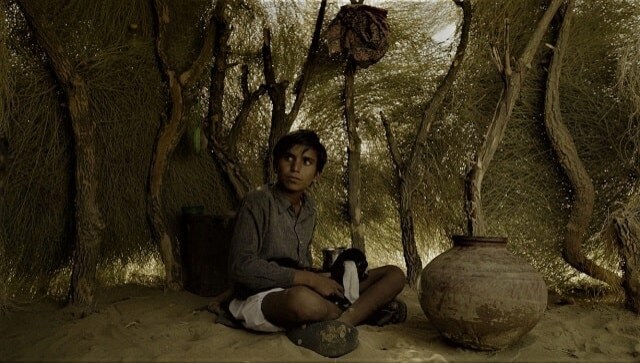
Still from Pushpendra Singh's wonderful film Pearl of the Desert, 2019, about a Manganiar boy musician called Moti

The Dharamshala International Film Festival went online this year, making its thoughtfully curated mix of features, documentaries and short films available to anyone in India with a screen and an internet connection, offering both season tickets and a daily Binge pass. Sunday, 8 November, is the last day of this year's festival. I've picked out five unusual films worth the price of admission:

Pearl of the Desert, 2019

Documentary | Rajasthani | 1 hour 22 mins

A boy is walking home with a group of other boys, all wearing that familiar dull blue shirt that is the uniform of countless government schools across India. Suddenly he falls behind, telling the rest to go ahead. “You do this every day!” complains another boy in the group. But they carry on, and the boy settles himself on a crooked tree trunk and begins to sing. As the rich, rugged notes emerge from his throat, the desert seems to spring to life. In case the sound doesn't thrill you, the filmmaker catches a black buck leaping up at the sound of Moti's voice. Then another. Animals seem to respond to the beauty of Moti's music, evoking mythical depictions of cattle gathering to listen to the flute-playing Krishna.

It is the sort of coded, powerfully cinematic image that makes Pushpendra Singh's hybrid documentary on the Manganiars such a layered, resonant piece of filmmaking. Time and again the film reminds us, without a word, that we live in a country of remarkable admixture: a country in which Muslim musicians have for centuries been the appointed bards to the upper caste Hindus of the Thar Desert.

It is something to listen to these men singing the praises of their Hindu patrons: enumerating the heroic exploits of their ancestors, laying out their genealogies, mourning the departure of their daughters — all in words profoundly redolent of the desert. If one song describes the carriage of the camel, another pays tribute to the dusky beauty of the lover in the courtyard, while one particularly stunning verse asks the stubborn lover to come back home, saying, “I have written you a carnival, at least now return”.

Whether the occasion is a birth or a marriage or any other celebration, the Manganiars are always called upon. They sing songs to the goddesses their patrons worship, and they also sing songs to the pirs of the Thar desert. The film closes with a group of Manganiar men harvesting cluster beans, singing in joyful unison a song that invokes Allah. In one of the film's reenacted scenes, Moti's grandfather is asked to relate the community's history — he connects them with Parashuram, with stories about asking for necklaces (maangan, haar), and their name to the Sanskrit word “mangal”, meaning auspicious.

Whenever the increasingly misguided votaries of Hinduism insist that their vengeful politics of purity is the only defense of Indian tradition, it is worthwhile bringing up the Manganiars — for this, too, is our tradition. One we must now fight to keep alive.

Dharamshala International Film Festival 2020 From Pearl of the Desert to Yalda five mustwatch picks
Still from the delightful Gaza Mon Amour, 2020

Gaza Mon Amour, 2020

Fiction Feature | Arabic | 1 hour 27 mins

Set in the small, densely populated Palestinian territory of Gaza, this film about an ageing fisherman who decides he has had enough of singledom is a quiet delight just for the stellar performances by Salim Daw as the externally crotchety but secretly romantic Issa and Hiam Abbas as the serious-faced widowed seamstress whom Issa finally gathers the courage to court after a naked ancient statue lands in his fishing net — that feels like a sign. Atmospherics are provided by the rundown location, where checkpoints, power cuts and bombings are the norm — as is the fact that many of the younger people want to escape to Europe even via the dangerous illegal route. Directed by Tarzan Nasser and Arab Nasser, this gently comic romance comes to DIFF after a premiere at this year's Venice Film Festival and the NETPAC award for best Asian film at Toronto.

Dharamshala International Film Festival 2020 From Pearl of the Desert to Yalda five mustwatch picks
Still from the documentary Influence, 2020, a film about the dangerous directions in which advertising and PR have taken us

Influence, 2020

Documentary | English | 1 hour 45 mins

Tim Bell was a British advertising man who went from being part of the founding team of Saatchi & Saatchi to Margaret Thatcher's campaign manager, his “Labour's Not Working” hoardings held responsible, among other things, for the decimation of the British Labour Party in that election. Diana Neille and Richard Polak's ambitious documentary portrait of Bell unpacks the rise and fall of a morally dubious man who created and ran the world's most influential political consultancy for decades. Bell Pottinger's clients ranged from the Chilean dictator Pinochet to South African Presidents FW De Klerk and Jacob Zuma. He was hired by the Pentagon to create a flood of propaganda videos in post-Saddam Iraq and by the Gupta Brothers to stir up racial violence in South Africa using hired bots to tweet and post on #whitemonopolycapital.

The film's watchability is aided by its incorporation of an interview with an aged Bell, who died in the summer of 2019 — perhaps precisely because Bell gives away so little, even as he has supposedly decided to tell his story. But its true impact lies in using Bell's life to trace the transformation that characterises our era perhaps more than any other: the dangerous transformation of advertising and marketing from an “art form into a science — and in many respects, into a workable weapon”. Those words belong to Nigel Oakes, an ex-Saatchi & Saatchi man now infamous as the founder of the SCL group, the parent company for Cambridge Analytica. The untrammelled rise of “strategic communication”, alongside social media, is the story of our times, altering political outcomes across the globe for several decades, and now scarily part of our present in India. In Oakes' words, what was once “just democracy” is now a “controlled democracy, maybe available to the highest bidder.”

Dharamshala International Film Festival 2020 From Pearl of the Desert to Yalda five mustwatch picks
Still from the gripping Yalda, 2019: Iranian realities filtered through the drama of a reality TV show

Yalda, 2019

Fiction Feature | Farsi | 1 hour 39 mins

Winner of the World Cinema Grand Jury Prize (Dramatic) at the Sundance Film Festival this February, Massoud Bakhshi's film Yalda, A Night for Forgiveness is a gripping drama that manages to reveal a great deal about the contradictions and hypocrisies of present-day Iran. The film unfolds on the set of a TV show called 'Joy of Forgiveness', during which a woman convicted for killing her husband might receive a pardon from her husband's daughter — and thus be saved from the death penalty.

Bakhshi based his fictitious show on a real show called Mah-e-Asal that aired daily on Iranian television during the month of Ramadan from 2007 to 2018, and does wonders by alternating between the scripted reality we see on TV and the real drama taking place off-camera. The story of why the 20-something Maryam Komijani married her late father's 65-year-old employer and became pregnant with his child brings into view not how skewed Iranian law is against women — the permissibility of 'temporary marriage', the greater claims of sons over family property — but also the deep fault lines of class in Iranian society. Dominant social morality and the law may see Maryam a certain way, but it is hard to look away from the alternative picture the film shows us.

Ghar Ka Pata, 2020

Documentary | Hindi, Kashmiri, English | 1 hour 7 mins

The filmmaker's search for the home she left at six is the basis of a personal essay about a very political place. Madhulika Jalali's family home was a traditional house in the neighbourhood of Rainawari in Srinagar, among the areas in the city that was home to the Kashmiri Pandit community. Like thousands of other Pandit families, Jalali's Hindu parents found themselves forced to leave the valley by the events of the early 1990s, when militancy in Kashmir took a dangerously communal turn. Like the others, they were never to return. The film makes this tragic political-communal context visible through a very personal keyhole. As if to compensate for her own lack of memory, Jalali tries to find an image of the house she can't see in her mind. When her own family albums are exhausted, the search leads her to cousins and relatives — and eventually to Srinagar.

Dharamshala International Film Festival 2020 From Pearl of the Desert to Yalda five mustwatch picks
Poster for Madhulika Jalali's moving personal documentary Ghar Ka Pata, 2020

The film splices these journeys with Jalali's two elder sisters reminiscing, about the house but also about the traumatic nights leading up to their departure, when proclamations of violence made from the neighbourhood mosques made their father dig out his hunting rifle — but eventually take his close Muslim friend's advice to leave.

Her parents, like most adults Jalali speaks to, remain reticent. But those who were younger then, seem happy to speak. Jalai's sisters talk about how happy and peaceful their childhoods had been in the Srinagar of the1980s: the fruit trees in their garden, the snow they used to try to make into ice cream, the neighbourhood shop from which they bought dahi, the walking route they'd try to take home to get their hands on any festive meetha chaawal being distributed. But even within this gently nostalgic past, one can see the inevitable seeds of the future. In one remarkable anecdote, one of the sisters recalls how in those months that Doordarshan telecast Ramanand Sagar's version of the Ramayana, Hindu and Muslim children alike used to come out onto the streets of their neighbourhood with homemade bows and arrows, taking aim with a "Jai Shree Ram".

Jalali doesn't dwell on it, or on anything really. Her film has a lightness that sometimes feels surprising. Is sorrow filtered through time and distance and forgetting still sorrow? Perhaps the answer is, sometimes.

Published on Firstpost, 8 Nov 2020.

31 May 2019

In the name of Gau Mata

My Mirror column:

A stark new film by Amit Madheshiya and Shirley Abraham documents the normalisation of Hindu vigilantism.


Image
Gyandev Ahuja, ex-BJP MLA (best known for his remarks about condoms in JNU), appears in the documentary at the head of a troupe of gau rakshaks. 
“When the public lynches in daylight, they make videos of it,” says the man. “It happened at night. Had it happened in daylight, there would have been a video of him.”

The man speaking is a family member of Rakbar Khan, a 28-year-old cattle farmer from Nuh, in the Mewat region of Rajasthan, who was murdered while bringing home two cows one night in July 2018. He is speaking of the circumstances of Rakbar's death, as part of a new documentary called The Hour of Lynching, directed by independent filmmakers Amit Madheshiya and Shirley Abraham, which was released for public view on The Guardian website yesterday.

We live in surreal times, and the more surreal things get around us, the less we seem able to see them for what they are. An increasingly thick ideological smokescreen seems to stand between us and the violence of post-2014 India: violence against solitary or small groups of Dalits and Muslims, invariably committed by larger groups of upper caste Hindu men.

But perhaps if you pause and simply listen again to that line I quoted, you might hear the madness echo, even through the blur of allegations and counter-allegations that is our new soundscape. Here is what I heard in it: that in the India in which we now live, so many incidents of “mob lynching” have taken place that there is now an accepted public understanding of the practice, and that public understanding includes, first and foremost, the fact that lynchings are public events, mostly conducted in broad daylight. They are recorded, sometimes by bystanders but quite often by the lynchers themselves. (The most well-known instance of such self-recording was in Una, Gujarat, in 2016, when four members of a Dalit family were stripped, paraded and thrashed by upper caste men who had come upon them skinning a dead cow.)

Rakbar Khan is one of the 47 people killed in cow-related hate crimes since 2014. The government does not keep records of cow-related violence, but the website https://lynch.factchecker.in/ documents 127 incidents of violence centred around the transportation of cattle and/or meat that is rumoured to be beef. Almost all of them have been against Muslims and Dalits, with the frequency of attacks rising steeply since 2014, across both BJP- and non-BJP-ruled states.


Image
A still from Amit Madheshiya & Shirley Abraham's The Hour Of Lynching (2019) 

The cow has been seen as sacred in India for centuries, but it was only under conditions of colonial modernity, in the late 19th century, that it became a symbolic rallying point for the organisation of Hindu identity. Swami Dayanand Saraswati, founder of the Arya Samaj, set up the first sanctuary for cattle in 1879, and also began the first gaurakshini sabha in 1881 in Agra. 

The banner of cow protection slowly grew into a countrywide campaign against cow slaughter. Akshaya Mukul’s exemplary work on the Gita Press documents the history of the movement, which was preoccupied enough with the cow to be organising an anti-cow slaughter day on August 10, 1947 – five days before independence. Over the next three decades, the banner of cow protection united various non-political Hindu organisations, including the Rashtriya Swayamsevak Sangh, with orthodox elements within the Congress. Such Congress figures as Seth Govind Das, Purushottam Das Tandon and Thakur Das Bhargava opposed Nehru's position on the matter, even defying the Congress party whip on occasion.

In September 1966, various cow protection groups came together to form the Sarvadaliya Goraksha Maha Abhiyan Samiti (SGMS), whose supreme council had members from the Hindu Mahasabha, the RSS, the Arya Samaj and various religious groups alongside the Congress and the Jana Sangh, the predecessor of the BJP. In November 1966, a massive gathering assembled in Delhi before a stage that included MS Golwalkar, Gita Press's Hanuman Poddar and the Jana Sangh's Atal Bihari Vajpayee, turned violent. At the end of a police lathi-charge, as Akshaya Mukul writes, “The movement for non-violence against the cow had led to widespread violence in the heart of New Delhi with eight dead and several more injured.”

I offer this distilled and necessarily incomplete history of cow protection to draw attention to something that will certainly strike you if you watch The Hour of Lynching: the bitter irony of violence committed in the name of non-violence. 

“Look closely at Mother Cow,” says Gyan Dev Ahuja, a BJP ex-MLA (who had hit national headlines for saying “thousands of condoms were found on the Jawaharlal Nehru University campus in New Delhi daily”.) “You will see that she is deserving of compassion [“daya ka paatra”]”. He goes on to speak of “cow smugglers” as people of “rakhshas vritti”, and painting the battle between this imaginary enemy and his army of gau rakshaks as that between Ravan and Ram.

A little later in the film, we watch as another BJP politician is cheered resoundingly for exhorting the crowd to heed the call of Gau Mata, take out their swords and behead the heathens (“dussahasi vidharmiyon ka [sar] kalamkar do”). “You mere 200 million Muslims, we are 1 billion Hindus. If we lose our minds, we will sacrifice you 200 million – and the country will be cleansed.”
On May 23, the country gave Narendra Modi’s government another resounding electoral mandate. We can only hope that this #Tsunamo will not involve such cleansing.

16 October 2018

A brief guide to Guide

My Mirror column:

60 years ago, RK Narayan wrote a novel that became a Hindi film classic. But he was not happy. Ahead of his 112th birth anniversary, let’s ask why that might have been.

Image


Most readers of this column have probably seen the 1965
GuideDev Anand plays a dapper tour guide who falls for an unhappily married Waheeda Rehman. But this Hindi film classic was based on an even earlier literary classic: RK Narayan’s 1958 novel The Guide.


The film retains most elements of Narayan’s narrative, and yet it is almost unrecognisable. For instance, the Waheeda we first meet in the film is a sad lady in a big car; all we know is that she’s the hero’s love interest. In the book, Rosie has more scope for surprise: because we learn about her slowly, she comes into her own in remarkable ways.


Reading
The Guide, one can see why Dev Anand, who set things in motion by reading the book in London, was entranced. Railway Raju, as his character is called in the book, is a disarming layabout who runs a shop at Malgudi Station, but soon finds himself in demand as a tour guide. He falls for Rosie and helps launch her as a dancer before landing in jail, and eventually being anointed a saint.


The novel is already a fifth of the way through when Raju says: “There was a girl who had come all the way from Madras and who asked the moment she set foot in Malgudi, ‘Can you show me a cobra — a king cobra it must be —which can dance to the music of a flute?’” Within four pages, the resourceful Raju fulfils this whimsical
farmaaish, and the two are face to face with the snake. “The whole thing repelled me, but it seemed to fascinate the girl...” writes Narayan. “She stretched out her arm slightly and swayed it in imitation of the movement; she swayed her whole body to the rhythm — for just a second, but that was sufficient to tell me what she was, the greatest dancer of the century.”


In Vijay Anand’s Guide, this half-a-page encounter between the cobra and Rosie (for that, of course, is who she is) became the sequence described on YouTube as “Serpent dance by Waheedaji”. Like the men in the scene, two generations of Hindi film viewers have gaped admiringly as Waheeda Rehman turns from primly elegant memsahib into a woman seemingly possessed by the sapera’s flute. Things delicately suggested in the novel — Rosie’s dancing talent, her repressed passion, the snake as sexual symbol — become full-blown in the film. The heroine’s suppressed erotic energy is channelled into the popularly understood naagin theme.

Otherwise, too, the sequence is emblematic of how the English novel was altered to make the popular Hindi film. What in Narayan’s tragicomic description was a forlorn place — bare-bodied children gaping at the arriving car, the poor snake charmer wearing nothing but a turban and “a pair of drawers” — gets amped up into Hindi cinema's familiar ‘tribal’ setting: thatched huts around a convenient circular clearing, with a ghaghra-choli-clad dancer present so that the heroine can join in.


An English version was also made, with the famous novelist Pearl S. Buck collaborating on the script with director Tad Danielewski, and the Indian cast speaking in English. (Buck apparently helped Rehman with her English.) RK Narayan described his brush with cinema in an essay called 'Misguided Guide'. The tone is characteristically mild, but the sarcasm is palpable. Danielewski and his crew requested the writer to show them the locations that had inspired his book. After the tour, however, Narayan was informed that the film was now to be shot a thousand miles away, in Udaipur and Jaipur. He tried to suggest that Malgudi, the imaginary South Indian small town in which he had set all his novels, was nothing like those places. His brother RK Laxman, the cartoonist, tried to suggest that real, filmable monuments on screen would undercut Raju’s character, since his talent was conjuring up historical grandeur out of nothing.


But the filmmakers would have none of this. “We are out to expand the notion of Malgudi,” they told a nonplussed Narayan. “Malgudi will be where we place it, in Kashmir, Rajasthan, Bombay, Delhi, even Ceylon.” In the Hindi film, this national tableaux idea gets underlined when Dev Anand's Raju takes groups across Rajasthan, speaking Punjabi to the Punjabis, Gujarati to the Gujaratis — and of course,
farraatedaar English to the British.


The English film version is hard to find. Though screened at Cannes in 2007, I've never seen it, nor met anyone who has. But a contemporary review by New York Times critic Bosley Crowther suggests why it sank in America. “The script is sluggish and uncertain, and Mr. Anand, who seems throughout to be modeling his style of acting on one of the more romantic Hollywood stars, bouncing about in boyish fashion and wearing his hat on the back of his pompadoured hair, is stumped by the staggering requirement of acting the weird, ironic twist,” wrote Crowther. “He leaves us feeling that we, as well as the people of this poverty-stricken area, have been hoaxed.” The externalised quality of Hindi film emotion clearly did not translate for an American audience.


What is remarkable, though, is that the American critic found the film authentic precisely for the “Indian scenes” that Narayan had so cringed at: “a succession of colorful views of sightseeing spots, busy cities, temples, dusty landscapes and crowds”. As Railway Raju says: “One thing I learnt in my career as a tourist guide was that no two persons were interested in the same thing.” Our satisfaction depends, I suppose, on what we most wish to see.

28 February 2018

Stepping out of story

My Mirror column:

MF Husain’s transporting 1967 short film ‘Through the Eyes of a Painter’ seems to laugh at our desire for narrative, yet teases us with a million possible stories.

MF Husain’s ‘Through the Eyes of a Painter’ won the National Award for experimental film in 1967. It was also shown at the Berlin International Film Festival, where it won a Golden Bear award in the Short Film category. It’s not hard to see why. In the space of barely 17 minutes, it manages to evoke an entire universe. That universe is rural Rajasthan, and it is signposted by recurring visual markers. Husain picks them out of the landscape with such precision that it instantly begins to feel as if these indeed are what makes up life in Rajasthan: a cow, an umbrella, the hurricane lamp better known as laltain, a handmade leather shoe delicately upturned at the toe...

But is Husain really picking these images out of the landscape, or is he populating the landscape with them? It’s hard to be sure. Perhaps both? Everywhere, Pandit Vijay Raghava Rao’s brilliant background score makes the gaze flow in a certain way, and seems to make the image move at a certain speed.


A cow appears to charge in our direction; a hurricane lamp waits in a natural alcove formed in a wall of rock; a black umbrella, a single jooti and another lantern are poised expectantly on a ledge. The camera glides up to the top of the fort walls, the lookout from which the royal inhabitants would look down at the ordinary folk below. And in perfect progression, we start to see the ordinary people. A man hurries through a barren landscape with an earthen pot held aloft; a series of women walking on the street find themselves captured, in succession, in the natural frame created by a door.

Image

Image


Then Husain starts to combine his camera images with painted figures. His almost life-size sketches appear, propped up against real walls, with real people beside them. A man with a moustache and earring is followed by Husain’s depiction of the type. A woman fastens the string of her ghaghra, laughing: the camera is flirtatious but not quite intrusive. It takes in, from a just-decent distance, a row of women bathing and washing clothes, squatting along the edge of a large water tank. The next thing we see is the painter’s brush, using just a few strokes of black on white to conjure up the female body in a choli.

‘Through the Eyes of a Painter’ was made under the auspices of the Films Division, in a time when it had a remarkable director called Jean Bhownagary – credited in this film with “Experimentation” (Husain gets “Creation”). If you watch the film on Youtube, you will see below it the following comments: “I am not understanding this video. is there any one who can explain", followed by “samaj me ni aaya koi bata dega story kya thi plz......”, not to mention a request for “Please English sub”, mysterious for a film with no dialogue except Husain’s brief introduction, which is in English. These comments are made funnier by the fact that the film starts with a disclaimer that could not be clearer: “No story. Impressions of painter Husain as he passes through Bundi, Chitor, Jaisalmer in Rajasthan”.

What is this desperation for story in cinema? In one of those serendipitous sequences that life sometimes offers, I watched Husain’s film on Friday, and on Saturday morning, found myself at a symposium in Delhi at which the filmmaker Gurvinder Singh (Anhe Ghore da Daan, Chauthi Koot) was discussing his relationship with narrative. “There are two kinds of films,” he said. “There are films which record events, and there are films which use the camera to create narrative.”

Singh’s films are meditative and evocative, with the plot and characters often intentionally not foregrounded. He studied filmmaking under the late Mani Kaul, who once described himself in an interview (published in the book Uncloven Space) as having spent all his life “trying to find different ways to do away with a linear narrative”. The linear narrative – which is the basis of all fiction, including the fiction film – puts “a bug in your mind” that “it should start from here and finish there”. But, said Kaul, “the experience of life is not like this. A person tries to say one thing and fifty other things come in the way.” Which is why, Kaul said, he was interested in documentary.

To take that thought and return to Husain's film is to realise that while there is no story, the possibility of a story is contained in every image. The little girl trailing her mother is shadowing the possibility of a future life. The little boy listening to the old man suggests a cycle of generations. Sometimes the story is contained in forms: the hand swirling jalebis is echoed by a man winding a turban. A black chhatri (umbrella) falls from an architectural chhatri (pavilion).

Tightening the screws on a single story means having to carve out most of the multiplicity of experience. No film can ever hope to contain everything. And all art is artifice. But watching the gentle wizardry of Husain’s 50-year-old film, one wonders: does art really need to step so far away from life as it has done in our time?


Published in Mumbai Mirror, 25 Feb 2018.

4 October 2016

A Feminist Fairy Tale

My Mirror column:

A picture-perfect desert village serves as the setting for Parched’s fantasy of female freedom.

Image

Leena Yadav’s Parched, completed in 2015 and finally released in India last week courtesy Ajay Devgn, is a feminist fairy tale. By which I mean that absolutely terrible things happen to the four female protagonists — three women in their 30s, and one 15-year-old — but we know they’ll be okay in the end. And not just okay: the film allows us the pleasure of watching these women triumph over a system weighted entirely against them. This might seem to stay within the Hindi movie tradition of the happy ending. But unlike older Hindi films, Parched’s climax doesn’t force its fictional context to accommodate the heroines’ unfulfilled desires; instead, it suggests that fulfilment is only possible if they leave their context behind.

This seemed to me a bit of a cop-out. But I don’t mean to suggest that this is a film to be dismissed. There is plenty going on in Parched— and plenty going for it, too. Shot by Oscar-winning cinematographer Russell Carpenter (of Titanic and True Lies fame) and edited by Kevin Tent (The Descendants, Nebraska, Sideways), Parched is a pacy film that puts its desert locations to picturesque use, and comes packaged with an attractive folksy score that includes the one Manganiyar song perfect for a Rajasthan-set girl-power movie: Bai-sa laad ka ghana. It’s also full of engaging actors: Surveen Chawla as the feisty but insecure stage dancer Bijli, Radhika Apte overdoing it a bit as the happy-go-lucky “baanjh” Lajo, while Tannishtha Chatterjee underplays beautifully as the widowed, lonely Rani. Leher Khan, last seen as the award-winning child star of 2013’s sincere Jalpari, is wonderfully effective as the big-eyed teenage bride Rani brings home for her son Gulab (a very persuasive Riddhi Sen), as is Chandan Anand as Bijli’s tongue-tied and hopeful assistant Raju.

Given these ingredients and its pleasure-focused feminist politics, Parched could have been that terrific thing: a Mirch Masala-plus-Manthan updated to the 21st century. But Yadav (who has previously directed the abysmal Sanjay Dutt-Aishwarya Rai starrer Shabd and an Amitabh Bachchan-Ben Kingsley thriller called Teen Patti!) seems oddly shy of the specificity that would require.

She sets her film in an unidentifiable locale, refusing to choose between Gujarat and Rajasthan, or telling us what communities the hamlet is occupied by (the plot about bride price rather than dowry suggests tribal Gujarat, but that’s just one element in the mix). Accents, too, come and go quite a bit, allowing in a strong Rajasthani inflection before suddenly switching back to Standard Hindi.

The film hands Lajo and Rani potential NGO-supported careers based on their embroidering talent, but never gives us a real glimpse of their work. Their own clothes are always seductively embroidered, without letting us place them in any community. In general, the village and its interiors feel like a rather stunning Rajasthali emporium — all mirrored earthen walls and stunning silver jewellery, with not one broken or ugly or plastic thing in sight. And the ‘fairground’ outpost, where the badass Bijli entertains all comers, seems intended to unite every kind of exportable Indian dancing body — from a seductive Bollywoodised nautanki to a dehati pole dancer, even a man in ghodi costume. The film’s most fantastic fantasy, however, is reserved for the sexual sphere: Adil Hussain’s guest appearance as the ash-smeared, free-spirited sadhu who offers soft-focus service as both impregnator-for-hire and orgasm-initiator.

All this desi exotica is clearly intended to woo a foreign film festival audience. Urban Indian movie-goers who’re irritated might want to focus instead on fun Bollywood references — like Bijli Chashmewali’s Aishwarya-like pink shades, or the shy enthusiasm with which Rani greets her own Bidi Jalai Le mobile ringtone, suggesting that she may have aged before her time, but the embers aren’t quite dead yet.

Yadav and her co-writer Supratik Sen (credited for dialogue) create warmly memorable women, whose easy equations with each other — bawdy, angry and emotional in turn — make for a happy-making female friendship film. These women aren’t perfect; I was struck in particular by Yadav’s grasp of how patriarchy is often perpetuated by women who don’t know any other way to be: Rani is the product of a society in which women are set up to remain unfulfilled by male partners and end up focusing their aspirations on their sons, keeping the unfortunate cycle in motion. Also, despite a great deal of recurring male violence against women, Yadav is keen to keep her film from feeling grim — and she mostly succeeds. There are grave missteps, though: such as the mistreated Champa, who seems intended to remind us how much worse things actually are ‘in real life’, but ends up ringing false.

Pink, the other recent Hindi film to give us both believable female friendship and political engagement with women’s sexuality, was pitched very differently, and in seeking to convert an Indian audience, gave away its punchy political messaging to a man (and the Bachchan baritone). Parched doesn’t do that, but it makes its men horrific villains, clumsy cowards, or unreal receptacles for female fantasy. But maybe Parched’s parade of men as wish-fulfilling genies, saviour princes or ogres who have to be slain should simply be seen as part of its fairy-tale mode. I just wish escape wasn’t the only solution it had to offer.


Published in Mumbai Mirror, 2 Oct 2016.

7 December 2015

Cobwebs of the Mind

My Mumbai Mirror column yesterday:

A documentary that brings the 'jharu' to the forefront, using it as an illuminator of our past and present.


Image

On a trip to Jodhpur a month or so ago, staying in a little budget hotel in the Old City, I was struck by the filth of the streets around me. I've lived in India pretty much all my life, and don't think I have unrealistic expectations. But this felt like a different degree of dirt: rotting vegetables and plastic, puja waste and more profane trash lay everywhere in piles. Animals rooted devotedly through it, while human beings seemed to have perfected the art of avoidance. 

The latter response, though, wasn't possible for at least two chunks of the day, when a mysterious stream of water came gushing down from the direction of Mehrangarh, the royal enclave atop the hill, turning the streets into a swirling sea of garbage. Then you could do nothing but wade through with your skirt/sari/trousers held gingerly up, and your chappals soaked through. It was a little like being in a real-life version of Chetan Anand's Neecha Nagar: the rich folk in the citadel diverting their river of sewage down to the lower town. 

Neecha Nagar, though, wasn't the movie on anyone's minds in Jodhpur. The film poster I did see several times was for a Rajasthani historical action drama called SP Chaudhari Tara Chand, apparently about a pre-Independence police officer. The tagline was: 'Swacch Bharat Nirmaan'. 

It felt quite serendipitous, soon after my return, to stumble upon the 2011 documentary Jharu Katha [Broom Stories]. Directed by Navroze Contractor, with a script by the scholar Rustam Bharucha, Jharu Katha draws inspiration from the lifelong work of Komal Kothari, a self-taught authority on the myriad folk cultures of Rajasthan. Kothari, who died in 2004, was exemplary in his ability to see how 'culture' is embedded deep in the roots of India's political and economic structures, and vice versa. The critical gaze he turned upon everyday life in the desert often focused on familiar objects, in which a host of social relationships lie congealed. And the broom, as the film demonstrates, is the perfect object to start with. 

Jharu Katha opens on a crisp Jodhpur morning, with two aerial views of the city showing us glimpses of the famous blue-walled houses. As we descend to the gali level, we are brought down to the ground -- literally -- by that familiar scratching-scraping sound so often heard in the Indian city: the sound of a jharu sweeping the street. 

The broom is the embodiment of some of our most deeply embedded civilisation tropes: ideas about pollution and purity that millennia of caste-consciousness have turned into a nigglingly pervasive Indian common sense, about what --and who -- is dirty, and what is clean. Without making heavy weather of it, the film constantly signals this ontological contradictoriness, most fascinatingly by taking us through a plethora of beliefs: when a jharu can be perceived as auspicious and when it becomes emblematic of inauspiciousness, filth (women of various communities describe the rules that govern the use of brooms in the home). 

Jharu Katha also does a fine job of introducing us to the communities engaged in broom-making in Rajasthan: the Banjaras, the Bagarias, the Bargundas, and the Harijans. The first three only 'make' brooms; the Harijans also 'use' them, in their professional capacity as municipal sweepers, and this seems necessarily linked to their 'lower' social status. We meet members of each of these communities -- and while jharu-making is clearly a household activity involving women and children, it is largely men who speak for the family and community. There is, for instance, Gopal Banjara, a middle-aged man with eight children and a bitter air. "Humne na toh iskool ka munh dekha hai... Hum toh matlab janme hain aur yeh Bajrangbali ka gota haath mein le liya (We have neither seen the face of a school... we were born, and took this hammer of Hanuman in our hands)," said Gopal, picking up the wooden mallet he uses to flatten brooms into shape. 

The film also details the material pressures on broom-makers today: the technological innovations that challenge profitability for these small-scale artisans, interlaced with the question of inter-community competition. Bagarias are listed as OBC. We hear from Onkar Lal Bagaria about how education isn't helping Bagaria young men get jobs, and how they are therefore 'stuck' in broom-making work. 

Understanding the different varieties of jharus is also to realise how closely the broom is tied to the natural environment. Moonj grass has to be brought from rainier areas. Household brooms can also be made from local desert plants -- kheemp, vipuno, buado, heeniyo -- but they do not seem prized. The Harijans have a traditional monopoly on the bamboo broom. The Bargundas used to make brooms out of khejur, date palm leaves, but they claim that Bagaria competition is forcing a shift to the more expensive, less popular phooljharu, for which the plant supplies come from Northeast India. "But we aren't even the only ones making phooljharus!" says Madan Lal Bargunda. "The Mohammedans, and every other caste, are making them, too." 

Most women's voices in the film tend to focus on household ritual. But a conversation with Lakshmi and Ratni, both Bagaria women, reiterates how forms of labour are linked to social position, and caste to gender. The villagers forbid them from spreading out their prickly khejur leaves to dry, forcing them to live beyond village limits. 

The film ends in Jodhpur's largest garbage dumping site, Keru, where a superintendent quietly quotes Gandhi: if we could each take charge of our own waste, there would be very little garbage problem to deal with. It is a simple maxim, but one that goes to the root of our murky relationship to dirt. Without actually trying to transform our minds, no amount of strategic appropriation of Gandhi is going to bring about a Swachh Bharat.

Published in Mumbai Mirror, Mon 7 Dec, 2015.