Showing posts with label Urdu. Show all posts

8 June 2020

Book Review: Lost in translation

This review of a new book on Sahir Ludhianvi and his poetry was commissioned much before the lockdown. It finally appeared in print this week, in India Today magazine's now-restored Leisure Section.

Image


Sahir Ludhianvi was among India’s most talented Urdu poets. After joining the film industry in 1950, he also became one of the most popular. If you’ve grown up with Hindi film music, you’re likely to know many of Sahir’s poems, even if you don’t know they’re his. You might know the multi-religious “Allah tero naam, ishwar tero naam, Sabko sanmati de bhagwaan” from Hum Dono or the critical-nostalgic “Yeh mahalon yeh takhton yeh taajon ki duniya” from Pyaasa. You might have sung one of his immortal love songs, from the irresistible “Yeh raat yeh chaandni phir kahan” (Jaal, 1952) or the wistful “Chalo ik baar phir se ajnabi ban jaaye hum dono” (Gumraah, 1963), all the way to “Kabhi kabhi mere dil mein khayaal aata hai”, an early Sahir poem around which Yash Chopra crafted his 1976 romantic classic Kabhie Kabhie. Nearly 40 years after his death, it is high time that Sahir was attentively translated, analysed, studied.

But Surinder Deol’s Sahir: A Literary Portrait does not deserve to bask in the late lyricist’s reflected glory. Deol, who left India in 1983 to work at the World Bank in Washington, DC, now lives in Maryland. Other than his most recent book, The Urdu Ghazal: A Gift of India’s Composite Culture, he has previously published a novel, a collection of poems and a book-length rendering of Ghalib’s poetry into what he calls “American free verse” (The Treasure, 2014). I have not read these other books. But Deol’s translations of Sahir are lacklustre at best and often distressingly unpoetic. He is painfully literal, and even then, not always accurate. “Sard jhonkon se bhadakte hain badan mein shole,/ Jaan legi yeh barsaat kareeb aa jao” becomes, in Deol’s inexplicable rendition, “Cold flames, hot flames engulf my body,/ This downpour will end my life./ Come up to me!” Meanwhile the crisp simplicity of “Chalo phir aaj usi bewafaa ki baat karein” gets stretched into a torturous “Today, let us talk once again/ about the graceful one/ who lacked constancy”.

In his preface, Prof. Gopi Chand Narang, former president of the Sahitya Akademi, whose book on Ghalib Deol translated in 2017, proclaims Deol’s translations to be “effortless”. But translating Ludhianvi is no easy ride. Deol at least seems to recognise that when he mentions reading Pablo Neruda in English and Coleman Barks’ renditions of Rumi. But these inspirations notwithstanding, Deol remains preoccupied with the dictionary meanings of Sahir’s Urdu usage, with little sense of what sounds poetic in English. So we get a book strewn with such lines as “It is just a demand of my wreckings” or “I want an answer/ from the foggy spoilers/ of my wishes and dreams”.

Deol is no literary scholar: his comments on individual poems are banal and unsatisfying. He is no biographer either, merely compiling a few snippets into an introduction. If you’re looking for a Sahir Ludhianvi biography to read, Akshay Manwani’s The People’s Poet (2014) is still your best bet.

Published in India Today, 6 June 2020.

21 May 2020

Shelf Life: The Hand-Me-Downs

My Shelf Life column for May 2020.

Other people’s clothes can be prickly things, fulfilling neither the wearer’s desire nor the giver’s expectation of gratitude.

In Vinod Kumar Shukla's magnificent 1979 novel Naukar ki Kameez, a low-level desk employee in a government office is forced to do duty at the big boss's home. In his spare, masterful style, Shukla condenses his narrator's class-ridden predicament into a single object: a shirt. The sahib's first servant, we are told, wore ill-fitting clothes, obviously belonging to someone larger than him. So a thick white shirt was stitched for him. But the servant didn't last. His replacement, too, was fired soon. The shirt, like the position, now lies empty, awaiting someone who can fit into it. “Naukar ki kameez ek saancha tha, jisse adarsh naukaron ki pehchaan hoti,” writes Shukla: 'The servant's shirt was a mould, which would help identify the ideal servant'.

Image
In an unsettling episode, Shukla's naive young narrator Santu is tricked into visiting the big boss's home, and physically held down until his own “bush-shirt” has been exchanged for the servant's waiting white kameez. Forced to wear it home, Santu returns the next day in his own clothes. When made to take his boss's wife shopping or conduct other semi-domestic duties, he goes along reluctantly. He doesn't see how else to keep his job. His resistance condenses into not wearing the servant's shirt.

The attempt to preserve one's self while being compelled to wear someone else's clothes is also the theme of the Hyderabadi writer Wajida Tabassum's famous story 'Utran' ('Cast-Offs'), translated by Sayeeda S. Hameed and Sughra Mehdi for Parwaaz, a now-classic volume of Urdu short stories by women. 'Utran' features a servant, too – but Chamki is the epitome of insubordination from the very first scene in which we meet her, as a seven-year-old who wants to exchange dupattas with her much richer playmate and 'become sisters'.
Her mother Anna Bi is wet-nurse to an aristocratic family, and so Chamki receives all of Shahzadi Pasha's innumerable cast-offs. But where Shahzadi's hand-me-downs leave Anna Bi thrilled and grateful, the one-way traffic only makes Chamki angrier: “Ammini! I am prettier than Bi Pasha. Then why doesn't she wear my cast-offs?”

 It is no surprise that the single saffron-coloured outfit that the mistress has tailored for Chamki, though it is of cheaper material than Shahzadi would ever wear, becomes the girl's favourite. Those clothes “elevate her to the heavens”, giving her a heady confidence that leads to the story's denouement.

And yet, there can also be confidence in wearing someone's old clothes. Upendranath Ashk's 1961 Hindi story 'The Ambassador' demonstrates this perfectly. It begins with a man arriving at the narrator's well-appointed bungalow in “a dirty shirt with no buttons, a loose coat full of holes, baggy trousers patched and torn, and boots that seemed worn down by centuries of use.” The houseboy is chasing the stranger away when he stretches out his hand, says “Hello, Bakshi” and advises the narrator, in perfect English, to fire his impolite servant.

By the end of Ashk's tale, the narrator's old roommate – for that is who he is – has eaten a sumptuous meal, wiped his dirty hands on his tattered clothes and demanded a set of clean old ones. As he walks away with them thrown casually over his arm, the narrator is struck that he hasn't even said 'thank you'.

Is this what makes old clothes so fraught? Those who receive them might use them, they might even be glad to have them. But the giver's demand for gratitude, wanting to be thanked for a 'gift' that the receiver knows to be mere surplus: that can cause heartburn.

And yet, clothes are often so powerfully desired that someone else's clothes can also become fetishised, objects of illicit passion. In Saadat Hasan Manto's story 'Kali Shalwar', a prostitute down on her luck tells her new lover that she really wants a new black shalwar for Muharram. When he actually brings her one, Sultana is very happy. It is just like the satin one her friend Anwari recently got made. Then she realises it is the same one.

Published in 1942 in the Lahore-based journal Adab-i-Latif, its frank portrayal of the margins of polite society got it banned for obscenity. But in fact the story displays Manto's characteristic combination of deceptively casual plotting and rare emotional subtlety.

If coveting a black shalwar brings Sultana quiet sorrow, coveting a dead sister's wedding trousseau brings grand gothic tragedy in Henry James' 1868 story 'The Romance of Certain Old Clothes'. Two New England sisters find themselves, as the daughters of 19th century gentry apparently often did, vying for the same man. One marries him, but dies soon after giving birth. The second, Rosalind, promptly inveigles herself into the widower's life, becoming the new Mrs. Lloyd. It is interesting that James seems to judge her less for wanting her dead sister's husband than for desiring her locked-away wardrobe. Of course, like a good gothic tale, when Rosalind opens the forbidden trunk, her sister's spirit finds a way to punish her. 

Aspiring for more can seem ungrateful. The sahib of Shukla's novel knew what he was doing: scotching desire. “I would never give my own shirt to the servant,” he tells his head clerk. “The tastes we know, they should never know. If they do, they will be ungrateful.”

Seen through the eyes of those who rule, even old clothes can disrupt status quo.

Published in The Voice of Fashion, 21 May 2020.

22 March 2020

A Wizard of Song

My Mirror column:

Sahir Ludhianvi, whose 99th birthday it is today, brought remarkable sophistication to the Hindi film lyric, yet never lost the simplicity of the popular. The first of a two-part column.


Image
A collage of Sahir Ludhianvi's letters, poetry and photographs recovered from a scrap shop in Juhu by archivist Shivendra Singh Dungarpur in 2019.
Sometime in 1937, a young man who had just taken his matriculation examination in Ludhiana read the words of the poet Mohammad Iqbal bemoaning the loss of the 19th century poet Daagh Dehlvi, and found in them the pen-name by which he would be known forever. The words were these: “Is chaman mein honge paida bulbul-e-shiraz bhi,/ Sainkdon sahir bhi honge, sahib-e-ijaaz bhi... /Hubahu kheenchega lekin ishq ki tasveer kaun?/ Uth gaya nawak fagan, maarega dil pe teer kaun?” [“There will be many nightingales born in this garden/ Countless magicians, men who work miracles as well... But who will sketch such a vivid portrait of love, Who will enchant the heart, now that the marksman is gone?”]

Young Abdul Hayee decided that he would henceforth be ‘Sahir’, and in the well-worn tradition of Urdu poets, he took the town of his birth as the second part of his name.
Akshay Manwani’s book on Sahir Ludhianvi, from which the above anecdote is taken, cites the poet’s reasons for this decision from Naresh Kumar Shaad’s ‘Sahir Ke Saath Ek Shaam’ – “Since I never had much of an opinion about my poetry and always considered myself one amongst several poets, the word “sahir” and its use in the poem immediately caught my attention and I chose it as my takhallus”.

The story seems to me to reveal a great deal about Sahir, his personality and his politics. In drawing his pen-name from the words of one great Urdu poet about another, Sahir placed himself squarely within a grand literary tradition. And calling himself a magician was a lofty claim to make. Yet he simultaneously undercut the claim to uniqueness, because Iqbal had spoken of “sainkdon sahir”. That self-deprecation suggests a political position: a man who holds that poets, too, are a class: a class of those who do magic with words. It is also an early glimpse of a man who could make himself immortal with a song about being a poet of the moment. “Main pal do pal ka shayar hoon, pal do pal meri kahaani hai”, picturised on Amitabh Bachchan’s poet hero in Yash Chopra’s ‘Kabhie Kabhie’, became one of Sahir’s most popularly sung lyrics: “Kal aur aayenge naghmon ki khilti kaliyan chunnewale,/ Mujhse behtar kehnewale, tumse behtar sunnewale,/ Kal koi mujhko yaad kare, kyun koi mujhko yaad kare?/Masroof zamana mere liye, kyon vaqt apna barbaad kare? [Tomorrow there will be more who can pick buds that bloom into songs/ Speakers better than me, Listeners better than you,/ Tomorrow if someone remembers me, why would someone remember me,/ The future will be too busy to waste its time on me.”

There was something of the romantic hero about Sahir, and very occasionally, that quality seeped through into the films that used his verse. That this happened even in an industry that rarely gives writers their due speaks to the power of Sahir’s words as much as his persona, his close – if often fraught – relationships with colleagues. Much before Kabhi Kabhie – a film whose very title comes from a poem from Sahir’s hugely successful book ‘Talkhiyan’ that director Yash Chopra had read as a young man in Jalandhar – there was ‘Pyaasa’, in which Guru Dutt’s hero Vijay is a young poet who goes from youthful romantic idealism to bitter disillusionment with the world around him. Sahir’s own trajectory as a Progressive poet – his critique of feudalism and capitalism, his attacks on social hypocrisy, especially around prostitution – gave Vijay his poetic voice.
Sahir’s songs for ‘Pyaasa’ also displayed his unrivalled range. “Jaane woh kaise log thhe jinke pyaar ko pyaar mila” is an anthem to unrequited love that could make anyone feel sorry for themselves. “Jinhe naaz hai Hind pe woh kahan hain” and “Yeh duniya agar mil bhi jaaye toh kya hai” are two of the most trenchantly critical songs ever written for the Indian screen. But ‘Pyaasa’ also contains the immortal “Sar jo tera chakraye”, a tel maalish song which manages to be socially sharp, and “Aaj sajan mohe ang laga le”, a love song in the form of a Vaishnava lyric, allowing us to see the sex worker Gulab’s (Waheeda Rehman) longing for Vijay as Radha’s for Krishna.

There were many things that made Sahir Ludhianvi unusual, and certainly this was true of the songs he sometimes put into the mouths of female characters. Poetry everywhere, and Urdu poetry especially, is filled to the brim with paeans to the physical beauty of women, and Sahir wrote many such love lyrics, often sung by Mohammad Rafi.

But only Sahir could make the heroine sing in praise of the hero’s beauty. So Vyjayanthimala could sing with perfectly believable abandon about Dilip Kumar’s hair “Ude jab jab zulfein teri,/ Kunwaariyon ka dil machle, jind meriye”. Or Reena Roy could describe herself as lost in Rakesh Roshan’s eyes in ‘Dhanwan’ (1981): “Yeh aankhein dekh kar hum/ Saari duniya bhool jaate hain,/ Inhein paane ki dhun mein/ Har tamanna bhool jaate hain”

Published in Mumbai Mirror, 8 Mar 2020. (Second part follows.)

24 December 2019

Do weep for Salim the lame

My Mumbai Mirror column:

Salim Langde Pe Mat Ro
won two National Awards in 1989. Thirty years later, its fierce indictment of the working class Muslim experience emerges as chillingly prescient -- right down to the police.

Image


There are many things in Salim Langde Pe Mat Ro that would have been recognizable to the mainstream Hindi film audience in 1989. There's the family thrown upon difficult times when the father loses his long-time job; the mother who takes on small-time tailoring work to augment the household income; the sweet-faced, dearly beloved younger sister who is 'of marriageable age'; the hero's turn to illegality placing him in conflict with his law-abiding father – as well as the remembered, almost hallowed figure of his elder brother. Also, as in so many commercial films, the hero is the leader of a trio, with him and his bumchums going everywhere together; and his love interest is a tawaif at the nearby brothel.

But Saeed Mirza's award-winning film – it won National Awards for Best Film and Best Cinematography in 1989– also contains a great deal that would have felt unfamiliar to Hindi film watchers. Or at least unfamiliar on screen, though perhaps deeply familiar from life. For instance, though the film doesn't actually take us into the mills of Bombay, it evokes the socio-economic world that existed around them, and the stark instability of Indian working class life in the late '80s. Salim's father has lost his job after decades of service, and is sitting at home, unable to find another. His son Javed, an electrician at a factory, is dead; killed in a tragic labour accident. Salim, the less academically inclined son, dropped out of school early on, because the family didn't have enough money to educate both sons. There is no mention of their younger sister Anis having been sent to school at all – though her suitor Aslam raises local hackles by pushing for the education of girls from the community.

The dialogue between Salim and Aslam is, in many ways, at the core of the tale Mirza wants to tell about poor urban Muslims. Salim and his mates, who are essentially all illiterate, have fallen early into a life of small-time crime: collecting hafta from local tailors and shopkeepers, conducting small and occasionally larger thefts, and acting as henchmen for local big men. Their fantasies of school and college are just that, fantasies -- as made memorable in a scene where Peera and Ahmad (played by theatre director Makarand Deshpande and filmmaker Ashutosh Gowarikar) perform a hilarious little spontaneous skit about how they imagine college girls and boys behave with each other.

Meanwhile the studious Aslam cannot find a job except as a poorly paid proofreader, because his MA was in Urdu literature. As he says, “Urdu zabaan ka istemaal hi kucch kam ho gaya hai.” Salim, appalled at his salary, initially rejects Aslam as a husband for his sister. His own ambitions are much grander: he and his friends dream of becoming as rich and well-connected as the local toughs who have risen to run illegal empires. As we watch Salim guiltily leave Aslam's book-filled room, we see little children unloading boxes. In fact Mirza's film, which thanks “the residents of Dongri, Do Tanki, Nagpada and Bachoo-Ki-Wadi”, is filled with working children in the background.

But it's Aslam's defense of Muslim girls' education that brings local men angrily to his doorstep. Salim shoos them away, but then asks Aslam why he's going against their religion. The ensuing conversation is a powerful one. Through Aslam, Saeed Mirza indicts Muslims for letting fear and ignorance keep them in a vicious cycle, while using Salim's experience to underline the poor urban Muslim's harsh experience of life in post-independence India: “Aa ke dekho, kaise log Musalman log ko nafrat karte hain! Kachra samajhte unko. Daraate hain, hamesha khallaas karne ka baat karte hain.

Mirza's perspective on the causes of Hindu-Muslim violence, from Partition to the Bhiwandi riots that form the backdrop to the film, is simple -- and tragically, still entirely valid. “Why did this Partition stuff happen?” asks Salim. “So that powerful people on both sides could have a hissa to rule over,” responds Aslam. Later, a filmmaker who shows up in the area to screen his documentary on the Bhiwandi riots makes the distraction argument -- that high communal feeling and the threat of violence only serve to keep people from asking why they don't have education, food, shelter.

Shockingly, thirty years after Salim Langde Pe Mat Ro, we have elected a government that has made such deliberate distraction their full-time occupation. But only one side is being successfully distracted. One hopes they will open their eyes, before it is too late.

Mirza's film does not depict police brutality, but it doesn't shy away from referencing the systemic communalisation of the system. Early on, we see a police officer on the phone. “Yes, it's a Muslim area, but we'll control it, sir,” he says easily. “Maar-maar ke khaal kheench lenge. They only understand the language of the stick. And if there is a problem, we'll impose Section 144.” A little later, we see another cop catch hold of Salim and his friends, heading home late, while Section 144 is officially still imposed in their area. “Are you planning a riot?” says the cop. “Nahi sahib. Aap hain na,” he responds, almost bantering. In December 2019, after all that has happened in Jamia, Aligarh, Lucknow and Mangalore – and possibly many other places whose news is still to reach us – it is impossible to summon up a laugh.

3 November 2019

Poetry in stealth mode


Fifty years after its release, Saat Hindustani feels both like a time capsule and a swinging pendulum: showing what has changed forever, and what we seem doomed to repeat. 

(The second of a two-part column.)

Image

Last Sunday, a week after Amitabh Bachchan’s 77th birthday, I wrote about his first film as an actor, Saat Hindustani, and how he landed that role. KA Abbas, who wrote and directed his debut, has written of how the tall, thin Amitabh matched his personal imagination of the character, who was modelled on an old Aligarh mate of his.

But watching the film, one has a sense that there was more to the casting. As the real-life son of a poet, Amitabh had cultivated the art of recitation. He was likely better equipped to play one than most debutante actors. His father Harivansh Rai Bachchan was a highly-regarded Hindi poet from Allahabad. Saat Hindustani's fictional Anwar Ali was an Urdu poet from a little further east: Ranchi, a city then in Bihar and now in Jharkhand.

The idea of poetry is crucial to the film. Syeda Hameed, co-editor of Abbas’s voluminous writings, has pointed to his abiding relationships with poets, and the importance of lyrics in his films. “The best poets of the 1960s and ’70s wrote for Abbas’s films, and that too for very little money: Ali Sardar Jafri, Kaifi Azmi, Majrooh Sultanpuri and Prem Dhawan, to name a few,” Hameed writes. The lyrics of Saat Hindustani were by Kaifi Azmi, and it was Azmi’s words that Amitabh spoke on screen as the sensual, lanky Anwar Ali.

Quite early in the narrative, six of the seven Hindustanis board a train headed to Goa to provide secret support to the Goan freedom struggle. A young and purposeful Amitabh shuts the compartment window as instructed, then turns to his companions with a marvellous air of having something to say, and declaims:
Aandhi aye ya toofaan koi gham nahi,
Hai abhi aakhiri imtehan saathiyon.
Ek taraf maut hai, ek taraf zindagi,
Beech se le chalo kaarwaan saathiyon.”

A half-smile flutters at the corner of his lips, and he looks pleased as punch. It was at that moment that I realised that although this was an ensemble cast, Amitabh was as close to being the film’s hero as possible. But what an unusual hero he was. The youngest and tallest of the assembled men – but also the one least capable of handling a gun, the one who hopes there will be no killing involved, who goes into shock when the security of the mission demands that a spy actually be eliminated. Weeping, Anwar actually has to be held back and comforted by the kindly Jogender (played, in Abbas’s anti-stereotype casting scheme, by Utpal Dutt). Traditional masculinity dies a quick death.

There are times in Saat Hindustani when the nazaakat of the North Indian gentleman-poet is served up for mockery – such as the laughter when Amitabh turns to the group and complains that the truck driver who has just dropped them off on the Goa border is “namakool” because he has just turned around and driven off “without even saying khuda hafiz”.

But later, captured by the Portuguese, Anwar is tortured and taunted by a faintly comic interrogator who has been informed of the young fellow’s diary: “Achha toh tum poet hai, kya kehta hai use, shaayar?” Hands and legs tied, Amitabh narrows his eyes disdainfully. “Hamare mulk mein har shaks shaayar hai.”

Abbas knew, though, that that mulk of poets, of possible empathetic connections across communities, was already threatened. In one scene set in the late 1960s present, an older Anwar Ali hears his house has been burnt down by anti-Urdu fanatics. Like his creator KA Abbas, who could simultaneously laugh at “jaw-breaking” Hindi and see it as a language a Tamilian Dalit might use as a way of entering the nation, the optimistic Anwar Ali immediately wants to write to his old comrade-in-arms, the Hindi campaigner Sharma. But his hope for civility is quickly dashed when his wife points him to a virulently anti-Muslim editorial by Sharma, directing all Urdu speakers to Pakistan.

In his more considered moments, Abbas presents an unusually calibrated idea of what constitutes leadership – and what courage might mean. The Gandhian model of non-violent resistance, satyagrah, is of course at the film’s muddled heart. But there’s more here than non-violence. For one, there is a clarity of goals, over and above a declared ideological arsenal of means: one man can be murdered if it means saving the lives of seven. For another, neither action nor leadership is to be trumpeted. No one is appointed to a position of permanent captaincy; members of the team are its “commanders” turn by turn. 

And crucially, what has to be done is done, preferably without announcement. When the selected men set out from the satyagrah camp, their departure is not flagged, they simply melt away. What will everyone at camp think of us, they ask their trainer. “That you are cowards who have run away,” he responds. "But the mission will succeed."

In that world, it was preferable to be thought of as a coward and succeed, than proclaim one’s heroism from the rooftops and fail. The past truly was another country.

Published in Mumbai Mirror, 27 Oct 2019.
 

The seventh satyagrahi

My Mirror column:

A look back at KA Abbas’s Saat Hindustani (1969), in the 50th year of its release, must begin with its most famous participant


Image


On October 11, 1942, in the city then called Allahabad, a child was born to a Hindi poet and his wife. The Quit India movement, launched by Gandhi with his ‘Do or Die’ speech on August 8, was in full swing. Despite the immediate arrest of the Congress leadership, mass protests took place all over the country. These were not always successfully non-violent: police stations, railway stations, railway and telegraph lines and other symbols of colonial government were attacked. The British cracked down, making some 100,000 arrests and killing hundreds of civilians. Born into that mood of national revolt, the boy was named Inquilab: revolution.

The story goes that it was another Hindi poet, Sumitrananandan Pant, who later suggested the name Amitabh. And Dr Harivansh Rai ‘Bachchan’ decided that his poetic pseudonym – not the family name of Srivastava – would be his children’s last name. On November 7, 1969, the 27-year-old Amitabh Bachchan made his screen debut, in a film about another nationalist revolt: Saat Hindustani.

Saat Hindustani, scripted and directed by the indefatigable KA Abbas, is by no means a great film. Abbas was a great screenwriter, responsible for much of Raj Kapoor’s seminal work from Shree 420 and Awara to Mera Naam Joker and Bobby, as well as such diverse scripts as Jagte Raho and  Achanak, a film on the Nanavati case, which Gulzar directed. But his own direction could leave something to be desired, even in such fascinating projects as Gyara Hazaar Ladkiyan (1962), dedicated to urban working women, or Bambai Raat Ki Baahon Mein (1967), in which an aam aadmi journalist tries to hold out against corruption. Saat Hindustani is more ham-handed than these. And yet, like all Abbas’s films, it has a certain inexorable honesty, unusual in his time and our own.

The film is about the liberation of Goa from Portuguese rule. The plot contrivances are almost silly: a young woman called Maria, admitting herself for a heart surgery, insists the doctor wait a week. She makes a nurse write telegrams to six men, each from a different community and part of the country, urging them to come to Goa. As she dictates each of their addresses from memory, we cut to each man in the present, and then from each man’s memory into their collective past: the month and a half they spent together on a mission. The bulk of the film involves six men crossing into Portuguese-controlled Goan territory where, together with Maria, they hope to hoist the Indian flag at various places, inviting possible arrest and torture.

Akira Kurosawa’s Seven Samurai are here turned into seven satyagrahis. Their modus operandi is non-violent resistance, and their ideology is nationalism (actual footage of a Nehru speech appears). Abbas’s casting, too, was crucial to his Hindustani project: as he later described it, he “wanted to prove... that there was no particular Hindu or Muslim, Tamilian, Maharashtrian or Bengali ethnic type”. To that end, he would transform “the smart and sophisticated and versatile Jalal Agha into the Maharashtrian powada singer”. His assistant “Madhukar, who hails from Meerut, would be a Tamilian; Sharma (Brahmin by caste) would also undergo a similar transformation; and Utpal Dutt, the cigar-chewing admiral, would be the tractor-driving Punjabi farmer” called Joginder. The Malayalam hero Madhu, fresh from the national success of Chemmeen, played “the sensitive Bengali” – a Mohun Bagan Club football player called Subodh. The Goan Christian Maria was played by Shahnaz Vahanvaty.

The two characters left to cast were a Hindi fanatic and an Urdu fanatic respectively. “Jalal one day brought with him his friend Anwar Ali (brother of the comedian Mehmood), in whose eyes I saw the Jana Sanghi fanaticism. So I decided to make him the Swayam Sevak who hates Urdu and speaks jaw-breaking Hindi,” wrote Abbas in an essay collected in the posthumous volume Bread Beauty Revolution.

The final character was an Urdu wallah, a man who when we meet him in the present, is getting his associate Mr Sinha to read out a letter from his son because he cannot read Devanagri. He was to be a poet from Bihar – whom Abbas named Anwar Ali – and who, he decided, “had to be thin, also corresponding to the thin image of my friend, the late Asrarul Haque ‘Majaz’”.

When a young man was recommended for the role, Abbas apparently looked at his photograph and asked that the fellow come and see him in person. “On the third day, punctually at 6 pm, a tall young man arrived who looked taller because of the churidar pajama and Jawahar jacket that he was wearing.”

After being told the story, he first asked after the Punjabi’s role. But then, told of Abbas’s cross-casting policy, he grew excited and said he would like the Muslim role “specially because he is under a cloud of suspicion” that is only removed at the end.

It was after offering him the standard fee of five thousand rupees that Abbas realised that the young man had actually arrived from Calcutta, and had apparently resigned his job to do so. “I was astonished. ‘You mean to say that you resigned a job of sixteen hundred rupees a month, just on the chance of getting this role! Suppose we can’t give the role to you?’ He said, ‘One has to take such chances’ with such conviction that I said, ‘The role is yours.’”

(To be continued next week.)

Published in Mumbai Mirror, 20 Oct 2019.

8 September 2019

No connection home

(This was my Mirror column on 11 August 2019, six days after the Indian government announced the abrogation of Article 370, stripped Jammu and Kashmir of statehood, and bifurcated the region into two Union Territories -- while simultaneously plunging it into a total communications shutdown that continues indefinitely.)


Image

The innocent Kashmiri child saved from a vengeful, violent future may still work for a Hindi film audience. But is it a delusional hope?

In Aijaaz Khan's Hamid, a CRPF soldier finds himself in an ongoing conversation with a little Kashmiri boy. One day, Hamid calls from outside when Abhay is on his way to disperse an ongoing protest. “I hope you're not with the stone-pelters! Go home!” Abhay yells into the phone. “I don't throw stones,” says Hamid. “Abbu used to say, you throw stones, they will shoot. And stones can't compete with bullets.” “Your Abbu made perfect sense,” the soldier agrees approvingly. “And Abbu also said, only Allah has the right to take away life, no one else,” the child patters on. “Tell me, have you ever taken a life?” The soldier's pleased expression crumbles.

Hamid, which won the National Award for Best Urdu Film last week (and can be streamed online), is built on a one-line premise: when the seven-year-old Hamid connects to Abhay, he thinks he's on the phone with Allah. Why does Hamid so badly want to speak to Allah? To urge him to send back his father, who disappeared a year ago -- and who he has been told is now with Allah.

The film uses the cuteness of its child protagonist in manipulative ways, draws out its one-line premise to excess, and often feels stilted in its performances. But in scenes like the one I described above, it opens up the possibility of conversation. The innocence of the child asking the question forces the adult to take a moment to confront his guilt – instead of responding, as Abhay does the rest of the time, with a torrent of thoughtless anger. In a time when all questions asked by Kashmiris seem only to elicit taunting counter-questions, when both grief and grievance is sought to be angrily bulldozed into compliance, such a cinematic moment is of great value.

The child protagonist is not a new device through which to view a conflict zone, and the effects do not need to be childish or cloying. Think of the marvellous clear-eyedness of Andrei Tarkovsky 1962 classic Ivan's Childhood, of Ziad Doueiri's atmospheric debut West Beirut (1999), Kurdish director Bahman Ghobadi's moving Turtles Can Fly (2004) or Yosef Baraki's underwatched Kabul-set film Mina Walking (2015). But Indian cinema hasn't really got there yet, certainly not with regard to Kashmir.

The best we seem to manage is the child poised on the precipice of losing his innocence – which in the case of Kashmir, seems to invariably involve losing him to a violent movement for Azadi. In 2008, Santhosh Sivan directed a film called Tahaan, also named for its child protagonist, and when I went back to watch it this week (it is also available online), I was amazed by how much it shared with Hamid. Sivan's film, like Khan's, centres on a young boy with a missing father, and a grieving mother who hasn't yet given up, but whose finances and hopes are fast dwindling. Unlike in Hamid, the object of Tahaan's cinematic quest isn't directly his father, the 8-year-old spends the film trying to get back his donkey from a merchant (played, interestingly, by Anupam Kher). But like HamidTahaan contains scenes in which the protagonist's mother makes a harrowing journey to identify what might be her husband's corpse, and later, joins a silent assembly of the Association of Parents of Disappeared Persons (the APDP is a real UN-backed human rights organisation founded by Praveena Ahangar).

Image

Sivan's English title for Tahaan was The Child With a Grenade, and his child actor spends a lot of the film being roped into transporting -- and almost throwing -- a bomb. There was a deep disingenuousness to that film, especially the way it staves off the threat of violence to produce an immediate, miraculous justice. Tahaan's delusional ending made it a political travesty in the name of a fable.

Ten years later, Hamid and his mother have given up hope of his father's return. But the film's depiction of their calm acceptance of this terrible injustice may be another sort of delusion.

Talha Arshad Reshi, who plays Hamid, has won the National Award for Best Child Artiste (along with three others). But the total communication shutdown since Monday's announcement of revocation of Article 370 and bifurcation of J&K has meant that Aijaz Khan has been unable to share the news of the awards with Reshi.

In July 2016, during one of the worst shutdowns (after Burhan Wani's death), a ScoopWhoop reporter asked six children in Kashmir what they thought of when they thought of India. 

“India is police who beats boys. I hate India,” said one. “India is a cunning country. They oppress us. If it would have been our own country they wouldn’t have killed so many people. We don’t like to be with India,” said another. “India is tyrant. India kills people and disappears them. I want free Kashmir. I don’t want to be with India or with Pakistan. I am afraid to go out. Policemen can do anything to me. I can’t trust them. They can kill me. I rarely study. And I can’t play outside. Who should I play with? The Indian army men on the street?” said a third.

No Hamid is likely to talk to Abhay. Even if his phone connects again.

15 July 2019

The White Noise of an Urdu Poet

Very happy to report that I started a new column called Shelf Life, down at TVOF. A monthly look at literature through the prism of clothing. Here's the first piece!

In fiction and film, Urdu poets find their distance from the mundane through pristine white, mostly a kurta pyjama. Time perhaps to dye them differently? 


Image

In Anita Desai's magisterial 1984 novel In Custody, which was adapted into a Merchant Ivory film in 1993, a small town college lecturer sets out to interview a great poet. The lecturer, Deven Sharma, teaches Hindi for a living, but dreams his literary dreams in Urdu—and Nur Shahjehanbadi is his idol.
Almost from the beginning, Desai uses clothes to mark the gulf between the two, to show us who they are and sometimes who they are trying to be, but failing. 

When Deven first knocks timorously at his door, Nur is lying there, “like a great bolster laid on a flat low wooden divan”. But even without words, in semi-darkness, the poet exudes a certain charisma, a grand visibility that has something to do with being dressed entirely in white, his “white beard splayed across his chest and his long white fingers clasped across it.” To Deven's awestruck eyes, his size and immobility suggest a marble statue, “large and heavy not on account of obesity or weight, but on account of age and experience."
Nur's all-white kurta-pyjama emerges as a signifier of his distance from the mundane, his separateness from the crowd. When Deven begins to doubt his gaze, Nur reappears “freshly bathed and looking truly poet-like in fresh, starched white muslin clothes, loose and flowing and free...”. He is a vision of purity, but purity in danger of being soiled by the lowly chaos around it. That metaphorical image is one Desai draws out fascinatingly, given that this is a Muslim man being described by a Hindu one: “It was clear to Deven that these louts, these lafangas of the bazaar world—shopkeepers, clerks, bookies and unemployed parasites lived out the fantasy of being poets, artists and bohemians here on Nur’s terrace, in Nur’s company... what was astonishing was that the great poet Nur should be in the centre of it, like a serene white tika on the forehead of a madman.”

Image

It is Deven's hero-worshipping gaze that keeps Nur “poet-like”, even after he soils his clothes. So it should be no surprise that the gaze Deven turns upon his own clothes is one of self-loathing, a tragic combination of economic deprivation and aesthetic despair. His Urdu department colleague Siddiqui Sahib has both the money and the taste for “a fine muslin shirt” to wear to college, Deven's only new shirt is a pale green nylon one from his in-laws. When his wife brought it, “he had tossed it on to the floor in an obligatory fit of temper--the meek are not always mild—saying the colour was one he detested, that the buttons did not match, that the size was too large—how could they have chosen such a cheap garment for their son-in-law?” Now, setting out on what feels like the most important assignment of his life, he feels he has no better option—though Sarla smirks when he asks her for it. 
Om Puri, the superb Deven of the film, gets a better deal. We see him in a Nehru jacket over a khadi kurta-pyjama, and once even a dark sherwani. Ismail Merchant seems to have decided that no Indian literary man—even a mere lecturer with a penchant for Urdu poetry, who keeps announcing self-deprecatingly that he is “only a teacher”—can be clad in the cheap bush-shirts and trousers that Anita Desai wrote.
But how do we understand Merchant's decision? Is there a self-Orientalising gaze here? Of course, the Urdu poets of the late Mughal court wore even finer clothes: Shamsur Rehman Faruqi's The Mirror of Beauty spends pages describing Zauq's mashru tunic and wide pyjamas, or Dagh's five-pointed black cap. But does associating present-day Urdu poets with the imagined uniform of a long-gone Muslim nobility celebrate that historical culture, or is it a form of othering we could really do without now? 
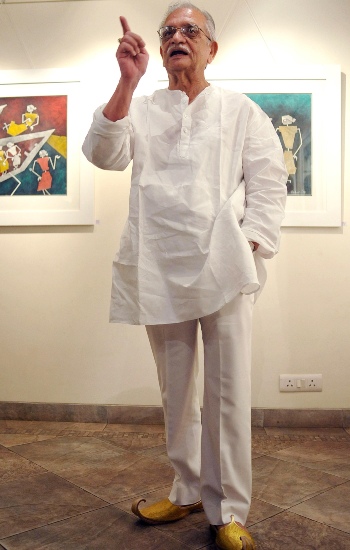
The great film lyricist Gulzar said in a 2017 interview that he has worn white since his college days, and it would “feel false” to wear colour now. But when asked if he feels most himself in a kurta-pyjama, he said he has never worn a pyjama! He wears a Punjabi-Pathani shalwaar on Sundays, of the sort worn in his home-town of Dina in Pakistan, and earlier often wore a dhoti. But what he wears almost all the time is “a regular pair of trousers, with the front crease and everything...” said Gulzar. “It’s just because I’m an Urdu poet that people assume I’m wearing a pyjama with my kurta.”
Photo: AFP PHOTO/STR STRDEL/ AFP
Image
Poet and lyricist Gulzar at an exhibition in Mumbai.
Who is this fictional Urdu poet, who must wear only white, or even only kurta-pyjama? The image may have been truer when In Custody was written, but even the 84-year-old Gulzar has spent a lifetime playing tennis, wearing shorts. The young Urdu poets you might meet at a mushaira in Delhi, at Jashn-e-Rekhta or one of the city's many literary festivals, might be software engineers or tourist guides, TV journalists or government school teachers. They may be “of the bazaar world”, but are no lafangas. And you cannot identify them by their clothes.
Published in The Voice of Fashion, 2 July 2019.

22 April 2019

Prisons of the Mind


At 25, Ismail Merchant's In Custody (Muhafiz) remains a striking vision of poetry amidst pettiness, as well as a memorable tale about Urdu and Hindi.  

Image

In 1984, Anita Desai was nominated for the Booker Prize for a novel called In Custody. It was a marvellous book about a shaggy old poet called Nur, whose last days we observe through the eyes of a college lecturer called Deven. Desai wrote her story in crystalline English, but the world she captured was that of the death throes of Urdu – as witnessed by a teacher of Hindi.

A decade later, the novel was made into a film by Ismail Merchant, starring Om Puri as the nervous, embattled Deven, and Shashi Kapoor – who had been a Merchant Ivory favourite from The Householder (1963) through ShakespearewallahBombay Talkie and Heat and Dust (1983) – as the teetering but still somehow charismatic Nur.


Interestingly, Desai agreed to adapt her book for the screen, collaborating with Shahrukh Husain, to whom we owe the fluid Urdu/Hindustani/Hindi in which Desai's imagined universe is translated back to life. Desai, the daughter of a German mother and a Bengali father who had been to school and college in Delhi, had set her novel between the hubbub of Old Delhi and the dusty provincialism of the fictional Mirpore, a trading town not far from Delhi. The film kept the poet's locational moniker “Nur Shahjehanabadi”, but transposed him (and the hole-in-the-wall magazine office run by Deven's friend Murad, which is angling for an interview with him) from the gullies of Shahjahanbad to Bhopal.


It was probably a practical decision, and certainly a more visually pleasing one. The circuitous route to Nur's house no longer went past “the reeking heart of the bazaar”, “evil-smelling shops” or the “lane lined with nothing but gutters”, but into a picturesque part of Bhopal. And the cinematic version of the haveli has a certain charm, despite the dysfunctional lives lived in it. The downstairs is presided over by the poet’s first wife, the perfect Sushma Seth, who spends her days supervising the fine chopping of onions and the utaaroing of nazar, while the upstairs is the preserve of the younger second wife, the complex, high-strung aspiring poetess Imtiaz Begum (Shabana Azmi).


Deven arrives with a very different vision of the life poetic than the one he finds being led by Nur. The film distils Desai's sharp-edged observations into something quite brilliant. An admirer of Nur's verse, Deven initially sees the great poet as trapped: when he seeks to escape the petty domestic squabbles of his household, his escape is limited to a circle of lowbrow sycophants. The delicacy of Nur's poetic imagination, it seems to Deven, cannot be nurtured by the coarseness that surrounds him. There is clearly an echo of recognition here – Deven, too, has aspirations to poetry, which he still writes – in Urdu. He feels defeated by having been tied to the mundane: the teaching job – in Hindi – that pays his bills but forces him to suffer the sly, mocking glances of students for whom romance tends more to dark glasses and motorbikes than literature; the harried, put-upon wife who does not understand poetry or the desire for it; the little son whose abilities seem too ordinary and unliterary to attract Deven's attention.


But Desai is not so one-sided as to allow even her favoured protagonists to get away with such easy self-delusion. The film incorporates these layers beautifully into the performances. We watch Deven's petulant, unnecessarily bossy behaviour with his wife Sarla (a superb Neena Gupta, who responds with the perfect balance between silent reproach and jaded complaints). We observe Nur’s own flaws: his indiscipline, his indulgence of the senses, his addiction to the excesses of alcohol and rich Mughlai cooking and late hours kept in the company of flatterers whose crude verse is so obviously no match for the quality of his. If coarseness there is, it is as much of Nur's making. And if the women are insecure, jealous, petty even when they have some ambition, In Custody is astute enough to show us that they cannot really be blamed: the limits of their imaginations are the limits of what their civilisation has allowed them.


The book went into much greater detail about the politics of Hindi and Urdu, with the poet often mocking Deven's employment in a Hindi department: “Forgotten your Urdu? Forgotten my verse? Perhaps it is better if you go back to your college and teach your students the stories of Prem Chand, the poems of Pant and Nirala. Safe, simple Hindi language, safe comfortable ideas of cow worship and caste and the romance of Krishna,” he derides Deven, in a line that seems bizarrely blind now. There are complaints about the Congress having placed Hindi and the Hindiwallahs atop the literary establishment, while Urdu is imprisoned in “those cemeteries they call universities”. Thirty-five, even 25 years ago, the fictional Nur and his bazaar hangers-on – largely Muslim, young, unsophisticated of taste and insecure of income – could still mock a Hindu lecturer of Hindi who had come to pay his respects to Urdu. If Nur stood for the decrepitude and self-delusion of Urdu, Hindi was represented by the innocuous wannabe poet Deven. That equation has changed, perhaps forever.

30 January 2019

Obituary: Krishna Sobti 1925-2019

My obituary of a great Indian and a great writer, who was also warm, forthright -- and crucially, great fun. 

A DELIBERATE OUTLIER

Image

Like the tragically rising caste of Indians educated almost entirely in English, the only Hindi writers I had read until 15 odd years ago were those prescribed in my school textbooks. Krishna Sobti was not one of them. Then, in 2005, I stumbled upon her Dil-o-Danish in the cold basement of a Columbia University library, and for the next 48 hours, exam semester notwithstanding, I couldn't tear myself away from Sobti's brilliant 1920s imagining of the city I called home.

Among the most delicious of Delhi novels, the saga of Kutumb, Kripanarayan and Mehek Bano is a universally recognisable love triangle embedded in a very particular Indian social context: the Kayastha patriarch, his lawfully wedded wife (perfectly named, 'kutumb' means family), and his beloved Muslim mistress, with whom, too, he has two children. Sobti captured the fraught but irrevocable tie of the marital, but also the deep-seated romantic attachment of the extra-marital. And she did all this while paying effortless tribute to the everyday cultural life of Delhi, from the making of new quilts at the onset of winter to the poems recited by children at weddings.

In the years since then, I read many more of Sobti's books, slowly realising that part of what made her oeuvre so remarkable was her mastery of language. In novel after novel, she worked to create a different milieu, each brought to fruition by her unerring ear for the multifarious spoken tongues that huddle together under the umbrella rubric of Hindi. The rhythms of rustic Punjabi (Mitro Marjani, Zindaginama) were as much under her control as the urbane Urdu-inflected language of Old Delhi's elite (Dil-o-Danish), or then again the mixture of English and Hindustani in a 1970s government office (Yaaron ke Yaar).

Her outspoken women characters, too, made her unique among Indian writers -- and unlikely to be prescribed in school textbooks. Whether it was the rough-tongued desirousness of Mitro in Mitro Marjani, or the difficult memories and sad-eyed yearning of Ratti in Surajmukhi Andhere Ke, or the many close mother-daughter pairs across her books, from Daar se Bicchudi to Ai Ladki, Sobti's very different women were unafraid yet never invulnerable. Perhaps a little like herself.

Her death yesterday, less than a month short of her 94th birthday, is likely to generate tributes to the grande dame of Hindi literature, but Sobti spent much of her career as a deliberate outlier. A Punjabi who chose to write in Hindi, she was too outspoken for the hidebound Hindi literary establishment. Her novel Zindaginama will live on among the most astonishing novelistic depictions we have of life in Punjab, but Sobti remained an outsider to the Punjabi scene -- especially after she filed a case of copyright infringement against the Punjabi literary doyenne Amrita Pritam for naming a book Hardutt ka Zindaginama. She was among the rare Hindi writers who wrote attentively, frankly and sharply about her peers, producing a series of magisterial sketches under the androgynous pen name Hashmat. Most of all, she was that rare Indian woman of her generation who carved out a life on her own terms: not succumbing to marital domesticity for most of her life, and only marrying the Dogri writer and translator Shivanath when she was 70.

When I first met her in 2009, Sobti was 84, and told me with all the clarity of experience: “Household chores sap women’s energies. If the family becomes the limit of your world, then you cannot think big.” It is a thought I often return to, and a dilemma that many women grapple with. Krishna ji resolved hers a certain way, but she knew that wasn't a possibility open to most women, especially in India.

By the time I met her again, for a long-form Caravan profile in 2016, she was 91, and practically as housebound as the mother in her Ai Ladki had been. Shivanath ji had passed away some years before, and she was back to living alone, with her trusted housekeeper-cum-assistant Vimlesh. But she rarely lacked for company: whenever she was well enough to see people, there were always writers, journalists or editors lining up to see her. And she loved to play the host, pressing Darjeeling tea and biscuits and namkeen upon guests in her small Mayur Vihar flat. Once I had spent the whole day listening to delightful tales of her Lahore or Shimla girlhood, or her frank, gleefully giggly accounts of scandalising the Hindiwallas, she might urge me to join her in a glass of rum-paani.

Yet there was something undeniably solitary about Krishna Sobti. When she retired to her desk, the world was always with her. But she always knew it had to be held at bay, in order for her to be free to do what she had been born to do: to write. 

29 January 2019

Book Review: Urdu Memoirs

A short book review published in India Today:
Image


Yeh Un Dinoñ Ki Baat Hai: Urdu Memoirs of Cinema Legends by Yasir Abbasi; Bloomsbury India; Rs 699; 448 pages

Here's a bit of film trivia: which Indian actor (other than Rajinikanth) worked as a bus conductor? Would it help to tell you he was originally called Badruddin Qazi? Or that he landed his first major role because Balraj Sahni suggested he enter Guru Dutt's office pretending to be drunk? Or (last clue) that his inebriated act was such a hit that he later named himself after a popular whiskey brand?

Yes, it's Johnny Walker.
Yeh Un Dinon Ki Baat Hai: Urdu Memoirs of Cinema Legends is full of such tales. Editor-translator Yasir Abbasi's excavation of old Urdu film magazines lays out a new matrix of origin myths, loving details and vicious gossip involving not just actors, but directors, writers, singers and lyricists from what used to be called Hindi cinema.
Some get to tell their own stories, which means elisions and self-aggrandisements or, at least, careful public presentations of the self. Johnny Walker is keen to establish that he's really a teetotaller. Writing in Shama magazine in 1981, the 1940s star Veena lists the many famous films she almost did: Anmol Ghadi, Udan Khatola, Mughal-e-Azam, Jogan, Mother India, even an abandoned early version of Mahal. Dharmendra mentions a close "friendship" with Meena Kumari, but completely avoids his role in ending it: "it never occurred to me back then that one day she... let's just leave it at that."
Others are described by friends and admirers, or by writers who happen to be friends and admirers. So the brothers Ganguly (Ashok Kumar and Kishore Kumar) get a tribute from the actor Iftekhar, Hindi cinema's once-perpetual police officer. The composer Naushad tells of the director K. Asif's grand ways, including the tale of how Bade Ghulam Ali Khan was persuaded to be Tansen's voice in Mughal-e-Azam. Dialogue writer and playwright Javed Siddiqui has a charming fanboyish piece about working with Satyajit Ray on Shatranj ke Khilari. K.A. Abbas writes with acuity about Raj Kapoor, for whom he wrote many films: "If he loves just himself, then why do all of us still love him? Well, that's because there's something else that he places even before himself -- his work, his art."
The crisscrossing narratives sometimes produce a Rashomon effect. Eg: Dharmendra's coy elision is matter-of-factly undercut by Nargis, who frankly appraises Meena Kumari's passion for him and her heartbreak when he left. Whether reading that piece, or Ismat Chughtai on the singing star Suraiya, or the memoirs by Nadira, Shyama or Meena Shorey, it's clear that the Hindi film industry awarded its actresses particularly lonely, difficult lives.
I have many quibbles with his translation, but Abbasi has done film buffs a service.

19 December 2018

Page-turner from the past

My Mirror column:

Thinking about Dilip Kumar, who turned 96 last week, as I leaf through a book of Urdu film memoirs now translated into English

Image
Dilip Kumar and Madhubala, who played Salim and Anarkali in Mughal-e-Azam


Last week, I started to read a new book called Yeh Un Dinon Ki Baat Hai: Urdu Memoirs of Cinema Legends, a collection of pieces from Urdu film magazines that have been selected and translated into English by Yasir Abbasi. Also last week, on December 11, actor Dilip Kumar turned 96. 

Dilip Kumar, born Yusuf Khan in Peshawar in 1922, has long been known as an Urdu aficionado, so I was hopeful that he might feature in the book. I was thrilled to find that there was actually a piece by him. Published in the Delhi-based Shama, it was a thoughtful reflection on his ‘King of Tragedy’ image. “I was declared a ‘tragedian’ at a time when I was still in the process of refining my skills,” he writes.

For Abbasi, a cinematographer and “lifelong film buff”, the book is clearly a labour of love, combining a nostalgic appreciation of Bombay filmdom with a desire to archive a lost world of Urdu journalism. By following each translation with a sample paragraph from the original essay, transcribed in Roman, the book offers a delightful little bonus to many readers like myself, who cannot read the Urdu script but are perfectly capable of understanding the words. 

But this also means opening up the translation to rather wider scrutiny than usual. To return to the Dilip Kumar reminiscence, for instance, it slips up in that single sample paragraph. “I believe real tragedy leads to a kind of sadness that permeates a person’s soul, making the individual stand out in a crowd,” reads Abbasi’s translation. But here is Dilip Kumar’s original Urdu: “Ya’ani andarooni wajood mein kucch aisi udaasiyan taari hon ki aadmi bharay mele mein bhi akela nazar aaye.” I’d say that “bharay mele mein bhi akela nazar aaye” here was meant to suggest that the tragic individual would have a profound air of solitude: he would appear alone even in a crowd.

Despite this, I was glad to read Dilip Kumar’s brief account, which revealed a man able to step away and scrutinise himself, both as an actor and a human being, in a way that would be rare in any era. He begins by pulling up those who equate tragedy with sentimentality. Tragedy, he says, goes beyond “superficial catastrophe” (though again, this is not how I’d render his “satahi qism ke haadsaat ki bharmaar”). His list of emotional markers is fascinating, because it maps a whole social -- and cinematic -- universe: “parting with the beloved, going bankrupt, betrayal of friends, or being disowned by the family”. (Again, the original ends with “makaan-jaaydaad se waalid ka be-dakhal kar dena”, which I’d have translated as “being disinherited from family property by a father”).

I was also struck by the remarkable honesty with which he spoke of his depressive tendencies — we must remember that he was writing for a mass Indian readership in 1973. He says he consulted psychologists in England, who suggested he take a break from melancholic roles. Taking on SMS Naidu’s comedy Azaad (a remake of the director's 1954 Tamil film Malaikkallan, starring MGRupon his return to India, he says, was a professional decision made for psychological reasons.

But while Dilip Kumar straddled Hindi cinema like a colossus (others in the book make many references to his aura, his linguistic skills and professionalism), what Yeh Un Dinon Ki Baat Hai makes clear is that his personal life also remained grist for the gossip mill. It comes up in all kinds of ways: as sly rumour, as tragedy, as professional hazard. An amusing instance of this is Dharmendra in Shama in 1977, where he cites Dilip Kumar’s affairs with co-stars as part of his aspirations: “Before I stepped into the world of films, I had heard a lot about the Raj Kapoor-Nargis and Dilip Kumar-Kamini Kaushal pairings. I too would fancy forming a similar duo with someone.”

His affair with Madhubala had a more tragic aftertaste because they separated on an acrimonious note (her father was, according to Dilip Kumar’s 2014 autobiography, not opposed to the wedding as much as keen to add Kumar to his money-making assets) — and because Madhubala died young. Madhubala seems to have other admirers: Nadira’s account here informs us that Premnath’s only true love was Madhubala, and the character-actor and later villain Ajit describes her after she dropped out of Naya Daur as “the wilted Anarkali who had been abandoned by Salim”. But other actresses could remain unsympathetic: the actress Veena’s version has Madhubala telling her during Chalti Ka Naam Gaadi that Dilip Kumar was her husband, and later, that she only married Kishore Kumar “[t]o annoy Dilip Kumar”. 

Among the last references to the thespian in the book is about how Ruby magazine went after the story of Dilip Kumar’s second marriage in 1982, when his vehement denials turned out to be false. But while it did not shy away from salacious or critical commentary, the Urdu magazine seems to also have offered a space for film folk to present themselves in their own words. Dilip Kumar's gift for words, of course, gave him an advantage here. Even in that tiny piece, he managed to suggest his perfectionism: “A misra [line of a poem] by Firaq saheb sums it up aptly for me: Akseer ban chala hoon, ki aanch ki kasar hai [I’d turn into an elixir, if only I could simmer a little more]." He may well have fulfilled that hope.

Published in Mumbai Mirror, 16 Dec 2018.