Showing posts with label modernity. Show all posts

29 March 2021

The freedom of the spirit, dead or alive

My Mumbai Mirror column:

An unexpected death opens up surprising new directions for life in Umesh Bist's deftly-balanced new film.

Image
Umesh Bist's new film may ride on the suggestion of quirky lightness – even the title, Pagglait, is an affectionate UP word for madcap -- but at its heart lies an absence. At the simplest level, the absence is of a person. A young man called Aastik, sole earning member of a joint family of five, has suddenly died -- leaving his parents bereft, his young wife widowed and all of them in financial trouble. The secondary form of absence, around which Bist really builds his narrative, is the absence of love. Aastik's wife of five months (the talented Sanya Malhotra) can't seem to grieve her loss. Is she just in shock? Or did she feel nothing for her late husband? Worse, did he feel nothing for her?

To build a film around this dual vacuum is a difficult task, but Bist pulls it off. Right from the very first shot -- a cycle-rickshaw driver shifting his weight from one buttock to another as he transports a heavy load of mattresses – the film balances a gentle, languorous gaze with mild, deadpan humour. He gets perfectly right, for instance, the air of melancholia in a house where a death has occurred -- the dark room, hushed voices and sombre faces. But he also catches the whiff of absurdity that is attached to conventional mourning: Having to field calls from relatives whose names you don't even remember, or the excessive weeping on the part of people who consider themselves close. The widowed daughter-in-law is expected to have cried herself into a stupor, but all she can think of is whether she can get a Pepsi instead of chai. The obligatory forms of mourning death can make a simple desire for continued life seem oddly obscene. But is it? That train of thought culminates in a memorable sequence where the eating of golgappas is intercut with the dead man's last rites.

These tonal shifts aren't easy, and Bist adds additional plot twists that offer a window into the dead man's secret life. (I won't go into them here, but suffice it to say that they touch on both love and money.)


Pagglait is also a fine addition to the growing body of Hindi films set in the north Indian small town, with a keen sense of familial dysfunction. Endowed with a stellar ensemble cast that includes Raghuvir Yadav, Sheeba Chaddha and Ashutosh Rana, the film catches much that's dire about the middle class extended family. This is less a world of angry recriminations than petty jealousies and long-held grudges. If the men judge each other for (the lack of) monetary success, the women compete in the domain of husbands and children. And while the women might have had to kowtow to men most of their lives, their words can drip with scorn. The barbs are quietly delivered, but go straight for the jugular. “Jo cheez khud ke paas nahi hoti, woh doosre ke paas bhi acchi nahi lagti [What one doesn't have oneself doesn't look good even when someone else has it],” says a husband-adoring sister-in-law to another who appears to be separated. “Pajaame se naada nikala nahi jaata, baatein badi-badi [Can't take the drawstring out of a pair of pyjamas, but talking big anyway],” a wife scoffs at her husband.
While the older adults conduct these hoary old battles, the younger lot are forging new arenas. There are plenty of indications of Bist's optimism. The widowed Sandhya's best friend, who quietly shows up to stay for the 13 days of mourning, is a young Muslim woman; the late husband's younger brother is happy to take English lessons from his bhabhi; the feisty 14-year-old girl visiting from out of town easily lords it over her 13-year-old male cousin. Even in relationships between women, the conventional path of jealousy and competition is sought to be replaced by the potential for understanding. There are no villains and vamps here, only people doing the best they can under the circumstances.

Pagglait works interestingly as a companion piece to the 2019 film Aise Hee, the marvellous feature debut from the writer-director Kislay (he goes by a single name) which won awards at MAMI and Busan, among other festivals. Both films are about women for whom the event of widowhood comes as unexpected liberation – not something they've yearned for, perhaps, but a vista that suddenly opens up before them. Whether you've been married for 52 years or five months, it seems, the absence of a man can sometimes be the only way for women to realise who they are.


Published in Mumbai Mirror, 28 Mar 2021.

23 November 2020

A day at the museums

My piece for India Today magazine:

Connoisseurs can once again visit the National Museum and the National Gallery of Modern Art in Delhi to gaze at some of India’s most iconic artefacts and works of art.
 
Image
Visitors at the National Gallery of Modern Art in Delhi admire Amrita Sher-Gil’s painting 'Young Girls'

The National Museum New Delhi had never felt this intimate. I was in the Miniature Gallery when a robust male voice began to sing loudly: “Tu hi pyaar, tu hi chaahat, tu hi aashiqui hai”. I had been admiring Radha and Krishna admiring their own reflection in a mirror: a pre-digital couplefie aided by an attendant, and the painter. Now the 1640 Mewar miniature seemed illuminated by the security guard’s rendition of the song from Mahesh Bhatt’s 1990 romantic superhit, Aashiqui.

It was 3 pm on the first Sunday after India’s premier museum reopened on November 10, but only 23 ticketed visitors before me had entered the grand old building on New Delhi’s Janpath. Inaugurated in 1960, the museum complex is being revamped since 2017, and I have often found the upper floors closed for renovation.

On Sunday, you could again climb the grand staircase to the second floor, but the only gallery open was ‘Tribal Lifestyle of North East India’: unreconstructed old-style anthropology running rampant, though there are some striking Monpa and Naga masks and headdresses. Sections of the open corridor display were cordoned off, but visitors might enjoy the 10th century South Indian stone sculptures of zodiac signs. On the first floor, I followed two reluctant men into the Ajanta Paintings gallery at a guard’s urging, but the lights were all off. Tanjore Paintings, too, was closed. But you could visit Central Asian Antiquities, Maritime Heritage and the Coins Gallery, which I have always thought an attractively condensed history of South Asia. Watch out for the 3rd-5th century CE Gupta emperors, who chose this most public canvas to enshrine themselves in the popular imagination as ‘Rhinoceros-slayer’, ‘Swordsman’ and my favourite, ‘Lyrist’: the conqueror Samudragupta proclaiming his mastery of the veena. Post-demonetisation currency isn’t a patch on Gupta coinage.

On the ground floor, I paid a visit to the Harappan Dancing Girl, tiny and insouciant as ever, before ambling into the sculptures, where a stunning buffalo-headed female figure caught my eye. “Vrishanana Yogini. Pratihara, 10th -11th cent. A.D. Lokhari, Distt. Banda, Uttar Pradesh,” said the label. It was only later that the internet told me this was one of the museum’s most treasured new acquisitions. Illegally trafficked out of an Uttar Pradesh temple, this example of the powerful female-centric Yogini cult was returned to the Indian embassy in Paris in 2008 by the widow of a French collector and acquired by the museum in 2013, under the then director general, Venu V. If only our curators understood: this is the story that should be on the plaque. The nation would want to know.

“Sixteen of the museum’s 27 galleries are accessible in this first phase of reopening,” the museum’s education officer Rige Shiba wrote in an email. Many new arrangements are in place: the ticket counter is now outside the entry gate to the complex, and temperature checks, sanitisation and security screening take place before you walk in. Following the ministry of culture’s guidelines for post-Covid reopening, free volunteer-led tours are currently suspended. So is one of the museum’s innovations for visually-disabled visitors: touch tours of the 22-item Anubhav gallery. Audio guides are also out for the moment “unless these can be disinfected after every single use”.

Curatorial tours are also suspended at the National Gallery of Modern Art (NGMA), where daily ticketed visitors are down from 250-500 in pre-Covid times to about 70. The gallery is discouraging group visits, with curators offering customised digital walkthroughs instead. There’s also a free virtual tour. But on Sunday evening, having scurried through November rain, I could not have found happier shelter than the beauteous airy interiors of the NGMA. Anupam Sud’s Ceremony of Unmasking triptych made me smile at its new relevance. Bhupen Khakhar’s miniature-inspired Hamam Khana (1982) seemed prescient about our strange faux-sanitised times: a naked woman standing rigidly to attention in a bare, controlled enclosure, as if waiting to be allowed to bathe.

I took the empty elevator upstairs, discovering the Mexican mural-like joys of Pran Nath Mago’s Rice Planters (1952), before arriving at his Delhi Shilpi Chakra collective contemporary, the underrated modernist B.C. Sanyal (1901-2003). I stood forever in front of Sanyal’s stunning At the Nizamuddin Fair and his seductively lungi-clad self-portrait, Old Man and the Bird. “Now that’s the old man of love to become,” a friend texted back.

A masked boy and girl stopped at an M.F. Husain. “Yeh Picasso hain (this is a Picasso),” the boy said. “Kehte hain inki chai bhi gir jaati thi, toh painting ban jaati thi (they say if he dropped his tea, it would also become a painting).” They held hands tightly. The world fell away.
 

19 October 2020

The Doctor as Anti-Hero

My Mirror column (this is the fourth piece in my series on doctors in our films):

Hrishikesh Mukherjee's Bemisal (1982) can be viewed as a subtle, affecting love triangle, but it is also a rare Indian film about medical malpractice -- and the possibility of atonement.

Image

Bemisal opens with a man in a kurta-pajama cycling between villages, with only a sola topi to protect him from the sun. From the little box affixed to his cycle, one wonders if he is a postman, but the mystery is solved soon: he is a doctor. “The only doctor within a forty mile radius,” as we learn when he gets home for a minute, only to be called away again before he can lunch with his wife.

This vision of the doctor as he should be, or at least could be – a much-needed saviour of the Indian poor – is one of the two faces of the medical profession in Hrishikesh Mukherjee's 1982 film. And ostensibly Vinod Mehra, as Dr. Prashant Chaturvedi, plays both of them.

A Hindi adaptation of the Bengali film Ami Se O Shakha, Bemisal relocates the writer Ashutosh Mukhopadhyay's original tale of friendship and sacrifice in the world of modern-day medical practice – and malpractice. From its opening rural scenes, the film moves swiftly into flashback -- and into what was still recognizable Hindi movie terrain in 1980s: a holiday in Kashmir. It is there, on a promontory looking down at the Dal Lake, that a much younger Prashant and his friend Sudhir Rai (Amitabh Bachchan), both recent medical graduates from Bombay, first encounter a visiting literature professor (AK Hangal) and his daughter, Kavita. Prashant, the son of a magistrate, has his path cut out for him and follows it: he becomes a doctor, marries Kavita (Rakhee), and goes abroad for higher studies in gynaecology. Meanwhile his friend Sudhir, rescued from a life of juvenile crime by Prashant's father, also becomes a doctor, but chooses to stay in India and work in a regular hospital as a child specialist.

The two remain friends despite these varying choices. But the Prashant who returns from the USA is a very different man from the one who left. “Hamaare profession mein aage badhne ke liye raasta seedha nahi hai, tedha hai [The way to get ahead in our profession isn't straight, it's crooked],” he announces to Sudhir and Kavita. “I came back with such a big degree, did I get a job, have I been able to establish my own practice? No, because in our country it is much easier to go from ten lakhs to eleven lakhs than from ten rupees to eleven rupees.” Bemisal is not one of Hrishikesh Mukherjee's finest films, but what he captures here is the sense of entitlement that had already become the tenor of conversation among educated young Indians in the late 1970s and 80s, a growing frustration with bureaucratic hurdles, a feeling that the country owed them – rather than they it. “My father wanted to see me become a big doctor, and I will fulfil his dream -- by hook or by crook,” says Prashant without the slightest irony. He proceeds, again without irony, to sell his father's house to buy a new private nursing home, which starts to rake in money.

This raging financial success, it turns out, isn't sanguine. What Prashant passes off to his wife as his popularity (“teen maheene se advance bookings”) turns out to be a matter of accepting black money and cooking the books. Second, it is the start of the era of Caesarian deliveries and Prashant is shown deliberately encouraging them, even for what could have been regular births -- each operation and hospital stay bringing in additional moolah. (The film also makes a joke of the new fetish: Deven Verma's character, while getting engaged, buttonholes a gynaecologist to book an advance Caesarian delivery for his wife-to-be.) More complicated is the nursing home's role as a site of expensive, often illegal, abortions: here Mukherjee and his screenwriter Sachin Bhowmick falter. The film mixes up what it considers the morally unethical practice of secret abortions for “the unwed daughters of the rich” with the medically unethical – and dangerous -- business of conducting MTPs past the advisable date, for an under-the-table fee.

A case of the latter sort finally leads to the death on the operating table at Prashant's hands – though we never see the young woman. What we are given instead is the agitated figure of Aruna Irani, a receptionist at the nursing home who reports the death because she is still traumatised by a long-ago unplanned pregnancy and unwanted abortion carried out on the instructions of her callous playboy lover.


I said at the start of this column that Vinod Mehra plays both figures: the doctor as hero, and the doctor as antihero. But this is a Hrishikesh Mukherjee film, so of course we also have a second hero – the film's real conscience, Amitabh Bachchan's Dr. Sudhir Rai. A character with greater spine than the poetry-spouting but easily-swayed Prashant, Sudhir seems on the surface to be a standard-issue mainstream Hindi film protagonist: a doctor who sacrifices his medical practice and his quasi-radical views about the class divide to friendship, the personal weighing in over the political.

But then you think about what Sudhir achieves by going to prison in Prashant's stead – bringing a doctor back from the brink of criminality and making him the model for another possible life, lived in an India “where our rotten civilization has not yet reached”. It may be a message quietly delivered, but it seems to me that Hrishikesh Mukherjee did leave doctors with the rather simple question that Amitabh Bachchan asks Vinod Mehra early in the film: “Ek baat bataa, kya tarakki karne ka yahi tareeka hai? [Tell me something, is this the only way to progress?]”
 

16 February 2020

Under the influence

My Mirror column:

The under-watched classic Bigger Than Life turns family drama into almost-horror, with prescient warnings against modern medicine and delusional masculinity


Image
 
The first 20 minutes of Bigger Than Life seem to paint a picture of the perfect family man, who’s also a hard-working, pleasant colleague. A schoolteacher in suburban 1950s America, Ed Avery (James Mason in a career-defining performance) is the nice guy you ask to help push your stalled car, the guy who lets the kid in detention go if he can name one Great Lake out of the five, the guy who sprints on to the last bus after school to work a second job at a garage.

But those first 20 minutes also show us that Ed is also the sort of guy who thinks he can handle everything, and do so alone: he hasn’t told his wife about the garage job because she’ll think it’s beneath him, nor mentioned the pains he’s had for six months because he thinks they’re nothing. So it doesn’t seem surprising that when he’s forced to go to hospital after a blackout, his first instinct is to instruct his little son Richie to be “the man around here” and “take care of your mother”.

On the surface, Nicholas Ray’s film is about the dangerous mental side effects of a miracle drug for the body. Ed is diagnosed with a rare inflammation of the arteries, and treated successfully with cortisone – until he starts to take it in excess. The mood swings, paranoia and manic depression that result only reinforce his impaired judgement, making him take still more pills. Screenwriters Cyril Hume and Richard Maibaum based the script on an article called ‘Ten Feet Tall’ by Berton Roueché, medical staff writer for The New Yorker, about a real schoolteacher’s experience with high-dosage cortisone. And though this is 1950s America, and patient and doctor are well-acquainted, even friendly, the film clearly indicates how alienating hospitalisation is: the non-stop tests, the solitary confinement, the ghostliness of barium meal, the unrecognisable medical jargon in which you hear your own body described.

But Ray, a director more famous for films such as Rebel Without a Cause and In a Lonely Place, was a man both ahead of his time and able to see into the depths of it. Released in 1956, when much of America was watching the era-defining sitcom Father Knows BestBigger Than Life revealed the frightening cracks in that idyllic ’50s family picture. At one level, Ed Avery’s symptoms are those of a mentally ill man, but he can certainly also be viewed as a barely-exaggerated version of the ordinary neighbourhood patriarch, the father who thinks he knows best even when he clearly doesn’t. This is the man insecure about being a “male schoolmarm”, who also has delusions of grandeur about schooling the nation. He insults his wife (“What a shame I couldn’t have married... my intellectual equal!”) and pushes his child beyond breaking point in the name of prepping him for the real world (“If you let it at ‘good enough’ right now, that’s the way you’ll be later on.”).

The film is also a powerful indictment of the pressures of life in a consumerist era, for a man trying to give himself and his family a good life on a single schoolteacher’s salary. The Averys’ house is filled with posters of faraway European holiday destinations, and there are wry, hopeful conversations about vacations and “getting away from it all” – while the camera often focuses on James Mason’s watch, and time and lateness is a frequent topic. The tight budgeting that makes Ed work a secret second job has as its flip side the grandiose display he indulges in when under the influence of the cortisone: hustling his wife into a fancy designer store, being rude to the saleswomen, and insisting on buying her two expensive dresses with a cheque that eventually bounces.

The more unbalanced Ed gets, the more he is convinced that he is the only smart person around. The milkman’s jangling of a bell seems to him deliberately designed to annoy him “because I work with my mind”, the other drivers on the street irritate him, his son and wife disappoint him, and the children he teaches for a living seem to him idiots. “We’re breeding a race of moral midgets,” he declares at a PTA meeting, eliciting mostly gasps of disbelief – but also a couple of votes for future school principal.

Watching Bigger Than Life in 2020, the self-aggrandising family man who thinks the country needs to do away with “all this hogwash about self-expression, permissiveness and emotional security” and focus on inculcating “a sense of duty” feels terrifyingly familiar. He might be your neighbour, your uncle, your father or your boss. And his condition is getting worse, under the influence of a collective drug called nationalism, being doled out for free at a counter near you.

Published in Mumbai Mirror, 2 February 2020.

4 October 2019

The dream machine - II

My Mirror column:

What might we learn about our relationship with machines from Ritwik Ghatak’s classic Ajantrik and Buddhadev Dasgupta’s recent Urojahaj – with a detour through Naya Daur? The second of a two-part column


Image


In last week’s column, I suggested that there might be something to be learnt from comparing two Indian films made 60 years apart, each about a man besotted with a machine – Buddhadeb Dasgupta’s most recent feature, Urojahaj (The Flight), and Ritwik Ghatak’s 1957 arthouse classic Ajantrik

In Urojahaj, the protagonist is a happily married man with a child, and his attachment to the broken-down Second World War plane he finds in the forest comes across as selfish. The mechanic’s quest for something so impractical can only be individualistic. The plane is an obsession that takes Bachhu Mondol away from those he loves. And as he hears more tales from ghosts of betrayed humans, he begins to be suspicious of those that love him: in one sadly revealing moment, when his wife tells him the police are looking for him, he actually asks her if it is she who has reported his discovery of the plane.


In Ajantrik, in contrast, the taxi driver hero Bimal has no-one else to love. The battered taxi seems to fill up the space in Bimal's heart where a person might have been. When Bimal speaks of Jagaddal, it is as a trusty companion – and when the car collapses, he sees it as betrayal.(“Even if I give you my all, I can't win your favour?”) His hunger for human company may be inarticulate, but when he encounters a young woman who has been cheated by her lover, something buried deep within the usually misanthropic Bimal bubbles up to the surface. When Jagaddal appears not to cooperate in his mission to help her, Bimal delivers a well-aimed kick to its engine. That unprecedented moment of anger kickstarts the process that will eventually bring the machine to its knees – and it might be said to stem from Bimal's frustrated effort to assist another human being.

Despite their differences, the close relationship between man and machine in both films seems to turn on excluding the rest of humanity. The same year as Ghatak made Ajantrik, the Hindi film industry also produced a hugely popular narrative about man and machine. Released on August 15, 1957, BR Chopra’s Naya Daur ('The New Age') starred Dilip Kumar as Shankar, a tangawalla who becomes the focal point of a battle between the horse-cart drivers of his village and the evil capitalist son of the village’s feudal landlord. The legendary climactic race between Shankar, straining at the reins of his horse-drawn cart, and the villainous Kundan at the wheel of his bus was staged such that the underdog would win. 

But even within Naya Daur’s wishful dream universe, laced with the labour-capitalist bhai-bhai rhetoric that was often as far as Hindi cinema socialism went, Shankar’s victory could only be presented as a one-time thing, a reprieve. The film was intended only to give us pause as we hurtled into the machine age, to consider the fate of the masses who would be left behind if we were not careful.

Ajantrik seems to occupy a mindspace so different that is scarcely recognisable as belonging to the same cultural landscape. Instead of a race between a tanga and a bus, Ghatak has his taxi compete with a train. The creaky, decrepit Jagaddal cannot win. But that does not lead us to anything so simple as a win or a loss for technology. Driving too fast on a curving hilly road to catch up with the train, Bimal must draw back from the edge in the nick of time – and the moment when he does is also the moment when he finally sees the world in which both taxi and train have arrived: disruptions, but here to stay.

What Ghatak shows us through Bimal’s eyes is a festive gathering of the Oraons: women singing with flowers in their hair, bare-chested men with drums, dancing in unison. There is something about Bimal’s gaze that seems to see but not see, the marvellous sight of the human body moving to a rhythm that has existed long before the rhythm of the machine. And yet, as the Oraon man who pushes the broken-down jalopy to Ranchi Station says to his sweetheart, it is the train from this station that takes “our people to Assam and Bhutan, to work in the tea gardens”. A single machine may die, Ghatak seems to suggest, but the machine is here to stay. 


Ajantrik extended the concept of pathetic fallacy from nature to the machine. But the human hero of 1957 still saw his favourite machine in human terms, giving his car a name and human attributes; a sense of life and death; even a kind of burial, at the scrap dealer’s. Sixty years later, at the end of Urojahaj, it is the human hero whose life and death are in balance. Bachhu Mondol, running from the irrationality of a tyrannical state, speeds through the forest and out onto what looks like a runway, and the camera pans over the ground, rising higher as if looking on from high. What Bachhu sees is what a plane would see, if it could. The man in search of freedom now models himself on the machine.

Published in Mumbai Mirror, 15 Sep 2019

The dream machine

My Mirror column:
In Buddhadev Dasgupta’s thought-provoking new film, a
 man obsessed with a plane starts talking to ghosts, making one think of another machine-loving madman in Ritwik Ghatak’s 1957 classic, Ajantrik

Image

In Buddhadev Dasgupta's evocative new film Urojahaj (The Flight), a motor mechanic called Bachhu Mondol (Chandan Roy Sanyal) discovers an old plane abandoned in a forest near his village, and becomes obsessed with the idea of making it fly. He spends hours with the plane, repairing and repainting and dreaming. And most of all, talking to ghosts – the only other human beings to frequent the clearing where it lies hidden.


When it turns out to be a Japanese fighter plane that may have crashed there during the Second World War, one of the ghosts asks Bachhu, does he intend to go to war with the plane?

“I'm rebuilding this plane. I'm making it a new thing. It won’t remember killing people, or war,” says Bachhu immediately.

“Then what will it remember?” asks the she-ghost.

“The sky,” says Bachhu.

The mechanic’s idea of the plane as having a memory – and also being able to forget – is one of the gorgeously poetic ways in which the filmmaker conveys to us that at least for Bachhu, the machine is half-human. There are many other occasions in Urojahaj when the plane’s power over Bachhu is coded this way. “You’re dressing up the plane so much,” another ghost giggles. “Are you going to marry it?” Decrepit though it is, the machine has so completely captured Bachhu’s attention that even his wife starts to wonder if it is her soutan, the rival love of her husband’s life. Bachhu keeps assuring her of his love, but she is not convinced. “You don’t love me any more, else why would you go to the plane every night?” she asks him. And later, “What does the plane give you that I don’t?”

Urojahaj (2018) is Dasgupta's 17th feature film, the latest in a long and distinguished career that has established him as one of India’s internationally known auteurs, his films regularly screened and awarded at top-tier festivals like Venice and Cannes. Sadly, we live in a country in which films like Dasgupta’s barely make it to cinemas. But Urojahaj is a film well worth your time, and worth thinking about at many levels.

For one, the depth of Bachhu’s preoccupation with the plane instantly brings to mind another film about a man’s attachment to a machine directed by a Bengali filmmaker: Ritwik Ghatak's Ajantrik, made an astounding six decades ago. Released in 1957, Ajantrik was the second film made by Ghatak, maverick member of the trio of great Bengali auteurs along with Satyajit Ray and Mrinal Sen. Known in the West alternately as The Mechanical Man and The Pathetic Fallacy, the film starred the well-known Bengali actor Kali Banerjee as a taxi driver who treats his dilapidated Chevrolet jalopy more lovingly than a human companion. Banerjee’s Bimal names the car Jagaddal, and talks to it at opportune moments.

“Thirsty, Jagaddal? Yes, you're panting, wait,” he might say, pouring water into the radiator on a hot day. Or “Sorry, Jagaddal, you'll have to make do with patches for now. I’ll buy you a shiny new hood when I’ve saved some money, I promise.”

Friends and acquaintances snigger about Bimal's excessive attachment to the car – “Private matter? Is the car your lady?” – but he is unperturbed, even turning up in a starched white dhuti-panjabi the day he decides to get Jaggadal photographed. But having shown us Bimal dressed as a coy bridegroom, Ghatak joyfully juggles the car’s imagined gender and age. “Amar Jagaddal baagher bachcha (My Jagaddal is a tiger cub),” announces Bimal proudly in the very next scene. “They envy him, naturally. What young man wouldn’t envy an old man with such stamina?” Soon enough, we also see Jagaddal's number plate, which reads ‘BRO 117’.

In contrast to Urojahaj’s fairly even fable-like quality, Ajantrik alternates between physical comedy, meditative observation and a surprising emotional heft. There is early laughter when Jagaddal splutters and bubbles and honks in response to Bimal, making the film a precursor of such Hollywood creations as Herbie, the Volkswagen Beetle of The Love Bug (1968). But for the lonely Bimal, Jagaddal is his most constant companion, about whom he is quite openly sentimental. “He earns me two rupees a day, no matter what. He’s been with me since my mother died,” he tells the little boy who works in the garage.

On another level, Bimal’s trips with Jagaddal are a way for us to travel through rural Chhotanagpur, a 1950s landscape in which female faces are disproportionately limited to line-drawn advertisements for Baidyanath and Dabur Amla Kesh Tel. It is no wonder that a bejewelled Bengali bride who boards the taxi draws Bimal’s attention. He does not chastise her even when she switches from a romantic, almost aesthetic appreciation of the ruin – how lovely the sky looks through a hole in Jagaddal’s canopy – to a pragmatic, modernist disdain for it: “What a rotten car!”

Ghatak may seem merely to be gesturing to what Urojahaj makes explicit: that a man’s attentions cannot be successfully divided between a machine and a woman. But perhaps there is much more there.

(To be continued next week)

Published in Mumbai Mirror, 8 Sep 2019.

8 September 2019

The Spirit of Technologies Past

My Mirror column:

As we hurtle ever faster into a digitised present, some recent films cast an affectionate glance back at the technologies that made us who we are.

Image

Right at the beginning of the recently released 
Shantilal O Projapoti Rohoshyo, director Pratim D Gupta tells us that his film is about a time “when porn was watched on DVD, news was read in print… and films were made for theatres”. Right from its charming children’s detective story title (the Bangla translates as ‘Shantilal and the Butterfly Mystery’), the film lives and breathes a certain gentle nostalgia. But its special focus is an era that existed until quite recently in India, a time that feels like it’s being elbowed out at top speed by technological transformation. What’s interesting is that the nostalgia is itself framed around an earlier era of technology: the newspaper, the cinema, the photograph.
The film’s deadbeat weather reporter protagonist, Shantilal, with his unquenched desire for a “front page story”; the neighbour who hounds him for a free spot in the matrimonial pages of The Sentinel; the DVD shop guy who urges Bertolucci, Bergman and Buñuel upon a customer who’s waiting for his supply of quality Malaysian erotica – all of these look back fondly to a time before the digital conquest of our lives. But the pirated DVD may be the one to focus on: a signifier of an in-between time. Not before computers, but before news stories began to be broken on Twitter timelines, before Shaadi.com, and before the endless glut of internet porn. It is an era that is not in fact that distant – which is perhaps why it feels so surreal that it is already gone.

Shantilal 
brings to the fore a theme that has, in fact, underlain many Indian films in the past five or six years: our memories of an analogue era. Ritesh Batra’s 2013 critical and commercial success, The Lunchbox, used a dabbawala mix-up to deliver a tribute to a fast-disappearing world – the Hindi music cassettes Deshpande Aunty still listens to, the Orient fan around which Deshpande Uncle’s stagnant life revolves, the Yeh Jo Hai Zindagi episodes recorded from Doordarshan that Saajan Fernandes watches endlessly in memory of his wife. (Using the voice of Bharati Achrekar as the never-seen Mrs Deshpande was, of course, the perfect meta-textual reference to Doordarshan, on which she was once such a profoundly familiar face.)


Image

If
 The Lunchbox took a rather melancholy view, Sharat Kataria’s Dum Laga Ke Haisha (2015) was a more enthusiastic, even raunchy tribute to the 1990s, featuring Ayushmann Khurrana as the small-town owner of a cassette shop. Some of the most endearing moments of the film’s post-marital romance between Khurrana and Bhumi Pednekar involved the VCR as a therapeutic sexual aid and the playing of songs as messages on a cassette player.

The audio cassette with songs personally picked out and recorded was, of course, the ultimate 1990s romantic gesture. That was the matrix of a more recent 1990s-set romance, the Yash Raj production
 Meri Pyaari Bindu (2017), also starring Khurrana. In that film, Khurrana plays a Bengali middle class hero (complete with a daaknaam – Bubla), whose largely unrequited love for his neighbour Bindu is tied up with the technology of their adolescence: Ambassador cars, STD-ISD booths, a nascent virtual universe embodied in email addresses such as [email protected].


Video cassettes were crucial to both Nitin Kakkar’s
 Filmistaan and Vishal Bhardwaj’s Haider. Both released in 2014: one set in Pakistan, the other in Kashmir, and both had political messages. Although tonally miles apart, the two films are united by their references to the early Salman Khan films Maine Pyar Kiya and Hum Aapke Hain Koun. Kakkar presents those films, as he does all Hindi cinema, as the great unifier of countries and people divided by Partition. Haider, written by the journalist and author Basharat Peer, adapts Shakespeare’s Hamlet to 1990s Kashmir: a dark and violent place, as searingly sarcastic as it is driven to desperation. In this world, the two Salmans – the original play’s Rosencrantz and Guildenstern turned brilliantly into Bhai fans and lookalikes who run a videocassette shop – initially seem like comic relief. But as the film builds to its necessarily tragic climax, it becomes clear that no amount of grainy re-watching of MPK songs can keep Haider (Shahid Kapoor) from seeing the reality of the Salmans – or keep Kashmir from seeing the reality of India.

To return to Shantilal o Projapoti Rohoshyo: it isn’t just a simple tribute to a past era. The protagonists of Pratim Gupta’s not-quite-mystery live on the cusp of the present, and often display an active reluctance to cross over. Shantilal himself doesn’t have Whatsapp, though he does have a mobile phone. The film star in her prime (Paoli Dam, very effective as Nandita) expresses a nostalgia for autograph seekers in an era of selfies, and keeps a corner of her bedroom as a photographic shrine to her past. But she finds her future threatened by a photograph from that past. Old technologies can inspire nostalgia, but our attachment to them may tell us less about those forms than about ourselves.

Published in Mumbai Mirror, 1 Sep 2019.

15 April 2019

In the name of a cause

Second part of my two-part Mirror column on Delhi Crime:

Almost unconsciously, Delhi Crime puts its finger on the disconnect between the police and the public. (The second of a two-part column)


Image

The worst written character in Delhi Crime is not one of the rapists. Richie Mehta's fictional depiction of the December 16, 2012 gang-rape gives the six men a rationale. Jai Singh, the driver of the bus as well as of the crime, gets to speak of his own motivations, however misguided. He had become 'unstable' after his wife died, unable to bear the sight of happy couples. 

As for the five younger men (including his own brother), they saw him as their leader, whose uncontrollable temper they knew not to get in the way of. Mehta and his co-scriptwriters resist the temptation to vilify them, instead giving us a remarkably sympathetic sense of their milieu – their poverty, the instability of their working lives, their attachment to their mothers and to family honour, so much so that they would rather be arrested quietly than face a public shaming. 

A long monologue by the series' bespectacled philosopher-cop, Sudhir Kumar (Gopal Dutt Tiwari, superb), offers a decent pop-psychological explanation for their actions: socio-economic deprivation set against a growing consumer culture, deep-rooted patriarchal assumptions about women running amok in a swiftly changing urban environment, in the absence of either sex education or gender equality.

But Delhi Crime affords no such explanation to the protestors. It doesn't help that the character who represents an entire city in tumult is the daughter of the DCP in charge of the case: a protected, spoilt, clueless teenager with the irritatingly alliterative name of Chandni Chaturvedi. Yashaswini Dayama is a good actor (she plays the funky teenage neighbour in both Phobia and Made in Heaven) but she cannot save this character, made up of so many stereotypes as to be downright unsympathetic. 

Chandni hates Delhi. She has grown up in it, but doesn't feel of it. She spends all her time glued to various screens. She is so alienated from her surroundings that her mother Vartika (the show's DCP protagonist) has requested two weeks' time in which to show her “the good side of Delhi” so that she stops clamouring to go off to firang lands for college.

To make Chandni stand in for the thousands of people who came out on to the streets that fateful December, to march and shout and weep and stand in solidarity with Jyoti Singh and with each other, is to not only support an establishmentarian politics that reads public criticism as a rejection of the city/country, but also to be utterly clueless about what the Nirbhaya protests meant. This cluelessness lies, unfortunately, at the very foundation of Delhi Crime

The show's dismissive, cynical attitude to protest emerges first in the way that Vartika eyerolls at a knot of students beginning to assemble outside Vasant Vihar Police Station. “Yeh lo, in students ko extracurricular activity mil gayi. They'll sit, soak in the sunshine, in the name of a cause. If they're lucky, they'll get on to TV. Aur is sab mein hamari lag jayegi,” says Shefali Shah's character to her subordinate Bhupender. “Yeh log itni jaldi signboards kaise banwa lete hain?” Bhupender responds on cue. Then the two of them chortle, as if they've made the funniest joke in the world. But really, if this is how disconnected the police are from the public they serve, then the joke is on them.

In another giveaway moment, an unnamed young policewoman working to deal with the gathering crowds at India Gate says to her colleague Neeti (Rasika Dugal), “Ek case ke liye itna sab? Ho kya gaya hai yaar?” The scene ties the quiet gravity of Neeti's response to an accident of circumstance: Neeti just happens to be in personal contact with the survivor. If she hadn't had that chance, the series suggests, she might well have been as baffled as the other young policewoman, untouched by the fervour that had taken hold of thousands of people her age, and her gender.

In turning the Nirbhaya case into a police procedural, the  makers of Delhi Crime have somehow missed the incredible power of that moment in our national life. The heightened public response that the show seems only to comprehend as a measure of the heinousness of the rape, the baffling crowd that must be dispersed as it gets 'dangerously' close to the PMO on a day when there are preparations to receive the Russian president at Hyderabad House, was not about “just one case”. True, there was something extraordinary about the violence, but there have been equally terrible rapes before and since (a point the show makes, again in bafflement).

But there was much more about the case that made it the symbolic epicentre of a vast spontaneous uprising, the spark that set a tinderbox city on fire: the young lower middle class physiotherapy student from a Hindi-speaking family who'd gone out to watch an English film, in one of the city's recently built malls, with a boy who may or may not have been her boyfriend. 

Each of those who protested that bleak, cold December drew from the not-yet-dead Jyoti Singh courage to wage our collective ongoing battles. We congregated in the streets to demand the equal rights to life and love and freedom that our cities will not award us without a fight. If we soaked in any sunshine, it was of our own making.


(Read the first part of this column here.)

16 March 2019

‘Modernism not the preserve of the West': Q&A

A short Q&A for India Today, to accompany my recent piece on modern Indian art:

Image
Giles Tillotson, one of the editors of Modern Indian Painting, on how private collectors can give us a different perspective on South Asian art.

Q. What role do private collectors like Jane and Kito de Boer play in the Indian art scene? 

They collect for their own pleasure. The collection reflects their personal taste rather than an academic agenda. But their choices might make us think about modern Indian art differently, seeing it through their eyes. You might see links between A. Ramachandran and Rameshwar Broota, for instance.

Q. Are such collections ever made accessible to a wider public? 

Works from private collections do find their way into public exhibitions. A recent Broota show at the Kiran Nadar Museum of Art included many works loaned from the de Boer collection. A book like this is also a way of putting the works in the public domain—only in reproduction, but available for research and comparison.

Q. Is India now part of the global reckoning of modern art? Or does the “derivative” tag still cling on? 

It is, and has been for some decades—Christie’s has been promoting modern South Asian art for 40 years or so. Still, it’s much less so than modern Chinese art. The “derivative” tag betrays its own Eurocentrism. If Picasso could draw on African art, why can’t an Indian artist create something that uses and transforms Picasso? What I’m saying is not new. In the 1950s, art historian W.G. Archer had to defend artists like Souza and Avinash Chandra against the charge of not being Indian enough. Modernism is not the preserve of the West.

Published in India Today, 15 Mar 2019.

1 July 2018

Hot, Pink: What The Magenta Line Is Like

I took my first ride on Delhi's newest and shiniest Metro line, thanks to Brown Paper Bag.
Image


The man who boards at Janakpuri West has two bags: one a black laptop backpack, the other an off-white jhola. He plonks them down, props them against each other, and takes a relieved swig of some virulently orange drink. I squint at the bottle as best I can without being obvious; I'm almost sure it's called “Daiquiri.” Then my view is obscured by a man who sits down right next to me, as if he needs an anchor in the gleaming sea of empty seats. I sit for two minutes, then move to the end of the row.

It is 5.30 on a Monday evening, and I am on the newest stretch of the Delhi Metro. Running from Janakpuri West to Botanical Garden, the Magenta Line is the latest addition to the network inaugurated on Christmas day almost sixteen years ago. I remember how it felt to take the Red Line from Tis Hazari to Shahdara in that last week of 2002: families pooling at the bottom of the escalators, their nervous excitement adding to the festivity, as if the city were prepping for a picnic. Those air-conditioned trains gliding in and out of stations without so much as a whistle were, for many Delhi inhabitants, our first excursion into technological modernity.

The Delhi Metro rider of 2018 is a much more seasoned creature: edging past others to get into lifts where there are no escalators, alert to which side the train doors will open, perfectly comfortable telling an errant male rider to leave the women's compartment. Technological sophistication has reached new levels. The new line connects to IGI Terminal 1, making it a much cheaper way to catch a domestic flight than the underused and overpriced Airport Express Line, which takes Rs 60 from New Delhi Railway Station to T3. The speed at which we whoosh out of the long tunnel between Palam and Sadar Bazaar Cantonment makes a Mahipalpur bus on the road below look like it's dawdling. I must confess to a momentary anxiety: the Magenta line is, after all, driverless. No one else seems concerned in the slightest.

Yet a new route can still lead to some confusion, and curiosity. A woman in a mismatched churidar-kurta gets on at Kalkaji Mandir, where the Magenta Line connects to the Violet Line via a long covered walkway. As the train crosses Nehru Enclave, something strikes her. She looks up, searching for the familiar band with a blinking light marking where we are. It isn't there. Instead there's a new square screen, on which the current station's name appears and disappears. All very fancy, but much less stable than the printed line map. Finally she turns to the balding man two seats away from her, “Excuse me, yeh Munirka jayegi?” He shakes his head for no. She clucks in some consternation, and stays standing all the way to the next stop.

The Daiquiri drinker, meanwhile, is swaying contentedly to his headphones when he gets a call. He laughs sheepishly into his cellphone: “Maine nayi line li thhi, socha dekhoon kaisi hai. Thhoda aur time lagega, haan...”. He isn't the only one out on a joyride: the North Eastern family from Dabri Mor turns their chubby baby's face up against the glass each time we emerge into the daylight, the view successfully distracting him from trying to chew on his father's wallet.

At Dashrathpuri station, an ad for a pimple-removal cream (Acne to Flawless Face) seemed to presage the five young women of acne-prone age who got on, standing in a little security huddle close to the door, as if they're afraid to miss their stop. At RK Puram, home of mid-level bureaucrats, is another demographically appropriate advertisement. 'Hair Transplant Now Easy On Your Pocket', it reads, above an photograph of a man's head, bald but for the hair spelling out the letters 'EMI'.

The train continues on its way, a microcosm of the city. IIT Delhi (where a controversy is raging about the station being sponsored by the coaching institute FIITJEE) yields some laptop-wielding young men. Before Hauz Khas, two women move to the door as if in unison, their differences of age and style erased as they pat their hair into shape, twins in the Metro looking-glass.

Hauz Khas is the interchange for the Yellow Line, and the train fills up, emptying again by the time we cross Greater Kailash and through the orderly expanse of Jamia: the MA Ansari Auditorium, the Urdu Department. The India Art Fair will finally have its own station: Okhla NSIC.

The industrial wasteland of Okhla gives way to some of Delhi's last surviving open spaces. As we cross what's left of the Yamuna, a fetid smell creeps into the train. Past Kalindi Kunj, the old floodplain is parcelled into neat little vegetable patches. But the green cover is deceptive. The canal runs poison. At Okhla Bird Sanctuary, I look into the haze, trying to spot a single sign of avian life. None. Then a sparrow cheeps, right next to me. It's the ringtone of the man getting out. I stay on the train. You never know -- there might be birds at Botanical Garden.


Trisha Gupta is an independent writer and critic. She writes a weekly column on Indian cinema for the Mumbai Mirror, and other pieces on films, books, art, photography and the city for other publications. She blogs at Chhotahazri.

19 March 2018

Coffee Break: thoughts on Stuart Freedman's pictures of Indian Coffee Houses

The Palaces of Memory: Tales from the Indian Coffee House is Stuart Freedman's visual journey of urban India.


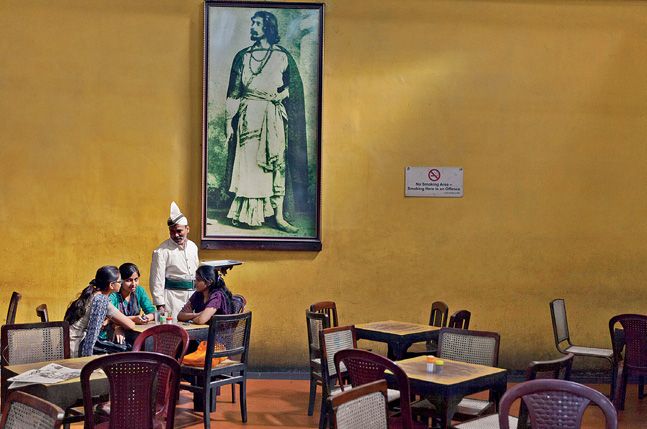
The Indian Coffee House, Kollam (now closed), 2013

When Stuart Freedman first arrived in Delhi in the mid-90s, it felt overwhelming. "I'd been to Pakistan, I'd been at the siege of Kabul, but India was something else," laughs the British photographer, now a veteran of many visits. "When I needed a break from the relentless push and pull of the city, I'd go to the Coffee House and be quiet. It was a refuge." But it wasn't till about 2010 that he picked up his camera inside one of them. Soon after, on assignments in Jaipur and Kolkata, he ended up photographing the Indian Coffee Houses there. "Then I knew it was a book," says Freedman, in Delhi for the Indian launch of his photo-exhibition and accompanying book, The Palaces of Memory: Tales from the Indian Coffee House (Tasveer/ Dauble, 2017).

If you grew up in urban India before liberalisation, the Coffee House, or at least the idea of it, is likely to have been part of your coming of age. Set up by the British government in the 1930s as a response to the Depression-era decline in coffee exports, the India(n) Coffee House chain did much more than create a local demand for the beverage. Its outposts across India became places where middle-class people met, to drink coffee, yes, but also to discuss politics and poetry and the day's gossip, to meet classmates after class or colleagues after work, or to conduct a romantic rendezvous in a place that offered anonymity but also safety. In short, to do all those things that not many places in the 20th century Indian city yet enabled, and to do so in a public place, inexpensively.

Yet, while the Coffee House experience captured something of modern western urbanity, it also represented India's unabashed, wholehearted claiming of it. Here, we produced our own version of modernity: where the coffee came in white ceramic cups (with saucers) but the kettles were aluminium; where you might cut up a mutton cutlet with a knife and fork but happily eat sambar-vada with your hands. Palaces of Memory does the much-needed job of making us look afresh at these remarkable places in our midst, their unpretentious formica tables and faded Gandhi-Nehru images offering a magical window into a vanished past. As the post-liberalisation city around it grows ever more brash and shiny, the more the Coffee House seems like a holdout: the last surviving outpost of what Amit Chaudhuri's 'Prologue' calls a "deliberately, almost jealously protected austerity".
Image
A waiter serves schoolgirls beneath a portrait of Rabindranath Tagore in the Indian Coffee House, Kolkata, 2013

Freedman's images do not shy away from this plainness, or signs of age: the peeling walls, the fraying pockets of uniforms, the blackened switchboards, table legs balanced in empty Amul cheese tins. But his gaze is affectionate, forgiving, even celebratory. Even a fly sitting in a bowl of sugar seems innocuous, yet another visitor to the Coffee House who hasn't been turned away. "I'm not romantic about India, the nonsense about elephants and maharajas. But there is a romance about what the Coffee Houses allow people to do. You can sit all afternoon with a cup of coffee and no one's going to tell you to leave," Freedman says. "I'm from Hackney, from a working class background. The Coffee House became this kind of translation device for me because I saw the same people there as in the cafes at home."

Of course, Coffee Houses are not all the same. "South Indian ones have much more substantial food," says Freedman. And one Coffee House might cater to different constituencies: retired old men, college students, middle-aged couples or a family on a ritual outing, young lovebirds. But what all these people are likely to have in common is that they are lower middle class.
Image
Men sit and talk in the Indian Coffee House, Baba Kharak Singh Marg, New Delhi, 2010

Freedman is clearly drawn to places that democratise leisure. If England's greasy spoon cafes summon up an era of post-war rationing that he didn't quite witness, his book on another dying British institution, the Eel, Pie and Mash shop, "is really about [his] past" and "that section of London's working class that feels dislocated". He has also photographed the cafes of Cairo "as a way to examine the Egyptian revolution". Does he see Indian Coffee Houses as resisting the neoliberal economy? "Modern cities privatise space," Freedman agrees. "Places where people gather and are not monetised like Starbucks are places where people discuss. And discussion is dangerous to the state. Indira Gandhi knew this; she closed the Coffee House during Emergency, saying it was seditious."
Image
Indian Coffee House, Chandigarh, India, 2013

What also makes the Indian Coffee Houses unique is that they are worker-run. In the 1950s, after the Coffee Board decided to privatise 43 outlets and fired many employees, the workers formed cooperative societies and persuaded the management to let them run the outlets.

Freedman's many superb portraits of waiters and kitchen staff are testament to the wonderful sense of ownership that pervades the Coffee Houses as a result. In one image in Palaces, a frail old man in a dhoti sits with his back to a man in collared shirt and trousers. As they raise their identical cups of coffee to their lips, one has the sense of a world in perfect balance, something sadly missing in the world outside.

10 February 2018

Book Review: Yashwant Chittal's Shikari

Bombay High

My review of Yashwant Chittal's classic novel Shikari, translated from the Kannada by Pratibha Umashankar-Nadiger:


Image


Pratibha Umashankar-Nadiger's long overdue English translation makes it clear why Shikari, originally published in 1979, is perhaps acclaimed Kannada writer Yashwant Chittal's best-known novel. Offbeat and absorbing, it provides a stirring portrait of urban Bombay, and a rare insight into Indian corporate life under the Licence Permit Raj.
Chittal's narrator Nagappa (often modernised to Nagnath, and further to Nag) was born, like the author, in a village called Hanehalli in Karnataka's Uttara Kannada, and his memories often take him back there. But it is in the Bombay bylanes of Khetwadi, Prarthana Samaj, Charni Road, Grant Road, Chowpatty and Dhobi Talao that the novel unfolds -- largely on foot, with Nagappa's distracted meanderings often guiding his thoughts. Passing the Communist Party press reminds him of health hazards at his company's Hyderabad factory; buying the Times of India sets him dreaming of an alternative life as a news-stall-owner. He responds to urban stimuli like an automaton: buying a bus ticket to Worli makes him realize he is going to see his friend Sitaram.

Together with Shantinath Desai and Jayant Kaikini, Chittal formed a triad of post-independence Kannada writers for whom Bombay defined urbanity. A superb new translation of Kaikini's Bombay stories, under the title No Presents Please, came out in November 2017. Shikari is Chittal's big Bombay novel, and his fine-grained observations feel like an ode to its streets, even when its narrator is at his most anxious. But the familiarity of the chawl and the neighbourhood, Chittal suggests, can turn into oppressive social surveillance. And economic rise does not guarantee belonging: neither Nag nor his bete noire Shrinivasa are confident of retaining their social status.

If Shikari is presciently pessimistic about urban alienation, it is downright depressing on the inner life of the corporation. Despite a century and a half of industrial modernity, the white-collar workplace isn't a frequent Indian literary setting: off the top of my head, I think of Krishna Sobti's Yaaron Ke Yaar (1968) and Amitabha Bagchi's The Householder (2012), both vivid portraits of corruption in government offices. Shikari is about corporate intrigue in a Bombay world that feels contemporary in some ways – say, its liberal use of jargon like MD, DMD, R&D – but not in others: the only women in Nagappa's working world are secretaries, receptionists or airhostesses, who are either Parsi, Anglo-Indian or Goan Christian.

Shikari references Kafka's The Trial on page one, and yes, both books contain an unspecified crime and erotically charged encounters with most of the female characters. But Nagappa's paranoia also brings to mind Bob Slocum, the manager narrator of Joseph Heller's 1974 novel Something Happened, for whom, too, the office is a space of dread. The relentless mutual suspicion that forms the matrix of Shikari, though, is informed by sexual hypocrisy and naked appeals to caste and community. The transparency of those factors in this supposedly modern white-collar milieu makes this a tragically Indian classic.

An edited version of this review was published in India Today, 9 Feb 2018.

21 June 2017

Alone Together

My Mirror column:

Living in collectivities can not only produce new relationships, but also new forms of individuality, as two powerful European films reveal.


Image

Image

I write this column from a friend’s charming old wooden Himachali house: a huge open balcony to welcome the sun and tightly shuttered rooms to block out the cold. The house is only opened for the summer, when she retreats here from the heat and dust of Delhi, bringing a variety of people with her. This summer’s assemblage consists of the friend, her 15-month-old baby, her 50-something male friend (whom I met here), the baby’s 18-year-old maid, and me. There are also two friendly locals who come in to help with provisions, cleaning and additional babysitting. Barring occasional expeditions to the river or the village, the emotional and material life of the household revolves around the next meal, the cooking of which is subject to the all-important task of Feeding The Baby. It has been an interesting exercise in communal living.

Serendipitously, while I’ve been up here, two friends in Delhi have been calling with updates on their respective rental searches: where to live, is the question – and whom to live with? Most people share domestic space with others at some point in their lives. Middle class young people leaving family homes often move to organised communal quarters – school or college hostels, or shared university flats. Shared homes remain the norm in early careers, too, for financial reasons.

But if you’re single and can afford it, then living alone, it seems, is the unspoken top of the hierarchy. The older one gets, the more unusual it becomes to live with anyone who isn’t either family or a romantic partner. The socially normative heterosexual coupledom at the core of these living arrangements is so deeply embedded as to really only strike most of us in absentia.

It is true that once your personal rules are set, to live with others is to test the limits of your adaptability. Unlike youthful communal spaces, whose appeal often lies in the suspension of childhood’s rules (or in breaking institutional ones), shared domesticity in later life is likely be based on the establishment of new ones.

In Thomas Vinterberg’s The Commune (2016), an architecture professor called Erik Moller inherits a house he dismisses as too large for his family. “Living together is about seeing each other,” he says, telling a broker to sell it for a million. But his wife Anna and teenaged daughter Freja have other ideas. Anna loves Erik, but two decades in, she needs newness – and what better way to create it than by inviting new people into a new sort of domestic life? “You speak all the time, and it’s sweet when you do, but it’s as if I’ve heard it all before. I need to hear someone else speak, otherwise I’ll go mad,” she says to her befuddled husband, proposing that they turn the many-roomed mansion into a commune. Friends bring in other friends, and soon there is a collective, a united front interviewing potential applicants.

And so, without any rebuilding, a classically bourgeois European home becomes a space that challenges the norms of bourgeois family life. Decisions now are made not to preserve coupledom, but a more expansive domesticity. It is not that familial love ceases to exist, but rather that the commune allows difficult emotional burdens – like a child’s terminal disease – to be shared across more shoulders. Meanwhile new freedoms and new proximities mean that people fall into new relationships – and sometimes out of old ones. The self-important Erik, increasingly lonely as the commune fills Anna’s emotional needs, starts an affair with a student. Anna, shaken but deep in her own love affair with the commune, invites Erik’s lover into it, saying: “There should be room for you, too. That’s what it’s all about.”

I happened to watch The Commune within a day of watching Swiss-born director Hans Steinbichler’s 2016 German-language feature The Diary of Anne Frank, in which, too, an unlikely assortment of people find themselves holed up together – though in rather more involuntary circumstances. Steinbichler’s is the latest cinematic version of the famous diary, kept by the Jewish teenager during the Nazi-ruled wartime years that she and her family lived hidden above a workshop. Unlike the deliberate newness inaugurated in The Commune, the Franks’ communal life in the annex strives to recreate their home. It is a forced exile into which they take as many possible accoutrements of their bourgeois life, from clothes and dinner sets to books and the writing instruments that make possible Anne’s startlingly frank record of emerging selfhood.

These things – the thingness of these things – help sustain something of the illusion of normalcy, but life in the commune produces its own effects. There is something about the inauguration of a collective domestic arrangement with people you wouldn’t ordinarily expect to live with that pushes buttons and expands boundaries. We are far from the free-spirited world of Vinterberg’s childhood memories, but here, too, the new freedoms and new proximities conjure new relationships – and alter old ones.

The communal life certainly allows for more openness than the traditional family unit, and yet in its difference, it can feel closed off from the world. Both the teenaged Freja in The Commune and the teenaged Anne develop an enhanced sense of privacy, not just because they are exploring their sexuality, but because they are beginning to see themselves as separate from their parents. The breakdown of the old family unit perhaps also enables each of the girls to see her parents separately, as individuals. Embracing the collective, it turns out, can be strangely individuating.


Published in Mumbai Mirror, 18 June 2017.