Contact Sales & After-Sales Service

Contact & Quotation

  • Inquire: Call 0086-755-23203480, or reach out via the form below/your sales contact to discuss our design, manufacturing, and assembly capabilities.
  • Quote: Email your PCB files to [email protected] (Preferred for large files) or submit online. We will contact you promptly. Please ensure your email is correct.

Send your project requirements through our Contact page. Ask about an NDA before sharing confidential files.

Continue to Contact →

Notes:
For PCB fabrication, we require PCB design file in Gerber RS-274X format (most preferred), *.PCB/DDB (Protel, inform your program version) format or *.BRD (Eagle) format. For PCB assembly, we require PCB design file in above mentioned format, drilling file and BOM. Click to download BOM template To avoid file missing, please include all files into one folder and compress it into .zip or .rar format.

Planning bare boards first? Use the rapid PCB prototyping build planner to define fabrication requirements before assembly.

PCBSync · Assembly engineering & project planning

Prototype PCB Assembly Services for Engineering Validation

Build the boards you need for the next engineering decision. Define component sourcing, assembly and testing scope, then send your BOM, placement data and fabrication files for a reviewed quotation.

Prototype through production · scope and schedule confirmed after file review

Rows of populated green circuit boards arranged upright in holding racks on a workbench
Populated circuit boards arranged in holding racks, showing components and connectors.
At a glance: Prototype assembly is a validation build. Its success is measured by what you learn and verify, not simply by how many boards are delivered.
Check the project fit

Prototype assembly at a glance

Describe the build you need. The reviewed quotation establishes the supported configuration, responsibilities and acceptance scope for your project.

Project decisionInclude in your requestWhat needs confirmation
Quantity and variantsBoards per revision and any DNP variantsBuild quantity, setup and material requirements
Assembly constructionSMT, through-hole or mixed; highlight BGA/QFN and unusual componentsPackage, board and process suitability
Component supplyTurnkey, partial turnkey or a customer-supplied kitAvailability, packaging, overage and substitution approval
Inspection and testingCritical features, programming and functional requirementsMethods, coverage, fixtures and pass/fail criteria
TimingTarget arrival date and material readinessStart conditions, capacity, approval time and transit
Release documentsRequired first-article and shipment recordsAgreed deliverables and acceptance owner

Check your prototype requirements with PCBSync →

Prepare a clearer project request

A clearer build starts here

Check your release package and identify the questions that affect sourcing, inspection and delivery. Prepare a brief without signing up or uploading files.

What does this build need?

Mark the items you have prepared

Make quotations comparable

What changes prototype PCB assembly cost and lead time?

Cost itemInformation neededQuote status before file review
Bare PCB fabricationFabrication files, stack-up, finish and quantityTo confirm, or customer-supplied
ComponentsBOM, approved MPNs, quantities and substitutionsAvailability and price to confirm
Setup, stencil and assemblyRevision, sides, placement data and package mixOne-time and quantity-dependent items to separate
Inspection, programming and testCoverage, firmware, fixtures and acceptance criteriaIncluded and optional scope to agree
Shipping and other chargesDestination, required arrival date and packingTransit, freight and applicable charges to confirm

Unknown costs are not zero. This page does not provide a calibrated selling-price estimate. Request a quotation with the included scope and exclusions stated explicitly.

Example: 5 boards versus 20 boards

For the same hypothetical revision, both builds need file preparation and setup. Components and placement work increase with quantity; setup cost per board may decrease. Extra variants, a new stencil or additional test fixtures can change that comparison. This is a planning example, not an actual price or customer case.

Agree when the production clock starts

Separate file review, material availability, tooling, assembly, first-article approval, testing and transit. Some preparation can run in parallel; assembly cannot start until its dependencies are ready. A requested delivery date is not a confirmed production slot.

Review quick-turn dependencies or prepare a comparable assembly RFQ.

Match the scope to the decision

Prototype PCB Assembly: requirements that change the build

Decision / stageWhat to defineEvidence or next action
Engineering sampleValidate circuits or interfacesDefined bring-up procedure and known exceptions
First articleVerify the released assembly setupNamed hold point, inspection evidence and approval owner
Pilot buildExercise the intended production routeRevision-controlled work instructions and test coverage
Repeat low-volume orderBuild the same approved configurationControlled changes, material availability and repeat-order records
Avoid gaps between purchasing and engineering

Who supplies what?

Supply modelDefine before quotingCustomer approval
TurnkeyPCB fabrication, approved BOM and sourcing scopeAlternates, shortages and substitutions
Partial turnkeyOwner and delivery date for each supplied itemReconcile customer inventory with purchased parts
Consigned kitQuantity, packaging, identification and kit completenessResolve missing or unsuitable parts before release

Testing, programming, fixtures and shipping should be separate quotation lines. An unknown cost is not zero. Use the scope checklist to prepare your request; obtain a file-reviewed total before making a purchasing decision.

Practical engineering and purchasing guidance

Plan the work before releasing the files

Start with the question the prototype must answer

A first power-on board, an RF evaluation build and a pilot for an enclosure trial have different acceptance needs. State the build objective and which circuits must operate before the next design gate. Identify optional components and do-not-populate positions before the BOM is priced.

For a new revision, ask for a documented review of BOM, placement data, polarity and package orientation. A board that passes a visual inspection has not automatically passed the functional tests your product needs. Provide a bring-up procedure or agree that functional verification will take place at your lab.

Choose the procurement boundary

Use turnkey PCB assembly when you want bare boards, component sourcing and assembly reviewed together. Use a consigned kit when you control selected inventory or already hold long-lead parts. Partial turnkey should name an owner for every BOM line so the same component is neither purchased twice nor omitted.

List approved manufacturer part numbers and allowed alternatives. A matching value or package alone is not enough to approve a substitution. Mark lifecycle, firmware, calibration and RF-sensitive parts for explicit review, and include packaging information for customer-supplied components.

Define the first-article hold point

A first-article review can catch orientation, fit and documentation problems before the remaining batch follows the same setup. Agree the sample quantity, evidence to be returned and the person authorized to approve continuation. Include the approval window in the schedule.

Request photographs or inspection records for named critical features, not an undefined promise that every possible defect will be detected. Hidden joints, programming and functional checks need separate methods. Record any deviation accepted for this prototype so it does not silently become the production standard.

Prepare the transition after bring-up

Keep the assembled revision tied to its BOM, firmware and test results. Log rework, component changes and unpopulated positions by reference designator. A useful prototype report separates design corrections from process findings and records the owner of each action.

When the design is stable, move to a repeatable low-volume PCB assembly plan or production plan. Revisit panelization, test access, fixtures, sourcing and traceability instead of assuming a one-off prototype setup is the lowest-cost production route.

Agree the evidence before the build

Make first-article acceptance specific

Define the hold point

Specify sample quantity, who approves continuation and the time allowed for review. Include this approval time in your schedule scenario.

Define test coverage

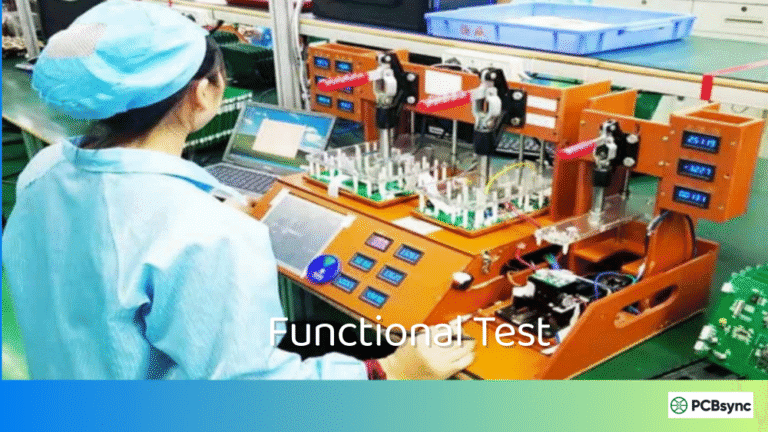
Inspection checks assembly features. Functional testing requires an agreed procedure, fixtures, firmware and pass/fail limits. Neither automatically validates the complete product.

Control changes

Record accepted deviations and rework against the board revision. Release the next batch only after the disposition is clear.

Customer drawings and reports are confidential. Request the process and acceptance scope applicable to your project through Contact; customer-specific evidence is not published here.

See the physical construction

Assembly examples from the PCBSync media library

These physical examples highlight component density, access, interconnects and handling details. Identify the features relevant to your design so the engineering review can focus on your actual build requirements.

Review the supplier and the agreed process

Build confidence without exposing confidential designs

Review PCBSync company information and quality documentation and applicable scope. Confirm which processes, records and acceptance requirements apply to your build. A board photograph illustrates construction; it does not establish test results or certification.

Example first-article review checklist

Illustrative template, not a completed customer report: revision and variant; quantity reviewed; critical polarity and placement checks; inspection method and coverage; programming/test results where agreed; deviations; disposition owner; approval date; authorization for the remaining build.

How to handle a shortage or proposed substitution

Identify the affected BOM line, proposed alternative, technical differences, price and timing impact. Record the customer’s approval before changing the released build scope. A matching package or nominal value alone is insufficient.

Customer drawings, reports and identifying project details are not published here. Discuss NDA and file-transfer requirements through Contact before sharing confidential information.

Answers before requesting a quote

Prototype PCB Assembly FAQ

What files are needed for prototype PCB assembly?

Provide fabrication data, a BOM with manufacturer part numbers, placement data and an assembly drawing. Add quantity, revision, required delivery date and test/programming instructions. Identify which items remain open.

Can I get a complete turnkey price from this planner?

No. The planner prepares your scope and open questions. PCB fabrication, component sourcing, setup, assembly, testing and delivery must be confirmed in the reviewed quotation.

Can a prototype be assembled in 24 hours?

Request a feasibility review. Material readiness, resolved engineering questions, approved files, tooling, test scope and available production capacity determine whether a short assembly window is possible. Shipping is a separate stage.

Apply the current documentation and project-specific acceptance requirements. Planners do not certify manufacturability or validate uploaded design files.

Your next step

Turn your prototype plan into a reviewed quote

Tell us what this build needs to prove, how many boards you need and your target date. Include unresolved questions so the review can focus on your project.

  • BOM
  • Placement data
  • Fabrication files
  • Assembly drawing

Add the revision and any programming or test requirements. You can download your planner summary above and attach it on Contact.

Need an NDA or an agreed file-transfer route? Contact us before sharing confidential files.